- 120 pages
- English
- ePUB (mobile friendly)
- Available on iOS & Android
eBook - ePub
About this book
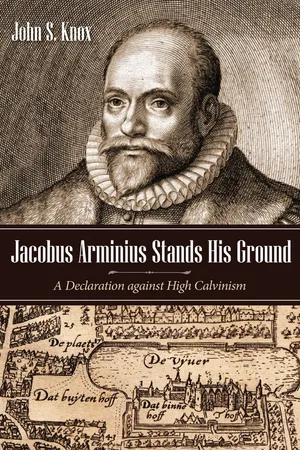
On October 30, 1608, Jacobus Arminius presented his Declaration of Sentiments to the Assembly of the States of Holland and West Friesland in the Binnenhof at The Hague. First, Arminius sought to defend himself and his theological views from the spirited attacks of opponents such as Gomarus, Lubbertus, and Plancius. Second, Arminius hoped to bring to light the wrongdoings of the European church and its extremist understanding of certain Christian doctrines.
Having trained in Geneva under Jean Calvin's successor, Theodore Beza (1519-1605), and having further expanded and honed his theology at the University of Leyden from both lectern and the pulpit, Arminius thoroughly presented his theological views in both oral and written form. He spoke in his native Dutch language to an assembly of his peers and religious authorities with the hopes of avoiding a theological rift in Holland--while at the same time hoping to remove a long-standing conflict with the Supralapsarian faction warring against him.
Thus, Arminius' Declaration of Sentiments is a sophisticated, passionate appeal to reason, scripture, and community. With each section, Arminius seeks not only to demonstrate the error of the attacks on him, but also to point out how and why reconciliation can take place through a careful examination of various precepts of Christian thought.
Information
Topic
Teologia e religioneSubtopic
Teologia cristiana1
Introduction
On October 30, 1608, Jacobus Arminius presented his Declaration of Sentiments to the Assembly of the States of Holland1 and West Friesland in the Binnenhof2 at The Hague.3 This promulgation was offered for two specific purposes. First, Arminius sought to defend himself and his theological views from the spirited attacks of opponents such as Gomarus, Lubbertus, and Plancius. Second, Arminius hoped to bring to light the wrongdoings of the European church and its extremist understanding of certain Christian doctrines.
Having trained in Geneva under Jean Calvin’s successor, Theodore Beza (1519–1605), and having further expanded and honed his theology at the University of Leyden4 from both lectern and the pulpit, Arminius thoroughly presented his theological views in both oral and written form. He spoke in his native Dutch language to an assembly of his peers and religious authorities with the hopes of avoiding a theological rift in Holland—while at the same time hoping to remove a long-standing conflict with the Supralapsarian faction warring against him. These Supralapsarians espoused “. . . a confessional and Geneva-oriented dogmatics, high Calvinism with its doctrine of predestination, rigid church discipline, the authority of consistory, classis, and synod, and intolerance of dissent.”5
Thus, Arminius’ Declaration of Sentiments is a sophisticated, passionate appeal to reason, scripture, and community.6 With each section, Arminius seeks not only to demonstrate the error of the attacks on him, but also to point out how and why reconciliation can take place through a careful examination of various precepts of biblical, Christian thought. As Sproul suggests in Willing to Believe, Arminius attempted to show that he was not the enemy of Calvinism; in many ways, he was Calvinism’s strongest advocate.7 Furthermore, Arminius wanted his audience to know that, based on both his expressed beliefs and deeds, he was not the false teacher that his adversaries unfairly made him out to be.
With this purpose in mind, A Declaration of Sentiments on Predestination contains ten chapters or theses that describe the author’s understanding of the predestination of humanity, the providence of God, the freedom of human will, the grace of God, the perseverance of Christians and their assurance of salvation, the possibility of perfection and holiness in the life of the believer, Jesus Christ’s divine nature and his part in the justification of humanity before God, and finally, Arminius’ own suggested revision of the Dutch confession and the Heidelberg Catechism.8
With each chapter in A Declaration, Arminius carefully built a defense of both his own Christian character and his biblical interpretation through highlighting what he considered to be important errors of hypocritical judgment and shallow hermeneutics in his adversaries. Therefore, the chief goal of this book will be to analyze Arminius’ defense of himself and his theology in his Declaration of Sentiments against a High Calvinist understanding of theology. Repeatedly, Arminius asserted that he was not diverting from Calvin, Confession, or Catechism; he was merely seeking to follow the truth of God’s Word while also hopefully enlightening those in darkness. Substantiating this, Arminius states,
I here tender my sacred affirmation . . . that, however cogently I may have proved by the most solid (human) arguments any article to be agreeable to the word of God, I will not obtrude it for an article of belief on those of my brethren who may entertain a different opinion respecting it—unless I have plainly proved it from the word of God and have with equal clearness established its truth, and the necessity unto salvation that every Christian should entertain the same belief.9
Drawing upon such remarks, excerpts from various primary sources of Arminius’ contemporaries and from secondary sources of modern scholarship, and through investigating the cultural milieu and characters surrounding Arminius, an attempt will be made to show how Arminius defended himself in A Declaration against numerous Supralapsarian criticisms.
1. Also known as The Netherlands.
2. The Binnenhof is the name of the building at The Hague where the Dutch government was housed.
3. The Hague is the seat of government and the administrative center of the Netherlands, on the North Sea coast, capital of the province of South Holland.
4. Also spelled as “Leiden.”
5. Bangs, Arminius, 54.
6. Arminius’ A Declaration should not be confused with the Declaration of Sentiments composed by Elizabeth Cady Stanton for the first Woman’s Rights Convention in Seneca Falls, New York, on July 19–20 1848, which outlined a list of complaints against the disenfranchisement of women and provided eleven resolutions arguing for female equality and suffrage.
7. Sproul, Willing to Believe, 126.
8. By the request of Elector Frederick III, ruler of the Palatinate (1515–1576), Professor Zacharius Ursinus and preacher Caspar Olevianus (with additional consultation and advice from theology faculty at the University of Heidelberg), wrote a lengthy catechism (eventually fifty-two sections in all) they hoped would unite Protestants over a common understanding of doctrine.
9. Arminius, A Declaration of Sentiments, 234.
Table of contents
- Title Page
- Foreword
- Preface
- Acknowledgements
- Chapter 1: Introduction
- Chapter 2: The Cultural Surroundings of Arminius and a Declaration
- Chapter 3: Principal Characters in the Development of a Declaration
- Chapter 4: Overview of a Declaration of Sentiments
- Chapter 5: Detailed Analysis of a Declaration of Sentiments
- Chapter 6: Scholarly Voices on a Declaration of Sentiments
- Chapter 7: Reflections Upon the Man and His Manuscript
- Chapter 8: Final Thoughts
- Afterword
- Glossary
- Additional Notes on A Declaration
- Bibliography
Trusted by 375,005 students
Access to over 1.5 million titles for a fair monthly price.
Study more efficiently using our study tools.
Frequently asked questions
Yes, you can cancel anytime from the Subscription tab in your account settings on the Perlego website. Your subscription will stay active until the end of your current billing period. Learn how to cancel your subscription
No, books cannot be downloaded as external files, such as PDFs, for use outside of Perlego. However, you can download books within the Perlego app for offline reading on mobile or tablet. Learn how to download books offline
We are an online textbook subscription service, where you can get access to an entire online library for less than the price of a single book per month. With over 1.5 million books across 990+ topics, we’ve got you covered! Learn about our mission
Look out for the read-aloud symbol on your next book to see if you can listen to it. The read-aloud tool reads text aloud for you, highlighting the text as it is being read. You can pause it, speed it up and slow it down. Learn more about Read Aloud
Yes! You can use the Perlego app on both iOS and Android devices to read anytime, anywhere — even offline. Perfect for commutes or when you’re on the go.
Please note we cannot support devices running on iOS 13 and Android 7 or earlier. Learn more about using the app
Please note we cannot support devices running on iOS 13 and Android 7 or earlier. Learn more about using the app
Yes, you can access Jacobus Arminius Stands His Ground by John S. Knox in PDF and/or ePUB format, as well as other popular books in Teologia e religione & Teologia cristiana. We have over 1.5 million books available in our catalogue for you to explore.