eBook - ePub
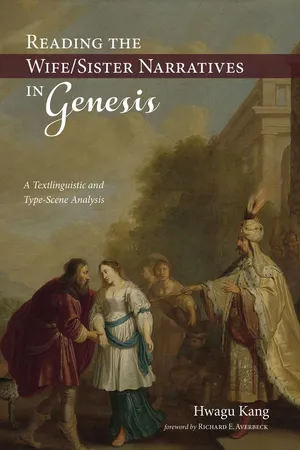
Reading the Wife/Sister Narratives in Genesis
A Textlinguistic and Type-Scene Analysis
- 208 pages
- English
- ePUB (mobile friendly)
- Available on iOS & Android
eBook - ePub
About this book
The book of Genesis introduces three similar wife/sister narratives, commonly thought to be originating from different sources because of their repetitive entries. This research explores the wife/sister narratives in Genesis (Gen 12:10-13:1, 20:1-18, and 26:1-11), and it aims to provide an understanding of the three stories as a whole by uncovering its context by textlinguistic and literary type-scene analysis. Textlinguistic analysis helps us to see how each wife/sister narrative functions in its context, while type-scene analysis emphasizes how the three narratives develop and contribute to the patriarchal narratives through their similarities and variations. Although the traditional type-scene analysis studies recurrent fixed motives in texts, this study focuses much more on literary aspects such as characterization, theme, and plot. Through this study, the three wife/sister stories will elaborate that the patriarchal narratives are not results of different authors, but the well-developed products of a single author. The three wife/sister stories work together to highlight God's faithfulness to his promises (Gen 12:1-3).
Information
Topic
Theology & ReligionSubtopic
Biblical Biographychapter one
The Wife/Sister Stories Within the Context
Before investigating each wife/sister story, we need to examine the structure of each story within its own context. Stories A and B belong to the Toledot of Terah, while Story C belongs to the Toledot of Isaac. In this chapter we will examine the places of the wife/sister stories in their individual contexts, in the Abraham narrative, and in the Jacob narrative.
Narrative Structure of the Toledot of Terah
This section will examine the literary structure of the Abraham narrative. The Abraham narrative is complicated—Jean-Louis Ska argues that, unlike the Jacob and Joseph cycles, it contains no single chain of conflict and resolution. Ska explains:
La trame du cycle d’Abraham n’est pas unifiée. Au contraire du cycle de Jacob et surtout de l’histoire de Joseph, Gn 12–25 n’est pas centré sur un seul épisode, un conflit et sa résolution, ou un problème et sa solution. Comme l’ont noté plusieurs auteurs, le lien entre les diverses péripéties du cycle d’Abraham est souvent assez lâche et la sequence n’est pas toujours très logique.170
It is true to say that the Abraham narrative is complicated, but contrary to Ska’s assertion, there is clear evidence to confirm that the Abraham narrative was intentionally composed to be a unified literary work. One of the most important signals for the narrative structure in Genesis is the Toledot formula. The Abraham narrative begins in Gen 11:27 with the new Toledot formula—“This is the account of Terah”—and ends with Abraham’s death and burial story in Gen 25:1–11. We then see a new beginning marked by a new Toledot formula—“This is the account of Ishmael”—in Gen 25:12.
Scholars have offered many different analyses of the structure of the Abraham narrative. George W. Coats argues that the Abraham narrative truly begins at Gen 11:10 and ends with the generation of Ishmael and Isaac in Gen 25:26.171 He sees ten steps of genealogy in the Abraham narrative, beginning with the Shem genealogy. David A. Dorsey recognizes the Abraham narrative as beginning with Gen 12:1 and extending to Gen 21:7, and locates its center in the covenant section (17:1–21).172 However, neither Coats nor Dorsey take the Toledot formulae seriously in the Book of Genesis. We can also look at the obvious repetitions of double narrative patterns within the same narrative. It is natural to understand the structure of the Abraham narrative according to these patterns, yet neither Coats nor Dorsey connect one story to another corresponding story. For example, while Gen 15 and 17 clearly illustrate stories of covenant, Dorsey attempts to parallel Gen 15 to Gen 18:1–15, where God promises a son to Sarah.173 Further, while Dorsey ends the Abraham narrative at the birth of Isaac (21:1–7), Wenham points out that we should not overlook the strong connection between 12:1–3 and 22:1–3.174
It is clear that the Abraham narrative contains patterns of repetition and organization that cannot be written off as accidental. Here it is worth considering the work of Gary A. Rendsburg, who assumes that the Abraham narrative contains a series of parallels in corresponding stories, and argues that intended theme-words and catchwords function to connect these units.
Since so much of redactional structuring is tied to theme-words and catchwords, a description of these items is appropriate. They can be of several types. The most obvious cases are those where the same word is used in matching or successive episodes. In other cases we see the use of different words—or, to use more precise grammatical terminology, different inflections—from the same root. Some theme-words and catchwords can be like-sounding words derived from separate roots, and still others may be merely similar in meaning or share a similar connotation. What all of these variations share is their ability, if the writer or compiler has achieved his goal, to connect the different units of the cycle.175 Rendsburg, then, suggests the following outline:176
A Genealogy of Terah (11:27–32)
B Start of Abram’s Spiritual Odyssey (12:1–9)
C Sarai in foreign palace; ordeal ends in peace and success; Abram and Lot part (12:10—13:18)
D Abram comes to th...
Table of contents
- Title Page
- Foreword
- Preface
- Abbreviations
- Introduction
- Chapter 1: The Wife/Sister Stories Within the Context
- Chapter 2: The First Wife/Sister Story
- Chapter 3: The Second Wife/Sister Story
- Chapter 4: The Third Wife/Sister Story
- Chapter 5: Conclusion
- Bibliography
Trusted by 375,005 students
Access to over 1.5 million titles for a fair monthly price.
Study more efficiently using our study tools.
Frequently asked questions
Yes, you can cancel anytime from the Subscription tab in your account settings on the Perlego website. Your subscription will stay active until the end of your current billing period. Learn how to cancel your subscription
No, books cannot be downloaded as external files, such as PDFs, for use outside of Perlego. However, you can download books within the Perlego app for offline reading on mobile or tablet. Learn how to download books offline
Perlego offers two plans: Essential and Complete
- Essential is ideal for learners and professionals who enjoy exploring a wide range of subjects. Access the Essential Library with 800,000+ trusted titles and best-sellers across business, personal growth, and the humanities. Includes unlimited reading time and Standard Read Aloud voice.
- Complete: Perfect for advanced learners and researchers needing full, unrestricted access. Unlock 1.5M+ books across hundreds of subjects, including academic and specialized titles. The Complete Plan also includes advanced features like Premium Read Aloud and Research Assistant.
We are an online textbook subscription service, where you can get access to an entire online library for less than the price of a single book per month. With over 1.5 million books across 990+ topics, we’ve got you covered! Learn about our mission
Look out for the read-aloud symbol on your next book to see if you can listen to it. The read-aloud tool reads text aloud for you, highlighting the text as it is being read. You can pause it, speed it up and slow it down. Learn more about Read Aloud
Yes! You can use the Perlego app on both iOS and Android devices to read anytime, anywhere — even offline. Perfect for commutes or when you’re on the go.
Please note we cannot support devices running on iOS 13 and Android 7 or earlier. Learn more about using the app
Please note we cannot support devices running on iOS 13 and Android 7 or earlier. Learn more about using the app
Yes, you can access Reading the Wife/Sister Narratives in Genesis by Hwagu Kang in PDF and/or ePUB format, as well as other popular books in Theology & Religion & Biblical Biography. We have over 1.5 million books available in our catalogue for you to explore.