eBook - ePub
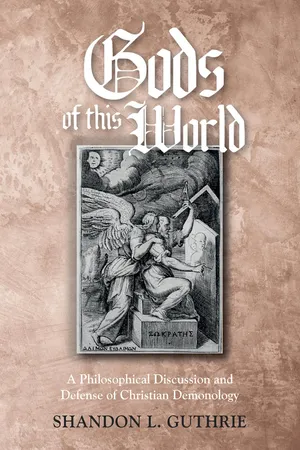
Gods of this World
A Philosophical Discussion and Defense of Christian Demonology
- 326 pages
- English
- ePUB (mobile friendly)
- Available on iOS & Android
eBook - ePub
About this book
Philosophers of religion have focused almost exclusively on the existence and nature of God and the nature and destiny of human beings. But these philosophers have been remiss in engaging discussions about the possibility of there being adverse gods of this world (demonic beings) despite being a doctrine that comprises a significant part of the Christian confession. This drought in the literature has left a number of questions unaddressed, including:
Hasn't science buried the demonic?
Are there any successful philosophical arguments for the existence of Satan?
What kind of being is Satan? Is he the fallen angel of lore?
Is it reasonable for Christians to say that demons are purely immaterial spirits?
Can demons causally interact with the physical world and its inhabitants?
Can demons perform diabolical miracles?
Shandon Guthrie broaches new territory beginning with a rigorous defense for the existence of Satan and his cohorts. He then advances and defends a model for how to understand their nature in terms of their ontology and causal powers. No other book has attempted a full-fledged natural diabology on behalf of Christian orthodoxy. This is a must-read for anyone interested in the dark side of Christian theology and metaphysics.
Information
Topic
Theology & ReligionSubtopic
Christian Theology1
Introduction
Demonology: A Doctrine in Disarray
Angelology and its filial by-product, demonology, have long been subjects on the fringe of serious intellectual investigation within, inter alia, the field of philosophy; and they have done so with very few historical exceptions. Perhaps this is due to the exotic, speculative, and unscientific nature of talk of spirit beings like those in the ideations of angels and demons. The notions themselves bear the unmistakable stench of mythology that further make them matters too obsolete for the scientist or historian and too archaic for the philosopher. Not surprisingly, these areas of inquest have been relegated to the specialized discipline of pneumatology in strictly theological quarters. With the advent of modernity and its contribution to metaphysics that the universe is but a world-machine, disenchanted members of the clergy were finding increasingly fewer places in our universe for the continued operations of angels and demons. At the later christening of psychology and psychiatry as sciences of the mind, talk of mental disorders and other psychodynamic factors finally buried the idea that one’s conscience was in part guided or manipulated by external spiritual forces beyond the material realm.
The recycled tongue-in-cheek question, “How many angels can dance on the head of a pin?” is often a clichéd reminder that intellectual discussions about things like angels can never be, so we are told, resolved from the standpoint of discursive reasoning. There is no doubt that demonology, as more or less the delimited study of deviant angels (or their offspring), is unarguably a far more vilified discipline than its adjoining cousin. Yet many detractors in the contemporary world are ill-informed about what angels and demons are and on what grounds one has to think that they exist despite the funereal pronouncements of the intelligentsia. No doubt the cynic will find demonology to be inherently laughable such that the shock of merely uttering its tenets aloud becomes its own refutation. Yet the believer’s response is often no better, for she simply retreats to the safe confines of her intimate cliques and fellowships wherein the mutual exchange of such ideas can be insulated from the scoffs of naysayers and critics. It’s the academic equivalent of an unrelenting trench warfare. Accordingly, neither the skeptic nor the believer has the intellectual upper hand.
But it gets even worse for twenty-first-century adherents. A number of religious people who pontificate on the subject invariably derive their doctrinal material from less-refined, casual sources like sermons from one’s local gathering, popular-level books on “spiritual warfare,” and even from vehicles of entertainment including movies, television shows, and novels. In fact, talk of literal demons in the Western world today owes much of its conceptual grooming to literary classics such as Dante Alighieri’s Divine Comedy (1320), Heinrich Kramer’s Malleus Maleficarum (1487), the fanciful stories in the sixteenth century of the fictional Dr. Faustus, and the unparalleled epic of John Milton’s Paradise Lost (1667). These works have led to the modern caricaturing of Satan and his demons as human gremlins dawning goatees, pitchforks, and red union suits who gleefully dish out hellfire judgment to society’s most egregious offenders. It is doubtful whether the average person even knows where an official canonized demonology ends and a fictional depiction of demons begins.
Despite the relative silence on the part of believers within the academic community, demonology among the rank and file figures quite prominently in populations around the world. In fact, a number of Christians and non-Christians alike, including those in the United States and Great Britain, believe that Satan and his demons actually exist.1 There is even evidence showing that the number of believers is steadily increasing.2 For the believer, it evidences its credibility in the face of rampant opposition and academic virulence. But for the cynic, it only means that there remains a gullible subset of folks willing to believe anything indiscriminately. Is it not surprising, then, that believing academics have kept the doctrine at arm’s length? Only those who wish to take the doctrine seriously as a body of knowledge—that is, one concerned about a literal race of superhuman spiritual beings—tend to confine their discussions to protected circles of theology or English literature within the halls of private universities. But despite having the appearance of being a superstition for the ignorant, it may shock the cynic to know that belief in demons is actually held by a number of academics.3 Consequently, one should expect that there is a case to be made for their literal existence that can repeal the cultural sentiment of demonology as a mere fascination for the uninformed and easily-entertained.
If that was not burden enough, believers–academic or otherwise–will also need to offer a coherent understanding of what demons are and what they can do. While positing their existence had been a congenial pursuit in Christian history, there has been, and remains, a substantial lack of clarity and coherence in the metaphysics of such beings. The third-century Christian philosopher Origen once made the following observation that applies equally to the modern situation as it did when he wrote these words:
Regarding the devil and his angels, and the opposing influences, the teachings of the Church has laid down that these beings exist indeed; but what they are, or how they exist, it has not explained with sufficient clearness.4
Attempts to formulate such a philosophy of demonology have been confounded by the lack of any explicit biblical teachings that clarify such matters. But as with other doctrines with similar deficits of biblical material, Christian philosophers and theologians had gone to work in clarifying, and in some cases “creedalizing,” their results. Alas! Christian philosophers are still far from reaching the diabolical Promised Land. Those who have meticulously written on the subject have only echoed the tenets of their Dominican forbearers and with that all of the shortcomings the church Fathers failed to rectify. These sins of the fathers have indeed become the sins of the sons. And the unwelcome consequence for realists is that demonology remains a doctrine in disarray. And, yet, if demonic realists are ever going to win over their skeptic interlocutors that evil spirits genuinely exist, they must declutter their metaphysical labyrinth and postulate a viable model worthy of sanction.
The Devil’s Advocate
There is something unsettling about volunteering to defend the existence and nature of Satan, the putative Prince of Darkness, and his minions. But one must understand that a defense of Satan in this way is not meant to be taken as a defense in the sense of sticking up for the practices of the Dark One. The project of advocating for the devil is more of a defense of a particular kind of worldview as espoused by many predecessors in the philosophy of religion. It is an advocating of additional tenets of belief that co-constitute an unexpurgated, ramified natural theology. Put another way, one must appreciate the pursuit to identify their suspect before prosecuting the case against them. Accordingly, such an enterprise is essentially no different than a project devoted to the existence and coherence of God. And those projects are themselves no different than those endeavoring to defend the existence and nature of abstract objects. These issues have been fair game since the days of Plato. In fact, the same goes for talk of demons! For pre-Christian Greek philosophers have readily affirmed the existence of the daimon in one form or another.5 Like talk of God and abstract objects, talk of daimonion is every bit a part of philosophy’s ancestry as they.
The goal of this book, then, will be similar to other projects in the philosophy of religion: to offer up reasons to think that a particular set of ultramundane beings (Satan and the demons) exist and that a viable doctrine of demonology can be held in confidence despite impetuous resistance from those with little patience on such matters. Toward this goal, all thinkers–not just Christians–can consider this particular way of viewing the world as being, in some sense, genuinely inhabited by evil spirits. It is true that many crude demonologies have been advanced in the past. Some have given rise to the deleterious effects that have marred the church. And yet the same could be said about scientific knowledge and the abuses of medical experimentation, weapons of mass destruction, and government surveillance. In the hands of a madman anything can be used for ill. Instead, this book is designed to contribute to a field of knowledge left vacated by the majority of philosophers. That someone might consider it licensure for harmful social practices will not only be going beyond the discussions of this book, but they would be failing to apprehend its distinct conclusions. For one of the main arguments of this work verily demythologizes the powers of demons,6 and so undermines the pockets of McCarthyism that ensued since the witch crazes of early modern Europe and colonial America to the “satanic panic” of the late twentieth century. This is to say that reasons will be offered to think that demons are likely incapable of the sorts of things alleged by those believing demons to have creative powers. That they cannot wield extravagant magic, adversely affect nature, or even appear as ominous extramental specters will be one of the unique conclusions setting this work apart from its predecessors. In fact, it is more accurate to say that these conclusions do not so much demythologize inasmuch as they “un-retrofit”7 preexisting assumptions wrongly intimated into a biblical demonology.
While demonology is not the sort of thing that is exclusive to Christianity (indeed, it is not even exclusive to religion as evidenced in popular-level works of non-fiction such as Rosemary Guiley’s The Encyclopedia of Demons and Demonology), it assumes the central tenets of its orthodoxy including, but not necessarily limited to, the existence of God and the life, ministry, death, and resurrection of Jesus of Nazareth. What is not stipulated is any tenet of demonology that is not arrived at by argument. Guiding readers toward a reasonable view worth committing to will be the burden of this book. It is a burden to be backed by rigorous philosophical assiduity informed by a biblical framework. But surely not all readers will agree with every conclusion drawn. Perhaps less so in the arguments that arrive at those conclusions. Even so, this work is designed to expose one to a thoughtfully argued demonic realism that emends both what the biblical canon leaves unaddressed and what the church has addressed. In the introduction to his classic novel, The Screwtape Letters, C. S. Lewis sums up the two kinds of polarizing extremities this book is pushing back against:
There are two equal and opposite errors into which our race can fall about the devils. One is to disbelieve in their existence. The other is to believe, and to feel an excessive and unhealthy interest in them. They themselves are equally...
Table of contents
- Title Page
- Acknowledgments
- Chapter 1: Introduction
- Part I: Background
- Part II: Existential Matters
- Part III: Ontological Matters
- Part IV: Objections
- Part V: Conclusion
- Bibliography
Trusted by 375,005 students
Access to over 1.5 million titles for a fair monthly price.
Study more efficiently using our study tools.
Frequently asked questions
Yes, you can cancel anytime from the Subscription tab in your account settings on the Perlego website. Your subscription will stay active until the end of your current billing period. Learn how to cancel your subscription
No, books cannot be downloaded as external files, such as PDFs, for use outside of Perlego. However, you can download books within the Perlego app for offline reading on mobile or tablet. Learn how to download books offline
Perlego offers two plans: Essential and Complete
- Essential is ideal for learners and professionals who enjoy exploring a wide range of subjects. Access the Essential Library with 800,000+ trusted titles and best-sellers across business, personal growth, and the humanities. Includes unlimited reading time and Standard Read Aloud voice.
- Complete: Perfect for advanced learners and researchers needing full, unrestricted access. Unlock 1.5M+ books across hundreds of subjects, including academic and specialized titles. The Complete Plan also includes advanced features like Premium Read Aloud and Research Assistant.
We are an online textbook subscription service, where you can get access to an entire online library for less than the price of a single book per month. With over 1.5 million books across 990+ topics, we’ve got you covered! Learn about our mission
Look out for the read-aloud symbol on your next book to see if you can listen to it. The read-aloud tool reads text aloud for you, highlighting the text as it is being read. You can pause it, speed it up and slow it down. Learn more about Read Aloud
Yes! You can use the Perlego app on both iOS and Android devices to read anytime, anywhere — even offline. Perfect for commutes or when you’re on the go.
Please note we cannot support devices running on iOS 13 and Android 7 or earlier. Learn more about using the app
Please note we cannot support devices running on iOS 13 and Android 7 or earlier. Learn more about using the app
Yes, you can access Gods of this World by Shandon L. Guthrie in PDF and/or ePUB format, as well as other popular books in Theology & Religion & Christian Theology. We have over 1.5 million books available in our catalogue for you to explore.