eBook - ePub
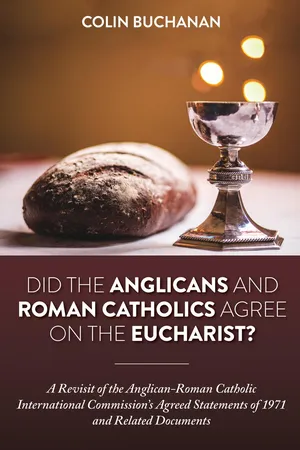
Did the Anglicans and Roman Catholics Agree on the Eucharist?
A Revisit of the Anglican-Roman Catholic International Commission’s Agreed Statements of 1971 and Related Documents
- 224 pages
- English
- ePUB (mobile friendly)
- Available on iOS & Android
eBook - ePub
Did the Anglicans and Roman Catholics Agree on the Eucharist?
A Revisit of the Anglican-Roman Catholic International Commission’s Agreed Statements of 1971 and Related Documents
About this book
Fifty-two years ago [in 1966] Archbishop Michael Ramsey of Canterbury visited Rome and agreed with the Pope to inaugurate an Anglican-Roman Catholic theological dialogue. Three phases of the Anglican-Roman Catholic International Commission (ARCIC) resulted and continue to this day. ARCIC I agreed on a statement on Eucharistic Doctrine in 1971 and an Elucidation of it in 1979. The Vatican declined full endorsement of these, and in 1994 ARCIC II produced Clarifications of them, which the Vatican accepted as sufficient. Colin Buchanan, who himself published the 1971 Statement in England, has followed the international dialogue closely since 1971. He here prints all the relevant texts and examines in detail the attempted reconciling of traditional Roman Catholic eucharistic belief and Anglican reformed doctrine. His study includes Apostolicae curae and Malines, and in the modern era follows public and synodical debate, and the question of "reception." Three unprecedented unique features are: first, a diachronic study of the one doctrine; second, a fair regard for reformed Anglican beliefs; and third, a relating of dogmatic theology to eucharistic liturgy. The history prompts the question that forms the book's title, and close following of that history also provides the answer.
Information
Topic
Theology & ReligionSubtopic
Christian Denominations1
Four Centuries of Division
From the Sixteenth Century to the Nineteenth
No one can entertain doubts about the central place of the eucharist in the disputes and divisions of the sixteenth-century Reformation in Europe; and few other places could rival England for the intensity of the disputes and the pain of the divisions. A powerful demonstration of these is contained in the confrontation of Thomas Cranmer with Stephen Gardiner in 1550–51. It had been adumbrated in the speech of Cranmer in the debate in the House of Lords in December 1548, and it found initial expression in the communion service in the 1549 Book of Common Prayer; and this was totally confirmed by the communion service in the 1552 book. Amid a cloud of lesser difficulties, such as the use of Latin and of reception in both kinds, the storm-centres were invariably the doctrines of transubstantiation and of eucharistic sacrifice.
Against that background it is with a wholly reformed understanding of the communion service that the Church of England, freed from the power of Rome by the death of Queen Mary, emerged into the reign of Elizabeth I in November 1558. This is testified not only by the strongly protestant doctrine contained in the communion service in the 1559 Book of Common Prayer, but also by the Articles currently numbered as XXV, XXVIII, XXX, and XXXI of the XXXVIII Articles originally agreed in 1562, and then strengthened in 1571 by the addition of the very hard-edged Article XXIX to make up the full corpus of XXXIX Articles of 1571.1 That corpus was finally endorsed that year by the Queen, and then took the canonical form it still has to this day. While the Articles wholly excluded Roman Catholic eucharistic beliefs and were actually orientated over against the Council of Trent, it is also worth noting their relationship to the puritan movement in Elizabeth’s reign. The proponents of this movement sought a more thorough Reformation than the Elizabethan Settlement provided; they made particular reference to eliminating the last “popish rags” which the Settlement retained. They had little mind for compromise. Thus they objected forcefully to the imposition of a fixed form of prayers, and denounced various accoutrements to the authorized holy communion rite in the 1559 book (notably the wearing of a surplice by the presbyter and the kneeling to receive communion by the people). But, astonishingly, they never accused any of the actual text of the communion service or the wording of the XXXIX Articles as being in any way indicative of that harboring of Roman Catholic beliefs or unreformed practice which they were denouncing in the rubrics about ceremonial. This almost universal absence of protest on this great central question of the Reformation by the noisiest and most theologically embattled members of Elizabethan society speaks volumes not only about the overall teaching of the formularies, but also about the general nature of eucharistic belief and practice in the nation.2 Nor was it different in the seventeenth century—the most determined puritans who signed the Millenary Petition, the slightly milder quartet at the Hampton Court Conference in January 1604, and the argumentative ones later at the Savoy Conference in April to July 1661, all provided a host of “exceptions” to the Book of Common Prayer and to the overall impact of the Elizabethan Settlement; but they identified virtually no problems with the text of the communion service or with the eucharistic doctrine of the XXXIX Articles. Both puritans and loyal Anglicans in the Church of England knew they were together well polarized from Roman Catholic eucharistic doctrine; and the general lack of controversy between them over the doctrine of the eucharist is all the more remarkable when it is contrasted with the virulence of such controversies both earlier, i.e., between Roman Catholics and protestants in Edward VI’s reign, and later, i.e., between anglo-catholics and evangelicals in the nineteenth century; and equally remarkable when it is contrasted with the actual controversies in which the two sides were themselves engaged at the time concerning other liturgical matters.
There is little need to carry the story through to the nineteenth century in any depth. After the debacle of the Glorious Revolution (1688–89), monarchs were required to deny the doctrine of transubstantiation at their coronations.3 Individual clergy may have veered towards Roman Catholic beliefs; but the general suspicion of the aims, methods and influence of the Church of Rome kept the nation at large and the Church of England’s leaders in particular well to the reformed side of any line that could be drawn. William Purdy, in tracing the background to the dialogue in the eighteenth and nineteenth centuries, sees little but antagonism.4 During the nineteenth century, however, a different picture within the Church of England itself began to emerge. Here the rise of anglo-catholicism led, among the most “advanced” exemplars of the cult, to their formulating eucharistic doctrine in Roman terms; first teaching about the eucharist in those terms, then larding over the Anglican liturgy with Roman ceremonial, and then changing it for Roman or semi-Roman texts; and they began also to reserve the consecrated species outside the times of celebration of the liturgy not only for communicating the sick, but also for the use of the reserved wafer in adoration and for the liturgical exercise known as Benediction. This affirmation of the Church of England as truly “Catholic” naturally led to pressure from the Anglican side for overtures to be made towards Rome; and even if such overtures received rebuffs (as with promulgation of the doctrine of papal infallibility) or a fairly cold shoulder in relation to doctrinal concerns, yet, if conversations ever were to come, anglo-catholics would press for it, but it would have to be a very mixed picture to be presented from the Anglican side.
Apostolicae curae
In 1896–97 a cool official interchange between Rome and Canterbury indirectly bore upon their respective doctrines of the eucharist. The presenting issue was the question of Anglican orders, a question pressed heavily from the Anglican side. Anglo-catholics had treasured the preservation of an unbroken succession of bishops and of those ordained by them as the hallmark of validity, and thus of the true standing of the Church of England as an integral part of the Western Catholic Church. It was, however, not seen that way by English Roman Catholics (who viewed themselves as the only true Catholics in England) nor by Leo XIII. In his encyclical, Apostolicae curae, in 1896 he suspended a major part of his rejection of Anglican orders upon the actual text of the Reformation ordinal, and particularly its omissions in relation to the office and work of a priest in respect of the eucharist.5 The vital parts read as follows:
Table 1
| Apostolicae curae —Latin Part of §§7 & 8 | Apostolicae curae —English Part of §§7 & 8 |
| Iamvero verba quae ad proximam usque aetatem habentur passim ab Anglicanis tamquam forma propria ordinationis presbyteralis, videlicet, Accipe Spiritum Sanctum, minime sane significant definite ordinem sacerdotii vel eius gratiam, et potestatem, quae praecipue est potestas consecrandi et offerendi verum corpus et sanguinem Domini (Trid. Sess. XXIII, de sacr. Ord.,can.1), eo sacrificio, quod non est nuda commemoratio sacrificii in Cruci peracti Forma huiusmodi aucta quidem est postea iis verbis, ad officium et opus presbyteri: sed hoc potius convincit, Anglicanos vidisse ipsos primam eam formam fuisse mancam neque idoneam rei. | [In §7] But the words used which until recently were commonly held by Anglicans to constitute the proper form of priestly Ordination—namely, “Receive the Holy Ghost” certainly do not in the least definitely express the Sacred Order of Priesthood, or its grace and power, which is chiefly the power “of consecrating and of offering the true body and blood of the Lord” (Council of Trent, Sess. XXIII. De Sacr. Ord., Can.1) in that sacrifice which is no “nude commemoration of the sacrifice offered on the Cross”(Ibid., Sess. XXII, de Sacrif. Missae. Can.3). This form had indeed afterwards added to it the words “for the office and work of a priest,” etc.; but ... |
Table of contents
- Title Page
- Acknowledgments
- Abbreviations
- Introduction
- Chapter 1: Four Centuries of Division
- Chapter 2: Historical Background to the ARCIC Texts
- Chapter 3: The Malta Report (1968)
- Chapter 4: The Windsor Agreed Statement on Eucharistic Doctrine (1971)
- Chapter 5: Elucidation of the Statement on Eucharistic Doctrine (1979)
- Chapter 6: The Anglican Response
- Chapter 7: The Official Roman Catholic Response (1991)
- Chapter 8: Clarifications (1994): Text and Context
- Chapter 9: Clarifications (1994): Content and Significance
- Chapter 10: Reception?
- Chapter 11: The Twenty-First Century
- Chapter 12: The Future
- Chapter 13: Postscript: ARCIC III and Walking Together on the Way
- Bibliography
Trusted by 375,005 students
Access to over 1.5 million titles for a fair monthly price.
Study more efficiently using our study tools.
Frequently asked questions
Yes, you can cancel anytime from the Subscription tab in your account settings on the Perlego website. Your subscription will stay active until the end of your current billing period. Learn how to cancel your subscription
No, books cannot be downloaded as external files, such as PDFs, for use outside of Perlego. However, you can download books within the Perlego app for offline reading on mobile or tablet. Learn how to download books offline
Perlego offers two plans: Essential and Complete
- Essential is ideal for learners and professionals who enjoy exploring a wide range of subjects. Access the Essential Library with 800,000+ trusted titles and best-sellers across business, personal growth, and the humanities. Includes unlimited reading time and Standard Read Aloud voice.
- Complete: Perfect for advanced learners and researchers needing full, unrestricted access. Unlock 1.5M+ books across hundreds of subjects, including academic and specialized titles. The Complete Plan also includes advanced features like Premium Read Aloud and Research Assistant.
We are an online textbook subscription service, where you can get access to an entire online library for less than the price of a single book per month. With over 1.5 million books across 990+ topics, we’ve got you covered! Learn about our mission
Look out for the read-aloud symbol on your next book to see if you can listen to it. The read-aloud tool reads text aloud for you, highlighting the text as it is being read. You can pause it, speed it up and slow it down. Learn more about Read Aloud
Yes! You can use the Perlego app on both iOS and Android devices to read anytime, anywhere — even offline. Perfect for commutes or when you’re on the go.
Please note we cannot support devices running on iOS 13 and Android 7 or earlier. Learn more about using the app
Please note we cannot support devices running on iOS 13 and Android 7 or earlier. Learn more about using the app
Yes, you can access Did the Anglicans and Roman Catholics Agree on the Eucharist? by Colin Buchanan in PDF and/or ePUB format, as well as other popular books in Theology & Religion & Christian Denominations. We have over 1.5 million books available in our catalogue for you to explore.