- 188 pages
- English
- ePUB (mobile friendly)
- Available on iOS & Android
eBook - ePub
About this book
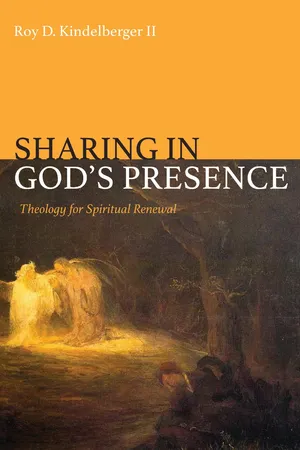
Sharing in God's Presence means far more than "getting saved" and experiencing God's blessing in our lives. As believers, his presence becomes a very personal part of who we are and what we do--God actually shares himself with us!
The language that we use often fails to capture the depths of God's nature penetrating ours, the fullness of his Spirit permeating our hearts, and the innermost infusion of his presence in our lives. But the truth couldn't be more intimate: "The person who is joined to the Lord is one spirit with him" (1 Corinthians 6:17)!
This book is an invitation to share in God's presence by allowing God to share himself with you. God wants everyone to share in his embrace. As we accept our responsibility for prayer, ministry, and even revival, we share in the very precious dynamic of give and response that's involved in an intimate walk with Jesus Christ.
For a general readership, this book is a reworking of material from the second half of the author's academic work God's Absence and the Charismatic Presence.
Information
Topic
Theology & ReligionSubtopic
Christian Ministry1
Presence: God Shares His World
Looking around at the world, most people get the sense that God doesn’t always get his way but has accepted significant risk by inviting people into his creation. Just to be clear, risk means that God doesn’t always get what he wants but actually exposes himself to significant loss. If God’s will was always done, then why would Jesus teach us to pray, “Your will be done on earth, as it is in heaven” (Matt 6:10)? God’s singular, consistent, perfect, and pleasing will can be, and is at times, thwarted!5 God does not will evil and suffering in the world but actually suffers at its hands, due to the freedom that he has bestowed upon humans and angels. We can all be certain that the choices of fallen humanity do not always line up with the will of God, yet God has never stopped believing that his creation was well worth the risk. For love to even be possible, it must involve not only our freedom but also God’s risk.
If we are to begin to understand what it means to share in God’s presence, it’s important to first understand the nature of the God who risks everything in order to share everything with his people. It is a profoundly freeing revelation to investigate the solid testimony of Scripture and discover in its pages a God who accepts the risk of loving and sharing himself with his creatures, what we should think of as a most profoundly relational theology. If we’re going to benefit from a relational theology, we’ll need to look to God’s inspired word as the final source of truth and revelation and fully embrace the descriptions, experiences, thoughts, and feelings attributed to God within its pages. The magnificent God of Scripture is both almighty and capable of anger, jealousy, regret, frustration, surprise, desire, sorrow, suffering, hope, and risk. Exploring such intimate depths of God’s open and responsive heart can revitalize the church’s understanding of God’s relationship to us. The God we worship is not only transcendent in power and presence but also immanent and absolutely relational. This very beautiful picture of the biblical God presents one who puts relationship first and therefore invites people to share his world!
In this chapter, we’ll see that God accepts the risk of sharing himself with us, and we’ll also consider how a God of perfect knowledge is even capable of risk. We’ll then look briefly at God’s relationship to change, time, suffering, and presence, and the role each of those play in his ability to share himself with people.
God Accepts the Risk
If I were to tell you, “God is love,” would you believe me? Such a weighty question deserves serious thought. You might have second thoughts if you’ve only ever heard that the God of the Bible is one who stringently controls a world full of hate and violence, much of which we’ve personally experienced. Or that God has ordained the damnation of certain friends and family, ultimately leaving them no choice but to remain in their sins because he has chosen to save others instead. Many of us have harbored the disturbing intuition that Satan must be some kind of puppet in God’s hands, while struggling to believe that God is somehow not to blame for all of the devastation caused by that demonic figure and those who abide in his kingdom of sin and death. If the world we live in exists under a God with complete and meticulous control, a God who has ordained the future in every detail, then we have no choice but to look around at all of the suffering and pain and question whether he really is the “God [of] love” that Scripture says he is (1 John 4:8, 16).
Over the years, many voices have taught me that prayers don’t change God and that God doesn’t actually need people in any fundamental way, along with so many other non-relational aspects of our Creator. Yet there’s something about all of this that just sticks in our craw when we size up our loving Savior with a God set on damning the world and damning our loved ones for the sake of his own glory. Challenges like these leave so many people confused and questioning. Why does this strange God seem so stubborn and dogmatic, ultimately closed to our input, while selfishly seeking to uphold his own honor and reputation? Why has this peculiar being ordained all things, yet chosen to save only some of the human race? All things considered, this rather boring God doesn’t take risks, prayer can’t change his mind, people aren’t free to accept or reject him, and ultimately, this sovereign dictator is responsible for all of the evil in the world. Yet the irony is that most evangelical believers live out the Christian life as if this isn’t so.6 Therefore, we can and should adopt a relational theology that acknowledges Scripture’s emphasis on a relational God who is open to a risky love because love is at the center of his existence and all of his ways. In fact, he risks everything so that he can share everything with us.
When Yahweh gave the first humans the choice to eat the fruit of the knowledge of good and evil, he accepted the blatantly obvious risk that they might very well eat it. From the beginning, it was apparent that the risks God takes are directly tied to the freedom that he has irrevocably given to humankind, a self-determining freewill. Accepting the risk, God pursues relationships that are of a truly personal, intimate nature, in which his heart is on the line because of the possibility of rejection.
Jesus summarized the grief of being rejected as he looked out over Jerusalem and stated with sad disappointment, “How often I have longed to gather your children together, as a hen gathers her chicks under her wings, and you were not willing” (Matt 23:37). Although Jesus longed to have a close relationship with God’s people, that desire went unfulfilled. Such grief is largely due to the costly risk that allows the kind of freedom that can reject God’s love in the first place. Yet God continues to risk so much because he aims so high and lovingly longs for more from us.
Although God wills and yearns for a loving relationship with every single person, that future prospect is not guaranteed. God hasn’t ordained every detail of the future but allows true freedom for the sake of relationship. For instance, there have been times when Yahweh remained undecided about Israel’s judgment because he was hopeful for their repentance. On one occasion, the Lord said to Jeremiah, “Perhaps they will listen and each will turn from their evil ways. Then I will relent and not inflict on them the disaster I was planning because of the evil they have done. . . . Perhaps when the people of Judah hear about every disaster I plan to inflict on them, they will each turn from their wicked ways” (Jer 26:3; 36:3, emphasis added).7 Passages like this imply a great deal of uncertainty from God—perhaps my children will do this or that! Although God hopes that they will change their wicked ways, he doesn’t know for certain! Such passages support the contention that the future is not set in stone but is full of possibilities.8
Prayer makes the most sense if the future is full of possibility. In one well-known Old Testament story, when King Hezekiah became ill and was about to die, a prophet came to him and in no uncertain terms declared, “You are going to die.” To avoid any confusion on the matter, the prophet added, “You will not recover” (2 Kgs 20:1; cf. Isa 38:1–6)! But the king cried out to God anyway, hoping that Yahweh wasn’t stubbornly set in his ways, and in a surprising turn of events, the prophet returned with quite a different message from the Lord: “I have heard your prayer and seen your tears; I will heal you. . . . I will add fifteen years to your life” (2 Kgs 20:5, 6). And yet he had been promised death, beyond recovery, which leaves readers to draw no other conclusion than the obvious—King Hezekiah’s prayer changed God’s mind! This is just one example of how prayer changes not only you and me but also God’s plans. Surely it would have been disingenuous for God to predict a death that wasn’t a real, or even likely, possibility. This king was doomed to die, yet the Lord regards a believer’s prayers to such a degree that the future can be changed.
Along with Hezekia...
Table of contents
- Title Page
- Copyright Notices
- Acknowledgments
- Introduction: God Shares His Heart
- Chapter 1: Presence: God Shares His World
- Chapter 2: Covenant: God Shares Himself
- Chapter 3: Salvation: God Shares His Son
- Chapter 4: Pentecost: God Shares His Spirit
- Chapter 5: Prayer: God Shares His Plans
- Chapter 6: Gifts: God Shares His Work (Part One)
- Chapter 7: Gifts: God Shares His Work (Part Two)
- Chapter 8: Ministry: God Shares His Power
- Chapter 9: Revival: God Shares His Glory
- Bibliography
Trusted by 375,005 students
Access to over 1.5 million titles for a fair monthly price.
Study more efficiently using our study tools.
Frequently asked questions
Yes, you can cancel anytime from the Subscription tab in your account settings on the Perlego website. Your subscription will stay active until the end of your current billing period. Learn how to cancel your subscription
No, books cannot be downloaded as external files, such as PDFs, for use outside of Perlego. However, you can download books within the Perlego app for offline reading on mobile or tablet. Learn how to download books offline
Perlego offers two plans: Essential and Complete
- Essential is ideal for learners and professionals who enjoy exploring a wide range of subjects. Access the Essential Library with 800,000+ trusted titles and best-sellers across business, personal growth, and the humanities. Includes unlimited reading time and Standard Read Aloud voice.
- Complete: Perfect for advanced learners and researchers needing full, unrestricted access. Unlock 1.5M+ books across hundreds of subjects, including academic and specialized titles. The Complete Plan also includes advanced features like Premium Read Aloud and Research Assistant.
We are an online textbook subscription service, where you can get access to an entire online library for less than the price of a single book per month. With over 1.5 million books across 990+ topics, we’ve got you covered! Learn about our mission
Look out for the read-aloud symbol on your next book to see if you can listen to it. The read-aloud tool reads text aloud for you, highlighting the text as it is being read. You can pause it, speed it up and slow it down. Learn more about Read Aloud
Yes! You can use the Perlego app on both iOS and Android devices to read anytime, anywhere — even offline. Perfect for commutes or when you’re on the go.
Please note we cannot support devices running on iOS 13 and Android 7 or earlier. Learn more about using the app
Please note we cannot support devices running on iOS 13 and Android 7 or earlier. Learn more about using the app
Yes, you can access Sharing in God’s Presence by Roy D. Kindelberger in PDF and/or ePUB format, as well as other popular books in Theology & Religion & Christian Ministry. We have over 1.5 million books available in our catalogue for you to explore.