Body Battlegrounds explores the rich and complex lives of society's body outlaws—individuals from myriad social locations who oppose hegemonic norms, customs, and conventions about the body. Original research chapters (based on textual analysis, qualitative interviews, and participant observation) along with personal narratives provide a window into the everyday lives of people rewriting the norms of embodiment in sites like schools, sporting events, and doctors' offices. Table of Contents Introduction | Chris Bobel and Samantha Kwan
Part I: Going "Natural" • Body Hair Battlegrounds: The Consequences, Reverberations, and Promises of Women Growing Their Leg, Pubic, and Underarm Hair | Breanne Fahs• Radical Doulas, Childbirth Activism, and the Politics of Embodiment | Monica Basile • Caring for the Corpse: Embodied Transgression and Transformation in Home Funeral Advocacy | Anne EsacoveLiving Resistance: • Deconstructing Reconstructing: Challenging Medical Advice Following Mastectomy | Joanna Rankin • My Ten-Year Dreadlock Journey: Why I Love the "Kink" in My Hair... Today | Cheryl Thompson • Living My Full Life: My Rejecting Weight Loss as an Imperative for Recovery from Binge Eating Disorder | Christina Fisanick • Pretty Brown: Encounters with My Skin Color | Praveena Lakshmanan
Part II: Representing Resistance • Blood as Resistance: Photography as Contemporary Menstrual Activism | Shayda Kafai • Am I Pretty Enough for You Yet?: Resistance through Parody in the Pretty or Ugly YouTube Trend | Katherine Phelps • The Infidel in the Mirror: Mormon Women's Oppositional Embodiment | Kelly Grove and Doug SchrockLiving Resistance: • A Cystor's Story: Polycystic Ovarian Syndrome and the Disruption of Normative Femininity | Ledah McKellar • Old Bags Take a Stand: A Face Off with Ageism in America | Faith Baum and Lori Petchers • Making Up with My Body: Applying Cosmetics to Resist Disembodiment | Haley Gentile • I Am a Person Now: Autism, Indistinguishability, and (Non)optimal Outcome | Alyssa Hillary
Part III: Creating Community, Disrupting Assumptions • Yelling and Pushing on the Bus: The Complexity of Black Girls' Resistance | Stephanie D. Sears and Maxine Leeds Craig • Big Gay Men's Performative Protest Against Body Shaming: The Case of Girth and Mirth | Jason Whitesel • "What's Love Got to Do with It?": The Embodied Activism of Domestic Violence Survivors on Welfare | Sheila M. KatzLiving Resistance: • "Your Signing Is So Beautiful!": The Radical Invisibility of ASL Interpreters in Public | Rachel Kolb • Two Shakes | Rev. Adam Lawrence Dyer • "Showing Our Muslim": Embracing the Hijab in the Era of Paradox | Sara Rehman • "Doing Out": A Black Dandy Defies Gender Norms in the Bronx | Mark Broomfield • Everybody: Making Fat Radio for All of Us | Cat Pausé
Part IV: Transforming Institutions and Ideologies • Embodying Nonexistence: Encountering Mono- and Cisnormativities in Everyday Life | J. E. Sumerau • Freeing the Nipple: Encoding the Heterosexual Male Gaze into Law | J. Shoshanna Ehrlich • Give Us a Twirl: Male Baton Twirlers' Embodied Resistance in a Feminized Terrain | Trenton M. Haltom • "That Gentle Somebody": Rethinking Black Female Same-Sex Practices and Heteronormativity in Contemporary South Africa | Taylor RileyLiving Resistance:
eBook - ePub
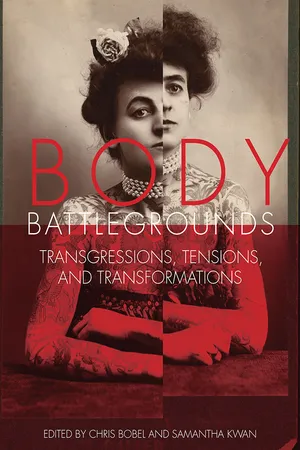
Body Battlegrounds
Transgressions, Tensions, and Transformations
- English
- ePUB (mobile friendly)
- Available on iOS & Android
eBook - ePub
Body Battlegrounds
Transgressions, Tensions, and Transformations
About this book
Information
PART I
Going “Natural”
1
Body Hair Battlegrounds
The Consequences, Reverberations, and Promises of Women Growing Their Leg, Pubic, and Underarm Hair
Breanne Fahs
Dangerously Crazy about Body Hair
I often remark to students and colleagues alike that hair is “crazy making.” Perhaps because we spend such an enormous amount of time managing and containing our hair—making sure it does not get too unruly or wild; trimming and shaving and plucking it into submission; cutting, dyeing, waxing, and styling our hair—it becomes impossible to truly assess how strongly we cling to ideas about “proper” and attractive hair and, by association, “proper” femininity and masculinity. Hair brings out deeply personal notions of morality, cleanliness, beauty, attractiveness, and status. In my career as a woman and gender studies professor and a practicing clinical psychologist, I have spent a rather large amount of time thinking about, studying, exploring, and provoking others to experiment with their body hair. This has offered me many insights into “doing gender” but has often come at great cost to me both professionally (as many have labeled this work as too “trivial” or “silly”) and personally (as my work on hair has inspired others to act in irrational ways toward me). And yet, each time that these reactions unfold, and each time the price of the work becomes clear, I feel renewed inspiration about the importance of these body hair battlegrounds.
In her now-seminal essay, “Thinking Sex,” Gayle Rubin (1984) said about the necessity of thinking seriously about sexuality, “To some, sexuality may seem to be an unimportant topic, a frivolous diversion from the more critical problems of poverty, war, disease, racism, famine, or nuclear annihilation. But it is precisely at times such as these, when we live with the possibility of unthinkable destruction, that people are likely to become dangerously crazy about sexuality. . . . Disputes over sexual behavior often become vehicles for displacing social anxieties, and discharging their attendant emotional intensity” (267). In this chapter, I argue that hair, too, makes us dangerously crazy, wildly incapable of direct and self-reflexive conversation, infused with the most panicky and anxiety-ridden sense of danger. Like Rubin, I argue that feminist scholars should approach the study of hair with the most seriousness we can muster, seeing it as a vehicle for social control, displaced anxiety, intense emotional energy, and cultural distress. Hair is at once a marker of social class and “respectability,” a highly racialized site of inequality and difference (particularly for African American women), a deeply gendered signifier of beauty and gender (non)conformity, and a form of artistic and cultural expression; it is messy and complex and always-already laden with stories about power.
This chapter extends my earlier work on a pedagogical exercise about body hair (Fahs and Delgado 2011; Fahs 2011, 2012, 2013, 2014), in which I outlined the ways that female college students characterized the temporary experience of growing out their body hair, by revisiting the question: What do women’s overt body hair rebellions provoke in others? Drawing from an extra credit assignment I give to students that asks them to engage in nonnormative body hair behavior (women grow hair on their legs, underarms, and pubis while men shave hair from these areas) and write about the experience, I revisit the question of what this assignment teaches students and the sorts of things that they learn from challenging traditional gender roles. Instead of only looking at the specific individual experiences of students in my courses who have chosen to grow out their body hair, in this chapter I also examine the ongoing public media attention (most intense in 2014) that this assignment received in the (mostly conservative) news media. In order to imagine what women’s body hair rebellions have provoked—both individually, collectively, and, now, culturally—I first trace the most recent literature on body hair, including an examination of my own work on women’s body hair rebellions. I then examine the chaotic experiencing of watching my work “go viral”—often with negative consequences for me and this work—as an example of why hair deserves the utmost attention in times of social stress, and why body hair rebellions matter. I conclude the chapter by looking at four recent semesters of women’s studies students who participated in this assignment and lay out some of the more interesting patterns of their reports on the experience.
Recent Literature on Body Hair
Despite accusations that research on body hair is “trivial” and that contemporary women live in a “postfeminist” society that gives them freedom to do whatever they want with their bodies, several scholars have continued to research women’s relationship to body hair removal and its meanings. In Plucked (2015), a large-scale examination of the cultural practices of hair removal, Rebecca Herzig argued that hair removal for women shifted from a “mutilation” practice (largely disdained in mainstream culture) to a mandate for women (where hairy women were seen as politically extreme, sexually deviant, or mentally ill). Herzig’s work, by outlining the forces that have driven this recent mandate for women to remove body hair, offers a major contribution to the task of “taking seriously” women’s body hair decisions.
Looking to the quantitative literature on body hair, studies show that over 91.5 percent of women in the United States regularly remove their leg hair and 93 percent regularly remove underarm hair (Tiggemann and Kenyon 1998). A recent Australian study found that approximately 96 percent of women regularly removed their leg and underarm hair, 60 percent removed at least some pubic hair, and 48 percent removed all pubic hair (Tiggemann and Hodgson 2008). One UK study found that over 99 percent of women reported removing body hair at some point in their lives (Toerien, Wilkinson, and Choi 2005) and a study of Australian women found that 98 percent of women were removing both leg and underarm hair (Tiggemann and Lewis 2004). In all, these estimates across Western cultures emphasize extremely high rates of body hair removal for women.
Much of the recent social science research on body hair has focused on women’s removal of pubic hair, with a variety of recent studies looking at the increase in women’s beliefs that hairless genitals symbolize cleanliness, sexiness, choice, and normativity (Braun, Tricklebank and Clarke 2013; Riddell, Varto and Hodgson 2010; Smolak and Murnen 2011). A cross-sectional study of low-income Hispanic, Black, and white women found that pubic hair grooming was more common among white, younger, under- or “normal”-weight participants, those making over $30,000 per year, and those having five or more lifetime sexual partners, though all demographics reported high rates of pubic hair grooming (DeMaria and Berenson 2013). In a Canadian sample, approximately half of women shaved their bikini line and 30 percent removed all pubic hair, with most citing appearance in a bathing suit, attractiveness, and cleanliness as the reasons (Riddell, Varto, and Hodgson 2010). A US sample also found high rates of pubic hair removal across demographics (Herbenick et al. 2013). Women reported far more removal of pubic hair than did men, and cited reasons of sexiness and feeling “normal” as the primary reasons they removed hair; these reasons correlated with feelings of self-objectification and self-surveillance (Smolak and Murnen 2011). Further, women cared more about removing their pubic hair than men did about removing their own, citing sexual impacts as one of their concerns (Braun, Tricklebank, and Clarke 2013).
In my previous work, starting with the publication of my first piece on body hair rebellions back in the 2011 Embodied Resistance collection, I found that women of color faced harsher penalties for growing body hair, both because they typically had darker hair but also because they faced pressures from family around respectability (Fahs and Delgado 2011). In my first journal article on the body hair assignment, I also found that women faced clear heteronormative patrolling messages and had to contend with fear of hate crimes, fear of being “outed” as lesbian, and homophobic reactions to their body hair (Fahs 2011). Following the publication of these two studies, I published three other journal articles on different aspects of women rebelling against the hairlessness norm: one that outlined the trajectory of the body hair extra credit assignment (Fahs 2012), one about men’s experiences shaving body hair (in which men masculinized the experience and rebelled by, for example, shaving their legs with a buck knife) (Fahs 2013), and one where I compared women’s imagined experiences with growing body hair to their actual experiences (revealing that actual body hair growth inspired a variety of people in women’s lives to control, comment upon, and show disgust about body hair, while imagining such growth mostly resulted in women saying it was “no big deal” and that they had “personal choice”) (Fahs 2014). Each of these studies further emphasized how embodied resistance through body hair growth came at great personal cost to women, in part by revealing networks of people—partners, family members, co-workers, and friends—invested in controlling women’s bodies.
While not much scholarly attention has focused on how women might use body hair to rebel against gender norms, popular media stories have sometimes framed body hair as a prominent public act of rebellion for women (celebrity or otherwise) who have grown tired of body policing and constraints. Consider how hippie women in the 1960s who challenged norms of shaving were criticized (see Weitz 2001). Links between fashion and rebellion—the body as a social text that reflects the social mores, values, and identity politics of the day (Craig 2002)—also apply to body hair. With pornography glorifying women’s hairless vulvas (Vannier, Currie and O’Sullivan 2014) and magazines emphasizing that women will have “great sex” if they remove their body hair (Ménard and Kleinplatz 2008), women who rebel against body hair norms face steep pressures to conform to sociocultural norms of “appropriate” hair growth. Despite this, a variety of celebrities have espoused body hair growth as a public rebellion, including Miley Cyrus, Sarah Silverman, Scout Willis, Penélope Cruz, Madonna, Gaby Hoffman, Juliette Lewis, Drew Barrymore, Julia Roberts, and Mo’nique (Butler 2015). Dyeing armpit hair has also received attention, with debates online about whether it represents symbolic rebellion, narcissistic calls for attention, or the latest fashionable statement (Holley 2014; Newman 2015). Young women who identified as “eco-grrrls” also sometimes used body hair growth as the ultimate political act of rejecting gender norms (Fry and Lousley 2001). Thus, body hair is emerging as a key player in gendered rebellions of the body, with new iterations of body hair rebellions appearing each year.
Body Hair Gone Wild (or Viral)
The body hair assignment has continued to grow and evolve—with students rebelling in new ways, recruiting others to join them in doing the project, confronting new challenges (workplaces, expressions of femininity), and redefining gender roles—and this has meant the assignment has gotten new kinds of attention from the public sphere when I share the results in journals, conferences, and media outlets. One of the great pedagogical strengths of the assignment is its ability to rapidly ignite conversations about body hair among women and their “social networks.” Hair has much salience in people’s lives and represents an easy access point for tougher discussions around hegemonic masculinity, social control, compulsory heterosexuality, and intersectionality. People love to talk about body hair; it somehow is just provocative enough that conversation is allowable about the subject, while still being taboo enough that debates, strong feelings, defiant actions, and healthy banter can easily ensue. As a sex researcher, I have published on a variety of topics I wish people would talk more about—for example, the rapid growth in numbers of teenage girls having unprotected anal sex with teenage boys, or the specific sorts of power imbalances that exist in “mainstream” pornography these days—but it seems that none of my work has inspired more conversation and media attention than body hair. This may reflect how people have to choose and manage aspects of their hair every day: shaving, plucking, waxing, grooming, washing, styling, presenting, controlling, etc. Hair is wholly relatable because everyone deals with it in their lives. (Sexuality, on the other hand, can alienate certain audiences fairly quickly and has fewer nearly universal “entry points” into conversation.)
While feminist researchers often worry their work goes unread or they do not engage enough in the public sphere as public intellectuals, my unanticipated jump into the media spotlight proved to be a harrowing experience that underscored the difficulty of having such exposure. In the summer of 2014, I had just published my most recent piece on body hair in Psychology of Women Quarterly, a respected journal that publishes mostly empirical psychological pieces about women and gender. In June, my university (Arizona State University) had published a short online story about the body hair assignment and how I had won the Mary Roth Walsh teaching award from the American Psychological Association for designing the assignment. This short online article got picked up by a conservative journalism student (and member of the red-baiting Campus Reform organization) who sent it to some ultra-conservative media outlets like the Drudge Report and Fox News. Soon, stories about the body hair assignment had “gone viral,” with over one thousand news outlets running “stories” about the body hair assignment within weeks. The story morphed in fascinating ways with a number of false details circulating wildly: I routinely “checked” students’ pubic hair; I was running a Communist training camp; I was giving enormous amounts of extra credit; I was handing out A grades for armpit hair (notably, leg hair disappeared from most of these stories and armpit hair loomed large); and I was “ruining America” by giving this “pointless” assignment. I learned quickly that nearly every major media outlet that ran the story had not researched a single original detail. Instead, they reprinted (and reprinted and reprinted) the same quotes, ideas, and information as the original story, often selectively leaving out information about the potential value of the assignment, without bothering to fact check or even to gather new pieces of information.
Soon, the hate mail started pouring in. Hundreds of emails were sent to me, the university, the Dean, and my program about my body hair assignment. Angry parents wrote the school. Outraged conservatives—I later learned from our security team that these were individual letters sent from all over the country—sent hotheaded, vitriolic letters calling me every profane name imaginable (of course centering on sexual identity, gender, fatness, and, in some cases, race). Fox News speculated on national television about my own body hair practices and “analyzed” my eyebrows for clues. Rush Limbaugh talked about the assignment to his listeners. Eventually, emails started to arrive that o...
Table of contents
- Cover
- Title Page
- Copyright
- Dedication
- Contents
- Acknowledgments
- Introduction
- Part I: Going “Natural”
- Part II: Representing Resistance
- Part III: Creating Community, Disrupting Assumptions
- Part IV: Transforming Institutions and Ideologies
- Afterword: Bodies of Resistance
- Contributors
- Index
Trusted by 375,005 students
Access to over 1.5 million titles for a fair monthly price.
Study more efficiently using our study tools.
Frequently asked questions
Yes, you can cancel anytime from the Subscription tab in your account settings on the Perlego website. Your subscription will stay active until the end of your current billing period. Learn how to cancel your subscription
No, books cannot be downloaded as external files, such as PDFs, for use outside of Perlego. However, you can download books within the Perlego app for offline reading on mobile or tablet. Learn how to download books offline
Perlego offers two plans: Essential and Complete
- Essential is ideal for learners and professionals who enjoy exploring a wide range of subjects. Access the Essential Library with 800,000+ trusted titles and best-sellers across business, personal growth, and the humanities. Includes unlimited reading time and Standard Read Aloud voice.
- Complete: Perfect for advanced learners and researchers needing full, unrestricted access. Unlock 1.5M+ books across hundreds of subjects, including academic and specialized titles. The Complete Plan also includes advanced features like Premium Read Aloud and Research Assistant.
We are an online textbook subscription service, where you can get access to an entire online library for less than the price of a single book per month. With over 1.5 million books across 990+ topics, we’ve got you covered! Learn about our mission
Look out for the read-aloud symbol on your next book to see if you can listen to it. The read-aloud tool reads text aloud for you, highlighting the text as it is being read. You can pause it, speed it up and slow it down. Learn more about Read Aloud
Yes! You can use the Perlego app on both iOS and Android devices to read anytime, anywhere — even offline. Perfect for commutes or when you’re on the go.
Please note we cannot support devices running on iOS 13 and Android 7 or earlier. Learn more about using the app
Please note we cannot support devices running on iOS 13 and Android 7 or earlier. Learn more about using the app
Yes, you can access Body Battlegrounds by Chris Bobel, Samantha Kwan, Chris Bobel,Samantha Kwan in PDF and/or ePUB format, as well as other popular books in Social Sciences & Discrimination & Race Relations. We have over 1.5 million books available in our catalogue for you to explore.