Interest in anthocyanins has increased in the past few years, due to their potential health-promoting properties as dietary antioxidants. Previously they were known as an important class of natural colorant, orange-red to blue-violet, found in fruits such as berries and in vegetables. This book discusses ways of targeting the delivery of these compounds, through manipulation of exploitation mechanisms. It addresses all aspects from extraction of anthocyanins from natural sources, their health benefits and metabolism to specialized controlled release applications. It will serve as a unique reference for those specializing in the fate of anthocyanins in the body (pharmacokinetics) and the research related to controlled release systems. It will provide an insight for pharmaceutical scientists, food engineers, food scientists and those interested in human health and nutrition.
eBook - ePub
Anthocyanins from Natural Sources
Exploiting Targeted Delivery for Improved Health
- 315 pages
- English
- ePUB (mobile friendly)
- Available on iOS & Android
eBook - ePub
Anthocyanins from Natural Sources
Exploiting Targeted Delivery for Improved Health
About this book
Information
Publisher
Royal Society of ChemistryYear
2019Print ISBN
9781788012157
9781788012157
Edition
1eBook ISBN
9781788017367
Part I
Chemistry and Extraction of Anthocyanins
Chapter 1
Natural Sources of Anthocyanins
a National Research Council of Canada, Aquatic and Crop Resource Development Research Centre, 1411 Oxford Street, Halifax, NS B3H 3Z1, Canada
b Dalhousie University, Department of Process Engineering and Applied Science, PO Box 15000, Halifax, NS B3H 4R2, Canada
* Email: [email protected]
1.1 Introduction
Anthocyanins are ubiquitous water-soluble pigments that have important roles in the propagation, protection, and physiology of higher plants. Evidence shows that these compounds can act by repelling herbivores and parasites,1 attracting pollinators and seed dispersers,2 and protecting plants against biotic and abiotic stresses.3 In human health, anthocyanins have been associated with various benefits due to their antioxidant,4 anti-inflammatory,5 neuroprotective,6 and anti-diabetic properties.7 Chemically, anthocyanins are polyphenols and belong to a large class of secondary metabolites known as flavonoids, with a core structure in the form of 2-phenylbenzopyrylium or flavylium cation (Figure 1.1). They are polyhydroxy and polymethoxy derivatives of this flavylium cation and can have sugar groups or acylated moieties attached at different positions.8 Although more than 700 compounds have been described in the literature,9 they are mainly derived of six anthocyanidins (aglycone form): cyanidin, delphinidin, pelargonidin, peonidin, petunidin, and malvidin.10
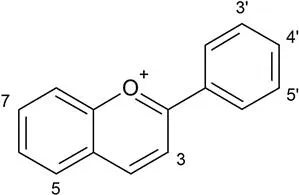
Figure 1.1 Core structure of anthocyanins, 2-phenylbenzopyrylium, also known as flavylium cation.
An interesting feature of anthocyanins is that they can display a great diversity of colors depending on their chemical structure and the environment in which they are found, ranging from orange to blue.11 Several factors likely contribute to the variations in anthocyanin content and profile in plants. Anthocyanin biosynthesis and structural skeleton diversity are controlled by a number of genes. As illustrated in a colored potato study, the red cultivars contained predominantly pelargonidin derivatives, while the purple/blue varieties had peonidin, petunidin, and malvidin as the main aglycones.12 A color change is usually seen in fruit over the growing and harvest seasons. For example, the intra-seasonal monitoring of total anthocyanins and specific components in blueberries showed that during the harvest season between June and August, the content had a generally increasing trend, but the percentages of delphinidin and malvidin glycosides were inversely mirrored.13 The environment also has an effect on anthocyanin production in plants. Although the specific role that these plant metabolites have in protecting against biotic and abiotic stresses is not well understood, studies have revealed interesting connections between anthocyanin profiles and various stress conditions. For example, Kovinich et al.14 reported a clear pattern of difference in model plant Arabidopsis thaliana under abiotic stresses, where low pH and phosphate deficiency induced anthocyanin accumulation, while osmotic stress with mannitol and high pH reduced the total anthocyanins level. Furthermore, some structural differences, mainly in the modification of glycoside chains, were observed under these stress conditions. In field crops, the anthocyanin content and profile are most likely affected by both genetic and environmental variations. A multi-year grape study by Ortega-Regules et al.15 showed that the total anthocyanins and fingerprint profiles varied considerably over 3 years with different weather conditions during the growing seasons for the same crop varieties, while the differences were relatively smaller for Monastrell variety grapes grown at two different locations.
Aside from their recognized health benefits, these colorful molecules from natural sources are very appealing to the food industry as colorants. The increasing interest in their use in food products has been driven by consumer and regulatory pressure to replace synthetic colorants. However, this substitution is not straightforward as anthocyanins can degrade under normal processing and storage conditions, such as during heat treatment, which would negatively impact the sensory properties of the product. Different strategies to improve the stability of these colorants have been investigated, some of which will be discussed in later chapters.
In this chapter, natural sources of anthocyanins, such as fruits, vegetables, and grains, are highlighted and discussed based largely on the literature of the past 20 years. Examples of anthocyanin-containing plants used in traditional Chinese and Indian medicine, as well as exotic plants found worldwide, are included. Mazza and Miniati8 have extensively reviewed the occurrence of anthocyanins in foods, and their work serves as the foundation for this updated account in the area.
1.2 Anthocyanins in Foods
Color is an important attribute of fresh or processed food products that is very appealing to consumers. As one of the largest groups of water-soluble pigments, anthocyanins are present in virtually all types of foods, contributing to the wide range of characteristic colors. The following sections list various types of foods available in North America (in alphabetical order by common name) and describe the main types of anthocyanins reported in the literature. Later sections include examples of anthocyanin sources used in traditional medicine and found in other parts of the world.
1.2.1 Fruits
1.2.1.1 Apple: Malus pumila L.
The red peel of certain cultivars of apples is very attractive and retains most of the pigment. Cyanidin-3-galactoside is the major anthocyanin in the red peel, while cyanidin-3-glucoside and cyanidin-3-arabinoside are minor ones.8 Apple flesh can also contain anthocyanins, as reported in red-fleshed apple varieties.16,17 A recent study of 22 apple cultivars in Poland revealed that the average total anthocyanin content of the whole fruit was 30 mg/100 g dry tissue, ranging from 5 to 133 mg/100 g depending on the cultivar. From this content, 85–100% was found to be cyanidin-3-galactoside.18
1.2.1.2 Apricot: Prunus armeniaca L.
Dried apricots were reported to have a total anthocyanin content of 3 mg cyanidin-3-glucoside equivalents/100 g.19 The major anthocyanin c...
Table of contents
- Cover
- Title
- Copyright
- Contents
- Part I Chemistry and Extraction of Anthocyanins
- Part II Health Benefits and Metabolism
- Part III Controlled Release Systems for Anthocyanins
- Part IV Conclusions
- Subject Index
Trusted by 375,005 students
Access to over 1.5 million titles for a fair monthly price.
Study more efficiently using our study tools.
Frequently asked questions
Yes, you can cancel anytime from the Subscription tab in your account settings on the Perlego website. Your subscription will stay active until the end of your current billing period. Learn how to cancel your subscription
No, books cannot be downloaded as external files, such as PDFs, for use outside of Perlego. However, you can download books within the Perlego app for offline reading on mobile or tablet. Learn how to download books offline
Perlego offers two plans: Essential and Complete
- Essential is ideal for learners and professionals who enjoy exploring a wide range of subjects. Access the Essential Library with 800,000+ trusted titles and best-sellers across business, personal growth, and the humanities. Includes unlimited reading time and Standard Read Aloud voice.
- Complete: Perfect for advanced learners and researchers needing full, unrestricted access. Unlock 1.5M+ books across hundreds of subjects, including academic and specialized titles. The Complete Plan also includes advanced features like Premium Read Aloud and Research Assistant.
We are an online textbook subscription service, where you can get access to an entire online library for less than the price of a single book per month. With over 1.5 million books across 990+ topics, we’ve got you covered! Learn about our mission
Look out for the read-aloud symbol on your next book to see if you can listen to it. The read-aloud tool reads text aloud for you, highlighting the text as it is being read. You can pause it, speed it up and slow it down. Learn more about Read Aloud
Yes! You can use the Perlego app on both iOS and Android devices to read anytime, anywhere — even offline. Perfect for commutes or when you’re on the go.
Please note we cannot support devices running on iOS 13 and Android 7 or earlier. Learn more about using the app
Please note we cannot support devices running on iOS 13 and Android 7 or earlier. Learn more about using the app
Yes, you can access Anthocyanins from Natural Sources by Marianne Su-Ling Brooks, Giovana B Celli, Marianne Su-Ling Brooks,Giovana B Celli in PDF and/or ePUB format, as well as other popular books in Technology & Engineering & Nutrition, Dietics & Bariatrics. We have over 1.5 million books available in our catalogue for you to explore.