By addressing challenges experienced at a cross-cultural level, this book is an invaluable resource for educators and higher education practitioners alike.
eBook - ePub
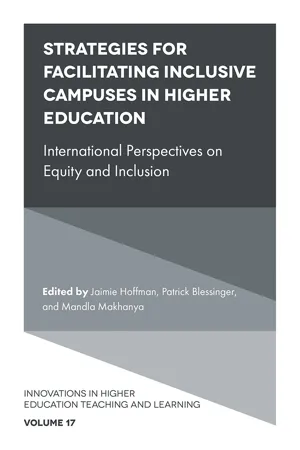
Strategies for Facilitating Inclusive Campuses in Higher Education
International Perspectives on Equity and Inclusion
- 310 pages
- English
- ePUB (mobile friendly)
- Available on iOS & Android
eBook - ePub
Strategies for Facilitating Inclusive Campuses in Higher Education
International Perspectives on Equity and Inclusion
About this book
Higher education institutions continue to encounter an increasingly complex set of issues regarding equity, diversity and inclusion on university campuses. Many institutions are striving to find creative solutions to eliminate access, participation, and achievement barriers as well as practices that impede retention and graduation rates. This volume provides educators with a global understanding of the successes and challenges associated with facilitating inclusive campuses in higher education amidst the growing diversity of students by providing evidence-based strategies and ideas for implementing equity and inclusion at higher education institutions around the world.
Information
Topic
EducationSubtopic
Educational PolicyPART I
CONCEPTS AND PRINCIPLES
INTRODUCTION TO STRATEGIES FOR FOSTERING INCLUSIVE CAMPUSES IN HIGHER EDUCATION
ABSTRACT
The chapters in this book focus on student experiences in higher education (HE) and how these experiences shape their future as contributors to the knowledge economy, which is being gradually replaced by natural resources. The chapter authors in this volumes stress on the value of mentorship program with a focus toward mentoring those who are neglected and underprivileged. Programs that help students with visual or audio impairment has been discussed along with bridge programs, which might help in imparting an inclusive and equitable HE with accessibility to all. Case studies from Ghana to South Africa, Glasgow, and Australia are discussed to increase motivation and willingness among educators and students to apply new skills and foster new teaching experiences that can help shape effective learning outcomes for students.
Keywords: Social inclusion; transformation; multiculturalism; social mobility; inequality; diversity; educational access
INTRODUCTION
The purpose of this chapter is to develop a more coherent understanding for fostering more inclusive and equitable campus environments in higher education (HE). As demand for HE increases and as lifelong learning becomes more pervasive in society, educators continue to respond to the needs of a more diverse student population, and educators continue to seek effective ways to create more inclusive campus environments. As such, institutional transformation with the concept of inclusiveness is a current trend in HE. The concept of inclusion has grown and now occupies a critical position in the realms of HE. Inclusion urges and advocates those who are responsible for leading students, at both the classroom level and the campus-wide level, to create inclusive spaces that include those who are categorized as exceptional or different (Sengupta, 2017). In addition, Fraser and Shield (2010 p. 7) noted that “Many current practices in education persist because of long held and unquestioned assumptions about the nature of schooling and the respective roles of educators and students.”
These assumptions have resulted from stereotyping and beliefs held by society. The increasing diversity which is becoming a reality in today’s education system is creating opportunities as well as challenges for instructional leaders across postsecondary and higher educational institutions. The concept of inclusiveness cannot be restricted to academic debates but a growing need to educate students in an environment that reflects the diversity of their society. The inclusive campus should reflect the global society in which tomorrow’s college graduates will be living and working. The concept of integration and multiculturalism is therefore considered paramount. Academic research conducted in this field supports the idea that a diverse campus environment is necessary to equip students to be successful in the twenty-first century and beyond (Milem, Chang, & Antonio, 2005).
The challenge remains as to how one can design and implement diversity initiatives, policies, programs, and practices in institutions of HE so that students receive the necessary support. The process is not yet set in stone and is unique to every situation or campus and thus remains an intriguing question that researchers, educators, and policymakers are currently trying to answer. In today’s institutions of higher learning, diversity is not a botheration but an opportunity that is considered as a transformative tool that can contribute to the betterment of society.
However, institutionalizing diversity and inclusive campus is not an ad hoc activity bolted on the institution, but should be viewed as an ongoing process rather than a single action or outcome (Milem et al., 2005). To create an inclusive campus one must secure the buy-in of all institutional stakeholders. Certain institutions have moved ahead in their diversity efforts than others, and their process has neither been linear nor uniform across institutions (Aguirre & Martinez, 2003). In other institutions of HE, minority students still remain underrepresented, unsupported, and unsuccessful (Harper & Hurtado, 2007; Milem et al., 2005).
In addition, diversity is not limited to the student population alone. For instance, nearly 83% of lecturers in public HE institutions in the United States are white (Turner, González, & Wood, 2008). True diversity involves an institution-wide focus that considers inclusiveness among students, faculty, administrators, and staff (Chen 2017). An institution can truly claim to be a world leader in HE when it is able to meet the projected workforce demands of the knowledge economy, and their student body reflects and is representative of the society or community it serves. To meet such a demand of the growing economy one has no alternative but to ensure equitable educational access for an increasingly diverse population. It becomes the responsibility of institutions of HE to play a critical role in this effort of creating an inclusive campus by strengthening the focus on promoting HE access for the underrepresented populations, and fostering inclusion initiatives on college campuses. An institution of HE is designed to benefit students of all backgrounds and there are likely to be distinct economic benefits for students from traditionally underserved and underrepresented populations. In an era of social inequality and discrimination a college degree remains a powerful vehicle for upward economic and social mobility.
LITERATURE REVIEW
Academics have been trying to meaningfully engage with diversity benefits of students educationally, yet we are still a long way off to create a comprehensive framework for excellence that will enable educational institutions to incorporate diversity at its core. A new body of knowledge that has been generated by researchers on how to help diverse and differentially able students succeed has not resulted in creating a widespread change across HE. Diversity and inclusion are yet to become a focus at any level in “quality improvement” efforts. As a result, the efforts of educational leaders seem to remain fragmented. This disconnect serves students very poorly and affects the long term benefit of educational outcomes.
DEFINITIONS
In an institution of HE all stakeholders are affected and are profoundly impacted by experiences of inclusion or exclusion. The concept of an inclusive campus touches the lives of the student community, staff, and faculty recruitment. It also influences the learning, curriculum, innovation, retention, success, and satisfaction of its stakeholders. Diversity is an all-encompassing term that includes social identities such as race, ethnicity, age, gender, sexuality, and disability. Apart from these common examples it also includes parental status, educational background, religion, socio-economic status, geographic region, military affiliation, marital status, genetic information, citizenship status, and much more (Chapman University, Diversity and Inclusion Strategic Plan 2016). Inclusion is a state and an experience that is nurtured with a sense of connection, care, and trust, facilitating a state of open communication and fairness, creating self-awareness about intrapersonal perceptions of belonging and overall integrating the entire community into a holistic manner.
Diversity consultant Dr Jaye Goosby-Smith (2016) uses the metaphor of a garden to explain the distinction between diversity and inclusion in a straightforward manner. Diversity, as described by Goosby-Smith, is characterized by the different types of plants that grow in the garden consisting of a wide array of flowers and vegetation which in its totality creates a beautiful garden. Inclusion, on the other hand, can be thought of as the soil, climate, and conditions into which the vegetation is planted with the intention that it will blossom into full bloom. To thrive and become bountiful, we know that some plants need full sun, while others need more shade. Some may need large amounts of water, while others are drought tolerant and some need varying amounts of soil nutrients to thrive. The requirement of every plant differs but collectively all of them make the garden beautiful. Similarly in an organization, individuals must be supported by organization culture and behavior, nurtured with a sense of collegiality, a feeling of being valued, welcomed, and connected. Equity is a state of being in the garden when all plants have a fair chance to thrive as do the various diverse stakeholders of an institution. Diversity and inclusion within human, organization systems are complex and may be difficult to comprehend. Hence, complex and strategic approaches are needed to create an inclusive campus climate and to meet the diversity and inclusion goals in an institution of HE (Goosby-Smith, 2016).
Diversity in higher educational institutions is often guided by clear standards and policies, that define the roles of the HE institution and helps in creating an ideal relationship between HE and diverse communities. Chen (2017) has advocated three standards that should be considered in relation to diversity, which are as follows: (a) developing trust and engaging individual culture both among student and faculty members, (b) developing new admissions and hiring policies which are inclusive in nature, and (c) introducing diversity into the university through a systemic 360° approach. Developing trust among the stakeholders and creating an engaging individual culture helps in restoring the integrity of nonmainstream populations, but this is by no means an easy task and there are challenges in this field considering the lack of diversity and inclusive policies in colleges and universities around the world.
CHALLENGES
While a garden of diverse range of flora and fauna is beautiful for a beholder it is fraught with considerable challenges that must be addressed and overcome. Some of the common challenges of diversity may include women and minority faculty members who are less satisfied with many aspects of their jobs. A number of studies in this field have revealed that women and minority faculty members are often discriminated leading to a decreased level of satisfaction with many aspects of their jobs than their majority male counterparts. Discrimination is often felt by the women members in the areas of teaching, and committee assignments, involvement in decision- making, professional relations with colleagues, promotion and tenure, and overall job satisfaction (Astin & Cress, 2003).
Students and even faculty of color can experience exclusion, isolation, alienation, and racism in a university that lacks policies of social inclusion and diversity. Women students also experience what is known as a “chilly climate.” Women students, particularly when they are minorities in their classes, may experience sexist use of language; presentation of stereotypic and disparaging views of women; differential treatment and even border toward sexual harassment (Foster 1994). Positive experiences increase comfort between groups and help build an atmosphere of bonding. Studies show that the lack of previous positive experiences with “outgroup members” (minorities) causes “in group members” (majority members) to feel anxious about interactions with minorities, which often poses hazardous effect to one’s mental and physical health. This anxiety can cause majority members to respond with hostility or to simply avoid interactions with minorities (Plant & Devine, 2003).
SUMMARY
In spite of the problems of inclusion and diversity being mammoth in nature, academics and institutions have often resorted to shotgun approach to assess the effect of diversity on student’s academic performance and outcome. Institutional leaders often fail to lead their institutions from a mono-cultural ambiance to that of a multi-cultural one. They need to move from a standardized method of operation to one that is more sensitive in nature catering to diverse needs. They need to tear away from the single determination of diversity needs to multiple avenues of exploring the benefits that lie in creating an inclusive campus.
CHAPTER OVERVIEWS
In “Removing the Rose Colored Glasses of Exclusivity” by Caterina Valentino, the author states that the aim of this chapter is to examine the degree to which mandated inclusion and diversity initiatives in HE have accomplished the goal of creating a more diverse workplace and student body compositions. The author argues that in attempting to achieve diversity targets, interpersonal conflict has increased between majority and minority groups. It is within this context that this chapter explores potential benefits that instructors may receive from professional development focused on diversity and inclusion. More specifically, this chapter examines social identity conflict that is produced when diversity increases. Finally, the author discussed the role of educators as moral leaders in and out of the classroom and the need for educators to develop inclusive classrooms, where diversity is not just tolerated but celebrated.
In “Authentic Caring: An Australian Experience” by Joshua Spier, the author discusses Heidegger’s concept of caring-for-others and what it means to care authentically for young students who struggle to engage in the learning process. This chapter focuses on Heidegger’s concept of care which is expressed as human action rather than just understood as an emotive or cognitive state. From a Heidegger perspective, the author discusses how humans care for others in variable ways, distinguishing between inauthentic and authentic modes of caring. Building on this concept of care, the author builds on this binary analysis and discusses how authentic caring is based on students leaping ahead of themselves, toward their own future self.
In “High-impact Inclusive Learning Organizations: Evidence-based Strategies in Higher Education” by Katelyn Romsa, Bryan Romsa, Kevin Sackreiter, Jana M. Hanson, Mary Kay Helling, and Heidi Adele Sackreiter, the authors discuss how inclusive learning in HE is essential for all learners. The authors argue that few theory-to-practice models exist that actually explain how to achieve this goal. To this end, the authors discuss how faculty and administrators from a public university in the United States are addressing the challenges associated with implanting inclusion at their university. The author explains how the main element of the inclusion model used by that university consisted of a campus-wide inclusion policy across all departments and disciplines. The policy was created collaboratively by all stakeholders with the aim to integrate universal inclusive learning throughout the entire institution. The goal of the policy is to equip students with broad knowledge, higher order thinking skills, and real-world experiences needed in a highly diverse global knowledge society.
In “Access4All: Policies and Practices of Social Development in Higher Education” by David Rodríguez-Gómez, Joaquín Gairín, Fabio Dovigo, Kati Clements, Miguel Jerónimo, Lisa Lucas, Elena Marin, Saana Mehtälä, Fernanda Paula Pinheiro, Sue Timmis, and Mihaela Stîngu, the authors discuss how HE in Europe are an essential component in fostering economic growth since the Bologna Declaration in 1999, the aim of which was to widen participation in HE by creating the European Higher Education Area. The declaration attempts, among other goals, to reduce the inequalities in education and training due to geography and ethnicity. Widening access opportunities is essential to expanding inclusion and reducing exclusion, especially for underrepresented groups. The authors discuss inclusion policies and practices in European HE and discuss a strategic planning model for promoting inclusion in HE.
In “Enhancing Inclusion, Experience, and Academic Performance: Peer-to-Peer Mentoring for Equity Group Students in an Australian Regional University” by Bill (W.E.) Boyd, Katrina Alexander, Margie Wallin, Warren Lake, Rob Cumings, and Rachel Callahan, the authors examine an undergraduate peer-to-peer mentoring program, UniMentor, at a regional Australian university. The aim of the program is to support students in equity groups and the authors discuss benefits of the program such as increased student retention, increased academic achievement, and fostering of student social capital. The authors discuss internal and external factors that may impact access to student mentoring such as institutional support and curricular change. The authors also discuss how training and support networks can enhance the mentoring experience. The authors discuss how the program compares favorably with published frameworks of student mentoring.
In “Using Virtual Communities of Practice to Coach and Mentor Faculty to Facilitate Engaging Critical Consciousness” by Valencia Gabay, Shann...
Table of contents
- Cover
- Title
- Copyright
- Contents
- List of Contributors
- Series Editor’s Introduction
- Part I. Concepts and Principles
- Part II. Global Practices and Challenges
- About the Authors
- Name Index
- Subject Index
Trusted by 375,005 students
Access to over 1.5 million titles for a fair monthly price.
Study more efficiently using our study tools.
Frequently asked questions
Yes, you can cancel anytime from the Subscription tab in your account settings on the Perlego website. Your subscription will stay active until the end of your current billing period. Learn how to cancel your subscription
No, books cannot be downloaded as external files, such as PDFs, for use outside of Perlego. However, you can download books within the Perlego app for offline reading on mobile or tablet. Learn how to download books offline
Perlego offers two plans: Essential and Complete
- Essential is ideal for learners and professionals who enjoy exploring a wide range of subjects. Access the Essential Library with 800,000+ trusted titles and best-sellers across business, personal growth, and the humanities. Includes unlimited reading time and Standard Read Aloud voice.
- Complete: Perfect for advanced learners and researchers needing full, unrestricted access. Unlock 1.5M+ books across hundreds of subjects, including academic and specialized titles. The Complete Plan also includes advanced features like Premium Read Aloud and Research Assistant.
We are an online textbook subscription service, where you can get access to an entire online library for less than the price of a single book per month. With over 1.5 million books across 990+ topics, we’ve got you covered! Learn about our mission
Look out for the read-aloud symbol on your next book to see if you can listen to it. The read-aloud tool reads text aloud for you, highlighting the text as it is being read. You can pause it, speed it up and slow it down. Learn more about Read Aloud
Yes! You can use the Perlego app on both iOS and Android devices to read anytime, anywhere — even offline. Perfect for commutes or when you’re on the go.
Please note we cannot support devices running on iOS 13 and Android 7 or earlier. Learn more about using the app
Please note we cannot support devices running on iOS 13 and Android 7 or earlier. Learn more about using the app
Yes, you can access Strategies for Facilitating Inclusive Campuses in Higher Education by Jaimie Hoffman, Patrick Blessinger, Mandla Makhanya, Jaimie Hoffman,Patrick Blessinger,Mandla Makhanya in PDF and/or ePUB format, as well as other popular books in Education & Educational Policy. We have over 1.5 million books available in our catalogue for you to explore.