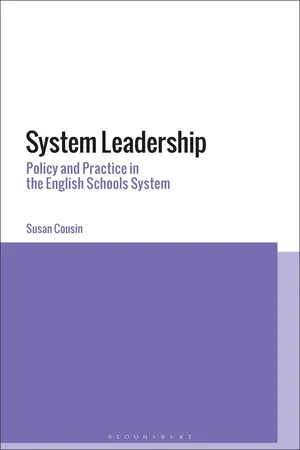
'System leadership' (defined as 'leading beyond a single institution') is a feature of the English education system which has been heralded as both the solution to school improvement and an extension to the school leadership career ladder. However, claims that it evidences a change of governance towards increasing self-regulation of the education system are contested.
Susan Cousin explores the governance and policy perspectives of system leadership. She captures rich narratives over several years from the lived experience of system leaders, headteachers they worked with and those brokering the relationships. The daily realities of the challenges they faced include tensions arising from conflicted governance environments where autonomy coexists with accountability and collaboration with competition. Identifying four types of system leader: the Hero-head, the Auditor, the Protector and the Collaborator, she presents a conceptual model of system leadership practice. A clear explanation of how different approaches affect power relationships, the nature of trust and types of learning, the model can be used to inform decisions made by current and future system leaders, and those who make policy. The book concludes by reaffirming the power of system leadership to deliver educational reform and the need to avoid unintended consequences including the fragmentation of the system and increased inequality.
- 256 pages
- English
- ePUB (mobile friendly)
- Available on iOS & Android
eBook - ePub
About this book
Information
1
System Leaders: Leaders of a Profession, or Instruments of Government?
Introduction
This chapter describes what is meant by system leadership and the global governance environment within which the concept was born and has flourished. It outlines the theoretical contestation around notions of system leadership and explains, in five propositions, the governance approach taken to problematize the concept so as to better understand its nature.
The global governance environment
The Organisation for Economic Co-operation and Development (OECD) was established in 1961 and has a membership of thirty-five countries. Its mission is
to promote policies that will improve the economic and social well-being of people around the world . . . [and] to provide a forum in which governments can work together to share experiences and seek solutions to common problems. We work with governments to understand what drives economic, social and environmental change . . . We analyse and compare data to predict future trends. We set international standards on a wide range of things. (www.OECD .org, 2018)
In 2008, the OECD explained the importance of ‘system leadership’ thus:
In many countries school leaders now have more autonomy, but it is coupled with greater accountability. [School leaders] must not only prepare all their students to participate successfully in the new global economy and society. They must take increasing responsibility for helping to develop other schools, their local communities and other public services. This means that school leaders must become system leaders. (Pont et al., 2008: 3)
The OECD located ‘system leadership’ within the then common narrative of a global governance trend away from hierarchical central control towards self-regulation of a complex adaptive system (Kamarck, 2003; Kooiman, 2003; Ranson, 2003; Pollit and Bouckaert, 2004; PMSU, 2006; Lodge and Kalitowski, 2007; Hopkins, 2009). The rationale was that the growing complexity of the world made governing too difficult for traditional top-down approaches. The literatures mentioned above presented a normative view of governments searching for more effective approaches to public services delivery in response to the external drivers of globalization, new technologies and increasing societal complexity. They suggested a single global movement away from hierarchical command and control towards less bureaucratic, more open, integrated forms of governance, with greater reliance on public engagement and co-production. Such critiques offered a new model of governance suited to the challenges of the postmodern world, which signalled, they claimed, a decline in the power of the state.
This concept of system leadership appears to have achieved a rare and global alignment of government, professional and academic ambitions. The OECD reported ‘significant system leadership activity’ (Pont et al., 2008: 11) in five countries (Australia, Austria, Belgium, England and Finland) and concluded that, although these approaches were at an early stage, significant emerging benefits included ‘the development of leadership capacity; rationalising of resources; increased cooperation; leadership being distributed further into schools and across education systems; improving school outcomes’. Academics offered new models of governance to theorize the trend. Kooiman (2003) summarized the shift as away from hierarchical command and control towards ‘steering’ or ‘shaping’, which was no longer solely the preserve of government but of a wide range of agencies. In Kooiman’s analysis, policy steering in this form is seen as a positive move towards ‘co-production’, indicating a lessening of state power in favour of greater democracy. Peters (2000) suggested such an interpretation may arise from the history in the Netherlands and Scandinavia of a strong tradition of dense networks and working towards a consensus. Ranson (2003) similarly described a governance journey in England from pre-Thatcher1 professionalism of legitimacy via expertise, through reduced professionalism via the new public management (NPM) of the Thatcher and post-Thatcher years, to a ‘new professionalism’ gained by informed and democratic consent. Ranson was more detailed than Kooiman, particularly about NPM and its negative effects on professionals, but his presentation of post-Blair2 reforms is similarly benign.
Leadership literature also claimed that system leadership was ‘a sign of the increasing professionalism with which school leadership is being regarded’ (Hopkins, 2009: 2). After a long history of teaching being treated as a ‘quasi-profession’ (Etzioni, 1969), successful headteachers and their professional associations welcomed system leadership as a legitimate extension of a headteacher’s career ladder, an acknowledgement of their expertise and evidence of a move towards professional self-regulation. Jopling et al. (2006: 1) described new opportunities for headteachers to ‘lead networks and lead the system [and] develop the strategic thinking, moral purpose and wider engagement increasingly identified as core characteristics of system leadership’. Headteachers described participation in these networks as empowering, an antidote to the isolation of the traditional role of headteacher. The Association of School and College Leaders (ASCL), the largest professional association in England for secondary headteachers, predicted that system leadership would ‘become a template for the future of school leadership, with leaders increasingly fulfilling their wider obligations by taking on one or more of these external responsibilities’ (Dunford, 2007: 7).
For policy designers, the use of system leadership offered a new solution to the old challenge of ‘reforming education’, one of the ‘diffuse problems’ subject to implementation issues which often cause policies to fail (May, 2012: 281). As O’Leary and Craig (2007: 8) observed, the emergence of systems policies in the decade after 2000 was partly in recognition that ‘central prescription takes us only so far and decentralised policies don’t take us very far at all’. Policies began to be designed specifically to ‘motivate the expertise and energies of others behind clear outcomes’ (DfES, 2006: 5).
Evaluations of early system leadership activity endorsed this optimism (Hopkins, 2007; Pont et al., 2008; Hargreaves, 2010, 2011). Higham et al. (2009: 10–14) acknowledged that this was contested terrain, with the results of their national survey showing only 11 per cent of the then current system leadership activity in England being professionally driven and the rest government-led. They nevertheless concluded that ‘the portents currently look good’ for a continued shift from national prescription to schools leading reform via system leadership.
So there existed, in 2009, a certain alignment of political, policy, professional and academic views of the world, a perspective which gave birth to system leadership as a potential means to ‘rebalance’ professional and political power. System leadership, it appeared, was a concept whose time had come.
Reconfiguring not relinquishing control
For some commentators, the argument for a single trend from top-down control to the devolution of power to professionals was unconvincingly idealistic, insofar as it assumed rational rather than politically self-interested debate and action. Ranson (2003: 213) presented the potential of public participation adapted to an increasingly complex and differentiated society, describing accountability as close to Durkheim’s ‘dialogic accountability’. Such accounts failed to explore the exclusionary possibilities of ‘one consensus’. Peters (2000: 45) also suggested that they showed ‘too much faith in the self-organising capacities of people’ and questioned the basis for assuming that unguided networks would result in action, without the state as a guiding force.
Several theorists (Rhodes, 1997; Jessop, 1998; Pierre and Peters, 2000) questioned the claim that state power had, in fragmenting, been weakened. They argued, rather, that other forms of control had been intensified and that state control had moved to ‘new sites of action’, but not lessened. Rhodes (1997) described how the freeing of service providers from state control, by marketization in the 1980s and 1990s, brought greater choice but also a fragmentation of service delivery and a proliferation of new forms of control such as frameworks, targets, performance indicators and increased regulation, an argument echoed by Newman (2001).
Stoker (1998: 18) argued that government, while no longer having the power to command by authority, was still able to use ‘new tools and techniques to steer and guide’ to achieve what Rose (1996: 350) called ‘governing at a distance’. However, unlike Kooiman, Stoker interpreted this adaptation of the state’s capacity to direct or influence behaviour not as a relinquishment but a reconfiguration of state power. Peters (2000: 45) described the changes as ‘decentring outwards’, that is, state functions are dispersed through market and quasi-market mechanisms, outsourcing government functions to private sector companies and establishing agencies, Trusts and quangos to act as agents for government. Power is fragmented but control is maintained via strengthened performance and accountability measures, while accountability is shifted to the professionals. The emergence of ‘governance’ is evidence not of the decline of the state but ‘rather of the state’s ability to adapt to external challenges’ (Pierre, 2000: 3).
The broad appeal of the normative narrative no doubt came from yoking together economic and social aims (Miliband, 2003; Pont et al., 2008). However, critical theorists were sceptical of the social democratic strand in the narrative, dismissed by Hall (2003: 3) as a ‘double-shuffle’ between the dominant neo-liberal3 strand and the subordinate social democratic strand, there to appease traditional Labour voters. Ball (2008: 11–12) warned that viewing education as a means of economic competitiveness was leading to a neglect of its social purposes. He argued the combined effects of market forces and managerialism were destroying the ethos of civic service, with consequent increases in inequality. Despite such warnings, the policy field has been dominated by the Global Educational Reform Movement (GERM) which, as Sahlberg (2011: 103) observed, had an explicit intention to align schools and education systems to the ‘operational logic of private corporations’. An emerging globalized education industry offered a range of services, including testing, tutoring, specialized knowledge management, new technologies and professional development (PD). Ball (2012: 112) outlined a complex interaction of networks of public and private interests in the education field: ‘The private sector now occupies a range of roles and relationships within the state and educational state in particular, as sponsors and benefactors, as well as working as contractors, consultants, advisers, researchers, service providers and so on and both sponsoring innovations (by philanthropic actions) and selling policy solutions and services to the state, sometimes in related ways’ (italics in original). So, competing conceptualizations exist of the claimed global governance trend from hierarchies, through marketization, to networks. Since the early 2000s, there has been an increasing focus in governance and policy literature on the role of networks, which, it has been argued (Rhodes, 1997), appear to be displacing both hierarchies and markets as a dominant form of governance. But all three forms continue to coexist. Ball and Junemann (2012: 5) described a ‘shift of balance’, arising from the need to address ‘wicked’ problems typically involving many stakeholders with different values and problems, which have long histories and tangled origins. Network governance, it is claimed, brings new solutions to bear.
Advocates claim that network governance provides a more democratic environment for consensus building, which in turn limits implementation resistance. Peters (2008: 3) described networks as a form of delegation which is not only a means to improve the efficiency of the public sector, but also ‘important for enhancing the democratic element of governing’.
Critics argue that when policy processes become more dispersed and opaque, a democratic deficit is created because powerful interests are privileged in the policy process. Jessop (2011) argued that the state had achieved an enhancement of its capacity to project its influence and secure its objectives by mobilizing knowledge and power resources from influential non-governmental stakeholders. Coffield et al. (2008) claimed that unelected agencies in England, such as non-departmental public bodies (NDPBs), had an increasingly important place in steering policy and in creating a direct link between central government and schools, thereby bypassing locally elected government; they signalled a lessening of democratic governance, rather than a lessening of state control.
Apple (2001: 410) described the myriad of players in the new governance environment as a ‘new alliance and new power bloc’, committed to neo-liberal solutions to educational problems. Members, he suggested, include ‘neo-conservative intellectuals who want a “return” to higher standards and a “common culture”; authoritarian populist religious conservatives who are deeply worried about secularity and the preservation of their own traditions and fractions of the professionally and managerially oriented new middle classes who are committed to the ideology of accountability, measurement and managerialism’. Since 2010, England has been characterized by a rapid intensification of the trend towards multiplication of types of schools and governance structures through the acceleration of the academies programme and the growth of academy ‘chains’, federations and Trusts. There has also been an intensification of public accountability measures. This perspective calls into question Newman’s (2001) analysis of the governance environment as conflicted, by linking apparently contradictory discourses of fragmentation, markets and choice on the one hand and accountability, performance measures and standards on the other, into a mutually reinforcing environment grounded in neo-liberalism. Ball and Junemann (2012: 133) argue, following Jessop, that the new hybrid mix of networks, markets and bureaucracy is fashioned ‘in the shadow of hierarchy’. While the influence of some players is diminished – elected local government, public sector organizations, qualified practitioners and their unions – the power of the state is not. One of the clear advantages for ‘the partnering state’ is that it can change its partners easily – programmes and initiatives can be ended, contracts reassigned, agencies closed: ‘The process of governance through networks is increasingly significant but always contingent’ (134). This impermanence, together with the ambiguous relationships and opaque accountabilities of network governance, make it an unstable means of managing state and society. The resultant instability has been noted as a major inhibitor of sustainable improvement (Robinson, 2012: 191; Cappon, 2015: 54).
Advocates of system leadership welcomed it as an overdue recognition of headteachers’ expertise but Forrester and Gunter (2009: 79) claimed that the English government had used deliberate strategies to seduce headteachers, first, with symbolic capital of national recognition in speeches, honours, higher pay and a training college, and, second, by their promotion as the linchpin of school improvement (which they dismiss as a ‘doxa’). Such positive attention, they warned, ‘can mean that headteachers misrecognise how this deflects attention away from the coercive force of performance audits’. Bangs et al. (2011: 57) also record, from their policy interviews, the government’s ‘determination’ to turn headteachers into its levers for improvement.
In summary, there is a body of literature which contests the claim for a single direction of travel towards state devolution of power, arguing instead that the ‘shift’ in approach from direct to more diffuse control renders a tighter government grip on action which, through a lack of transparency, becomes harder to challenge. This analysis of the implementation of system leadership in the English secondary school system was conducted within precisely this contested environment.
Conceptual approach
The contestation outlined above raises several questions about the theory and practice of system leadership, which this book addresses. Are system leaders leading the education profession towards greater self-governance or operating as the instruments of government in their quest to gain tig...
Table of contents
- Cover
- Half Title
- Dedication
- Also available from Bloomsbury
- Title Page
- Contents
- Acknowledgements
- Glossary
- Introduction
- 1 System Leaders: Leaders of a Profession, or Instruments of Government?
- 2 The Evolution of System Leadership Policy in England
- 3 The System Leaders
- 4 Towards a Model of System Leadership Practice
- 5 Policy Instruments and Intermediaries
- 6 System Leader Training and Development
- 7 Partnerships and Place
- References
- Index
- Copyright Page
Trusted by 375,005 students
Access to over 1.5 million titles for a fair monthly price.
Study more efficiently using our study tools.
Frequently asked questions
Yes, you can cancel anytime from the Subscription tab in your account settings on the Perlego website. Your subscription will stay active until the end of your current billing period. Learn how to cancel your subscription
No, books cannot be downloaded as external files, such as PDFs, for use outside of Perlego. However, you can download books within the Perlego app for offline reading on mobile or tablet. Learn how to download books offline
Perlego offers two plans: Essential and Complete
- Essential is ideal for learners and professionals who enjoy exploring a wide range of subjects. Access the Essential Library with 800,000+ trusted titles and best-sellers across business, personal growth, and the humanities. Includes unlimited reading time and Standard Read Aloud voice.
- Complete: Perfect for advanced learners and researchers needing full, unrestricted access. Unlock 1.5M+ books across hundreds of subjects, including academic and specialized titles. The Complete Plan also includes advanced features like Premium Read Aloud and Research Assistant.
We are an online textbook subscription service, where you can get access to an entire online library for less than the price of a single book per month. With over 1.5 million books across 990+ topics, we’ve got you covered! Learn about our mission
Look out for the read-aloud symbol on your next book to see if you can listen to it. The read-aloud tool reads text aloud for you, highlighting the text as it is being read. You can pause it, speed it up and slow it down. Learn more about Read Aloud
Yes! You can use the Perlego app on both iOS and Android devices to read anytime, anywhere — even offline. Perfect for commutes or when you’re on the go.
Please note we cannot support devices running on iOS 13 and Android 7 or earlier. Learn more about using the app
Please note we cannot support devices running on iOS 13 and Android 7 or earlier. Learn more about using the app
Yes, you can access System Leadership by Susan Cousin in PDF and/or ePUB format, as well as other popular books in Education & Leadership in Education. We have over 1.5 million books available in our catalogue for you to explore.