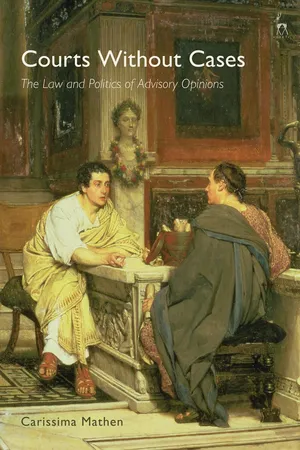
Since 1875, Canadian courts have been permitted to act as advisors alongside their ordinary, adjudicative role. This book offers the first detailed examination of that role from a legal perspective.
When one thinks of courts, it is most often in the context of deciding cases: live disputes involving spirited, adversarial debate between opposing parties. Sometimes, though, a court is granted the power to answer questions in the absence of such disputes through advisory opinions (also called references). These proceedings raise many questions: about the judicial role, about the relationship between courts and those who seek their 'advice', and about the nature of law.
Tracking their use in Canada since the country's Confederation and looking to the experience of other legal systems, the book considers how advisory opinions draw courts into the complex relationship between law and politics.
With attention to key themes such as the separation of powers, federalism, rights and precedent, this book provides an important and timely study of a fascinating phenomenon.
- 304 pages
- English
- ePUB (mobile friendly)
- Available on iOS & Android
eBook - ePub
About this book
Information
1
Courts with Cases
This book is about what it means for a legal system to permit courts to issue advisory opinions. Drawing on the experience of a particular country, Canada, it contrasts advisory opinions with the other function of courts, namely deciding cases. The title of this work, after all, posits the idea of courts ‘without’ cases. That is an intentional reference to the fact that the advisory function quite often is understood to be separate and apart, in some way, from the case-deciding one.
But why would that be so? Why isn’t an advisory opinion just a different kind of case? Or, to put it another way, why aren’t cases and advisory opinions part of some larger category of legal phenomena?
It will become clear in later chapters that the above questions hint at the better view. That is to say, cases and advisory opinions are, indeed, part of a larger whole. In order, though, to see the strength of that conclusion, it is necessary to address the traditional view that advisory opinions and decisions really are different.
This chapter begins by asking how courts are understood – what they generally do. It posits that fundamental to understanding courts is their function of adjudication. The chapter describes that function along with certain assumed defining and limiting features of it. It then suggests that the adjudicative function of courts is linked, at least in part, to the courts’ relationship with other arms of the state. That relationship, the separation of powers, has not only influenced what courts are expected to do, but has also shaped beliefs about what they should not do. Those expectations encourage the idea not just that advisory opinions and cases are distinct, but that the latter alone is an appropriate function for the courts. The remainder of the book will show the limitations of that idea as illustrated by the Canadian example.
What Do Courts Do?
The question of what courts, typically, do is of course difficult to answer in any kind of universal sense. ‘What courts do’ invariably depends on their broader context and surroundings. For example: does a court operate in a unitary or federal state? What legal tradition (for example, common law or civilian) does it follow? Does the underlying legal system have a Constitution? Is that Constitution written, unwritten or a combination of the two? Does the court operate in a hierarchical relationship with other courts, or as a singular body? Does it exercise jurisdiction over more than one country, like the European Court of Human Rights?
It is not possible to investigate court functions across all of those cross-cutting lines. Nor does this chapter argue that there is one set of features that applies to all courts. Instead it draws upon a particular subset of courts, namely those operating in common law systems (though it does acknowledge others). The subset includes most of the United Kingdom,1 the United States, Australia, New Zealand, Ireland and of course Canada. Having said that, a number of the observations below would apply to many other courts in many other systems.
Whatever else courts in those systems do, they are closely identified with the function of adjudication. That is, they resolve disputes between parties. They do so through a formalised process. While the active participation of the parties is not necessarily required it is almost always facilitated: parties are afforded some opportunity to advocate for their interests. The person rendering the judgment is a neutral third party – a judge – who occupies that role in a permanent way and who generally does not engage in other activities. The judge is expected to make the decision in accordance with the law. And the judge is expected to offer reasons showing that consistency. The decisions that emerge from the process just defined are understood as cases.
Adjudication, broadly speaking, is a form of dispute resolution. One of the things that makes it distinctive compared to other models of dispute resolution is its coercive character. The consent of the parties is not required for a court’s judgment to be enforceable. The court’s decision is backed by the power of the state – indeed, as explained further in this chapter, it is appropriate to view the court as an arm of the state.
At least two points bear mentioning. First, this classical understanding of adjudication involves a trial court presided over by a single judge. Of course, in all of the systems being considered, there are other courts; in particular, appellate courts, which exist mainly to review and ‘correct’ lower court decisions and to set out broader legal principles.2 The appellate function involves certain variations from ordinary adjudication – for example, a limited ability to review factual questions. Appeals also tend to involve multi-member panels. Throughout this book, the term ‘case’ nonetheless includes all of the court levels at which that case might be heard before it is considered to be finally resolved.
The second point is that the scope of issues considered appropriate for courts to decide as cases varies greatly even in the smaller subset of common law systems noted above, and such variation only increases once other systems are included. In particular, the ability of courts to adjudicate issues involving other arms of the state – in other words, judicial or constitutional review – depends on a myriad of other factors. Conversely, advisory opinions commonly are sought for issues of constitutional law and most of the topics covered in later chapters are related in some way to constitutional laws and conventions. The idea of a ‘constitutional case’ is hardly universal. Such cases, though, are common in Canada, in many common law systems, and increasingly in other systems as well.
The Power, and Limits, of Cases
All kinds of cases arrive before courts, from the mundane and quotidian to the historic. They include traffic violations, child custody battles, sexual assault trials and constitutional challenges. The adjudicative function, the cases that courts decide, and the parameters under which they decide them, means that courts play an extremely important role in almost every society. Disputes can have high stakes. The parties may be arguing over millions of dollars; the dispute may be a class action involving thousands of people; a person may face life imprisonment. Leaving such cases aside, though, courts are involved in a vast range of disputes that would otherwise be resolved by the parties themselves – and perhaps go unsettled. Almost every society acknowledges that human relations require some sort of regulation by law: to coordinate human interaction for society’s benefit and protection; and to provide a means of non-violent, predictable and fair dispute resolution.
Nonetheless, there are limits to the role of courts. For example, courts are essentially passive with respect to the cases that come before them. Claims must have an essentially legal character. And legal claims must relate to some dispute between persons or entities deemed to occupy an oppositional or adversarial relationship. Further, a court is expected to deliver a remedy that is within the confines of, and enforceable in accordance with, law. A few other rules and elements, like the doctrine of standing, will be touched on in later chapters.
Together, these limits inform, and are informed by, the concept of justiciability. And the idea of justiciability is built into the concept of the ‘case’. To the extent that courts are limited to deciding ‘cases’, then, their ability to intervene in human disputes and, therefore, to invoke the authority of the law to compel a particular outcome, is constrained.
The justiciability doctrine is thought to ensure, at least in part, that courts stay within their ‘proper’ boundaries. (It is therefore linked to the separation of powers, discussed below.) It acknowledges the need to limit ‘the scope of judicial intervention in social, political and economic life’.3 If a court routinely sought out disputes to decide, if it dispensed with any pretence of requiring a legal basis for its pronouncements, if it eschewed the need to stick at least somewhat reasonably close to what other courts have decided in the past – if it did those things often enough, it would cease to function in the way generally thought necessary for it to be a court. As the Canadian scholar Lorne Sossin puts it, the doctrine of justiciability ‘defines the boundaries between our legal and political systems’.4 It is one way that the courts’ otherwise immense power is curtailed, winnowed and made predictable. In the remainder of this section, I will make some brief comments about each of the limitations entailed by the doctrine.
The first element, mentioned above, is that courts are passive. Generally, they do not initiate legal cases.5 They do not scan the landscape, seize upon a particular issue, and then compel people to appear before them to argue it.6 It is possible to imagine a system where courts might behave like that, or at least take a more active role.7 Inquisitorial systems permit a much broader investigatory function for judicial officers.8 In some systems, ordinary courts may refer constitutional issues to separate constitutional courts. But even those courts generally observe limits to their self-initiated participation.
An important reason why courts wait to be asked is that they are expected to maintain neutrality regarding the disputes and parties before them. Courts may well be ‘interested’ in the outcome to the extent that they try to ensure that it is consistent with relevant law or legal principles. Otherwise, courts are assumed and expected to be detached from the proceedings. Such detachment would be challenging for a court to maintain, and almost impossible for others to accept, if the court initiated the proceedings in which it subsequently gave judgment.
It is very hard to imagine a circumstance where it would be thought right for a court to initiate a case in which it would then sit as the decision maker. Overwhelmingly, courts do not do that, even if the society in which they are situated is facing a true crisis and many people are clamouring for them to act.9 The gravity of a particular problem is almost never sufficient justification for the courts to seek to become part of the solution. Courts wait to be asked.10
Not only do courts wait to be asked before they take up a dispute, but they generally follow certain additional preconditions. One such precondition is the second limitation mentioned above: courts are creatures of law. Courts render decisions of a particular, legal character. They intervene only in a disagreement that is, in some way, amenable to the law.
The second limitation is critical to understanding cases. Human disputes are inherently multifaceted, engaging not just legal concepts, but ethical, moral and factual ones. But not all of those are considered apt for judicial intervention. Conflicts over etiquette or manners, in most societies, are regarded as unsuitable subjects for adjudication. One does not seek an injunction prohibiting a fellow congregant from wearing a baseball hat in church, or damages against a stranger for cutting in line at an amusement park. In 2014 a Canadian man named Randy Wall sought judicial review of a decision by the Judicial Committee of the Highwood Congregation of Jehovah’s Witnesses. The Congregation had ‘disfellowshipped’, or excommunicated, him. Wall argued that the decision, which had caused him both personal and professional harm, was procedurally un...
Table of contents
- Cover
- Dedication
- Title Page
- Acknowledgements
- Table of Contents
- Table of Cases
- Introduction
- 1. Courts with Cases
- 2. Apex Courts
- 3. Canadian References
- 4. Separate Functions – Separate Powers
- 5. Arbitrating Federalism
- 6. Rebirth, and Rupture
- 7. Interpretation and Rights
- 8. Institutions
- 9. Actors, Advice and Law
- 10. The Advisory Court
- Conclusion
- Index
- Copyright Page
Trusted by 375,005 students
Access to over 1.5 million titles for a fair monthly price.
Study more efficiently using our study tools.
Frequently asked questions
Yes, you can cancel anytime from the Subscription tab in your account settings on the Perlego website. Your subscription will stay active until the end of your current billing period. Learn how to cancel your subscription
No, books cannot be downloaded as external files, such as PDFs, for use outside of Perlego. However, you can download books within the Perlego app for offline reading on mobile or tablet. Learn how to download books offline
Perlego offers two plans: Essential and Complete
- Essential is ideal for learners and professionals who enjoy exploring a wide range of subjects. Access the Essential Library with 800,000+ trusted titles and best-sellers across business, personal growth, and the humanities. Includes unlimited reading time and Standard Read Aloud voice.
- Complete: Perfect for advanced learners and researchers needing full, unrestricted access. Unlock 1.5M+ books across hundreds of subjects, including academic and specialized titles. The Complete Plan also includes advanced features like Premium Read Aloud and Research Assistant.
We are an online textbook subscription service, where you can get access to an entire online library for less than the price of a single book per month. With over 1.5 million books across 990+ topics, we’ve got you covered! Learn about our mission
Look out for the read-aloud symbol on your next book to see if you can listen to it. The read-aloud tool reads text aloud for you, highlighting the text as it is being read. You can pause it, speed it up and slow it down. Learn more about Read Aloud
Yes! You can use the Perlego app on both iOS and Android devices to read anytime, anywhere — even offline. Perfect for commutes or when you’re on the go.
Please note we cannot support devices running on iOS 13 and Android 7 or earlier. Learn more about using the app
Please note we cannot support devices running on iOS 13 and Android 7 or earlier. Learn more about using the app
Yes, you can access Courts Without Cases by Carissima Mathen in PDF and/or ePUB format, as well as other popular books in Derecho & Derecho público. We have over 1.5 million books available in our catalogue for you to explore.