eBook - ePub
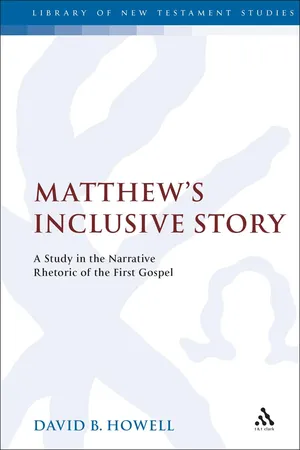
Matthew's Inclusive Story
A Study in the Narrative Rhetoric of the First Gospel
- 292 pages
- English
- ePUB (mobile friendly)
- Available on iOS & Android
eBook - ePub
About this book
Matthew has been described as an 'inclusive story', in which the experiences of the evangelist's post-Easter church are inscribed in the story of Jesus' earthly ministry. This book explores the inclusive nature of the Gospel by means of reader-response literary criticism. Some recent redaction studies of Matthew are reviewed from the perspective of reader-response criticism. Then, in an attempt to understand the interpretative moves readers make, Matthew's story, story-teller and audience are examined.
Information
Chapter 1
INTRODUCTION
A. The Problem
The Gospels can be read and used in a variety of different ways: they can be used as sources for historical information about either Jesus or the communities for which they were written; they can function as the basis for theological propositions or ethical guidelines; they can be read devotionally; or they can serve liturgical purposes in the prayers and worship of the church.1 While Matthew can be read for these purposes, it is not a historical account, a theological tract, a rule of discipline, or a liturgical formulary. The text type of the Gospel is narrative, and it can be read as a story with its own integrity rather than as a collection of traditional units and pericopae.2
Telling a story involves what Robert Tannehill calls ‘narrative rhetoric’ because ‘the story is constructed in order to influence its readers and particular literary techniques are used for this purpose’.1 A narrative world is constructed or projected by the Gospel within which the narrative events occur. It is populated by the story’s characters, structured according to a particular system of values, and the reader is invited to inhabit imaginatively this world. An important part of the narrative rhetoric of Matthew is that the Gospel does not simply tell the past story of Jesus’ life. A recent commentator has labelled the narrative an ‘inclusive story’ because of the double horizon visible in the Gospel.2 On the one hand Matthew operates within a linear-temporal framework that is concerned with the story of the earthly Jesus and his disciples. On the other hand the evangelist appears to address the members of his community throughout the Gospel, telling a story and interpreting discourses for a later audience without exhibiting any apparent concern to establish the sense the story had for earlier audiences.3 The so-called mission discourse in ch. 10 provides us with a clear example of the tension between these two horizons in the Gospel. Instructions which are ostensibly given to the disciples for a pre-Easter mission to Israel also seem directed to the post-Easter Matthean community since they reflect the experiences of the post-Easter mission (10.17ff.). The disciples in the Gospel thus appear as historical persons, companions of the earthly Jesus in one reading, while being transparent for the Matthean community when seen from a different perspective.1
Traditional biblical scholarship has usually discussed these two perspectives in the Gospels on the basis of historical and theological rather than literary categories. The issues are debated in terms of a historical reconstruction of the evangelist’s theology and placed in the historical context of his community.2 In Matthean studies, for example, the theological concept of salvation history has often been used as the interpretive category which attempts to encapsulate the two horizons in the Gospel. Georg Strecker’s thesis emphasizes the historicizing perspective in the Gospel narrative.1 He proposes that the problem of the delay of the parousia was resolved by the evangelist with a salvation history theology in which the time of Jesus is treated as a past epoch. Others such as J.D. Kingsbury emphasize the element of transparency in the narrative by constructing a two-fold scheme of Matthean salvation history theology in which the time of the church is included in the time of Jesus. The disciples are thus representative of Christians in the evangelist’s church, and Matthew is able to assert ‘the unbroken continuity and legitimacy of the tradition of doctrine and practice observed by his own community’.2
In neither interpretation is the historicizing or transparency element in the narrative considered absolute, but the different narrative perspectives are discussed within parameters defined by the reconstructed historical situation of a Christian community and the theology of an evangelist at the end of the first century CE.3 There seems to be an underlying assumption that the message of the Gospel is a set of theological propositions, and that its inclusive nature should be interpreted in static categories which have been mined from the text.4 The issues at stake in the debate can, however, be recast in literary categories which are more sensitive to the movement and dynamism of the story. That is to say, questions about the ‘inclusive’ nature of Matthew’s narrative could be formulated as questions concerning how readers of the gospel are to appropriate and involve themselves in the story and teaching of the Gospel.1 Who is ‘included’ in Matthew’s story and how are they ‘included’? Are literary techniques used which help structure a reader’s response to the story and its message? If so, how do they function?
This book is an attempt, with the help of selected aspects of narrative criticism and a type of reader-response criticism, to describe the narrative rhetoric of Matthew in order to understand better the inclusive nature of the narrative. Our approach to the question of a reader’s response to Matthew will be bifocal: it will examine the narrative structure to be realized and the structured act of realization.2It is hoped that a literary approach to the Gospel rather than the use of a more traditional historical or theological paradigm will provide the critic with a different repertoire of interpretive devices and categories which can shed light both on the mechanisms used by the evangelist to communicate his message and on the ways a reader responds to and appropriates that message when the gospel is read. Since there are no basic facts of reading which are independent of interpretation,1 our description of Matthew’s narrative rhetoric will also develop the thesis that the disciples are not to be equated with the readers included or implied in the story. Discipleship is not membership in a character group but acceptance of the value system espoused by Jesus. Since he embodies these values and virtues in his life, he functions as a model for discipleship in Matthew.
B. Narrative Criticism and the Literary Paradigm
The use of narrative criticism to interpret Matthew involves a shift in critical assumptions and strategies from those used in the prevailing historical critical paradigm of biblical studies. We will thus outline some of the limitations of the historical critical paradigm in providing a theoretical framework for explicating how readers appropriate the Gospel and create meaning in their involvement with the narrative, before going on to delineate the critical presuppositions of our literary paradigm. The designation ‘historical critical paradigm’ is used in an inclusive sense with the awareness that it is dubious to speak of the historical critical paradigm when there is actually a plurality of historical methods.2 W.S. Vorster’s definition of ‘historical paradigm’ as ‘a broad and general term for presuppositions, values, beliefs, techniques and historical methods which are used to provide perspectives on and to manipulate the data of the New Testament and primitive Christianity’ is adequate for our purpose.3 A similar inclusive sense is intended by the use of the term literary or reader-response paradigm, for it too comprehends a variety of different literary methods and presuppositions.
1. Limitations of the Historical Critical Paradigm and the Move to a Literary Paradigm in Gospel Studies
Biblical texts exhibit three closely related and interdependent features: a historical, a structural, and a theological dimension.1 In the synoptic Gospels the historical dimension is twofold. First, it is represented in their reference to past historical events such as the life and crucifixion of Jesus. Second, it is present in the existence of the text as a historical phenomenon with its own history; that is, the Gospels reflect the process of transmission of material as well as the time and communities in which they were written. The structural dimension of the synoptic Gospels refers to the fact that we encounter the Gospels in the form of a specific literary structure. Not only does the text exhibit certain grammatical and semantic features; equally, the various parts of the Gospel are related to each other in the text as a literary whole. Finally, the theological dimension of the Gospels means that the texts contain statements about God and humankind with specific theological and soteriological import.
Traditional historical critical methods used in the interpretation of the Gospels have focused primarily on the historical and theological dimensions of the text. The Gospels are read for the information they contain either about the historical Jesus or about the theology of the evangelist and the historical situation of the community for which he wrote.2 Even when the structural dimension of the Gospels has been examined, as in form criticism for example, the studies have usually been restricted to historical concerns.1 Form critics conceived their task to be the reconstruction of the origin and history of the small units of tradition in the Gospels. Once the originally independent traditional units had been identified, the different forms were related to specific sociological or institutionalized activities of the early Christian communities which transmitted the traditions.2 In this way literary and aesthetic considerations of the Gospels as whole narrative texts were avoided in much traditional historical critical exegesis. Form criticism was concerned with the small units of tradition, and redaction criticism focused on the editorial seams as indicators of an evangelist’s theology.
In recent years, however, some scholars have become dissatisfied with the historical critical paradigm which tended to operate by dissection, cutting up the biblical narrative texts into their smallest component parts. While it is acknowledged that historical critical methods illumine some of the dimensions of the biblical text, certain limitations in providing an overall perspective for understanding narrative texts are also recognized.3 Perhaps the most fundamental limitation in the traditional historical critical paradigm is its disregard for the narrative integrity of the Gospel stories. Because of the historical paradigm’s interest in the development of the Gospel traditions, the tendency is to disintegrate the narrative text as it now stands. Form criticism sought to get behind the Gospels in order to study the transmission of the small units of tradition about Jesus. Literary criticism in this paradigm has become source criticism, as is seen when Klaus Koch writes:
Properly understood, literary criticism can now only be considered as a branch, along with many others, of form criticism. It is that aspect of form criticism which is concerned with the transmission of books, tracing their development right back to their many written sources.1
Redaction criticism may be seen as a movement towards the reintegration of the narrative, but even it is still concerned with the separation of tradition from redaction. The redaction critic is interested in the theology expressed in the finished Gospel, but it is assumed that this can best be found in the editorial activity of the evangelist.2 The effect of focusing on the preliterary parts of the Gospel narrative in the historical critical paradigm, however, has been to dissolve the sense of a narrative whole.1 The traditional historical critical paradigm has not been able to explore adequately the narrative dimension of the Gospels, because it simply has not always appreciated the Gospels as texts with their own integrity. Although the final narrative text may in some ways resemble a mosaic, it was intended to be read as a homogeneous whole.
This tendency of the historical critical paradigm to disintegrate the Gospel narratives can be seen as part of a more general historicist approach to literary texts. Scholars working with the traditional paradigm are concerned with the genesis of a text: with the original author’s meaning and intention, and with the immediate historical and cultural context which called forth the Gospel and in which it received.2 The primary task of the biblical critic thus conceptualized is determining what the text ‘meant’ in the mind of the author and in its reception by its first readers.1 With this approach, however, what one ends up examining in order to understand the Gospel is not the narrative text but something external to the text. George Stroup describes the historical critical modus operandi in biblical studies in the following way:
Understanding the text means looking behind or outside of the text at its development or formation, historical setting, the theological intentions of the author, and at parallels in other religious or cultural traditions.2
The starting point of exegesis is therefore often not the texts as they have actually come down to us but some hypothetical historical situation or hypothetical ‘text’ within the extant document.3
The limitations of a textually disintegrative and historicist approach in the historical critical paradigm resulted in a failure by biblical critics to appreciate the narrative character of the Gospel texts. The Gospels came to be read for the information they contain, and the story simply seemed to be considered as a vehicle for this information...
Table of contents
- Cover
- Title Page
- Dedication
- Copyright
- Contents
- Acknowledgments
- Abbreviations
- Chapter 1. Introduction
- Chapter 2. The Use Of ‘Salvation History In The Interpretation Of Matthew: A Reader-Response Critique
- Chapter 3. Narrative Temporal Ordering, And Emplotment, In Matthew’s Inclusive Story
- Chapter 4. Implied Author, Narrator, And Point Of View In Matthew’s Inclusive Story
- Chapter 5. The Implied Reader In Matthew’s Inclusive Story
- Chapter 6. Conclusion: Jesus As Exemplary For Discipleship
- Selected Bibliography
- Index of Biblical References
- Index of Authors
Trusted by 375,005 students
Access to over 1.5 million titles for a fair monthly price.
Study more efficiently using our study tools.
Frequently asked questions
Yes, you can cancel anytime from the Subscription tab in your account settings on the Perlego website. Your subscription will stay active until the end of your current billing period. Learn how to cancel your subscription
No, books cannot be downloaded as external files, such as PDFs, for use outside of Perlego. However, you can download books within the Perlego app for offline reading on mobile or tablet. Learn how to download books offline
Perlego offers two plans: Essential and Complete
- Essential is ideal for learners and professionals who enjoy exploring a wide range of subjects. Access the Essential Library with 800,000+ trusted titles and best-sellers across business, personal growth, and the humanities. Includes unlimited reading time and Standard Read Aloud voice.
- Complete: Perfect for advanced learners and researchers needing full, unrestricted access. Unlock 1.5M+ books across hundreds of subjects, including academic and specialized titles. The Complete Plan also includes advanced features like Premium Read Aloud and Research Assistant.
We are an online textbook subscription service, where you can get access to an entire online library for less than the price of a single book per month. With over 1.5 million books across 990+ topics, we’ve got you covered! Learn about our mission
Look out for the read-aloud symbol on your next book to see if you can listen to it. The read-aloud tool reads text aloud for you, highlighting the text as it is being read. You can pause it, speed it up and slow it down. Learn more about Read Aloud
Yes! You can use the Perlego app on both iOS and Android devices to read anytime, anywhere — even offline. Perfect for commutes or when you’re on the go.
Please note we cannot support devices running on iOS 13 and Android 7 or earlier. Learn more about using the app
Please note we cannot support devices running on iOS 13 and Android 7 or earlier. Learn more about using the app
Yes, you can access Matthew's Inclusive Story by David B. Howell in PDF and/or ePUB format, as well as other popular books in Theology & Religion & Biblical Studies. We have over 1.5 million books available in our catalogue for you to explore.