This book is available as open access through the Bloomsbury Open Access programme and is available on www.bloomsburycollections.com.
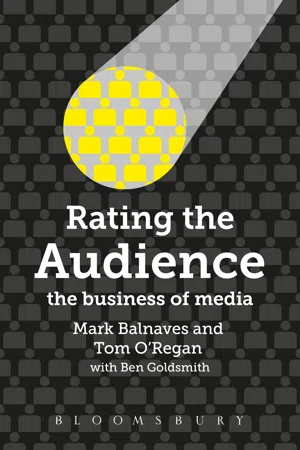
Knowing, measuring and understanding media audiences have become a multi-billion dollar business. But the convention that underpins that business, audience ratings, is in crisis. Rating the Audience is the first book to show why and how audience ratings research became a convention, an agreement, and the first to interrogate the ways that agreement is now under threat.
Taking a historical approach, the book looks at the evolution of audience ratings and the survey industry. It goes on to analyse today's media environment, looking at the role of the internet and the increased difficulties it presents for measuring audiences. The book covers all the major players and controversies, such as Facebook's privacy rulings and Google's alliance with Nielsen.
Offering the first real comparative study, it will be critical for media students and professionals.
- 288 pages
- English
- ePUB (mobile friendly)
- Available on iOS & Android
eBook - ePub
About this book
Information
1 Why the Ratings Are Important
A huge apparatus is called into play.
Leo Bogart (Bogart 2000a: 301)
In this chapter the authors show why the measurement of audiences has become critical in modern society. Audience ratings are the currency by which decisions are made on whether an audience does, in fact, exist and the subsequent media buying and selling that happens as a result. Ratings, though, are also more than this. Like public opinion polls, they have become an established and socially accepted way of representing individuals and groups in markets or in political decisions. In order to gain this acceptance, modern ratings involves a large range of organizations, private and public, that have to agree on the methodologies and knowledge involved. This agreement is the basis of the ratings convention. As the number of media channels has grown, so has the capacity of audience ratings to represent everything, as the standard, come under pressure.
Introduction
Knowledge of audience preferences and behaviour is critical to the operation of contemporary media organizations. Systems of audience measurement, known colloquially as ‘ratings’, influence the timing, placement and markets for media content and advertising. Audience measurement companies emerged in the 1930s to fill this need. Over the years, these companies’ abilities to describe and predict audience behaviour have varied, along with the techniques and technologies developed to measure audiences. While the technology, panels and survey frequency of ratings instruments have become more sophisticated over time, ratings conventions are still beset with the problem of the differential between the actual and the measured audience. Indeed, in the contemporary period, characterized by media fragmentation, niche channels and dispersed audiences, questions have been raised over the adequacy and appropriateness of ratings systems and instruments in measuring audience behaviour, with significant economic cost as a result (Napoli 2003). Investigation into the conventions that govern the relationship between measurement and markets has become more urgent. Rating the Audience provides the first historical study of the overall trajectory of the audience ratings technologies and conventions, the companies providing these ratings and the media organizations using them. The study provides a detailed analysis of the emergence, development and transformation of audience ratings in order to promote better public and media industry understanding of the nature, character, productivity, limits and challenges facing ratings conventions.
The aims of our study are to: (i) establish and interrogate the nature, character and evolution of the audience-ratings conventions used to address the complicated trade-offs between the need for accuracy and the acceptance of ‘imperfections’ (issues often confused in the public mind with the rigging or fixing of ratings by broadcasters); (ii) establish and interrogate the nature, character and evolution of methodologies and technologies used in audience ratings, such as diaries, interviews and peoplemeters; (iii) analyse the consequences of the audience-ratings conventions, in their different forms, for the operations of media audience markets and media content markets, over time; (iv) analyse the consequences of the decline in exposure-based pricing, typically cost-per-thousand (CPM), and alternative pricing structures; (v) analyse the balance between social control and manipulation in audience-ratings conventions and ethical and transparent conduct; and (vi) document the decline in audience participation in audience data collection.
Research on audience exposure technologies has typically been conducted for particular and local purposes, and largely without reference to existing and prior historical research. Audience measurement research is characteristically fragmented both institutionally and methodologically. Records on the development and application of audience research methodologies are also fragmented. Much of the knowledge about both the history and the rationale for selection and use of audience measurement methodologies and technologies is only available through interviews with those who made the selections and archives of media research companies. This book is based in large part on interviews conducted by the authors with historical and contemporary figures from around the world who have contributed to the development of audience ratings.
Audience ratings systems provide an economic foundation for advertiser-supported media. Consequently the audience measurement process affects the structure and behaviour of media companies and regulators alike. When the techniques and technologies of the ratings change, these changes can, as Napoli observes, have ‘a significant effect on the economics of media industries (because these changes can affect advertiser behaviour), the relative economic health of various segments of the media industry, and the nature of the content that media organisations provide’ (Napoli 2003: 65). The authors’ own preliminary research into the ratings convention in Australia (Balnaves and O’Regan 2002; Balnaves and O’Regan 2008) confirms this estimation. These changes are driven by the desire on the part of all participants to the convention to minimize the inevitable gap between the measured audience and the actual audience for a service or programmes. With the advent of a more diverse and fragmented media environment and new methods for segmenting audiences, this gap has become even more evident, leading to challenges to the validity of ratings as currency for buying and selling media. Napoli suggests that changes in technologies and audiences are leading to a decline in the quality and value of the ‘audience product’ – data on who is watching (Napoli 2003). The provision of reliable third-party syndicated and customized audience measurement systems for the production of ratings, however, remains essential to good media management nationally and internationally. As industrialized countries move into a more fragmented and differentiated multichannel broadcasting environment these issues will become more important.
Napoli’s recent analysis has identified the empirical trend for audience and content markets, which historically have been connected, to separate (Napoli 2003: 181). The audience market and ratings have traditionally informed programmers and advertisers on what content to provide and where to target advertising. With the emergence of cable, satellite and internet delivery systems, direct audience payment for content has become more common, with a series of implications for advertiser-supported media (Napoli 2003: 180). In the new media environment, it is technologically possible to gather more information about audiences than ever before, but media and audience fragmentation have made it more expensive for media producers and distributors to find audiences, to discover their viewing or listening preferences and to deliver content across a range of different media.
In order to understand the current situation and its difficulties it is worthwhile thinking about audience ratings development as falling into three major periods:
- ‘The Old Regime’, 1930–50. This was a period in which few media channels existed. Despite their desire to target narrow demographic groups, advertisers and programmers relied in this era on simple audience size as an indicator of audience value. Extensive audience segmentation was not technologically or economically feasible. This was the era of paper diaries and interviews, and the first audience segmentations (A,B,C,D) were focused on the family environment.
- ‘The Transitional Regime’. The period 1950–90 was a time of increased fragmentation of the media system, more television channels, more radio channels, and increas...
Table of contents
- Rating the Audience
- Copyright
- Contents
- List of Figures
- List of Tables
- Preface
- Acknowledgments
- 1 Why the Ratings Are Important
- 2 Convention
- 3 The Panel and the Survey
- 4 The Audit
- 5 The Technologies of Counting
- 6 The Ratings Provider
- 7 Networks and Other Media Providers
- 8 Advertisers and Media Planners
- 9 The Audience
- 10 The Critics
- 11 The Future of Ratings
- Bibliography
- Index
Trusted by 375,005 students
Access to over 1.5 million titles for a fair monthly price.
Study more efficiently using our study tools.
Frequently asked questions
Yes, you can cancel anytime from the Subscription tab in your account settings on the Perlego website. Your subscription will stay active until the end of your current billing period. Learn how to cancel your subscription
No, books cannot be downloaded as external files, such as PDFs, for use outside of Perlego. However, you can download books within the Perlego app for offline reading on mobile or tablet. Learn how to download books offline
Perlego offers two plans: Essential and Complete
- Essential is ideal for learners and professionals who enjoy exploring a wide range of subjects. Access the Essential Library with 800,000+ trusted titles and best-sellers across business, personal growth, and the humanities. Includes unlimited reading time and Standard Read Aloud voice.
- Complete: Perfect for advanced learners and researchers needing full, unrestricted access. Unlock 1.5M+ books across hundreds of subjects, including academic and specialized titles. The Complete Plan also includes advanced features like Premium Read Aloud and Research Assistant.
We are an online textbook subscription service, where you can get access to an entire online library for less than the price of a single book per month. With over 1.5 million books across 990+ topics, we’ve got you covered! Learn about our mission
Look out for the read-aloud symbol on your next book to see if you can listen to it. The read-aloud tool reads text aloud for you, highlighting the text as it is being read. You can pause it, speed it up and slow it down. Learn more about Read Aloud
Yes! You can use the Perlego app on both iOS and Android devices to read anytime, anywhere — even offline. Perfect for commutes or when you’re on the go.
Please note we cannot support devices running on iOS 13 and Android 7 or earlier. Learn more about using the app
Please note we cannot support devices running on iOS 13 and Android 7 or earlier. Learn more about using the app
Yes, you can access Rating the Audience by Mark Balnaves,Tom O'Regan,Ben Goldsmith in PDF and/or ePUB format, as well as other popular books in Social Sciences & Media & Communications Industry. We have over 1.5 million books available in our catalogue for you to explore.