This book traces the history of television journalism in Britain from its austere roots in the BBC's post-war monopoly to the present-day plethora of 24 hour channels and celebrity presenters. It asks why a medium whose thirst for pictures, personalities and drama makes it, some believe, intrinsically unsuitable for serious journalism should remain in the internet age the most influential purveyor of news.
Barnett compares the two very different trajectories of television journalism in Britain and the US, arguing that from the outset a rigorous statutory and regulatory framework rooted in a belief about the democratic value of the medium created and sustained a culture of serious, responsible, accurate and interrogative journalism in British television. The book's overarching thesis is that, despite a very different set of historical, regulatory and institutional practices, there is a very real danger that Britain is now heading down the same road as America.
eBook - ePub
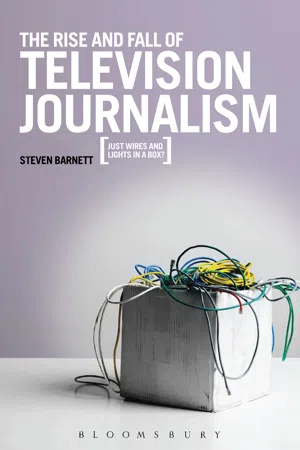
The Rise and Fall of Television Journalism
Just Wires and Lights in a Box?
- 304 pages
- English
- ePUB (mobile friendly)
- Available on iOS & Android
eBook - ePub
About this book
Information
1 Laying the Foundations: Policies, Practices and a Public Monopoly
The early political context for broadcast journalism
The arrival of television in Britain, formally inaugurated by the BBC on 2 November 1936 and covering only the London area, was barely noticed. Sir John Reith, the BBC’s ‘founding father’ himself, regarded it as an unnecessary distraction from the real business of radio, and was anyway becoming engulfed – as was the rest of the country – in the rumours of impending constitutional crisis surrounding the King’s relationship with Mrs Wallace, which culminated in his abdication the following month. Those who had been raised on the disciplines and practice of radio broadcasting were both unschooled in the practice of translating entertainment or information into vision and, more importantly, highly distrustful of the medium. For those who ran the BBC, radio was conducive to the thoughtful and the serious; television was only good for pantomime. In the words of Grace Wyndham Goldie, who was to become one of the great pioneers of early BBC television journalism, ‘they associated vision with the movies and the music hall and were afraid that the high purposes of the Corporation would be trivialised by the influence of those concerned with what could be transmitted in visual terms’.1 The thesis which Neil Postman came to personify in the 1980s was pre-empted by a good 50 years, even before television had entered most people’s consciousness.
As Wyndham Goldie also pointed out, however, BBC television’s journalistic legacy from radio was fundamentally important because it inherited ‘two essential freedoms, achieved by few other television services as they developed around the world’:2 freedom from government intervention (although only the most ardent purist would say there was no government influence); and freedom from influence by commercial interests. Both these freedoms were not just the cornerstone for television journalism on the BBC but for the commercial television service that followed.
This legacy, while partly down to the tenacity of Reith and his determination to keep the meddlesome hands of politicians away from any direct interference, was also attributable to the committees which had been set up during the 1920s and 1930s to make recommendations for the future of broadcasting. This was no accident: these committees reflected the mood of the moment and the psyche of a nation that was not naturally inclined to hand over institutional control of a major organ of public influence to the State but was also somewhat distrustful of the wholly commercialized, commodified approach that personified American radio. The Sykes Committee was set up by the Post Office in 1923 to solve the funding problem of the British Broadcasting Company in the wake of widespread evasion of the tax on wireless sets, but understood clearly that ‘broadcasting holds social and political possibilities as great as any technical attainment of our generation’. It therefore concluded – in words which would have resonated throughout Western Europe – that ‘the control of such a potential power over the public opinion and the life of the nation ought to remain within the State and the operation of so important a national service ought not to be allowed to become an unrestricted commercial monopoly’.3
However, Sykes was also quick to point out the distinction of control remaining ‘within the State’ rather than broadcasting being managed by the State, which it firmly opposed. The reasons were twofold, and not only confined to fear of government censorship; there was a secondary concern simply about making news too boring: ‘If a Government Department had to select the news, speeches, lectures, etc. to be broadcast, it would be constantly open to suspicion that it was using its unique opportunities to advance the interests of the political party in power; and, in the endeavour to avoid anything in the slightest degree controversial, it would probably succeed in making its service intolerably dull.’4
Ironically, concern about the impact of State intervention on news was superfluous given that discretion for news broadcasting on radio had been entirely circumscribed by the newspaper owners’ terror of losing newspaper sales. The BBC was only allowed to broadcast news from ‘certain approved News Agencies’ and even then not until 7 p.m. so as not to interfere with the sale of evening newspapers – a restriction justified by Sykes on the grounds that newspapers spend heavily on news collection and distribution, and ‘urge with justice that it would not be in the public interest that the broadcasting system ... should be allowed to publish news otherwise than from authoritative and responsible sources of information’.5 In 1923, then, the nascent radio service was not trusted to treat news with the same respect for journalistic values as those virtuously embodied by an authoritative press.
Less than three years later, the Crawford Committee reported its conclusions on what should happen when the British Broadcasting Company’s licence to broadcast expired at the end of 1926. Crawford, like Sykes, rejected a Staterun institution in favour of a new corporation whose ‘status and duties should correspond with those of a public service’. Crawford, however, seemed to move towards a greater flexibility about the BBC and news. The new organization should not be providing material ‘as it pleases’, said the committee, but then added – with what might be interpreted as astonishing foresight – that newspapers will adapt ‘perhaps depending more upon narrative and criticism than upon the mere schedule of facts’. Moreover, it said, broadcasting could even have a promotional impact, heightening interest in news and therefore improving circulation figures.6 And while it was tentative on the subject of whether ‘controversial matter’ could be safely entrusted to the new Corporation, on balance it was prepared to accept that ‘if the material be of high quality, not too lengthy or insistent, and distributed with scrupulous fairness, licensees will desire a moderate amount of controversy’.7
The first test of independent journalism – the general strike
In fact, even before its inauguration as a public body, the BBC had an opportunity both to engage in unfettered news dissemination and to test political commitment to the principle of independence. On 3 May 1926, the unions called a general strike in support of the coal miners. Not only did this pitch workers against the government in a major political confrontation, it also took newspapers off the street because of the involvement of the print unions. Apart from the government-sponsored British Gazette – printed in Paris, flown to Britain daily and known to be essentially a government propaganda tool – the only source of news for a nation on the brink of industrial paralysis was the wireless and the BBC. Reith asked for and was given authority from the postmaster general to broadcast news at any time, and instituted bulletins every three hours from ten in the morning using material from Reuters. It was a difficult balancing act, given that influential cabinet voices – including the Chancellor of the Exchequer Winston Churchill – were arguing vociferously that the government should use its emergency powers to commandeer the BBC. Asa Briggs draws a distinction between the ‘constitutional’ position of the BBC – the government had legal authority to take it over – and the ‘diplomatic’ position held by a majority in the cabinet that ‘it would be wiser to leave the BBC a measure of independence or at least of “semi-independence”’.8
In order to dissuade the Prime Minister from a wholesale takeover, Reith decided to commit his argument to paper. Two days into the strike, on 5 May, Reith penned what his biographer overenthusiastically called ‘a classic statement of the case for broadcasting to be independent of government’:
The BBC has secured and holds the goodwill and affection of the people. It has been trusted to do the right thing at all times. Its influence is widespread. It is a national institution and a national asset ... This is not a time for dope, even if the people could be doped. The hostile would be made more hostile from resentment. As to suppression, from the panic of ignorance comes far greater danger than from the knowledge of facts.9
It was, in fact, a rationale which owed more to political survival than any grand vision of democratic intent: a source of information which was neither run by the government nor identified with it – but which behind the scenes had close links to it – was just what Prime Minister Baldwin and the like-minded members of his cabinet wanted. Thus, BBC coverage of the general strike was the first example of engagement in the delicate realpolitik of an independence that has always been conscious of – and sometimes constrained by – the BBC’s relationship with the State. This has not, as we shall see, prejudiced its ability to conduct vigorous and independent journalism that can deeply antagonize governments, but it has – at some times more than others – involved an awareness of the political environment that can spill over into undue caution and voluntary self-censorship. As the BBC evolved into a self-sufficient journalistic institution – and as its values and constitution increasingly served as a model for other countries searching for a viable compromise between market and State in the evolution of broadcasting – this notion of ‘constrained independence’ is perhaps a more useful concept than Briggs’ description of ‘semi-independence’.
Since it had no journalistic resources of its own, the BBC took its news of the strike from two sources: the Admiralty office of the Deputy Chief Civil Commissioner, who acted as the link between government and Reith during the strike, and Reuters. According to Briggs, ‘One or two BBC employees actually went out collecting news,’ but bulletins were essentially rewritten second-hand affairs which tried to encapsulate the essence of what was happening around the country. Reith was keen to impress on listeners the BBC’s sense of its own responsibility, himself telling listeners in the 10 o’clock bulletin of 4 May: ‘The BBC fully realizes the gravity of its responsibility to all sections of the public, and will do its best to discharge it in the most impartial spirit that circumstances permit ... We would ask the public to take as serious a view as we do ourselves of the necessity of plain objective news being audible to everybody.’ The limits to that impartiality were manifested in examples of inaccurate reporting that have an uncanny echo of complaints made against television broadcasters in Britain during the bitter miners’ strike of 1986: accounts of engine drivers and firemen returning to work in Oxford, for example, or the strike breaking down in Salisbury.10
It is therefore fair to conclude with Briggs that ‘BBC news assisted the government against the strikers’ not through blatant propaganda but, first, through selective presentation of news reporting and, second, through its ability to dispel any ugly rumours which might have fanned the flames of revolution (e.g. stories about the murder of police officers or riots at Hyde Park Corner). Some accused the BBC of producing news bulletins which were ‘doped’ and called it the BFC – the British Falsehood Corporation. It was not the last time the acronym was to be parodied in accusations of deliberate bias. In response to these general observations of partiality, Reith acknowledged openly in the Radio Times that the BBC had lacked ‘complete liberty of action’ during the strike but did not believe that any government ‘would have allowed the broadcasting authority under its control greater freedom than was enjoyed by the BBC during the crisis’.11 Given the nascent condition of broadcasting, he was certainly right. This was an organization searching for a new journalistic culture within the constraints of what was deemed acceptable by an establishment used to controlling information in a crisis. The BBC, in Briggs’s words, ‘reinforced authority’ in a way which it found very hard to shake off – arguably even until the arrival of a new era and an iconoclastic director general in the 1960s.
But Reith had achieved two things for the future of broadcast journalism, with repercussions that arguably extended well beyond the confines of the United Kingdom as the BBC’s influence began to be felt internationally. First, he had ensured that the then very vulnerable concept of ‘impartiality’ – however compromised it had been in practice – had at least not been uprooted and cast aside; it remained a legitimate aspiration for the broadcast medium (albeit currently limited to radio) and for broadcasting institutions. Second, he had ensured that broadcasting was now recognized as a potent force in national life. When it came to the BBC’s next test of journalistic integrity, in the run-up to the Second World War, the second of those was rather more visible than the first.
‘Constrained independence’ consolidated
In the meantime, BBC progress towards a self-sufficient independent journalism moved slowly against the joint suspicions of government and press. With the beginning of the new corporation in 1927, the BBC was given permission not only to subscribe to news agencies but to undertake its own reporting. A year later, in March 1928, the ban on reporting matters of controversy was withdrawn on an experimental basis in the light of the ‘loyal and punctilious manner’ in which the BBC had conformed to its obligations.12 This gradual loosening of the apron strings was assisted by the new constitutional system that established a ten-year Royal Charter and independent ‘governors’, thus ensuring that the new British Broadcasting Corporation was dominated neither by the commercial marketplace nor by the State. As Reith wrote in the first BBC Handbook: ‘The Royal Academy and the Bank of England function under Royal Charter. So does the BBC. It is no Department of State’.13 Reith’s cautious approach to controversy had not only paid dividends in terms of a secure future for the corporation; it had also established important ground-rules for a journalistic independence which made overt government interference quite awkward. The ‘experiment’ on covering controversy continued over the next 12 years, during which time it was understood (and explicitly stated in Parliament) that it was up to the independent BBC Governors to monitor and interpret the relevant material.14
Lack of direct intervention did not, however, mean lack of accommodation at sensitive times. The time limit on its Royal Charter meant that, as each ten-year expiry date neared, the BBC was subject to government review. An early example of the potential impact on BBC journalism of these delicate negotiations came in 1935, when the BBC Governors approved a proposal to broadcast talks from a renowned communist, Harry Pollitt, and a renowned fascist, Sir Oswald Mosley. The government disapproved and, while not prepared to intervene directly, did indicate that the strategy was unwise given the Charter’s imminent expiry at the end of 1936. In the event, Pollitt and Mosley were discreetly dropped without any public suggestion of interference, and the BBC retained its reputation for independence. This sensitivity to negotiations around Charter renewal presaged similar examples of journalistic caution in the decades to come. As Seaton says: ‘This cautious self-protection was shrewd, and may have been the only strategy available. However, it made the BBC vulnerable to bullying ... the most important constraint came to be the Corporation’s anxiety to pre-empt the threats.’15 This sensitivity of a publicly funded broadcaster to government thinking – which later became more memorably known as the ‘pre-emptive cringe’ – again resonated in other countries seeking to emulate the BBC model.
In the event, the 1936 Ullswater Report into the BBC’s future was an almost unconditional endorsement of the BBC’s achievements. No doubt aware of the propaganda techniques already being employed in Italy and Germany, it reiterated the need to safeguard a powerful medium of political expression. But it went further than its predecessors by arguing for more freedom in the broadcasting of news and for a ‘strong and impartial editorial staff’. ...
Table of contents
- The Rise and Fall of Television Journalism
- Copyright
- Dedication
- Contents
- Preface
- Introduction: The Argument
- 1 Laying the Foundations: Policies, Practices and a Public Monopoly
- 2 Competition and Commercialism: The Early Days
- 3 Competition, Commercialism and the ‘Golden Age’
- 4 ‘Real Lives’ v ‘Death on the Rock’: Journalism, Terrorism and Accountability
- 5 The Propaganda Model and the 1990 Broadcasting Act
- 6 Competition and Commercialism into the Twenty-first Century
- 7 Tabloidization
- 8 The BBC and the Aftermath of Hutton
- 9 Television Journalism, the Market and the Future
- 10 24-hour News Channels and the ‘New’ Television Journalism
- 11 Television Journalism and Impartiality
- Conclusions
- Appendix 1: Methodology for News Study
- Appendix 2: Detailed Breakdown of Story Types on UK News Bulletins 1975–99
- Notes
- Index
Trusted by 375,005 students
Access to over 1.5 million titles for a fair monthly price.
Study more efficiently using our study tools.
Frequently asked questions
Yes, you can cancel anytime from the Subscription tab in your account settings on the Perlego website. Your subscription will stay active until the end of your current billing period. Learn how to cancel your subscription
No, books cannot be downloaded as external files, such as PDFs, for use outside of Perlego. However, you can download books within the Perlego app for offline reading on mobile or tablet. Learn how to download books offline
Perlego offers two plans: Essential and Complete
- Essential is ideal for learners and professionals who enjoy exploring a wide range of subjects. Access the Essential Library with 800,000+ trusted titles and best-sellers across business, personal growth, and the humanities. Includes unlimited reading time and Standard Read Aloud voice.
- Complete: Perfect for advanced learners and researchers needing full, unrestricted access. Unlock 1.5M+ books across hundreds of subjects, including academic and specialized titles. The Complete Plan also includes advanced features like Premium Read Aloud and Research Assistant.
We are an online textbook subscription service, where you can get access to an entire online library for less than the price of a single book per month. With over 1.5 million books across 990+ topics, we’ve got you covered! Learn about our mission
Look out for the read-aloud symbol on your next book to see if you can listen to it. The read-aloud tool reads text aloud for you, highlighting the text as it is being read. You can pause it, speed it up and slow it down. Learn more about Read Aloud
Yes! You can use the Perlego app on both iOS and Android devices to read anytime, anywhere — even offline. Perfect for commutes or when you’re on the go.
Please note we cannot support devices running on iOS 13 and Android 7 or earlier. Learn more about using the app
Please note we cannot support devices running on iOS 13 and Android 7 or earlier. Learn more about using the app
Yes, you can access The Rise and Fall of Television Journalism by Steven Barnett in PDF and/or ePUB format, as well as other popular books in Social Sciences & Media & Communications Industry. We have over 1.5 million books available in our catalogue for you to explore.