eBook - PDF
Slaves of the Shah
New Elites of Safavid Iran
- 257 pages
- English
- PDF
- Available on iOS & Android
eBook - PDF
Slaves of the Shah
New Elites of Safavid Iran
About this book
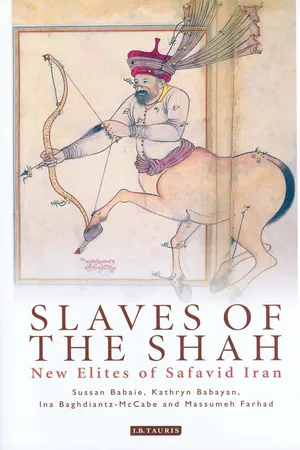
The Savafid dynasty represented, in political, cultural and economic terms the pinnacle of Iran's power and influence in its early modern history. The evidence for this -the creation of a nation state, military expansion and success, economic dynamism and the exquisite art and architecture of the period - is well-known. What is less understood is the extent to which the Safavid success depended on - and was a product of - a class of elite originating from outside Iran: the slaves of Caucasian descent and the Armenian merchants of New Julfa in the city of Isfahan. It was these groups, bolstered by Shah Abbas the Great (1589 – 1629) and his successors, who became the pillars of Safavid political, economic and cultural life. This book describes how these elites, following their conversion to Islam, helped to form a new language of Savafid absolutism. It documents their contributions, financed by the Armenian trade in Safavid silk, to the transformation of Isfahan's urban, artistic and social landscape. The insights provided here into the multi-faceted roles of the Safavid royal household offer an original and comprehensive study of slave elites in imperial systems common to the political economies of the Malmuk, Ottoman and Safavid courts as well as contributing to the earlier Abbasid, Ghaznavid and Saljuq eras. As such this book makes an original and important contribution to our understanding of the history of the Islamic world from the 16th to the 18th centuries and will prove invaluable for students and scholars of the period.
Information
Table of contents
- Cover
- Contents
- Illustrations
- Acknowledgements
- Notes on Transliteration and Usage
- 1. Slaves of the Shah
- 2. The Safavid Household Reconfigured: Concubines, Eunuchs and Military Slaves
- 3. Armenian Merchants and Slaves: Financing the Safavid Treasury
- 4. Launching from Isfahan: Slaves and the Construction of the Empire
- Plate Section
- 5. Military Slaves in the Provinces: Collecting and Shaping the Arts
- Appendix
- Notes on the Text
- Bibliography
- Index
Trusted by 375,005 students
Access to over 1.5 million titles for a fair monthly price.
Study more efficiently using our study tools.
Frequently asked questions
Yes, you can cancel anytime from the Subscription tab in your account settings on the Perlego website. Your subscription will stay active until the end of your current billing period. Learn how to cancel your subscription
No, books cannot be downloaded as external files, such as PDFs, for use outside of Perlego. However, you can download books within the Perlego app for offline reading on mobile or tablet. Learn how to download books offline
Perlego offers two plans: Essential and Complete
- Essential is ideal for learners and professionals who enjoy exploring a wide range of subjects. Access the Essential Library with 800,000+ trusted titles and best-sellers across business, personal growth, and the humanities. Includes unlimited reading time and Standard Read Aloud voice.
- Complete: Perfect for advanced learners and researchers needing full, unrestricted access. Unlock 1.5M+ books across hundreds of subjects, including academic and specialized titles. The Complete Plan also includes advanced features like Premium Read Aloud and Research Assistant.
We are an online textbook subscription service, where you can get access to an entire online library for less than the price of a single book per month. With over 1.5 million books across 990+ topics, we’ve got you covered! Learn about our mission
Look out for the read-aloud symbol on your next book to see if you can listen to it. The read-aloud tool reads text aloud for you, highlighting the text as it is being read. You can pause it, speed it up and slow it down. Learn more about Read Aloud
Yes! You can use the Perlego app on both iOS and Android devices to read anytime, anywhere — even offline. Perfect for commutes or when you’re on the go.
Please note we cannot support devices running on iOS 13 and Android 7 or earlier. Learn more about using the app
Please note we cannot support devices running on iOS 13 and Android 7 or earlier. Learn more about using the app
Yes, you can access Slaves of the Shah by Sussan Babaie,Kathryn Babayan,Ina Baghdiantz-MacCabe,Mussumeh Farhad in PDF and/or ePUB format, as well as other popular books in History & Middle Eastern History. We have over 1.5 million books available in our catalogue for you to explore.