- 584 pages
- English
- ePUB (mobile friendly)
- Available on iOS & Android
eBook - ePub
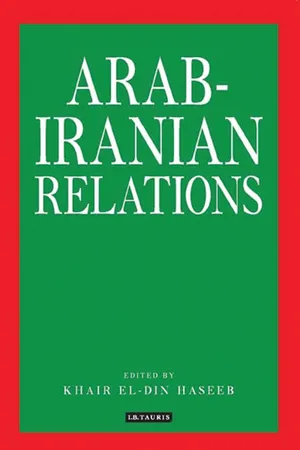
Arab-Iranian Relations
About this book
Regionally-based Arabs and Iranian scholars here explore the preoccupation of the economic, political, educational and strategist present of Arab-Iranian relationships in the context of the historical and cultural past. The issues covered include: historical ties and the current state of mutual awareness between Arabs and Iranians; the impact of the political and journalistic rhetoric of each side on their relationships; the image of Arabs and Iranians in each others' schoolbooks; economic ties and the prospects for their future development; the status of Arab and Iranian women; border and territorial disputes between Arab states and Iran; the position of Arab states and Iran on the Kurdish question; the Palestine question in Arab-Iranian relations; a comparative study of civil society in Iran and in Arab countries; and Arab-Iranian ties in the context of international relations.
Information
One
Historical Ties between Arabs and Iranians
1
Arab–Iranian Relations: Historical Background
In order to achieve a better future for Arab–Iranian relations, there must be a better understanding of them. In turning to history, the aim of this chapter is to understand the present through a study of the past. History is the actions of men in a specific terrain at specific times. This means looking carefully at the nature of that terrain, that is the geography of Iran and neighbouring Arab countries. For geography has an impact. The Iranian plateau with its mountainous western edge, and then the Tigro-Euphrates Valley, with its fertile plains and ample waters, are followed by steppes and deserts. The Iranians, then, stand between the highlands, the forbidding mountains and the open plains. Their relations, however, were not confined to the Tigro-Euphrates Valley, but included the Gulf area overlooked by the Iranian highland. This geographic contiguity implies political, civilizational and normal human contact, or possibly collision and conquest. States that emerged in the Iranian highland frequently invaded the rich plains. This happened with the Achamenids, Parthians and Sassanians before Islam, the Buwayhids, Seljuks, Mongols and Safavids after Islam.
States also emerged in the Tigro-Euphrates Valley, such as Assyria, and turned eastwards to prevent attacks on their territories or to expand their power, but they did not advance beyond Iran’s west or northwest. As for the powers that invaded Iran, they came from beyond neighbouring countries; for example, the invasion by Alexander of Macedonia. The geographic situation also influences the human. Most inhabitants of the Tigro-Euphrates Valley are from the Arabian Peninsula. Human waves from the peninsula followed natural population increases in a desert environment with few resources, prompting movement to the northeast and northwest. Pre-Islamic migrations from the peninsula entered neighbouring plains but not the mountains; this confirms the migratory patterns that followed the victory of Islam. The mountains remained the eastern limit of Arab movement. The inhabitants of the Iranian highland, on the other hand, came from other peoples to the east or northeast.
The mountains thus became a divider between Arab and Aryan peoples. This geographic and human situation led to the formation of two distinctive cultures/civilizations, each with its own language – Pahlavi in Iran and Arabic in the Tigro-Euphrates Valley and Peninsula. But these cultures were not isolated. Though relatively limited, commercial and cultural ties existed through the ages; but with the arrival of Islam, the impact became wide-scale. Before Islam, there were general direct ties between Iran, the Tigro-Euphrates Valley and the Gulf area. In the Sassanian period, Persia expanded into Iraq and the eastern section (East Khabur) of Mesopotamia. Sassanian suzerainty extended at times to the west of the Gulf and certain shores of Oman. Against this, bedouin pressures on the Tigro-Euphrates Valley, whether in the form of migration or invasion, were continuous; hence the establishment of the kingdom of al-Hirah. While the Lakhmids felt a kinship with the Arabian tribes of the Peninsula, the Persians wanted them as a buffer to these tribes.
The penetration of Arab tribes was limited to Iraq and Mesopotamia. Beyond this, occasional forays would be made at the fringes of the Tigro-Euphrates Valley and, rarely, on the east coast of the Gulf. As for the spread of Iranians into Iraq, it was relatively limited and assumed the form of military garrisons, administrators and landowners; there was no settlement process of any great consequence. In the last third of the 6th century CE, the Persians extended their hegemony to Yemen, following the call by a Yemeni chieftain for their aid in expelling the Abyssinians.
Perhaps the cultural/civilizational ties were wider. Cuneiform characters, and then Aramaic, along with many civilizational terms, entered Pahlavi. A study of influences may also reveal the impact of the ancient civilizations of Iraq. Iran in its turn had a role in the religious formation of the area as Zoroastrianism spread to a limited degree in Iraq (and Mesopotamia), the Gulf and perhaps in other directions. But Manichaeism started from Iraq, and continued to have an impact even after the conquests of Islam. Mazdakism may also have had roots there.
The Islamic conquests changed the political situation in a fundamental way and had a profound impact on the state of civilization. The conquest overthrew the Sassanian state and eliminated the class system and hegemony of Zoroastrianism. Arab tribal groups then came, particularly from Kufa and Basra, to Iran’s administrative centres (such as Isfahan, Merv, and Balkh), initially as military garrisons. However, they did not spread to rural areas, and their numbers were generally small compared to Arab extensions elsewhere. Relations were affected, during the first two centuries, by the attitude to Islam. Non-Muslims remained dhimmis, free to have their own rights, laws and religious freedom, against the payment of jizyah and kharaj taxes.
Islam spread by its merit and openness, with hardly any effort from official institutions. The role of sects and opposition groups was important here. The invasion occurred at a time when the Zoroastrian religion was losing the backing of the state, and other Mazdean religions, such as Manichaeism and Mazdakism, found a freedom and clemency they had never known before. We have no record of an increase in taxes in Iran. But there are indications of manipulations by tax collectors, mostly local notables, in the amounts collected, as well as occasional dubious dealings. As for non-Arabs who embraced Islam, presumably what applied to the Muslims in rights and obligations applied to them as well. They became known as the mawali. The term mawla did not involve a clearly defined social status, but rather, in a society based on tribes and clans, meant ‘ally’. Affiliation gave the new Muslim a place in the social structure, but not full social equality.
The mawali were not a homogeneous group. Some became the kuttab (‘secretaries’) and then viziers, some jurists and ‘ulema (religious scholars) – positions of very high standing; others were merchants who had a major impact on social life. Craftsmen and peasants were also from among the mawali, and were looked down upon. Thus, to discuss the mawali as though they were a single social group is very risky and a gross oversimplification. It appears that the tribal perspective was the first factor in classifying or demeaning non-Arabs, discouraging their enrolment in the Islamic forces or giving them salaries and provisions, in marked contrast to the Islamic perspective. The differences between the two perspectives, tribal and Islamic, had a role in public life; time and developments tended to favour the Islamic perspective.
There are indications that the jizyah was imposed, during the time of the Marwanids, on new converts to Islam. This included some Iranian areas, creating a stir between Muslims, until abrogated by Omar bin Abdel Aziz, only to appear again, and then finally to end in the last years of Hisham bin Abdel Malik. As for the fighting forces, recent research suggests that there were non-Arab garrisons in Syria and Transoxiana, deriving from necessity, whereas from the days of Abdel Malik, Arab fighting forces were being limited. Complete equality in the administration, army, pay and financial obligations needed time to materialize, and their realization moved in line with the gradual preponderance of Islamic precepts in public life.
During the Umayyad period, a large-scale translation took place to Arabize financial registers (diwans) in the eastern provinces. The process took half a century to complete, thus enriching Arabic and rendering it the language of administration as well as of culture. Also during this period, the foundations of Islamic and Arabic fields of knowledge were laid down, and the contribution of non-Arabs to them, especially the Persians, began. There were also widespread contacts in new Arab centres, such as Basra and Kufa, including extensive intermarriages between Arabs and mawali – an aspect that has not received the attention it deserves. The extent of wala’ (mawali) had a considerable bearing on intellectual and social contact by the Iranians with the Arabs, In Iran, especially Khurasan, Arab mixing with the indigenous peoples was conspicuous. They were affected by the local customs and dress to the point where they at times were indistinguishable. There was also close cooperation between Persian noblemen (dihqans and marzbans) and the Arabs, but tensions were encountered with the spread of Islam and social development.
Khurasan (and some parts of Iran) became fertile ground for the Abbasid movement that advocated the application of the Book and the sunnah and the realization of equality and justice. But the Abbasid movement was not the first to call for these; it was preceded by other movements in the name of Islam’s tenets. Non-Arabs did not have parties or associations of their own. The Islamic parties, such as the Kharijite, Shiite and Marj’ite, were initiated by the Arabs, then joined by the mawali. These also joined the Abbasid movement and participated in some revolts, including the Abbasid, alongside the Arabs.
One can regard the advent of the Abbasids as the start of a new phase. The first Abbasid period (132–218 AH) was an age of much cooperation between Arabs and Persians. Arab–Iranian relations took on a new form. Persians shared in the government, administration and the army; tribal forces were cancelled; and they were replaced by a standing army of Arabs and Persians. A new capital was established (Baghdad), symbolizing the new image of the state. Its population included Arabs and others; its quarters and suburbs were inhabited by persons of the same origin or profession, and some quarters were for groups from Iranian lands. The cooperation of Persian notables with the Arabs continued, and Khurasan was the Iranian province most closely connected with the Abbasids. It was during this period that the institution of kuttab (secretaries) became prominent, with considerable impact on administration and culture. Some Iranian families entered public life (the Barmakids, the Banu Sahl, and Banu Tahir) and played a prominent role therein. Khurasan was the cause of al-Ma’mun’s victory over his brother al-Amin and his attaining the caliphate by force. Most of al-Ma’mun’s forces were Iranians from Khurasan.
But this widespread cooperation did not last. There was the problem of the relationship between caliph and the vizier, and the palace coalitions that emerged. There was also the adverse impact of the Khurasanite invasion of Baghdad, in addition to the civil strife, which weakened the caliph’s army. This led to the introducing of mercenaries/Turks into the army and to far-reaching changes in the centre of power, the most serious being the weakening of the caliphate.
It was in the first Abbasid period that revolts occurred in Iran for the first time. Perhaps the Abbasid movement provoked a certain awareness and stirred certain hopes in Iran. One notes that these revolts broke out among the common people and took on a religious character, goaded on by followers of Mazdeanism (Zoroaster, Mazdak), who were influenced by Islam; no noblemen were among their leaders.
The most serious revolt was that of Babak al-Khurrami in Azerbaijan; most of whose followers were Khurramis (neo-Mazdakites). These revolts were not by Iranian Muslims, but by followers of dualist religions who tried to combine with their own creeds certain Islamic tenets. They opposed the caliphate and its representatives, including large landowners. The revolts showed that the public in Iran did not profit tangibly from the promises of the Abbasid movement. They also suggest that Islam had not yet become very widespread in Iran. This period was one of intense cultural activity, with a meeting of cultures and creeds. It was not expected to be void of wealth, nor was it void of conflict.
Manichaeism was now active in Iraq, its home, and its perspective of interpretation gained ground for it. Its social concepts sometimes contradicted the Islamic. If the word zindiq in Zoroastrian writings meant Manichaean, it has since widened to mean any adherent to a dualist creed (non-Zoroastrian) or beliefs that conflict with Islamic tenets. Muslim scholastic theologians (‘ulema’ al-kalam), armed with logic, took the offensive against the zindiqs, as did the caliphate.
There was a literary and cultural dialogue between the bearers of Arab Islamic culture (Arabs and Persians) and a group desiring to revive their Sassanian heritage in the humanities and administration. The kuttab participated in this, as is evident from the writings of Ibn al-Muqaffa’ for example, as well as al-Jahiz’s Risalah fi Dhamm Akhlaq al-Kuttab, which notes a negative view by some of them (sympathizers of zandaqa and Sassanian culture) towards the Islamic cultural base. It was not strange to see some elements reviving their heritage as a means of self-assertion, taking pride in past glories, and taking a stand from prevailing conditions.
Culture may encompass values and ideals about it, literary and social, religious too perhaps, and may go beyond cultural dialogue to transmitting concepts and views that conflict with Islamic values or go further to encroach on Arabic and its defenders. Thus cultural dialogue tends to blend with the political and religious. The participating group was represented by a few non-Arabs, who were naturally unconnected with Islamic parties or sects such as the Kharijites, Shi‘ites and others. Baghdad became the principal cultural centre. It was understood that Muslims would borrow from earlier cultures; for after laying the broad lines of their own culture, embodied in Arabic and Islamic studies, they proceeded to enrich it with translations and transmissions from Greece, Persia and India. Transmission from Sassanian culture had begun since the later Umayyad period. Then came an enormous translation effort with the arrival of the Abbasids. The kuttab played a role in translating from the Persian and transmitting the Sassanian heritage.
Arabic was the language of culture in Dar al-Islam during the first four centuries. Talk of Arab–Iranian relations finds its most resplendent pages in culture. The contribution of peoples of non-Arab origin, especially the Persians, to culture was very substantial; in fact, openness was an important factor in the flourishing and enrichment of Arab Islamic culture, which was embodied in the forms and contents of literature, art and thought generally. We cannot in the space available, deal properly with this broad field; a few simple illustrations will have to suffice. We can return to the beginning to see registers (taxes and expenditures) in the East in Phalli, until they were Arabized in the time of Abdel Malik ibn Marwan and Hisham ibn Abdel Malik. The Sassanian administrative heritage made its impact in the Abbasid period in particular, just as some viziers and kuttab played their part too.
Translation began from Persian, in history (Khudhaya-namah – ‘The Book of Kings’) and literature (adab), from the Umayyad period. Perhaps the wider translation work in the Abbasid period was in history and literature. It is sufficient to mention Kalilah wa Dimnah and Hazar Afsana (‘Thousand Tales’). Moreover, not only were scientific works translated to Arabic from Syriac, but some were translated from Pahlavi as well. The Jundayshahpur academy’s medical sciences were put to widespread use, thanks to translation and writing. One may also point to the arts of Persian architecture, assaying, music and song and their impact on Islamic society. Baghdad attracted scientists from all over the Islamic world, especially from Iran and Transoxiana. We believe that the role of language and culture in the scientific movement did not obscure the impact of environment and locale. For among the great names were Abu Ma’shar al-Falaki from Balkh, Muhammad bin Musa al-Khwarazmi who left valuable works in mathematics and algebra, the famous astronomer Ahmad al-Farghani, the philosopher Abu Nasr al-Farabi, al-Zamakhshari, author of al-Kashshaf , and the meritorious historian Miskawayh. But then, what distinguishes man, after all, save his heart and his tongue?
This cultural reality had a profound impact on the cultures that emerged later in Islamic languages such as Persian, Turkish and others. In the 3rd century AH, the first stirrings of autonomous activity began in Iran. This was partly due to the failure of cooperation between the Persian nobility and the Abbasids after al-Ma’mun did away with his vizier, al-Fadl bin Sahl, and to the disappointment of the Persian people with al-Ma’mun’s promises when he abandoned Merv and returned to Baghdad. It was the period of the emergence of the first Iranian dynasties in Khurasan, Transoxiana, and Sijistan (the Tahirids, 205–259 AH; the Saffarids, 247–287 AH; the Samanids, 261–389 AH).
While the two dynasties, Tahirid and Samanid, constituted a movement of governors from among the Persian nobility, the Saffarid dynasty was a populist movement in the beginning. And while the Tahirids and Saminids maintained their loyalty to the caliphate and stood against movements in their own areas opposed to the Abbasids, the Saffarids’ relations with the caliphate were often negative to the point of collision. Arabic was the language of culture and civilization in these dynasties, but the beginning of poetry in the newly revived Persian language now manifested itself, though it was a modest beginning and only a few scattered remnants have come down to us. Mention should be made that Yaqub bin al-Laith al-Saffar did not understand Arabic, and this was one reason for the development of Persian poetry in Sijistan. Possibly the Persian poets here were among the first to...
Table of contents
- About the Author
- Title Page
- Copyright Page
- Contents
- Preface to the Second Edition
- Introduction
- Part One Historical Ties between Arabs and Iranians
- Part Two Arab–Iranian Economic Ties: Current Situation and Future Prospects for Development
- Part Three Mutual Awareness between Arabs and Iranians
- Part Four The Political and Media Message of Governments and Elites and Its Impact on Arab–Iranian Ties
- Part Five The Image of Arabs and Iranians in School Books
- Part Six The Status of Arab and Iranian Women
- Part Seven Border and Territorial Disputes between Arabs and Iranians
- Part Eight The Kurdish Question
- Part Nine The Palestine Question in Arab–Iranian Relations
- Part Ten Comparative Study of Civil Society in Iran and the Arab Union
- Part Eleven International Relations in the Arab and Iranian Corners, and Sensitivity of International Interests to Their Ties
- Part Twelve The Middle East Order
- Part Thirteen The Place of Arab–Iranian Ties in the Islamic World Frame
Trusted by 375,005 students
Access to over 1.5 million titles for a fair monthly price.
Study more efficiently using our study tools.
Frequently asked questions
Yes, you can cancel anytime from the Subscription tab in your account settings on the Perlego website. Your subscription will stay active until the end of your current billing period. Learn how to cancel your subscription
No, books cannot be downloaded as external files, such as PDFs, for use outside of Perlego. However, you can download books within the Perlego app for offline reading on mobile or tablet. Learn how to download books offline
Perlego offers two plans: Essential and Complete
- Essential is ideal for learners and professionals who enjoy exploring a wide range of subjects. Access the Essential Library with 800,000+ trusted titles and best-sellers across business, personal growth, and the humanities. Includes unlimited reading time and Standard Read Aloud voice.
- Complete: Perfect for advanced learners and researchers needing full, unrestricted access. Unlock 1.5M+ books across hundreds of subjects, including academic and specialized titles. The Complete Plan also includes advanced features like Premium Read Aloud and Research Assistant.
We are an online textbook subscription service, where you can get access to an entire online library for less than the price of a single book per month. With over 1.5 million books across 990+ topics, we’ve got you covered! Learn about our mission
Look out for the read-aloud symbol on your next book to see if you can listen to it. The read-aloud tool reads text aloud for you, highlighting the text as it is being read. You can pause it, speed it up and slow it down. Learn more about Read Aloud
Yes! You can use the Perlego app on both iOS and Android devices to read anytime, anywhere — even offline. Perfect for commutes or when you’re on the go.
Please note we cannot support devices running on iOS 13 and Android 7 or earlier. Learn more about using the app
Please note we cannot support devices running on iOS 13 and Android 7 or earlier. Learn more about using the app
Yes, you can access Arab-Iranian Relations by Khair El-Din Haseeb in PDF and/or ePUB format, as well as other popular books in History & 20th Century History. We have over 1.5 million books available in our catalogue for you to explore.