eBook - ePub
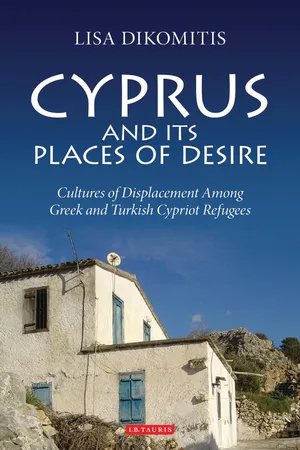
Cyprus and its Places of Desire
Cultures of Displacement among Greek and Turkish Cypriot Refugees
- 248 pages
- English
- ePUB (mobile friendly)
- Available on iOS & Android
eBook - ePub
Cyprus and its Places of Desire
Cultures of Displacement among Greek and Turkish Cypriot Refugees
About this book
By the summer of 1974, the island of Cyprus was home to two separate refugee communities. Charting the displaced cultures of the Greek Cypriot community in the south, and that of the Turkish communities in the north, Lisa Dikomitis provides a moving and detailed qualitative ethnography of the refugee experience in Cyprus. In her groundbreaking study, made possible by the opening of the north/south border during fieldwork, Dikomitis demonstrates how both ethnic groups are linked by their histories of displacement to a single 'place of desire', a small mountainous village located in the north of the island. By identifying the specific social and cultural meanings that the notions of home, identity, justice and suffering have come to have for both populations, Cyprus and its Places of Desire will appeal to scholars and students of Cypriot, Turkish and Greek history as well as those with an interest in the fields of anthropology, sociology and identity.
Information
CHAPTER ONE
NOTHING COMPARES TO OUR VILLAGE
Larnakas tis Lapithou lies seventeen kilometres west of the town of Kyrenia (Girne) on the southern side of the Pendadaktylos. Before 1974 it was an exclusively Greek Cypriot community. The neighbouring villages were the Turkish Cypriot village Kambili (Hisarköy), the mixed village Vasilia (Karşıyaka) and the Greek Cypriot villages Myrtou (Camlibel) and Argidaki (Alemdağ). In 1973 the population of Larnakas was 873. One hundred and seven pupils attended the village’s primary school that year.
The data on which this chapter is based were collected during the summer of 2002, primarily among the former residents of Larnakas, known as Larnatsjiotes, who now live in Nicosia. At the time that this data were collected the Larnatsjiotes had not seen their village for nearly three decades. When I started my fieldwork among them, the opening of checkpoints on the Green Line was inconceivable, and when they were opened in April 2003, it took everyone by surprise.
The displacement of the Larnatsjiotes in 1974 shattered their community. In contrast to most Turkish Cypriot refugees who were resettled together with co-villagers, the Larnatsjiotes are scattered all over the south. The Larnatsjiotes still meet regularly and are still attached to their co-villagers, but the strong village-solidarity that once existed has disappeared. Before the border opening, the Larnatsjiotes held an idealized image of their village. After April 2003, when it became possible to see the village again, the Larnatsjiotes were shaken by the realisation that the image they nurtured in their minds and the reality they witnessed did not match.
‘Our Desire Is To Return’
During my fieldwork in Nicosia, I mainly lived in a refugee house in Agios Pavlos, only a ten-minute drive away from the old city centre. I lived in the flat that was allocated to my grandmother Olymbia after she was displaced from Larnakas. Until she died, in 1988, my grandmother, yiayia, lived in Agios Pavlos with three of her nine children. Her youngest daughter still lives in the synikismos (refugee estate).
I have some clear memories of that particular refugee neighbourhood in the 1980s. We used to visit yiayia during summer holidays. The synikismos consisted of three floors, each with three flats. The building was painted in a light shade of beige. There were brown wooden shutters and small brown railings on the balconies. Potted flowers, plants and herbs crowded every free corner of the balconies and hallways. The geraniums, lilies, carnations and sweet basil were planted in plastic pots or metal containers. The garden surrounding the building, planted with lemon and olive trees, was well tended. Jasmine and honeysuckle climbed the walls and twined around the iron gates. A long wire stretched between two trees and served as a washing line. Fresh lines of laundry populated the garden and the roof. The rooms in yiayia’s flat were tiny but functional. The kitchen was the largest room and had a massive old-fashioned fridge that made a grating noise that kept me awake at night. We arranged mattresses on the floor and the five of us, my parents and three children, slept in one of the tiny bedrooms. I remember the constant background noise from adjacent flats: chatter, laughter and the blaring sound of a radio or TV that never seemed to be switched off. The front doors of all the flats were open from very early in the morning until late at night, unless the residents were away. We knew all the tenants. I remember that Kyria (Mrs) Eleftheria from downstairs, who was always whispering a prayer to herself, would treat us to sesame sticks. Kyrios (Mr) Christakis, with his bushy white eyebrows and permanent cigarette dangling from his lips, taught us how to make a catapult. My brother and I would hang over the railing of the third floor and fling small pebbles with our makeshift catapults at the stray cats that lolled around the entrance. Other times, bored stiff by the obligatory siesta, we would run up and down the three flights of stairs playing tag until we were reprimanded for making too much noise. In the summer the heat was so scorching that everything vanished in the glare of white light. Mercy arrived at night when a cool breeze drove all the residents onto to their balconies or into the garden. At that time of day, just before dark, we would play endless variations of hopscotch on the pavement in front of the entrance. There were always other children around, presumably the grandchildren of the other residents. This is how I remembered yiayia’s house, but that was twenty years ago and I had not visited the synikismos often since she passed away in 1988.
When I moved to the flat in 2003, the building and its residents were very different from what I remembered. The synikismos was rundown. Although the wooden shutters had been replaced by white plastic ones, the whole facade looked battered. Everything seemed so flimsy and dilapidated: the stairways, the old letterboxes, the by now rusty railings and the front doors with the paint peeling off. It came as a bit of a shock. The garden of my memory was now a dirty forlorn patch of ground with two filthy, brown, yappy dogs occupying it. The once blossoming plants and bushes were shrivelled from lack of water. In the summer there was also a rotten smell of the constantly overflowing rubbish containers.
Only three of the nine flats were still inhabited by the original residents. The other refugees had died or moved out. The other two families living on our floor were noisy and neglected the common hallway completely. They kept two rabbits and a big turtle in a cage on the stairs and on the roof they kept chickens. The corridor was littered with rubbish, discarded toys and dozens of empty beer bottles. The families were working-class Maronites who spoke a mixture of Greek and Turkish Cypriot. I soon learned that these two families were related. An older couple lived in one flat and their daughter with her children lived in another. Her husband was in prison and at some point the woman had a relationship with a Turkish Cypriot man who stayed with her. The shrieking sounds of fighting, between the couple, the daughter and her father when he returned from a drinking binge, and the grandmother shouting at the children made the other residents of the building very uncomfortable. Because of this we all kept our front doors locked and dreaded the verbal or physical fights which usually ended with yet another visit from the police. The residents on the second floor had even put up a huge iron gate to close off their corridor from the rest of the hallway. The sense of community I remembered from my childhood summers was long gone. Over time I got used to the miserable state of the synikismos and was not afraid to climb the stairs at night. I no longer dreaded the cat that might jump out of nowhere, or the bat that flew between the only two fluorescent lights that still worked in the hallway. Nor did I pay much attention to the lump of my drunk neighbour on the steps, locked out of his house yet again. When I asked Kyria (Mrs) Eleftheria, who still lived there, how things had ended up this way, she did not answer my question directly, but reminisced about the time when my grandmother (and many of the other original inhabitants) lived there. With grief on her face, she said something along the following lines:
We are now left with a very few who know what prosfygia (refugeeness) is. They have all left us. Some moved to their children’s place and some died, like our Olymbia (she crossed herself). Do you know that your yiayia would walk these steps every day several times? She would bring us our groceries and make us coffee. For me, it was good to have another Larnatsjiotissa living nearby. And now, look at this. We have all these gypsies living here. [She was referring to the two Maronite families living on my floor] They come and go and do not care about anything. And the government (i givernisi), they do nothing. They promised to renovate the building but now I hear we will have to move. That will be the second time I will be made a refugee. I want to go back to Larnakas. That is my true home. I will always be a refugee here.
I had never realized that Kyria Eleftheria was a Larnatsjiotissa. As a child I was too young to know, or perhaps I was not interested when somebody told me. I only remember her sesame sticks wrapped in wax paper. The government now often uses the empty flats and houses on the refugee estates as social housing and allocates them to poorer families. The building where yiayia’s flat was located was one in a row of several almost identical blocks of flats. Within walking distance there are some streets lined with small matching houses that are also part of a refugee estate. They are in slightly better condition than the flats, but are still in urgent need of repair.
Like Kyria Eleftheria, most Greek Cypriot refugees express an overwhelming yearning to return to their villages. ‘Our desire is to go to our house [home] (O pothos mas einai na pame sto spiti mas)’ is one of the common phrases I heard countless times. This desire is underpinned by the official state discourse which has always emphasized that the refugees’ settlement in the south of Cyprus is temporary and that its stance in negotiations would always be that all refugees should be able to return to their places in the north. The desire to return is based on an idealized, perfect past that anthropologist Michael Herzfeld refers to as ‘structural nostalgia’, a ‘collective representation of an Edenic order – a time before time – in which the balanced perfection of social relations has not yet suffered the decay that affects everything human’.1
The different ways in which the Larnatsjiotes express their nostalgia for the village are often what cultural theorist Mieke Bal coined as ‘acts of memory’:
Memory is an act of ‘vision’ of the past but, as an act, situated in the present of the memory. It is often a narrative act: loose elements come to cohere in a story, so that they can be remembered and eventually told. But as is well know, memories are unreliable – in relation to the fibula – and when put into words, they are rhetorically overworked so that they can connect to an audience.2
Thirty years after their displacement, the Larnatsjiotes retain vivid and detailed memories of their pre-displacement lives, their village and their houses. The most ordinary, but probably also most powerful ‘act of memory’ of the Larnatsjiotes is the story telling about their way-of-life in the village and the description of buildings, the flourishing trees, the fertile fields and places of exceptional natural beauty. They passionately recall a perfect harmony in the village and celebrate the uniqueness of their place of origin asserting that ‘no other place compares to Larnakas (san ton Larnaka den eshei allo)’.
The memories first evoked in conversations with Larnatsjiotes always focussed on the village as a ‘paradise’. The Larnatsjiotes would say: Larnakas was beautiful, it was perfect. Life was great back in the village and there was harmony with nature and with each other. The village had the best water, the purest air and the healthiest climate. This attitude was not unique to the Larnatsjiotes. I interviewed several Greek Cypriot refugees from other villages in north Cyprus, such as Aigialousa (near Famagusta), Agios Georgos (near Kyrenia) and Gerolakkos (near Nicosia), and their stories were similar. Their village was always the best place to live in Cyprus and if ever a solution would come they would take me there to prove it. At times, the start of such conversations was intensely emotional. Michalis, a Larnatsjiotis in his eighties, was at a loss, his eyes instantly brimming with tears as he searched for the right words to begin his story about the village:
Everybody loves the place where he is born. I have memories from the moment I was born until we had to leave Larnakas. I have too many memories . . . (long silence) Friends, I went to school there, I worked in the village. . . (long silence) The whole scenery, mountains, the house. . .It was a special. . . I mean, I don’t think it was special because it was my village. It was. . . I mean, our house was at the foot of the mountains and in front of the house were the fields. It was very nice. I remember everything of the village. From the start of the village until the end.
It was not only those Larnatsjiotes who live in a refugee estate who spoke with almost tangible yearning about their village. I lived in different houses within Nicosia for each round of fieldwork because I believed it was important to live with refugees from different class backgrounds, in the intimacy of their own homes. In addition to the large number of Larnatsjiotes living in refugee estates,3 some Larnatsjiotes were able to build their own houses, while others could only afford to buy a modest flat. However, regardless of their relatively successful emplacement in the south, the Larnatsjiotes are unified in the feeling that their real home is in Larnakas.
At some point during my first fieldwork round I found lodgings in Aglantzia, a large municipality in Nicosia. My hosts were both refugees in their late fifties: Antonis is a Larnatsjiotis and Georgia is a refugee from Agios Georgios, a village located close to the coastal town of Kyrenia. After their displacement they lived in a number of apartments until 1988, when they moved into their newly built house in Aglantzia. The house is in a residential area, where most of the houses were built around the same time. It is a large detached house with a small front and back yard. The interior reflects the taste of the middle classes. It has three bathrooms with trendy tiles, central air conditioning and is decorated in a modern black-and-white style. On a particular hot summer day Georgia told me that she was glad they could now afford air conditioning. She emphasized that there was no need for it in her former village, Agios Georgos, because the continuous breeze from the sea made the scorching heat of summer bearable. During the first fourteen years after their displacement, Antonis and Georgia moved several times, from one rented flat to the next, each time attempting to improve their living conditions. In all these flats there was no air conditioning available. The central air conditioning system they now have in their house is a symbol of the fact that, despite all the financial hardship and suffering, they managed well. The neighbouring houses are similar in layout and style. These houses often have an exterior staircase that leads to a second floor that does not yet exist. Rusted metal rods sprout from the flat roofs like clusters of antennae. These will reinforce the walls of the second storey to be built for the daughters when they marry.
Antonis, charming and talkative, soon became a key informant and facilitated my introduction to many other Larnatsjiotes. In our very first formal interview, a taped conversation, Antonis insisted on starting with the ‘beginnings about Larnakas’. This conversation was very similar to other conversations I had with male informants from Larnakas. These Larnatsjiotes spoke to me in a didactic and sometimes even pedantic way. I was put in the position of the student; they were not telling me about the village, in a certain way they were ‘teaching’ Larnakas to me. I often felt it was because I was a woman that the men spoke to me in this condescending and often pompous way. Once I became more accepted by the community after my first fieldwork period, I noticed that the men’s tone changed. When we talked about Larnakas the men would often start a discussion about small details. It was if they were competing among themselves to convince me that they remembered a particular aspect of the village best. This became especially clear in the way they spoke when the conversation was being taped. The men would speak very slowly, as Antonis did during our first interview:
First, do not confuse. There is Larnaca and Larnakas. These are two different places. The town of Larnaca [a coastal town in the south of Cyprus] is the female: ‘i Larnaca’. Our village, it was the male: o Larnakas tis Lapithou. It has some historical meaning why it is called Larnakas. ‘Larnakas’ means tomb in Greek, where they put the dead. When several different files (races) invaded Cyprus, they always invaded from the seaside. Kyrenia, Karavas, Lapithos . . . They came from the seaside to get Cyprus and the Lapithiotes, the inhabitants of Lapithos. It is the village on the other side of the mountain, near the seaside. They [the Lapithiotes] came with their families to the other side of the mountain, in order to save the families. There was Larnakas and they put their timalfi (jewellery, valuables) there. You know, their precious things: gold, silver, money and their families to save them from the invaders. Then they put the dead people there [in Larnakas] as well. Those who were killed by the invaders. It [Larnakas] was a hiding place for Lapithiotes. The name is about 7000 years old. There are two or three myths about the name. The other meaning is from ‘Posidonas’, the old Greek god. He has his place in the middle of Larnakas. It was a church of old Greeks: (pronounces the words very slowly and loudly) ‘Larnakios Posidonas’, ‘Larnakios’ or ‘Narnakios’. It was a place to worship him there. That is Larnakios, Larnakas.
It was a source of pride for the Larnatsjiotes that their village was also the location of some archaeological artefacts with Phoenician inscriptions. Many Larnatsjiotes referred to these inscriptions found on a rectangular tablet, now displayed in the archaeological museum in Nicosia, and the engravings in a rock called ‘Lacharopetra’. Archaeologists who have analyzed these inscriptions have pointed out that these refer to the local city-kingdom of Lapithos.4
Women, on the other hand, were storytellers in the more romantic meaning of the word. Once I gained their trust, they would try to speak slowly to me, but once into the flow of their story they were so enthused that they ceased to notice my presence. The Larnatsjiotisses were also keen on listing the places they missed the most, often with tears in their eyes. Fotini, for instance, very often launched into a detailed account of what she would visit if she were able to return to Larnakas:
I would like to climb the Pendadaktylos ag...
Table of contents
- Cover
- About the Author
- Title Page
- Copyright
- Dedication
- Contents
- Acknowledgements
- List of Figures
- Preliminary Notes
- A Village in Paradise
- Introduction An Island in Transition
- Chapter One Nothing Compares to Our Village
- Chapter Two A Crack in the Border
- Chapter Three Pilgrims and Tourists
- Chapter Four Under One Roof
- Chapter Five This is Our Village
- Chapter Six Refugees and Locals
- Places of Desire
- Notes
- Bibliography
- Index
Trusted by 375,005 students
Access to over 1.5 million titles for a fair monthly price.
Study more efficiently using our study tools.
Frequently asked questions
Yes, you can cancel anytime from the Subscription tab in your account settings on the Perlego website. Your subscription will stay active until the end of your current billing period. Learn how to cancel your subscription
No, books cannot be downloaded as external files, such as PDFs, for use outside of Perlego. However, you can download books within the Perlego app for offline reading on mobile or tablet. Learn how to download books offline
Perlego offers two plans: Essential and Complete
- Essential is ideal for learners and professionals who enjoy exploring a wide range of subjects. Access the Essential Library with 800,000+ trusted titles and best-sellers across business, personal growth, and the humanities. Includes unlimited reading time and Standard Read Aloud voice.
- Complete: Perfect for advanced learners and researchers needing full, unrestricted access. Unlock 1.5M+ books across hundreds of subjects, including academic and specialized titles. The Complete Plan also includes advanced features like Premium Read Aloud and Research Assistant.
We are an online textbook subscription service, where you can get access to an entire online library for less than the price of a single book per month. With over 1.5 million books across 990+ topics, we’ve got you covered! Learn about our mission
Look out for the read-aloud symbol on your next book to see if you can listen to it. The read-aloud tool reads text aloud for you, highlighting the text as it is being read. You can pause it, speed it up and slow it down. Learn more about Read Aloud
Yes! You can use the Perlego app on both iOS and Android devices to read anytime, anywhere — even offline. Perfect for commutes or when you’re on the go.
Please note we cannot support devices running on iOS 13 and Android 7 or earlier. Learn more about using the app
Please note we cannot support devices running on iOS 13 and Android 7 or earlier. Learn more about using the app
Yes, you can access Cyprus and its Places of Desire by Lisa Dikomitis in PDF and/or ePUB format, as well as other popular books in Sciences sociales & Émigration et immigration. We have over 1.5 million books available in our catalogue for you to explore.