eBook - ePub
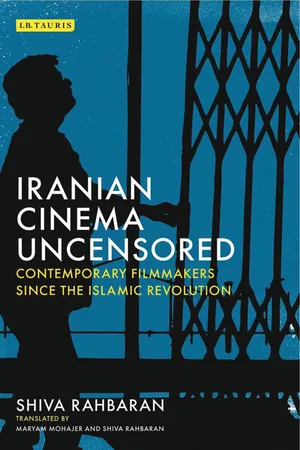
Iranian Cinema Uncensored
Contemporary Film-makers since the Islamic Revolution
- 288 pages
- English
- ePUB (mobile friendly)
- Available on iOS & Android
eBook - ePub
Iranian Cinema Uncensored
Contemporary Film-makers since the Islamic Revolution
About this book
The New Iranian Cinema is considered by many to be the most fascinating cultural phenomenon produced within the Islamic Republic of Iran. Containing twelve first-hand interviews with the most renowned film-makers living and working in contemporary Iran, this book provides insights into film-making within a society often at odds with its rulers. Reflecting upon the 1979 revolution and its influence on their work, as well as the effect of their films on Iranian audiences, film-makers such as Abbas Kiarostami and Jafar Panahi highlight the key issues surrounding the reception of Iranian cinema in the West and also its role in the development of Iran's global image. Through these conversations Shiva Rahbaran reveals that the seeds of the New Iranian Cinema were sown long before the revolution, and that Iranian film-makers gave rise to a cinema which became a global phenomenon despite censorship, sanctions and political isolation.
Information
Table of contents
- Cover
- Title page
- Copyright
- Contents
- Introduction: New Iranian Cinema in its Cultural, Historical and Political Context
- 1. Mohammad Beheshti: The Role of Post-Revolutionary Institutions in the Development of Iranian Cinema
- 2. Bahram Beyzaie: The Myth of Revolutionary Cinema
- 3. Abbas Kiarostami: Where is the Revolution?
- 4. Dariush Mehrjui: Islamic Ideology and Post-revolutionary Intellectual Films
- 5. Bahman Farmanara: Exporting New Iranian Cinema
- 6. Rakhshan Bani-Etemad: Cinema as a Mirror of the Urban Image
- 7. Majid Majidi: The Revolution and the Cleansing of Film Farsi
- 8. Jafar Panahi: Cinema and Resistance
- 9. Tahmineh Milani: New Iranian Cinema and the Education of the Masses
- 10. Ebrahim Hatamikia: Cinema, War and Peace
- 11. Mohsen Makhmalbaf: An Interview That Never Was
- Notes
Trusted by 375,005 students
Access to over 1.5 million titles for a fair monthly price.
Study more efficiently using our study tools.
Frequently asked questions
Yes, you can cancel anytime from the Subscription tab in your account settings on the Perlego website. Your subscription will stay active until the end of your current billing period. Learn how to cancel your subscription
No, books cannot be downloaded as external files, such as PDFs, for use outside of Perlego. However, you can download books within the Perlego app for offline reading on mobile or tablet. Learn how to download books offline
Perlego offers two plans: Essential and Complete
- Essential is ideal for learners and professionals who enjoy exploring a wide range of subjects. Access the Essential Library with 800,000+ trusted titles and best-sellers across business, personal growth, and the humanities. Includes unlimited reading time and Standard Read Aloud voice.
- Complete: Perfect for advanced learners and researchers needing full, unrestricted access. Unlock 1.5M+ books across hundreds of subjects, including academic and specialized titles. The Complete Plan also includes advanced features like Premium Read Aloud and Research Assistant.
We are an online textbook subscription service, where you can get access to an entire online library for less than the price of a single book per month. With over 1.5 million books across 990+ topics, we’ve got you covered! Learn about our mission
Look out for the read-aloud symbol on your next book to see if you can listen to it. The read-aloud tool reads text aloud for you, highlighting the text as it is being read. You can pause it, speed it up and slow it down. Learn more about Read Aloud
Yes! You can use the Perlego app on both iOS and Android devices to read anytime, anywhere — even offline. Perfect for commutes or when you’re on the go.
Please note we cannot support devices running on iOS 13 and Android 7 or earlier. Learn more about using the app
Please note we cannot support devices running on iOS 13 and Android 7 or earlier. Learn more about using the app
Yes, you can access Iranian Cinema Uncensored by Shiva Rahbaran, Shiva Rahbaran, Maryam Mohajer, Shiva Rahbaran,Maryam Mohajer in PDF and/or ePUB format, as well as other popular books in Médias et arts de la scène & Film et vidéo. We have over 1.5 million books available in our catalogue for you to explore.