'An energy, a pulse form of quantum physics perhaps, alive at the margins of sleep or madness, and more often in the whispering of a single unwelcome thought.'
The Economist
According to Islamic tradition, Allah created three types of beings: angels, made of light; humans, made of earth; and jinn, made of smokeless fire. Supernatural, shape-shifting, intelligent and blessed with free will and remarkable powers, jinn have over the ages been given many names - demon, spirit, ghoul, genie, ifrit and shaitan. Neither human nor immortal, they roam the earth inhabiting dark and empty places, luring humans to their deaths or demonically possessing them if harmed or offended. Despite the fact they cannot be seen, jinn are said to be strangely human-like - marrying, bearing children, forming communities and tribes, eating, sleeping, playing and facing judgement like any other human. They are ever-present partners in the human experience, causing endless mischief, providing amazing services and sometimes inducing sheer terror.
Believed in by hundreds of millions of people throughout the world and from all faiths, jinn have played a particularly central role in the literature, culture and belief systems of the Middle East and the Islamic world. Legends of the Fire Spirits explores through time and across nations the enduring phenomenon of the jinn. From North Africa to Central Asia, from the Mediterranean to sub-Saharan Africa and beyond, this riveting, often chilling, yet reasoned book draws on long-forgotten ancient testimonies, medieval histories, colonial records, anthropologist's reports and traveller's tales to explore the different types of jinn, their behaviour, society, culture and long history of contact with humankind. It documents their links with famous figures in history such as King Solomon and the Queen of Sheba and illustrates the varied and vivid portrayals of jinn in world literature. In essence Legends of the Fire Spirits demonstrates the colourful diversity of human culture and the durability of faith and is a magnificent and indispensable portrayal of the rich folklore of the Islamic world.
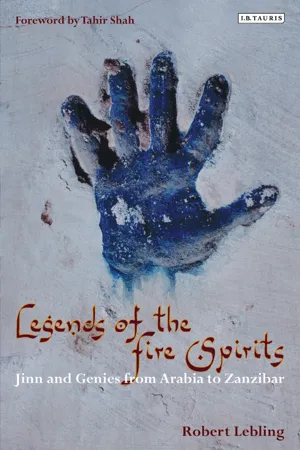
- 272 pages
- English
- ePUB (mobile friendly)
- Available on iOS & Android
eBook - ePub
About this book
Information
Chapter One

Origins
It is related in histories, that a race of Jinn, in ancient times, before the creation of Adam, inhabited the earth, and covered it, the land and the sea, and the plains and the mountains; and the favours of God were multiplied upon them, and they had government, and prophecy, and religion, and law; but they transgressed and offended, and opposed their prophets, and made wickedness to abound in the earth; whereupon God, whose name be exalted, sent against them an army of Angels, who took possession of the earth, and drove away the Jinn to the regions of the islands, and made many of them prisoners ...
– Zakariya al-Qazwini, cosmographer
Jinn are best known as an Arab and/or Islamic phenomenon. In Arab tradition, the jinn is a spirit creature, often linked to nature, with the ability to manifest itself physically. The jinn have great powers, sometimes miraculous abilities, which humans normally lack.
Jinn are usually divided into five major ‘categories’: jann, jinn, shaitan, ifrit and marid. These terms sometimes overlap and are often not as precise as one would like. Jann is a collective term referring to the masses of jinn of all types; the term is sometimes interchangeable with jinn. ‘Jinn’ is used more often to refer to specific individuals or families or tribes of fire spirits. Jinn can be good or evil, but shaitans (‘satans’ or devils) are the children and servants of the chief devil, Iblis (the equivalent of the West’s Satan), and are always evil. Ifrits are more powerful than shaitans and are most often evil.1 Marids are evil as well and most powerful of all. All of the above categories have the ability to shapeshift or shield themselves with invisibility, so their appearance varies depending on circumstances.
The various categories of jinn were created separately, according to a creation myth reported by the Arab historian Abu al-Hasan Ali al-Mas'udi (896–956), called by some ‘the Herodotus of the Arabs’. In his celebrated Meadows of Gold, al-Mas'udi explains the sequence of this creation:
It is said that God created the demons from the semoum (burning wind); that from the demon he created his woman, as he created Eve from Adam; that the demon having had relations with his woman, she became pregnant from him and laid thirty eggs. One of these eggs cracked open, giving birth to the qotrobaht, which was, so to speak, the mother of all the qotrobs, demons that have the form of a cat. From another egg emerged the iblises, in whose number must be counted El Harith Abou Murrah and which make their home within walls. From another egg were hatched the maradahs, which inhabit islands. Another produced the ghouls, which chose for their refuge ruins and deserts; another, the si'lahs, which hide in the mountains; the others, the ouahaouis, which inhabit the air in the form of winged serpents, and fly from place to place. From another egg emerged the daouasiks; from yet another the hamasiks; from still another the hamamis, and so forth.2
Most of these types of jinn will be encountered and explained later in this book. The egg motif appears in the earliest creation myths of many peoples, including the Greeks, Egyptians, Hindus and Chinese, suggesting a pre-Islamic origin for al-Mas'udi’s account. But its exact source is unknown.
The Arabs’ belief in jinn long predates Islam and played a role of considerable importance in the seventh-century environment in which the Islamic faith was born. According to this ancient belief, spirits were believed to haunt dark and desolate locales in the desert, and people needed to protect themselves from these beings. ‘It is often assumed that belief in the jinn who were thought to dwell in the desert originated with the Bedouin and was passed from them to the settled tribes,’ notes German scholar Joseph Henninger.3 He says: ‘This assumption does not seem to me to be well founded.’
Bedouin tribesmen who are at home in the desert experience much less fear in those regions than do villagers or townspeople who are often terrified by the desert and are convinced that all sorts of demons and monsters live there. Among the Arabs today, Henninger asserts, ‘belief in spirits is much more intense among the [settled] agricultural population than among the Bedouin’. This is not to say, however, that the Bedouins of the Arabian Peninsula disbelieve in the jinn. This belief is very much a part of their everyday lives. But nomadic Arabs are generally less frightened by the jinn than are their settled counterparts.
Another scholar, American archaeologist William F. Albright, believed that the word jinn is not originally Arabic but is derived from Aramaic. Aramaic-speaking Christians used the term to designate pagan gods reduced to the status of demons. Albright concluded from this that the jinn themselves were introduced into Arabic folklore only late in the pre-Islamic period. Not all scholars agree on this point. Some maintain that the Arabic word jinn is older, and that the Palmyran (ancient Syrian) word jny' or gny', which we shall encounter later, derives from the earlier Arabic form.
Henninger did a study of local Arabian pre-Islamic divinities – called ‘idols’ (asnam) or ‘companions’ (shuraka') by Hisham ibn al-Kalbi (d.821) and other early Muslim authors. Cults worshipping these divinities were limited to specific areas or tribes. The Hudhayl tribe, for example, worshipped a god called Suwa' in a village near Yanbu' on the Red Sea coast, according to Ibn al-Kalbi. The Tayyi tribe had an idol called al-Fals, a red rock shaped like a man atop a black mountain, which was worshipped up until the birth of Islam and was destroyed by the Prophet’s son-in-law 'Ali. Such pre-Islamic deities are often called companions because they were sometimes – mistakenly, from the Muslim viewpoint – associated with Allah. Apart from Ibn al-Kalbi’s slender volume from the eighth century, The Book of Idols,4 very few specifics have survived about the hundreds of early Arabian deities. In some cases we don’t even know their real names or where they were worshipped. Sometimes they are referred to only by a title, for instance, as ‘lord of such and such a place’. The myths which might have told us more about these divinities and their character are almost entirely lost, eclipsed and in some cases suppressed by Islam and its proselytisation. So it is often problematic deciding whether a specific deity originated with the nomadic Bedouins of the deserts or with the settled peoples of the Middle East. At various times before Islam, Bedouin tribes often adopted divinities from settled communities so as to facilitate rudimentary trade and social interaction with these areas. But the nomadic people of the Syrian and Arabian deserts may also have had their own gods; Henninger cites the example of a god named after a mountain – Dushara or Dusares5 – who was almost certainly of Bedouin origin.
Henninger describes pre-Islamic deity worship as a ‘chaotic picture’ and is reluctant to characterise the large array of gods as a ‘pantheon’. ‘Among these gods there may be some that were originally jinn, mythical ancestors or legendary heroes, elevated little by little to the rank of god,’ he says. ‘On the other hand, some of the gods developed directly from the personification of natural forces (in [the pre-Islamic deity] Quzah, for example, one may still discern the features of a storm god). It should not be thought, however, that these gods must first have passed through a spirit or demon stage, and that celestial beings are posterior to earth spirits.’
Some Western scholars of the Middle East believe that the earliest jinn were conceptualised as malicious demons living in deserted or contaminated places and often taking the form of animals. Other Middle East scholars say the jinn originated as early deities of such peoples as the Sumerians and Akkadians, often nature gods and goddesses, who were later dethroned and displaced by more sophisticated beliefs but not totally discarded or forgotten.
Although the specific origins of jinn belief are in dispute and shrouded in confusion and mystery, it is known that the earliest jinn were believed to come from the desert. But belief in these creatures crystallised not in the deserts of the Middle East themselves, but in settled and sown areas, where agriculture had taken root and cities – civilisations – were being built, particularly in Mesopotamia, the ‘land between the rivers’, home of the Sumerians, Babylonians and Assyrians and now the land we called Iraq. The Bedouins who roamed the trackless deserts of greater Arabia with their flocks of sheep, goats and camels feared the spirit creatures of these regions much less than did the city and village folk, who dreaded the remote sand wastes because they were thought to harbour the unknown and the mysterious.
Pazuzu, the ancient Mesopotamian wind demon, is an example of a desert spirit, a primordial jinn, who struck terror in the hearts of city dwellers of Eridu, Ur, Nippur, Uruk, Akkad and other Sumerian cities some 4,000–6,000 years ago. Jinn are often associated with the wind and are said to travel by it. Pazuzu, a demon brought into Western consciousness by the novel and film The Exorcist, is an early form of nature spirit, probably a fallen deity of antiquity relegated to the world of the jinn. Pazuzu is first mentioned by the Sumerians and is later identified in Assyrian and Babylonian mythology as the son of Hanpa (or Hanbi), who is lord of all demons and sometimes identified with Satan himself. Novelist William Burroughs, in his Cities of the Red Night, called Pazuzu ‘Lord of Fevers and Plagues, Dark Angel of the Four Winds with rotting genitals from which he howls through sharpened teeth over stricken cities’. This seems to refer to the common depiction of Pazuzu with an erect penis ending in a serpent’s head. In general, the demon is portrayed as a human-animal hybrid, with a canine or leonine head, animal horns, a human beard, two pairs of bird wings on his back and a scorpion’s tail.6 The animal parts associated with his image are by and large those of beasts of the desert wastelands.
Pazuzu is often associated with a southwest wind, but recent research suggests that this may be an error and should be a cold, north-east wind.7 Some scholars consider this wind demon to be one of the most malevolent elemental forces in world mythology. He was certainly a scavenger of desert wastelands, carrying loathsome disease, desolation and starvation. Significantly, William Woods states in his History of the Devil, ‘In Mesopotamia the horned demon, Pazuzu, rode on the wind and carried malaria ... ’, thus affirming the demon’s destructive role as ‘lord of fevers and plagues’.8 Although he is certainly evil, Pazuzu curiously sometimes appears on ancient amulets as a defence against other demons. In the brutal eras of antiquity, occasionally appeasement was the smartest survival tactic.
Portraying a wind demon such as Pazuzu as a creature of the desert may derive from the Egyptian concept of Set, the destroyer, most ancient of the gods, who was represented as a strange, dog-like animal, not unlike that scavenging denizen of the desert, the jackal.
We need to keep in mind that Pazuzu, despite his perceived desert origins, frightened settled populations, not Bedouins.
The ancient Babylonians, who succeeded the Sumerians in Mesopotamia, were a Semitic people believed to have originated in Arabia. They were great practitioners of magic, and their lore was replete with grotesque and frightening demons that could be summoned by sorcery or driven off by talismans. Many of these demons were primordial jinn.
Scottish folklorist Lewis Spence says, ‘Babylonian demons were legion and most of them exceedingly malevolent.’9 A good example was the utukku, an evil spirit that normally lurked in the desert, where it lay in wait for unsuspecting travellers. But this particular demon did not limit itself to remote wastelands. It haunted graveyards, a common abode for jinn, and sometimes made its home in the mountains and even in the sea. Any man who spied an utukku was certain to face a grim fate.
The Babylonians feared another lurking demon called the rabisu, which hid in unfrequented spots and leapt out upon passers-by (the modus operandi, as we shall see later, of a fairly specialised jinn called the ghul). Yet another early jinn was the labartu, a Lilith-like figure, said to be the daughter of the ancient sky deity Anu. She was believed to live in craggy mountains or in dismal swamps and was particularly addicted to destroying children. Babylonian mothers would shield their children from the horrors of this demon by placing protective talismans on cords or chains around their youngsters’ necks.
Another Babylonian demon called the sedu was possibly a guardian spirit, like the qarin/qarinah which we shall visit later. But it was also seen as having evil propensities. The sedu and a similar demon called the lamassu were often appealed to at the end of written invocations that have survived to this day on clay tablets. ‘These malign influences were probably the prototypes of the Arabian jinn, to whom they have many points of resemblance,’ Spence observes.
In northern Mesopotamia, the Assyrians feared a variety of spirits that were described as half-human and half-supernatural. Some of these demons engaged in sexual relations with humans – another jinn characteristic. The offspring of these demon-human unions was said to be a spirit creature called the alu, sometimes identified as a wind demon (like Pazuzu) which haunted desolate ruins and abandoned buildings and would enter houses like a ghost and steal people’s sleep.
Primordial jinn were sometimes portrayed in reliefs and sculptures by Babylonian and other artists of Mesopotamia. A few representations of the utukku have survived the ravages of time. They show a creature with a powerful human body, large wings, and a beast’s head – a cross between a bird of prey and a lizard.
Other unique representations of the jinn in the Arab East have been found in the oasis-city of Palmyra in what is now Syria. Palmyra, also called Tadmor or Tudmur, was a trade emporium and a crossroads of peoples and cultures in ancient times, first settled by the Amorites and Aramaeans, then conquered by the Romans in the first century. Taken by the Arabs in the seventh century, it endured until the sixteenth. Because of its location on the principal east-west caravan route, Palmyra’s culture and society were influenced by Phoenicians, Hebrews, Babylonians, Persians and Greeks. Its cultural tapestry was rich and diverse. When the Romans seized the city, Palmyra’s main temple, said to have been built by King Solomon of the Israelites, had already stood for two thousand years. Impressive ruins, including temples to Semitic deities such as Ba'al of the Canaanites, Nabu of Babylon and the goddess Allat of Arabia, survive to this day. Ancient jinn reigned in Palmyra as tutelary or guardian deities.
Palmyra is perhaps most famous for Zenobia, the beautiful and brilliant third-century Syrian queen who led a revolt against Rome and created a breakaway Palmyrene Empire in Egypt and the Levant. She ruled this short-lived realm for about five years, until she was defeated and taken to Rome in golden chains by the soldier-emperor Aurelian in 274. Zenobia’s claim of descent from Dido of Carthage and the Greek queen Cleopatra VII of Egypt demonstrates the cultural and social complexity of Palmyra and its people.
Palmyra’s Arabian jinn-gods are often called gny' (jny') or ginnaya (plur. ginnayê), an Aramaic term that some Western scholars have tried to link with the Roman-origin genii (singular genius), tutelary or household deities.10 The ginnayê of Palmyra are indeed similar in function to the Latin genii, and the resemblance was probably encouraged during the period of Roman occupation. Roman genii protected individuals, families and places. Even as late as the European Renaissance, the Latin term ‘genius’ had not taken on its modern meaning of a person endowed with great intellect and creativity. In Leonardo da Vinci’s time, extraordinary accomplishments of artists or scientists were attributed to their genius, or attendant spirit.11 The Palmyrene jinn were protective and supportive as well, but they were indigenous and anci...
Table of contents
- Cover
- Author biography
- Title page
- Copyright page
- Contents
- Foreword by Tahir Shah
- Acknowledgements
- Notes on Transliteration
- Introduction
- 1. Origins
- 2. Historical Encounters
- 3. By Their Deeds: Jinn Behaviour
- 4. Jinn Geography
- Turkey: Out of the Forest
- 5. Cultural Echoes
- Appendix A: Edward Lane’s Notes on the Jinn
- Appendix B: Muhammad Asad on the Jinn
- Appendix C: Jinn Physics
- Notes
- References
Trusted by 375,005 students
Access to over 1.5 million titles for a fair monthly price.
Study more efficiently using our study tools.
Frequently asked questions
Yes, you can cancel anytime from the Subscription tab in your account settings on the Perlego website. Your subscription will stay active until the end of your current billing period. Learn how to cancel your subscription
No, books cannot be downloaded as external files, such as PDFs, for use outside of Perlego. However, you can download books within the Perlego app for offline reading on mobile or tablet. Learn how to download books offline
Perlego offers two plans: Essential and Complete
- Essential is ideal for learners and professionals who enjoy exploring a wide range of subjects. Access the Essential Library with 800,000+ trusted titles and best-sellers across business, personal growth, and the humanities. Includes unlimited reading time and Standard Read Aloud voice.
- Complete: Perfect for advanced learners and researchers needing full, unrestricted access. Unlock 1.5M+ books across hundreds of subjects, including academic and specialized titles. The Complete Plan also includes advanced features like Premium Read Aloud and Research Assistant.
We are an online textbook subscription service, where you can get access to an entire online library for less than the price of a single book per month. With over 1.5 million books across 990+ topics, we’ve got you covered! Learn about our mission
Look out for the read-aloud symbol on your next book to see if you can listen to it. The read-aloud tool reads text aloud for you, highlighting the text as it is being read. You can pause it, speed it up and slow it down. Learn more about Read Aloud
Yes! You can use the Perlego app on both iOS and Android devices to read anytime, anywhere — even offline. Perfect for commutes or when you’re on the go.
Please note we cannot support devices running on iOS 13 and Android 7 or earlier. Learn more about using the app
Please note we cannot support devices running on iOS 13 and Android 7 or earlier. Learn more about using the app
Yes, you can access Legends of the Fire Spirits by Robert Lebling in PDF and/or ePUB format, as well as other popular books in Theology & Religion & Islamic Theology. We have over 1.5 million books available in our catalogue for you to explore.