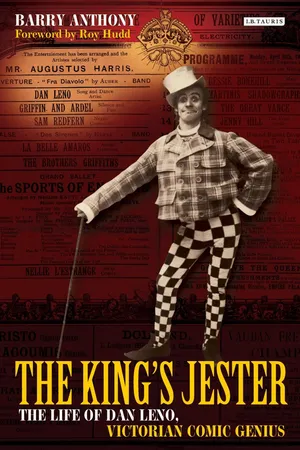
- 224 pages
- English
- ePUB (mobile friendly)
- Available on iOS & Android
eBook - ePub
About this book
Who was Dan Leno? In 1901 everyone in Britain knew who he was. They had seen him live on the music hall stage, listened to his jokes on the new gramophone and watched his funny antics in some of the earliest moving pictures. Even King Edward VII was a fan and the popular press dubbed Dan Leno 'The King's Jester'. But his path to fame was a hard one: he journeyed from being a child performer in the London and Liverpool slums to a chaotic career in hard-bitten northern variety theatres. Dan became the nation's favourite comedian, but as one of the first mass media stars he suffered from this continual exposure and died at the early age of forty three. Drawing on many previously unused sources, this is first, authoritative, biography of Dan Leno. Only Charlie Chaplin, often compared to Dan in style and appearance, was to occupy a similar position in the hearts of the British public. In telling the full story of Dan's life and career on the stage and screen, Barry Anthony brings to life the everyday life of Victorian Britain, as well as Dan's unique brand of humour and its resonance with later comedians such as Spike Milligan and the Monty Python team.
Information
1
PRELUDE
The Gaumont movie camera clattered into action. It had been a good morning for filming, the low November sun throwing trees and buildings into sharp relief. But now, at midday,
a cold wind began to blow, with heavily-banked rain clouds filling the sky. Despite the sudden change in the weather the scene was still full of sombre interest. Dark, dense crowds stood
respectfully watching the long procession of carriages slowly depart from Clapham Park. The hearse was pulled by six black horses, plumed and with ornate trappings. Beside, as pallbearers, walked
some of the most famous stars of the British music hall.
Londoners had turned out in their thousands to bid farewell to an old and cherished friend. There were few people, from King Edward downward, who did not spare a thought for Dan Leno on the day
of his funeral. Some had known him by other names – ‘Little George, the Infant Wonder’; one of ‘The Brothers Leno’; ‘Young Leno’; ‘Dan Patrick, Irish
Comedian’; even ‘Pongo’, the most mischievous of stage monkeys. For the previous 20 years, however, the nation’s leading comedian had been almost universally referred to as
‘Dan’.
Alongside the elaborate floral tributes, from celebrities such as the actor Sir Henry Irving and the opera diva Nellie Melba, were more humble offerings from those who had known him in earlier
years. There were wreathes from his brother, Harry Galvin, with whom he had danced as a boy in the 1860s; from Bradley Truman, a comedian he had shared the bill with in the 1870s; from King Ohmy
and other proprietors of Northern music halls where he had made his earliest successes. And from his uncle and life-long friend Johnny Danvers, there was an allusion to his seemingly endless supply
of nervous energy, a cushion of flowers bearing the words ‘Rest, Dan, Rest.’
After a service at the Church of the Ascension, Balham Hill, the cortège moved on, its progress impeded by a multitude of mourners. Such was the congestion that shops closed their doors
and the Clapham tramcars suspended their services. Street hawkers did a brisk trade in ‘In Memoriam’ cards, decorated with a photo of the departed comedian and bearing a few lines of
doggerel verse. Despite a decade of entertaining privileged audiences in the spectacular pantomimes presented at the Theatre Royal, Drury Lane, Dan was still seen by millions of the working classes
as their principal representative. It was a culture that had seen many changes since his childhood days in the slums of London and Liverpool, and one which was to alter even more radically within
the next few decades. During his final years Dan had become a major figure in the fledgling film and recording industries. As one of the earliest superstars of a new, mass media age he had also
become the first of many performers to suffer the negative consequences of unlimited fame and a life lived almost entirely in the public gaze.
By the time the carriages reached Tooting Cemetery it was three in the afternoon, too dark for the Gaumont cameraman to secure any further ‘animated photographs’. A notice attached
to the gates announced that the interment was to be held in private, but Dan’s audience, always reluctant to let him take his leave, crushed against the gates until their heavy chains gave
way. Gradually the crowd filed past the simple stone cross, its base bearing the inscription ‘Here Sleeps the King of Laughter-Makers’. They were paying their last respects not only to
the comedian Dan Leno, but to the many characters he had created. There was the blustering recruiting sergeant with so many medals that he had become knock-kneed under their weight; the ice-cream
seller whose sweetheart left him for another because ‘she liked his raspberry better’; the harassed mother who stopped to exchange a few words before rushing ‘off to buy milk for
the twins’. And above all there was Mrs Kelly, the infamous gossip and busybody whose strategic position at the street corner allowed her to keep an eagle eye on what things had happened and
what were about to take place.
2
AN INCONVENIENCE
London during the mid-nineteenth century was a city bursting at the seams. The end of the Napoleonic wars in 1815 had caused a general increase in population, added to which rural poverty and the lure of regular employment resulted in a vast influx of migrants into the capital. London’s heavy clay soil provided the raw material for London’s growth. Brickfields and kilns multiplied on the fringes of the city, their distinctive yellow bricks being laid one on the other to build streets of new houses, railway stations, churches and chapels, public houses and music halls. At the ancient centre of London a maze of courts and alleys harboured a seething population of labourers, street traders, bricklayers, beggars, prostitutes and, sometimes, comic singers – all desperately struggling to keep body and soul together. Male life expectancy over the whole of London hovered around the mid-30s, but in the densely-packed central area the inhabitants might expect substantially less. The old graveyards were so choked with burials that extensive new necropolises were created in the outer, less congested suburbs.
George Wild Galvin, later to become famous as Dan Leno, joined the three and a half million inhabitants of London on 20 December 1860. Amid such crowds and turmoil his birth was unremarkable. ‘Everybody – mark this – everybody has to be born, one way or another,’ he wrote in a spoof autobiography, ‘you have to go through this inconvenience.’ Dan’s comments emphasised the ordinariness of being born. It was a matter of fact, commonplace sort of thing, like catching a cold or stubbing one’s toe. But it was unavoidable – ‘birth comes to us all sooner or later.’1
That other inescapable inconvenience caught up with Dan only 43 years later. Despite its brevity, his life ended at an appropriate time. His career as a music-hall comedian was played out against a background of an evolving entertainment business. To provide diversions for a rapidly multiplying population, music halls had grown larger, attempting to balance the intimacy of their public-house origins with the constant requirement to increase audience capacity. The industrialisation of music halls continued with the establishment of limited companies and syndicates, which attempted to impose a degree of standardisation and centralised control. Being by definition ‘variety’, music hall proved difficult to regulate, but economic factors were eventually to win the day. A few weeks after Dan’s death a gigantic ‘palace of variety’, the London Coliseum, opened in central London. Its enormous stage and immense auditorium dictated that entertainments should be excessive in scale and effect – the antithesis of Dan’s miniature, reflective style of performance. His death drew the curtain on a form of entertainment that still bore traces of its ‘free and easy’ tavern-concert ancestry, while the Coliseum heralded an age of spectacular but impersonal showmanship.
Unlike Sunset Boulevard’s Norma Desmond, Dan stayed small, the music hall got big. He achieved his success by being diminutive in both a physical and intellectual sense. On stage he stuttered and stumbled, struggling to convey the intricacies, and inconveniences of everyday life. His characters were born losers: careworn charwomen, weary waiters and harassed husbands who fought a futile battle to preserve a tiny vestige of dignity and self respect. He had rubbed shoulders with most of the characters he portrayed: some were based on friends and family, others came about through chance encounters in cheap lodging houses, pubs and local shops.
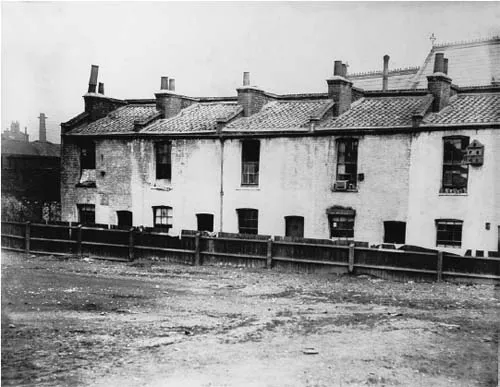
2 Eve Place, c. 1870
Dan was born at 6 Eve Place situated in Somers Town, a sprawling slum that lay on the sloping ground between central London and Camden Town. The Place was a single row of nine dilapidated cottages, ‘two up, two down’ dwellings with little room to accommodate their numerous occupants. The 1861 census, taken when Dan was four months old, shows a total of 51 residents of The Place. A wide range of occupations was recorded; a gold-chain maker, two labourers, a laundress, a butcher’s boy, three errand boys, a jeweller, a grocer’s assistant, a railway carman, an ‘express’ van driver, a coal porter and a French polisher. Dan’s parents, John and Louisa Galvin, were described as ‘comedian’ and ‘vocalist’, with George listed as the youngest of four children. John and Louisa were not the only music-hall performers living in Eve Place – no. 3 was occupied by Benjamin Mills, ‘author and vocalist’, and his wife Elizabeth, ‘vocalist’. Ben had been a well-known comic singer for over 20 years, and written songs for one of the most famous early music-hall performers, J.W. ‘Jacky’ Sharp.
Louisa’s antecedents are obscure. She was born in about 1831, probably in Worthing, a small seaside town close to the Sussex coastal resort of Brighton. Her father, named on her two marriage certificates as Richard Dutton, was a ‘painter’, not of houses, but an ‘artist’. At the birth of her brother James in Carey Street, Westminster, in July 1840, Richard was described as a ‘gentleman’, but when the census was taken in April 1841 Louisa, her young brother, three sisters and mother were living in John Street, Waterloo. The reason for her father’s disappearance may well have been health related – the same census recorded a 45-year-old actor named Richard Dutton as a patient at the Middlesex Pauper Lunatic Asylum. John Galvin’s origins are clearer. Born in 1826, he was recorded on the 1841 census as living with his family in Wild Street, in the notorious central London ‘rookery’ of St Giles. His father, Maurice Galvin, was a labourer, born in about 1791, almost certainly in Ireland. A later census shows that John’s mother, Frances, was born in Northamptonshire in about 1801. Like John, his sisters Mary and Frances and brother Michael were all born in London. Wild Street itself was to possess a special significance for John Galvin, not only providing him with his early home but supplying him and Louisa with their stage noms-de-plume, ‘Mr and Mrs Johnny Wild’, and his son with an unusual middle name.
John and Louisa were married at St John’s Church, Waterloo, on 2 January 1850. St John’s is an imposing and elegant neo-classical building that still stands at the south side of Waterloo Bridge facing the railway terminus. When John and Louisa married, the church was relatively new, one of a number constructed in the 1820s to minister to the spiritual needs of Lambeth’s mushrooming population. Waterloo Station was an even more recent addition to the south-east London landscape, the first train – the Southampton Mail – having arrived there on 13 July 1848. The Galvins gave nearby Ann Street as their address when registering the wedding, but they were soon to leave London for a number of years. At about this time the older Galvin family appears to have met with disaster. The 1851 census records Frances, widowed and working as a charwoman, living with 14-year-old Michael in new, crowded lodgings in St Giles.
The Galvins’ movements throughout the 1850s can be traced through the births of their children. The eldest, John, was born in Dublin in 1851, and a girl, Frances Elizabeth, in Liverpool in 1852. At this time John, like his father, was a labourer, but by the birth of Henry Michael in Salford, Lancashire, in 1854 he had become a commercial traveller. Despite John’s roving occupation the family appear to have settled in Salford for some time, Maurice Danvers Galvin being born there in 1855. By 1859 when Louisa Mary was born the family had returned to London, where John and Louisa pursued careers as music-hall performers.
Before moving to Eve Place the Galvins had occupied lodgings in Gloster Buildings, White Cross Street, St Luke’s, a slum area situated between Old Street and the Barbican. White Cross Street was famous, or infamous, for a massive street market that sold leather goods, clothes, household items and, perhaps of some interest to John and Louisa, cheap literature and street ballads. Tradition links Mr and Mrs Johnny Wild with the Rotunda, a predominately working-class hall close to Blackfriars Bridge, Southwark, but there were scores of similar establishments in which they might have performed. It is almost certain that they appeared in the vicinity of John’s childhood home in Wild Street. Concert rooms abounded in the area, with the Middlesex Music Hall, opened in 1851, standing just a few yards away in Drury Lane. Despite some attempts to elevate standards and to provide a more family-orientated entertainment most halls still reeked of their tavern origins. Many, like the Middlesex, which was built onto the Old Mogul Saloon, were still part of the pubs that had engendered them, and it was common practice to offer admission through a refreshment ticket or token which could be redeemed at the bar for alcohol.
G. M. W. Reynolds described the ‘Old Mo’ during the 1850s as:
[A] large room holding several hundred persons: concerts and performances every night: frequented by all kinds of people: great numbers of dissolute livery servants meet here: also young apprentices and their girls. The landlord keeps it as respectable as he can.2
The proprietor of the Black Bull, in Windmill Street, Haymarket, had no such interest in maintaining respectability:
Music and dancing at this place: singing to a piano accompaniment. Most of the men frequenting are cross coves, thimble-men, or swell-mobsmen: the females are women of the town. A great many juveniles visit this house, young thieves with their girls. The waiter is a comic fellow, sings comic songs, is on good terms with everybody and sips of everybody’s brandy-and-water with the most condescending friendship: always calling for ‘ladies and gentlemen to give their orders’. The songs sung at this place are not indecent, mostly humorous.3
One such a humorous song from music hall’s early days suggests that the entertainers, like the entertainment, were frequently fuelled by drink:
In a garret I show’d my nob [head]
In Earl Street, Seven Dials,
My father was a snob [shoemaker],
My mother dealt in wials;
But my mind took higher flights,
I hated low-life things!
Made friends with a cove wot writes,
Now I’m the chap what sings.
Chorus: Tol de rol, etc.
When at singing I made a start,
Some said my voice was fine;
I tried a serious part,
But turned to the comic line;
I found out that that was best,
Some fun it always brings –
To the room it gives a zest,
And it suits the cove wot sings.
To a concert, ball or rout,...
Table of contents
- Cover
- Author biography
- Title page
- Copyright page
- Contents
- List of Illustrations
- Foreword by Roy Hudd OBE
- Acknowledgements
- 1 Prelude
- 2 An Inconvenience
- 3 The Infant Wonder
- 4 Nightmare Years
- 5 Monarch in Wooden Shoes
- 6 Leno’s Grand Varieties
- 7 The Talk of London
- 8 Dame Durden and Mr Tambo
- 9 The War between the Sexes
- 10 The Reign of Augustus
- 11 Cruffins and Mumpets for Tea
- 12 A Large, Genial Gentleman
- 13 Popularity
- 14 Regime Change in Drury Lane
- 15 The Funniest Man on Earth
- 16 Orlando Dando
- 17 Grimaldi’s Scissors
- 18 The Living Image
- 19 The Apotheosis of St Dancras
- 20 Postscript
- Notes
- Select Bibliography
Trusted by 375,005 students
Access to over 1.5 million titles for a fair monthly price.
Study more efficiently using our study tools.
Frequently asked questions
Yes, you can cancel anytime from the Subscription tab in your account settings on the Perlego website. Your subscription will stay active until the end of your current billing period. Learn how to cancel your subscription
No, books cannot be downloaded as external files, such as PDFs, for use outside of Perlego. However, you can download books within the Perlego app for offline reading on mobile or tablet. Learn how to download books offline
Perlego offers two plans: Essential and Complete
- Essential is ideal for learners and professionals who enjoy exploring a wide range of subjects. Access the Essential Library with 800,000+ trusted titles and best-sellers across business, personal growth, and the humanities. Includes unlimited reading time and Standard Read Aloud voice.
- Complete: Perfect for advanced learners and researchers needing full, unrestricted access. Unlock 1.5M+ books across hundreds of subjects, including academic and specialized titles. The Complete Plan also includes advanced features like Premium Read Aloud and Research Assistant.
We are an online textbook subscription service, where you can get access to an entire online library for less than the price of a single book per month. With over 1.5 million books across 990+ topics, we’ve got you covered! Learn about our mission
Look out for the read-aloud symbol on your next book to see if you can listen to it. The read-aloud tool reads text aloud for you, highlighting the text as it is being read. You can pause it, speed it up and slow it down. Learn more about Read Aloud
Yes! You can use the Perlego app on both iOS and Android devices to read anytime, anywhere — even offline. Perfect for commutes or when you’re on the go.
Please note we cannot support devices running on iOS 13 and Android 7 or earlier. Learn more about using the app
Please note we cannot support devices running on iOS 13 and Android 7 or earlier. Learn more about using the app
Yes, you can access The King's Jester by Barry Anthony in PDF and/or ePUB format, as well as other popular books in History & British History. We have over 1.5 million books available in our catalogue for you to explore.