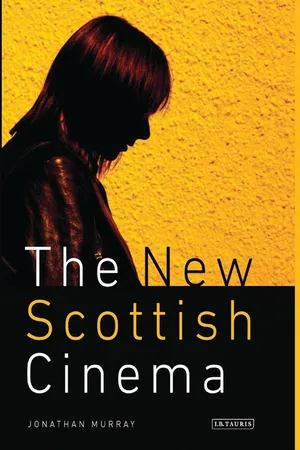
From a near standing start in the 1970s, the emergence and expansion of an aesthetically and culturally distinctive Scottish cinema proved to be one of the most significant developments within late-twentieth and early twenty-first-century British film culture. Individual Scottish films and filmmakers have attracted notable amounts of critical attention as a result. The New Scottish Cinema, however, is the first book to trace Scottish film culture's industrial, creative and critical evolution in comprehensive detail across a forty-year period. On the one hand, it invites readers to reconsider the known - films such as Shallow Grave, Ratcatcher, The Magdalene Sisters, Young Adam, Red Road and The Last King of Scotland. On the other, it uncovers the overlooked, from the 1980s comedic film makers who followed in the footsteps of Bill Forsyth to the variety of present-day Scottish film making - a body of work that encompasses explorations of multiculturalism, exploitation of the macabre and much else in between.In addition to analysing an eclectic range of films and filmmakers, The New Scottish Cinema also examines the diverse industrial, institutional and cultural contexts which have allowed Scottish film to evolve and grow since the 1970s, and relates these to the images of Scotland which artists have put on screen.
In so doing, the book narrates a story of interest to any student of contemporary British film.
- 304 pages
- English
- ePUB (mobile friendly)
- Available on iOS & Android
eBook - ePub
The New Scottish Cinema
About this book
Information
1
METAMORPHOSIS: SCOTTISH CINEMA, 1990–95
27 March 1995: a Scottish filmmaker enjoys what at that time was an unaccustomed moment in the sun. In Los Angeles, writer/director Peter Capaldi wins the Best Short Film Oscar for his 25-minute drama Franz Kafka’s It’s a Wonderful Life (GB, 1993). Capaldi’s film was one of the first projects produced through the then recently launched Tartan Shorts scheme, a collaborative initiative between the Scottish Film Production Fund and BBC Scotland. The work cross-pollinates the eponymous Czech writer’s travails as he strives to start writing his 1915 novella Metamorphosis with the cathartic crisis endured by George Bailey (James Stewart), the hero of the canonical Classical Hollywood movie It’s a Wonderful Life (Frank Capra, USA, 1946). The cohabitants of Kafka’s Prague garret rally round the troubled and isolated writer on Christmas Eve, and their support enables him to begin work on his masterpiece.
This individual success proved symptomatic of a wider upturn in Scottish cinema’s fortunes during the early 1990s. This is because the unlikely choice of cultural reference points juxtaposed within the title of Capaldi’s work indicates the terms of a film industrial metamorphosis which took root in Scotland during the years in question. If the history and practice of European Modernism structures Franz Kafka’s… narrative premise, it is the legacy of Hollywood populism that endows the film’s climax with comedic and emotional impact. Analogously, the story of a rapidly evolving Scottish film culture between 1990 and 1995 was one of industrial and aesthetic practices associated with traditions of European Art Cinema (formally innovative, subsidy-dependent, non-commercial) giving ground to successors derived from mainstream American counterparts. In Capaldi’s short, Kafka’s Metamorphosis is an as-yet-unwritten literary classic in the very earliest stages of composition. As such, that book is used to communicate one possible vision of artistic production, that of a fundamentally isolated and precarious experience, one to be endured, rather than enjoyed. Kafka’s downstairs neighbour, for instance, notes that ‘Mr K’ is ‘frail – like many of the artistic disposition’. Yet the film’s simultaneous references to It’s a Wonderful Life set out a very different conception of the creative act: an individual moment of transcendence made possible only by the development and maintenance of a wider enabling infrastructure of support. Some contemporary observers understood the state of early-1990s Scottish cinema in a similar light: piecemeal local engagements with European Art cinema models supplanted by a more systematic and entrepreneurial attempt to weave local variants into the weft of various popular American cinematic practices past and present. Writing in the same year as Franz Kafka’s… Oscar, John Brown argued that:
The new generation of Scottish filmmakers shows little sign of being interested in arthouse fare. Their sights are set on making the Scottish equivalents of El Mariachi [Robert Rodriguez, Mex/USA, 1992], Just Another Girl on the I.R.T. [Leslie Harris, USA, 1992] and Reservoir Dogs [Quentin Tarantino, USA, 1992]… and getting them into the multiplexes.1
This proved a remarkably accurate prediction of Scottish cinema’s developmental trajectory during the early 1990s and beyond. This chapter’s discussion of four case studies from the period – The Big Man (David Leland, GB, 1990), Soft Top, Hard Shoulder (Stefan Schwartz, GB, 1993), Rob Roy (Michael Caton-Jones, USA/ GB, 1995) and Shallow Grave (Danny Boyle, GB, 1995) – illustrates and explains the contemporary rise of two key indigenous production templates: the Scottish independent film (Soft Top…, Shallow Grave) and the Scottish Classical movie (The Big Man, Rob Roy). After being established between 1990 and 1995, this diptych went on to structure much of the indigenous feature work produced in Scotland between 1995 and 2001, as Chapter 2 will go on to show.
Any comprehensive account of 1990s Scottish cinema must acknowledge the deep pessimism that dominated the period’s early part, dispiriting years when observers bemoaned Scottish film culture’s seemingly intractable industrial underdevelopment. In 1990, the documentary filmmaker Murray Grigor complained that, ‘if film-making were an industry [here in Scotland] it would have investors and a proper production structure… new talent takes a bow before heading for more rewarding territory’.2 Gillies Mackinnon, one of the very few indigenous feature filmmakers to emerge during the late 1980s and early 1990s, regretted in 1992 the fact that, ‘after Bill Forsyth’ a decade before, Scotland had produced ‘nothing of any great significance’.3 That same year, Peter Meech and Richard Kilborn wondered if it were ‘really possible to look forward to the growth of a national cinema when the number of indigenous films produced… in the last five years has averaged just under two a year?’4
Parlous infrastructural fragility explains this contemporary collective gloom. Scotland’s largest public funder, the Scottish Film Production Fund, had seen its annual investment pot grow from £80,000 in 1982 to £214,000 by 1990. But Ian Lockerbie, the Fund’s outgoing chairman, conceded that the latter figure remained ‘puny when set against the actual costs of film production’.5 Meanwhile, what little production infrastructure did exist in Scotland was contracting at a frightening rate. Rank, the only film processing laboratory in the country, and Blackcat, Scotland’s only permanent studio space, both closed their doors in early 1991.6 Channel 4, peremptorily acclaimed in the early 1980s as ‘a radically new source of money and an outlet for Scottish filmmaking’,7 was seen to have disappointed such hopes ten years on. Film and television commissions dispensed year-on-year by the broadcaster to Scottish independent producers amounted to only c. 10 per cent of the annual levy Channel 4 extracted from advertising revenues raised by Scottish commercial broadcasters.8 Indeed, in 1989 Channel 4’s outgoing Chief Executive, Jeremy Isaacs, admitted regret that the company had not ‘done enough for Scotland’9 in commissioning terms. Against this depressing backdrop, the obvious conclusion to draw was that ‘we have struggled to establish a distinctive moving screen culture simply because there just aren’t enough opportunities to do this kind of work on home soil’.10
But Franz Kafka’s… Oscar success proved the first in a series of brighter signs seen in Scotland between 1993 and 1997. Independent producer Peter Broughan secured c. £16m of funding from Hollywood studio United Artists to make Rob Roy. BBC Scotland and London-based independent producer Ecosse Films brokered a North American theatrical distribution deal with Miramax Films for Mrs Brown (John Madden, GB/Ire, USA, 1997), turning a modestly budgeted domestic television film into an Oscar-nominated international theatrical success.11 Formed in 1990 to encourage enhanced levels of mobile production activity in Scotland, Scottish Screen Locations helped inject c. £50 million of production spend into the national economy by 1996; some £23 million of that figure was generated in 1994/95 alone.12 Meanwhile, the low-budget Shallow Grave and Trainspotting (Danny Boyle, GB, 1996) each performed exceptionally well at both domestic and global box offices. Recently baleful, the representative tenor of local assessments of Scottish cinema’s industrial prospects instead became bullish. Allan Shiach, Chair of the soon-to-be-established Scottish Screen, confidently proclaimed at the 1996 Edinburgh International Film Festival that ‘film is potentially a massive business for us which has too long been seen as an artsy little enclave’.13 The first stirrings of the significant, if unexpected, industrial expansion witnessed in early-1990s Scotland can be detected in two relatively neglected movies from the period, Soft Top, Hard Shoulder and The Big Man. Both films self-consciously attempt to adapt different American film genres to the cultural and film industrial circumstances of contemporary Scotland. If such a strategy seemed novel at the decade’s outset, it became second nature for many Scottish filmmakers by the period’s end.
The Big Man
The Big Man, an adaptation of William McIlvanney’s 1985 novel of the same name, narrates the devastation of Thornbank, a fictional Scottish mining community, in the aftermath of the 1984/85 miners’ strike. Central protagonist Danny Scoular (Liam Neeson) is an unemployed ex-miner who has served a prison sentence for his part in picket line violence during that bitter industrial dispute. Danny’s wife Beth (Joanne Whalley) has thus become the family breadwinner. Unable to accept this reversal of traditional gender roles, Danny ill-advisedly accepts a commission from a corrupt local businessman, Mason (Ian Bannen), to take part in an illegal bare-knuckle boxing match. He convinces himself that victory in that contest will somehow restore his personal pride and that of Thornbank. But such self-serving folly puts strain on Danny’s marriage: Beth leaves him and starts seeing young middle-class doctor Gordon (Hugh Grant) instead. Danny’s torment deepens when he discovers that Mason is a drug dealer. He rebels against the latter’s control and is saved from the villain’s retribution only by an unexpected physical show of strength led by Beth and the other Thornbank villagers.
The Big Man’s screenwriter, Don McPherson, actively applied the iconography and narrative structure of the Classical Hollywood Western to a story set in 1980s Scotland. McPherson explained that creative decision by making reference to the ‘things that make’ the Western genre, most important among them, a recurrent thematic ‘concern about community, about historical change’.14 Similarly, director David Leland noted a desire to achieve ‘that epic quality’15 which he associated with the Western. The Big Man’s £3.1m production budget – unusually large for late-1980s/early-1990s British cinema – was financed through a long-term working partnership between American producer Miramax and London-based independent Palace Pictures. But Leland’s film performed disastrously at the British box office: eventual receipts (£0.268m), failed even to cover the cost of domestic film prints and advertising (£0.35m).16 Lacking the financial reserves to sustain losses on this and a string of other commercially ambitious American co-productions, Palace went into receivership in May 1992.17
Academic criticism typically sees The Big Man as an ideologically problematic work. Douglas Gifford, for example, argues that the movie’s attempt to link ‘Hollywood film to West of Scotland shabby post-industrial hinterland’ is ‘a too-slick and forced cultural paralleling [that] no longer discusses Scottish issues for themselves’.18 While there is much to recommend that view, The Big Man is worthy of note because it initiated the Scottish Classical production cycle that went on to account for a significant proportion of the feature work produced in 1990s Scotland. Like Rob Roy and several other later films, The Big Man deliberately conflates Scottish national identity with a more exclusive gendered equivalent: a heroic form of working-class masculinity that seeks to sideline potential feminine (and/or feminised) alternatives to it. In this sense, Leland’s work draws on the Western genre’s typical foregrounding of masculine identities and concerns, ‘function[ing] precisely to privilege, examine and celebrate the body of the male’.19 The Big Man’s producer, Steven Woolley, argued that application of classic Western tropes to contemporary Scottish socio-political questions represented a progressive ideological act, an attempt to show and celebrate ‘[how a] community came together under the worst strain of the Thatcher years’.20 But that theoretically laudable project is compromised by the borderline misogynistic gender discourses to which creative reliance on the Western’s narrative and iconographic structures opens The Big Man up.
Only one character within The Big Man echoes Woolley in drawing explicit cultural parallels between Scotland and America. Tellingly, that protagonist proves to be untrustworthy in the extreme. Danny’s childhood friend Frankie (Billy Connolly) is now one of criminal kingpin Mason’s minions, acting as a go-between during Danny’s arduous training for the bare-knuckle boxing match. Although born and raised in Thornbank, Frankie has spent several years living in the US. Recently returned to Scotland, he claims that Glasgow ‘reminds me of New York’, and proclaims Danny to be ‘Thornbank’s answer to Rocky Marciano’. These overblown assertions come to seem as unreliable as everything else that Frankie says and does. He conceals the fact of Mason’s drug-dealing activities from Danny and privately despises the Thornbank locals while assiduously courting them in public. If both Frankie and his creators propose the idea of a profitable dialogue between Scottish and American cultures and identities, the latter figures’ position in this regard is called into question through its association with such a slippery fictional fellow traveller. Ultimately, The Big Man’s overeager attempt at transatlantic dialogue – Danny ‘answering’ Rocky, Clydeside recalling Lower East Side, Scottish social realism mixing with Western mythology – proves ideologically problematic from a local perspective. The film reinforces the reductive, regressive and stereotypical idea of Scottish identity personified by the (over-)familiar figure of the Glasgow Hard Man. Symptomatically, Danny’s first words within the movie, the opening of the speech he gives at his wedding to Beth, subsume his wife’s subjectivity and agency within his own. Falling back on cultural convention, he presumes (quite literally) to speak for her: ‘My wife and I would like to….’ More generally, although The Big Man represents a selective range of different Scottish identities – working-class heroism (Danny), traitorous post-class entrepreneurialism (Mason/Frankie), middle-class ineffectuality (Gordon) – all of these subject positions are coded as masculine. Ostensible differences between central male characters mask the extent to which the film depicts contemporary Scottish culture and identity as phenomena wholly definable by phallocentric metaphors of masculine identity, authority and conflict. Even though Gordon seems to be Danny’s opposite in class, sexual and professional terms, both subscribe to an unspoken ideal of nationality-cum-masculinity enshrined within particularly revered (and traditionally masculine) forms of occupational status. In this sense at least, there is little to choose between a career in mining and one in medicine. The rivals for Beth’s affections each believe that virility, honour and a stable sense of self are secured through masculine agency and primacy in the workplace. For these reasons, The Big Man’s portrayal of Danny’s bare-knuckle boxing match as an aberrant event, an illegal and immoral bloodb...
Table of contents
- Cover
- Title page
- Copyright
- Contents
- List of Figures
- Acknowledgements
- General Editor’s Introduction
- Introduction
- 1. Metamorphosis: Scottish Cinema, 1990–95
- 2. ‘It’s Been Great Working with You’: Scottish Cinema, 1995–2001
- 3. DOGMAC: 2000s Scottish–Scandinavian Cinema
- 4. Travelling Scots: Images of Race and Ethnicity in 2000s Scottish Cinema
- 5. Nazis, Neds and Netherworlds: Scottish Low-budget Genre Cinema of the 2000s
- Afterword
- Notes
- Bibliography
Trusted by 375,005 students
Access to over 1.5 million titles for a fair monthly price.
Study more efficiently using our study tools.
Frequently asked questions
Yes, you can cancel anytime from the Subscription tab in your account settings on the Perlego website. Your subscription will stay active until the end of your current billing period. Learn how to cancel your subscription
No, books cannot be downloaded as external files, such as PDFs, for use outside of Perlego. However, you can download books within the Perlego app for offline reading on mobile or tablet. Learn how to download books offline
Perlego offers two plans: Essential and Complete
- Essential is ideal for learners and professionals who enjoy exploring a wide range of subjects. Access the Essential Library with 800,000+ trusted titles and best-sellers across business, personal growth, and the humanities. Includes unlimited reading time and Standard Read Aloud voice.
- Complete: Perfect for advanced learners and researchers needing full, unrestricted access. Unlock 1.5M+ books across hundreds of subjects, including academic and specialized titles. The Complete Plan also includes advanced features like Premium Read Aloud and Research Assistant.
We are an online textbook subscription service, where you can get access to an entire online library for less than the price of a single book per month. With over 1.5 million books across 990+ topics, we’ve got you covered! Learn about our mission
Look out for the read-aloud symbol on your next book to see if you can listen to it. The read-aloud tool reads text aloud for you, highlighting the text as it is being read. You can pause it, speed it up and slow it down. Learn more about Read Aloud
Yes! You can use the Perlego app on both iOS and Android devices to read anytime, anywhere — even offline. Perfect for commutes or when you’re on the go.
Please note we cannot support devices running on iOS 13 and Android 7 or earlier. Learn more about using the app
Please note we cannot support devices running on iOS 13 and Android 7 or earlier. Learn more about using the app
Yes, you can access The New Scottish Cinema by Jonathan Murray in PDF and/or ePUB format, as well as other popular books in Media & Performing Arts & Film Direction & Production. We have over 1.5 million books available in our catalogue for you to explore.