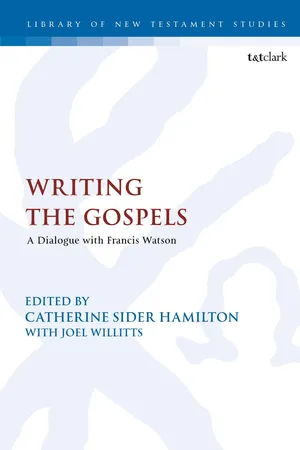
In this book prominent biblical scholars engage with Francis Watson's most striking arguments on the creation of the gospels. Their contributions focus in particular on his argument for a fourfold gospel rather than four separate gospels, his argument against Q but for an early sayings collection, and on the larger landscape of Jesus studies, gospel reception and interpretation
The contributors ask whether, and in what ways, Watson's reorientation of gospel studies is successful, and explore its implications for research. Leading scholars including Jens Schröter, Margaret Mitchell, Richard Bauckham and many others provide a close critical and creative engagement with Watson's work. More than merely a critical review of Watson's writing, this book carries forward his work with fresh treatments and provides an essential volume for students and scholars seeking to understand the landscape of gospel studies and to explore new directions within it.
eBook - ePub
Writing the Gospels
A Dialogue with Francis Watson
- 296 pages
- English
- ePUB (mobile friendly)
- Available on iOS & Android
eBook - ePub
Writing the Gospels
A Dialogue with Francis Watson
About this book
Information
Part I
Critical Assessments of Gospel Writing and The Fourfold Gospel
Chapter 1
Gospels Before Normativization: A Critique of Francis Watson’s Gospel Writing
Richard Bauckham
Francis Watson’s Gospel Writing is an important and admirable book. I wish to state that emphatically at the outset because much of this review will be highly critical. Usually I would judge a book of this length (665 pages) to be too long, but this one certainly is not. It is wide-ranging but coheres closely around a strong, overall thesis to which every part contributes significantly. It is lucidly written, and often a delight to read. It is full of original insights and provocative thoughts. It turns many a topic around and invites us to see it quite differently—and, even if we are unpersuaded, that will have made a permanent difference to how we see it. Above all, it is full of energetic argument and focused intelligence. I have learned a lot from it and have had to work hard to disagree with it. Moreover, I am sympathetic (as doubtless not all reviewers will be) to his project of combining historical, hermeneutical, and theological approaches in what he calls “historically informed theological hermeneutics.”1
Watson intends a paradigm change in the way in which we consider how gospels originated and relate to each other. Standard accounts are limited to the canonical gospels and to the first century (both artificial limits). A canonical perspective (his subtitle) does not mean just reading the canonical gospels as a fourfold collection; it means investigating the history of the reception of the Jesus tradition from the earliest period (so far as this is accessible) through a process of interpretation and reinterpretation that does not distinguish canonical and non-canonical gospels, up to the sea-change that occurred with canonization (in Watson’s terminology “normativization”). Before that stage all gospels must be interpreted in relation to each other, without regard to their later canonical or non-canonical status. After that stage, theological hermeneutics works with a new creation, the Fourfold Gospel, which requires the four to be interpreted in relation to each other and only in relation to each other.
Along the way this project involves detailed treatments of many relevant topics, invariably in original ways that cry out for detailed discussion and evaluation. Since I do not have space to comment on all, I shall select specific topics for comment, with no implication that they are more important than others.
Against Q
Watson’s book could have been subtitled How to dispense with Q and get our theology right at the same time. A remarkable amount of the discussion actually revolves around Q. This is because Watson sees the Q hypothesis and its success as the central plank in the “dismantling of the canon” (of the Fourfold Gospel) in modern Gospels scholarship, the history of which, from Reimarus to Harnack, he relates in some detail in Chapter 2. This account of the history of the Synoptic Problem is designed to climax in Harnack’s view of Q as the earliest and most reliable source for the historical Jesus, preferable to Mark, giving us Jesus unadulterated by the theological interpretations of Jesus that pervade the New Testament. The Q hypothesis therefore represents for Watson the overarching theological error of modern study of the Gospels: its quest, pursued by means of source criticism, for the uninterpreted Jesus behind the Gospels. Watson, while not abjuring source criticism, wishes to create a new framework that, instead of working backward to the “most original” form of the Gospel tradition, traces rather the forward movement of the tradition, the process of the reception of Jesus and the written interpretations of him, culminating in the formation of the canon. In this new framework, source criticism takes its place, not as a means of moving backward, but, through observation of the way an author (such as Luke or John) interprets his sources, as a means of tracing the forward movement of constant reinterpretation of the Jesus tradition. Removing Q from the account of Gospel origins becomes almost a symbol of this reversal of hermeneutical direction.
One cannot deny that Harnack’s view of Q is persistent, but it is somewhat misleading to end the story with him. The landscape of Gospels criticism was transformed after Harnack by form criticism, whose effect was to separate Jesus even from Q by a gulf of oral transmission of traditions. This effectively meant that the quest, if it was to be viable at all, could not proceed simply by identifying reliable early sources. Every individual unit of the tradition had to be assessed separately by means of the famous criteria of authenticity. Mere presence in Q did not guarantee the authenticity of a saying. An interesting feature of Watson’s own account of gospel origins is that he minimizes the importance of oral tradition, at least in the sense that he thinks the oral and the written co-existed and interacted all along. While abolishing Q, he fills the period before Mark instead with early Sayings Collections.
Watson is well aware that a source-critical hypothesis cannot be refuted by theological argument. The strength of the Q hypothesis lies in its claim to be the most adequate explanation of the literary relationship between Matthew and Luke. So Watson must refute it in those terms and put another hypothesis in its place. In this book he has become probably, after Mark Goodacre, the foremost contemporary proponent of the Farrer hypothesis, which he calls the L/M hypothesis. Yet the source critical and the theological remain fused. Chapters 3 and 4, which contain his refutation of the Q hypothesis and his account of how Luke interpreted Matthew, designed to make the L/M hypothesis plausible, are laced with comments suggesting that if one resists his interpretation of much in Luke’s Gospel as highly creative interpretation of Matthew, this will be because one fails to assess this positively as a feature of the tradition’s own ongoing dynamic, in which (he can go so far as to say) Jesus was continually reinterpreting himself (e.g., 208).
While it is not my purpose to defend Q, it seems to me that Watson has given unwarranted importance in his program to dispensing with Q and the accompanying hypothesis of Lukan creativity in interpreting Matthew. I do not see why, should one judge the Q hypothesis to be the most plausible explanation of the data of the Synoptic Problem, one could not integrate Q into a framework like Watson’s. Q would be an early interpretation of Jesus (does anyone still seriously believe it gives us Jesus uninterpreted, as Watson’s rhetoric so often imputes?) and one could observe the dynamic of ongoing interpretation in the ways that Matthew and Luke receive and interpret Q. Conversely, one could accept the L/M hypothesis merely as a way of dismissing Luke as any kind of source for knowing about the historical Jesus. The backward and forward movements, with their respective theological freight, are both possible with or without Q.
Watson’s case against Q is based on what he calls “coincidences” between Matthew and Luke for which Q does not account. For example, both have extended birth narratives including annunciation stories and genealogies. I have read more persuasive cases against Q.2 A general weakness that I see in Watson’s book is his almost complete failure to refer to any ancient literature other than gospels (canonical and otherwise) and patristic writing about the gospels. Insistent as he is that the canonical gospels should not be studied in isolation from other gospels, he nevertheless treats gospel literature as an isolated field of study. For example, he takes no account whatever of the now widely accepted view that the canonical gospels (and some of the non-canonical) fit the generic category of Graeco-Roman biography (βίος). In such a work it was standard to begin with an account of the subject’s ancestry, birth and early life, often including omens or prophecies of his future greatness. To those familiar with such works, Mark must have seemed deficient in this respect. It would not be surprising if two writers, engaged in expanding Mark, should independently seek to remedy this deficiency. If Luke had access to a traditional genealogy of the family of Jesus (as I have argued at length his genealogy is),3 it would be natural for him to include it. Matthew’s genealogy fulfills a quite different function as the introduction to his gospel, resuming the history of Israel, with its messianic promise, and connecting the story of Jesus with it.
The birth and infancy stories in both Gospels are, of course, saturated with Old Testament allusions, including, in Matthew’s case, analogies to the birth and infancy of Moses, and, in Luke’s case, to the birth of Samuel. Stories of the “annunciation” of key figures before their birth are to be found in the Old Testament, developed and multiplied in later Jewish literature. In Genesis, Isaac’s name is announced before his birth (which is also miraculous); in Pseudo-Philo’s Biblical Antiquities this privilege is extended to Samson and Samuel. In such a literary context, it does not seem to me very surprising that both Matthew and Luke should tell such a story about Jesus. When we put these Gospels in their wider literary contexts, both Graeco-Roman and Jewish, the coincidences look much less remarkable.
Nor should Raymond Brown’s argument that the coincidences derive from shared tradition with historical origins be disparaged on the theological grounds that it values history over interpretation (as it is by Watson: 132–33). Brown does not devalue the interpretations of Matthew and Luke but sees them as interpretations of some genuine historical data. This is how Watson himself sees some other parts of the gospel narratives. He just opts to see the birth narratives as pure interpretation (of what?). But this point illustrates how Watson’s theological approach mingles with more purely literary and historical arguments against Q.
Watson’s case against Q rests entirely on what he calls the “coincidences of Q” (i.e., correspondences that would be coincidences if Matthew and Luke were independent of each other). These do not include the Minor Agreements (scarcely mentioned by Watson) but refer to large-scale correspondences in the earlier parts of the two Gospels. As I have already indicated, I do not find all of these convincing. The strongest argument among Watson’s “coincidences” is that Matthew ties his Sermon on the Mount and Luke his Sermon on the Plain to the same Markan context (Mark 3:7–10). Thus, although Matthew and Luke hardly ever place the same Double Tradition material in the same Markan context (a fact commonly advanced in favor of Q), in this one case they rather impressively do. But, suppose Watson is right that Matthew and Luke are not completely independent, is the only possible explanation of the Double Tradition material that Luke drew it from Matthew?
Clearly not. If Q existed, there is no improbability in supposing that Luke knew Matthew and both of Matthew’s two major sources, Mark and Q. On Watson’s hypothesis, Luke must have known Mark as well as Matthew, and most of the time he prefers to draw his Markan material direct from Mark, not from Matthew’s redaction of Mark. He could have exercised the same preference for Matthew’s other source, Q, over Matthew’s version of it. Surely it is even probable that he would. He could have taken some hints from Matthew as to how to fit the Q material together with Mark’s narrative, but have generally disapproved of the way Matthew used Q, just as he evidently disapproved of Matthew’s rearrangements of Mark, usually restoring the original Markan order. So, if the L/M hypothesis fails to give a convincing account of how Luke could have derived all his Double Tradition from Matthew, it remains a perfectly plausible hypothesis that Luke knew Matthew, Mark, and Q.
Watson rules out such a hypothesis: “Q’s existence can only be sustained if Matthew and Luke write independently of each other,” for “if Luke can be shown to take even a single item from Matthew, he may also have taken others from the same source” (120). But this “may” does not amount to a “must.” A great deal depends on whether an intelligible and plausible account can be given of precisely how Luke has used Matthew if all his Double Tradition material derived from Matthew. For the time being, that means that much depends on whether we find Watson’s account of that convincing. It is surely the best such detailed account to have been offered so far.
It is, of course, true that most advocates of Q treat the independence of Matthew and Luke virtually as part of the Q hypothesis. But the history of research on the Synoptic Problem is not a good basis for rejecting without due consideration hypotheses that have not ...
Table of contents
- Cover
- Half-Title
- Dedication
- Title
- Contents
- List of Contributors
- Preface
- Permissions
- Abbreviations
- INTRODUCTION: FRANCIS WATSON’S GOSPEL WRITING AND THE FOURFOLD GOSPEL: ENGAGING A “NEW PARADIGM”
- Part I CRITICAL ASSESSMENTS OF GOSPEL WRITING AND THE FOURFOLD GOSPEL
- Part II GOSPEL WRITING AND GOSPEL SOURCES
- Part III GOSPEL WRITING AND THE FOURFOLD GOSPEL
- Part IV FRANCIS WATSON’S RESPONSE
- Bibliography
- Index of Subjects
- Index of Scripture and Other Ancient Sources
- Copyright
Trusted by 375,005 students
Access to over 1.5 million titles for a fair monthly price.
Study more efficiently using our study tools.
Frequently asked questions
Yes, you can cancel anytime from the Subscription tab in your account settings on the Perlego website. Your subscription will stay active until the end of your current billing period. Learn how to cancel your subscription
No, books cannot be downloaded as external files, such as PDFs, for use outside of Perlego. However, you can download books within the Perlego app for offline reading on mobile or tablet. Learn how to download books offline
Perlego offers two plans: Essential and Complete
- Essential is ideal for learners and professionals who enjoy exploring a wide range of subjects. Access the Essential Library with 800,000+ trusted titles and best-sellers across business, personal growth, and the humanities. Includes unlimited reading time and Standard Read Aloud voice.
- Complete: Perfect for advanced learners and researchers needing full, unrestricted access. Unlock 1.5M+ books across hundreds of subjects, including academic and specialized titles. The Complete Plan also includes advanced features like Premium Read Aloud and Research Assistant.
We are an online textbook subscription service, where you can get access to an entire online library for less than the price of a single book per month. With over 1.5 million books across 990+ topics, we’ve got you covered! Learn about our mission
Look out for the read-aloud symbol on your next book to see if you can listen to it. The read-aloud tool reads text aloud for you, highlighting the text as it is being read. You can pause it, speed it up and slow it down. Learn more about Read Aloud
Yes! You can use the Perlego app on both iOS and Android devices to read anytime, anywhere — even offline. Perfect for commutes or when you’re on the go.
Please note we cannot support devices running on iOS 13 and Android 7 or earlier. Learn more about using the app
Please note we cannot support devices running on iOS 13 and Android 7 or earlier. Learn more about using the app
Yes, you can access Writing the Gospels by Catherine Sider Hamilton, Joel Willitts, Catherine Sider Hamilton,Joel Willitts in PDF and/or ePUB format, as well as other popular books in Theology & Religion & Biblical Criticism & Interpretation. We have over 1.5 million books available in our catalogue for you to explore.