- 896 pages
- English
- ePUB (mobile friendly)
- Available on iOS & Android
eBook - ePub
About this book
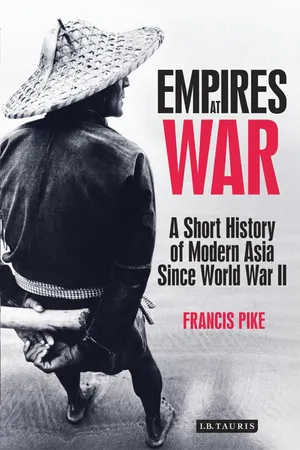
Asia - with four billion people, almost two-thirds of the world's population, a huge landmass and the fastest-growing economies - has in the past decade transformed the geopolitical global balance. "Empires at War" gives a dramatic narrative account of how this 'Modern Asia' came into being. Taking the bombing of Hiroshima on 6th August 1945 as its starting point, Francis Pike chronicles the modern fortunes of fourteen Asian countries. The iconic figures of post-World War II Asia - Mao, Gandhi, Nehru, Ho Chi Minh, Kim Il Sung, General MacArthur and Lord Mountbatten - figure prominently but so also do a great many lesser-known but pivotal figures. Francis Pike weaves the dramatic events and episodes of the region - the great battles between American and Soviet-backed forces in Korea and Vietnam but also episodes such as Indian 'Partition', Japan's 'Lost Decade', Indonesia's 'Year of Living Dangerously' and Cambodia's 'Killing Fields' - into a coherent whole, which forms the essential guide to the history of modern Asia.
Information
PART I
American Empire and Its Competitors
1621–1945
1621–1945
1
American Empire and Its Competitors
America: 1621–1945
Ancestors give them the love of equality and of freedom; but God Himself gave them the means of remaining equal and free by placing them upon a boundless continent.
Alexis de Tocqueville, ‘Democracy in America’ (1835)1
The USA has been the most expansionist and successful empire of the modern age. The early American settlers proved to be hardy adventurers; a spirit of enterprise and taste for commercial venture ran through their veins, and above everything, they possessed an all-consuming appetite for land. The achievements of these early pioneers and their successors were truly astonishing. From their tenuous foothold on the eastern seaboard of America, the colonists survived their early hardships, to win independence, establish nationhood and then conquer the North American continent.
Old empires were challenged. Both Spain and France were overwhelmed by the newcomers. Great Britain was forced to agree to American suzerainty over the Oregon territories. The independent kingdom of Hawaii was colonised and its people subjugated. Having become a major participant in the Chinese opium trade, American forces landed in Guangzhou and defeated a Chinese army in pitched battle. Also, Commander Mathew Perry’s black-hulled gunboats forced Japan to open its markets.
By the end of the nineteenth century, Imperial Russia, aware that it could no longer defend Alaska and Oregon from the pioneer onslaught, sold Alaska and all its claims and was pushed off the American continent. In a dispute over Cuba, the American fleet stationed in Hong Kong sailed to the Philippines, sank the Spanish fleet in Manila Bay and took its colonial possessions in Asia. The USA had become the emerging new power in Asia; the formerly dominant position of Great Britain was now challenged. Towards the end of the nineteenth century, Admiral Shufeldt wrote that the Pacific was the ocean bride of America and that Japan and China were the bridesmaids.
By the end of the First World War, the USA, under President Woodrow Wilson, had victoriously sent an army to Europe, and then dominated the protracted peace negotiations at Versailles. America subsequently dictated the size of British and Japanese navies at the Washington Naval Treaty (1922) and the subsequent London Treaties (1930 and 1936). The Great Depression notwithstanding, by the end of the Second World War, the USA accounted for more than half of global economic output. By 1945, in just 324 years after the arrival of the Pilgrim Fathers, the USA had become an economically prolific and populous nation and the great arbiter of world power. As the historian Paul Johnson has concluded, the Americans had achieved ‘the transformation of a mostly uninhabited wilderness. . . .’2
In Asia, moreover, in the vacuum created by the defeat of Japan, the collapse of the European Empires and the economic exhaustion of Great Britain, America was left standing at the head of a vast Asian hegemony. Also, as the world’s only nuclear power, not just Asia but the world lay at its feet. In explaining the origins of this great surge of humanity across the American continent and Asia beyond, which catapulted America to the head of the world’s nations, it is necessary to look at the origins and character of the mass migration which made it possible. This had its beginnings in Europe in the seventeenth and eighteenth centuries with the emergence of modern nation states which had intellectually revolutionary concepts of government, technological advances, rapidly growing economies and burgeoning populations.
The Rise of European Nations and Migration to America
Arriving some 28 years after the Pilgrim Fathers committed themselves to set up a colony in newly discovered America, the 1648 Treaty of Westphalia, which settled the Thirty Years War, proved a defining moment in the development of the modern nation state. Before 1648, ‘Europe was thought of as a collection of communities arranged vertically in a hierarchy, at the head of which reigned the temporal power of the Emperor and the spiritual power of the Pope.’3 Writing in 1677, the German philosopher Leibniz, seeking an answer to the establishment of perpetual peace, was looking back to history when he suggested that ‘All Christian Kings and princes are subject to the orders of the Universal Church, of which the Emperor is the Director and temporal head.’4
In truth, after Westphalia, the teetering remnants of the Holy Roman Empire were finally shattered; Rome’s claims to European suzerainty were effectively ended. The drawing to a close of one empire in Europe was to have a profound effect on the emergence of a new nation on the other side of the Atlantic, a country that would achieve nationhood and become the world’s dominant hegemonic power.
Even before the Thirty Years War, the power of Rome had been under threat from the rise of the secular ‘nation states’. More than a century earlier, Henry VIII had severed the English church from Rome, and in spite of his autocratic qualities, best displayed in the despatch of successive queens, he had overseen significant advances in the development of constitutional government and the development of legal process; furthermore, ‘enclosures’ – the process by which feudal strip farming was replaced by more efficient agricultural practice – proceeded rapidly during this period and, by its liberation of capital and labour from the land, laid the preconditions of an industrial economy. The organs of a modern state had been formed. Nevertheless, his daughter, Queen Elizabeth I, had had to battle a Spanish armada and the constant threat of a European alliance which aimed to bring England and the United Provinces (the Netherlands) back to Rome.
It was not only in England that the Reformation transformed the relationship between the state and its people. Before Protestantism, the European monarchies could appeal above the heads of national interest groups to the Roman Church and to God. The severance of the Roman link forced the northern protestant monarchies, in addition to the Republic of the United Provinces, to increasingly focus attention on cultivating support and validation from temporal interest groups, not only the nobility but more importantly the rising commercial class.
In effect, the Treaty of Westphalia accepted the separation of the protestant nations and ‘defined the modern idea of sovereignty of the nation which declared that a state’s domestic conduct and institutions were beyond the reach of the other states’.5 Henceforth, a state’s accumulation of power would be independent of international religious bonds but increasingly beholden to domestic institutional structures. In international politics, until the arrival of Napoleon, an uneasy recognition of the new nations was accepted as the norm. Writing in 1751, Voltaire noted that the European states were ‘at one in the wise policy of maintaining among themselves as far as possible an equal balance of power’.6
France, which had consolidated its own borders and effectively ended English claims to the throne by the mid-fifteenth century, emerged as the greatest of the new nation states after the Thirty Years War. French power and culture reached its apogee in the glittering reign of Louis XIV, ‘the Sun King’. France was only briefly diminished by the collapse of the Bourbon monarchy. Following the French Revolution, Napoleon would threaten to unite Europe under French power. England, perhaps ‘constitutionally’ and ‘institutionally’ the most sophisticated of Europe’s new nations, battled France, not with the aim of creating a European Empire but with the objective, achieved by British Foreign Minister Castlereagh at the 1815 Congress of Vienna, of creating a balance of power between independent nation states.
Meanwhile, the Hapsburg Empire, the great fourteenth-century power centred on Austria, was much diminished in the aftermath of Westphalia, but would stagger along in increasing decrepitude. Just over a century later, the empire, centred in Vienna, would lose its dominant position in Germany to Frederick the Great of Prussia, the last of Europe’s warrior kings. A final ‘coup de grâce’ was not given until 1919, when, after the First World War, President Wilson’s utopian vision of ‘self-determining nation states’ gave independence to the Eastern European states such as Hungary and Czechoslovakia at the Treaty of Versailles.
Spain, the strongest of European countries in the late-fifteenth and sixteenth centuries, had been in steady decline after the great gold-induced inflation and subsequent depression of the sixteenth century. Population continued to fall in the seventeenth century, and the loss of vitality and declining birth rate seriously compromised Spain’s ability to sustain its New World Empire in the face of the rapid expansion of the Anglo-Saxon colonies in North America. A British traveller contemptuously observed of Spain’s American Empire that
The sole purpose for which the Americas existed was held to be that of collecting together the precious metals for the Spaniards; and if the wild horses and cattle which overrun the country could have been trained to perform this office the inhabitants might have been altogether dispensed with, and the colonial system would then have been perfect.7
Indeed, gold and silver accounted for 90 per cent of South America’s exports to Spain, and in aggregate, bullion from this source amounted to more than 50 per cent of global coinage.
Within the space of a little over 20 years, Spain’s 300-year-old American Empire, which comprised the Audiencias of Mexico (extending into New Mexico, California, Texas and Florida) and Santo Domingo; the captaincy-generalships of Guatemala and Cuba and of Santiago de Chile (modern Chile); the presidency of Quito (approximately modern Ecuador); the Audiencias of Santa Fé de Bogotá (modern Colombia), of Caracas (modern Venezuala), of Buenos Aires (modern Argentina) and of Cuzco (modern Peru); and the presidencies of Asunción (modern Paraguay), Charcas (modern Bolivia) and Banda Oriental (modern Uruguay), was destroyed. The trigger to this collapse was the forced abdication by Napoleon of Charles IV of Spain and his son Ferdinand VII in 1808, and their replacement on the Spanish throne by Napoleon’s elder brother Joseph Bonaparte.
However, with the example of the USA to the north, combined with the promptings of General Miranda – a freebooting soldier with epicurean taste, a former lover of Catherine the Great of Russia and the father of revolutionary thought in South America – the seeds of revolt had already been sown. England also participated, only too keen to revenge itself for the loss of its own colonies; the Pan-American Centennial Congress of 1926 noted that ‘there was no battlefield in the war of Independence on which British blood was not shed’.8
Yet the leaders of the revolts were a rag-tag bunch of romantic visionaries such as the aristocratic playboy Simón Bolívar, San Martín (an Argentine general), Bernardo O’Higgins (a viceroy’s illegitimate son), Iturbide (a soldier who went from military obscurity to become Emperor of Mexico) and Crown Prince Pedro of Portugal (who overthrew his father to make Brazil independent). The political instability in South America, which these revolutionaries brought in their wake, in no small measure contributed to the ease and speed with which the USA became the dominant power in the Americas.
England was not the only protestant nation to emerge from the Reformation and the Thirty Years War with new vitality. Smaller protestant nations such as Sweden and Denmark also emerged with clearer identities during the Thirty Years War. After a long-drawn-out revolt, the Republic of the United Provinces (the Netherlands) secured its formal independence from Spain in 1648; the celebrated American historian, Barbara Tuchman, would later claim that the winning of its own sovereignty ‘vindicated the struggle for political liberty that was to pass in the next century to Amsterdam’.9
The United Provinces continued to achieve a trading and mercantile success that was built on innovative boat-building technology. The Dutch developed a shallow-bottomed 250-ton cargo ship called a ‘flute’, which was quick and inexpensive to build and, with its simplified rigging, could be sailed by a crew of just ten. In 1697 Peter the Great came to reside at Zaandam to learn the secrets of Dutch naval technology.
The Dutch drove to the forefront of European exploration and established settlements in South Africa and the East Indies, bringing back exotic oriental spices. In the west, the coast of America was surveyed and a colony founded at New Amsterdam. The Hudson River was exploited for furs, and in South America, a sugar trade was developed. In 1626 the island of Manhattan was purchased from the Indians. The Dutch East Company was founded in 1602, and was followed by the development of innovative financing techniques. The Bank of Amsterdam was founded in 1609, and a stock market developed with the bank printing regular lists of prices: a world first.
After Westphalia, Prussia – a small agricultural state pressed against the Baltic – would develop a unique military culture, almost Spartan in the centrality of soldiering to its social and political system; Frederick the Great in the eighteenth century significantly enhanced Prussian power and prestige but realised the limits to his expansionist tendencies. The equalising trend in national power since Westphalia was noted by Frederick the Great, who observed that
Arms and military discipline being much the same throughout Europe and the alliances as a rule producing an equality of force between the belligerent parties, all that princes can expect from the greatest advantages at present is to acquire, by accumulation of successes, either some small cities on the frontier or some territory which will not pay the expenses of war.10
It was not until the age of steel in the nineteenth century that Chancellor Bismarck would finally force the independent German states into a free trade and currency union as a precursor to sovereignty for a united German nation. Sense of nationhood was finally conferred to Germany after the Franco-Prussian War of 1870 when Prussian forces, under the brilliant generalship of Von Moltke, defeated Napoleon III in successive battles and captured Paris itself. The war destroyed French claims to be the most powerful nation of Europe. Germany’s rapid industrialisation and the concomitant growth of its population in the nineteenth century would provide a major component of America’s immigration in this period. Between 1820 and 1920, Germany provided America with 5.5 million immigrants, the largest of any country; by comparison, over the same period, there were 2.5 million migrants from Great Britain.
In spite of the constant warring and vying for power of the European powers after Westphalia, because of the competition it engendered, the embryonic nation states of Europe enjoyed constant technological and economic advance. Developments in land management and animal husbandry improved agricultural output and, by generating product beyond the need for nutritional survival, enabled the accumulation of capital for investment in trade and industry; also in Italy in the sixteenth century, Florence had developed an international textile trade and innovative banking techniques.
England’s industrial revolution grew from these origins and from the development of property rights enshrined in law, which had their origins in Magna Carta, the treaty between King John and his barons in 1215 which curtailed his powers. Without the transparency given to the legal right to own land under the law, and hence outside the purview of government, modern lending techniques and industrial investment would not have been possible.
It was not coincidental that the seventeenth century’s two fastest growing economies, Britain and Holland, were the earliest European nations to adopt recognisably modern institutions and to develop sophisticated ‘property rights’ that dispensed with the Royal Prerogative to grant monopolies, thus creating competitive commercial conditions. By contrast, the ...
Table of contents
- Cover
- Author biography
- Title page
- Copyright page
- Dedication page
- List of Maps
- Contents
- Acknowledgements
- A Reader’s Guide
- Introduction and Background
- PART I AMERICAN EMPIRE AND ITS COMPETITORS 1621–1945
- 1 American Empire and Its Competitors America: 1621–1945
- PART II ASIA’S POST-WAR SETTLEMENT
- 2 Potsdam, Hiroshima and the Atom Bomb Japan: 1945
- 3 Mao and the Chinese Revolution China: 1945–54
- 4 Emperor Hirohito and the Tokyo War Crimes Trial Japan: 1945–8
- 5 Mahatma Gandhi: Passive Aggression India: 1945–7
- 6 ‘An Iron Curtain Has Descended’ America–Soviet Union: 1945–61
- 7 Stalin, Mao and Truman: Post-War Alliances China: 1945–50
- 8 Chiang Kai Shek and the Flight to Taiwan Taiwan: 1945–9
- 9 MacArthur, Yoshida and the American Occupation of Japan Japan: 1945–54
- 10 Ho Chí Minh and the Battle of Diên Biên Phu Vietnam: 1945–54
- 11 General Phibun: National Socialist Dictator Thailand: 1945–58
- 12 From Independence to Dependency Philippines: 1945–60
- 13 Lord Mountbatten and the Partition of India India–Pakistan: 1945–7
- 14 Origins of the Korean War Korea: 1945–50
- 15 Aung San: Revolutionary and Turncoat Burma: 1945–9
- 16 Sukarno: The Founding Father Indonesia: 1945–50
- 17 Independence and the Racial Contract Malaysia: 1945–80
- 18 Lee Kuan Yew: Pocket Giant Singapore: 1945–64
- 19 Capitalist Redoubt Hong Kong: 1945–97
- PART III COLD WAR IN THE BALANCE
- 20 The Korean War Korea: 1950–3
- 21 The Great Leap Forward China: 1949–61
- 22 Dictatorship and Prosperity Taiwan: 1947–75
- 23 Nehru: The Fashioning of a Legend India: 1945–65
- 24 Jinnah and Pakistan’s Failed Constitution Pakistan: 1945–65
- 25 Fall of Rhee and Park’s ‘Economic Miracle’ South Korea: 1954–79
- 26 Kim II Sung: The ‘Great Leader’ North Korea: 1950–80
- 27 The Todai Oligarchs Japan: 1955–92
- 28 The Cultural Revolution China: 1961–70
- 29 Indira Gandhi: A Study in Nepotism India: 1966–84
- 30 Kennedy: Vietnam and the Vienna Summit America–Vietnam: 1954–63
- 31 ‘The Year of Living Dangerously’ Indonesia: 1950–68
- 32 LBJ and the Vietnam Quagmire Vietnam: 1963–9
- 33 The Trouble with Tigers Sri Lanka: 1945–94
- 34 Nixon in China America–China: 1969–71
- 35 The Night of the Intellectuals Bangladesh–Pakistan: 1965–73
- 36 Têt Offensive: Lost Victories America–Vietnam: 1968–75
- 37 The Bombing of Cambodia Cambodia: 1969–73
- 38 Revolution’s End: The Deaths of Mao, Zhou Enlai, and Lin Biao China: 1970–6
- 39 The Murder of Aquino: The Disgrace of Ferdinand Marcos Philippines: 1960–86
- 40 Coups d’Etat: A Way of Life Thailand: 1958–91
- 41 Zulfikar Ali Bhutto and General Mohammed Zia ul-Haq Pakistan: 1973–88
- 42 Pol Pot: Deconstructionism and Genocide Cambodia: 1973–79
- PART IV COMMUNISM IN RETREAT
- 43 The Gang of Four China: 1976–9
- 44 The End of the Tyrants Korea: 1979–2001
- 45 Dr Mahathir: The Acerbic Autocrat
- 46 Suharto: Rule of the Kleptocrats Indonesia: 1965–98
- 47 Rogue State North Korea: 1980–2005
- 48 Bloodlust and Revenge Bangladesh: 1971–96
- 49 Cory Aquino and the Rocky Path to Democracy Philippines: 1986–2000
- 50 Deng Xiaoping: ‘Capitalist Roader No. 2’ China: 1974–96
- 51 Benazir and Sharif: Rise and Fall of the Demagogues Pakistan: 1988–99
- 52 The Narcotic State Burma: 1948–2005
- 53 Rajiv Gandhi: The Reluctant Pilot India: 1984–9
- 54 The Tiananmen Square Massacre China: 1987–9
- 55 Property Crash and the Lost Decade Japan: 1990–2000
- 56 Narasimha Rao and the Quiet Revolution India: 1990–2003
- 57 The Savaging of the Tiger Economies Asia: 1996–8
- 58 A Bungled Surrender Hong Kong: 1980–97
- 59 One China or Two? Taiwan: 1947–2005
- 60 Nukes and Mullahs Pakistan: 1973–2005
- PART V END OF AMERICA’S ASIAN EMPIRE
- 61 Asia Redux Asia: 1990–2010
- 62 From Cold War to End of Empire America–Asia: 1945–2010
- Notes
- Bibliography
Trusted by 375,005 students
Access to over 1.5 million titles for a fair monthly price.
Study more efficiently using our study tools.
Frequently asked questions
Yes, you can cancel anytime from the Subscription tab in your account settings on the Perlego website. Your subscription will stay active until the end of your current billing period. Learn how to cancel your subscription
No, books cannot be downloaded as external files, such as PDFs, for use outside of Perlego. However, you can download books within the Perlego app for offline reading on mobile or tablet. Learn how to download books offline
Perlego offers two plans: Essential and Complete
- Essential is ideal for learners and professionals who enjoy exploring a wide range of subjects. Access the Essential Library with 800,000+ trusted titles and best-sellers across business, personal growth, and the humanities. Includes unlimited reading time and Standard Read Aloud voice.
- Complete: Perfect for advanced learners and researchers needing full, unrestricted access. Unlock 1.5M+ books across hundreds of subjects, including academic and specialized titles. The Complete Plan also includes advanced features like Premium Read Aloud and Research Assistant.
We are an online textbook subscription service, where you can get access to an entire online library for less than the price of a single book per month. With over 1.5 million books across 990+ topics, we’ve got you covered! Learn about our mission
Look out for the read-aloud symbol on your next book to see if you can listen to it. The read-aloud tool reads text aloud for you, highlighting the text as it is being read. You can pause it, speed it up and slow it down. Learn more about Read Aloud
Yes! You can use the Perlego app on both iOS and Android devices to read anytime, anywhere — even offline. Perfect for commutes or when you’re on the go.
Please note we cannot support devices running on iOS 13 and Android 7 or earlier. Learn more about using the app
Please note we cannot support devices running on iOS 13 and Android 7 or earlier. Learn more about using the app
Yes, you can access Empires at War by Francis Pike in PDF and/or ePUB format, as well as other popular books in History & 20th Century History. We have over 1.5 million books available in our catalogue for you to explore.