- 336 pages
- English
- ePUB (mobile friendly)
- Available on iOS & Android
eBook - ePub
About this book
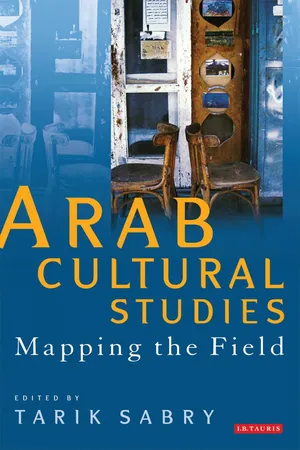
'Arab Cultural Studies: Mapping the Field' is the first attempt to explore ways of conceptualising and theorising the nascent field of Arab Cultural Studies. It reflects and engages in an interdisciplinary discussion on the different facets of Arab cultural studies, including gender, economy, history, epistemology, language, method, politics, literary and cultural criticism, institutionalization, popular culture, creativity and much more. The book presents a meta-narrative about how scholars have thus far thought and re-thought the field. It brings together prominent and emerging experts, writing from both Arab and Western academia, to engage with key complex, epistemic and methodological questions and to articulate in the meantime the new kinds of language and hermeneutics necessary for the appropriation of an historically conscious and coherent field of scientific enquiry into contemporary Arab media, culture and society.
Information
1
Introduction
Arab Cultural Studies: Between
‘Reterritorialisation’ and ‘Deterritorialisation’
‘Reterritorialisation’ and ‘Deterritorialisation’
Tarik Sabry
[ ... ] beginning with beginning will consist of an operation which [ ... ] will have already begun. Even though this means that a procedure has already been identified, more will still be at stake here in this particular beginning than what would amount to nothing other than an assessment of the viability of a procedure which was itself advanced in terms of a beginning that did no more than concern itself with beginnings. In this instance there will be a different point of departure involving a substitution of that which is taken to be central. What this will mean at this stage is that the strategy that comes to be articulated within the terms set by the posited centrality of beginnings will itself be taken as central. (Andrew Benjamin, 1993: 3)
Beginning with beginning
Over the last decade, while many scholars researching ‘Arab media’, both in Western and Arab academe, worked ceaselessly thinking and writing about different aspects of this relatively new area of research, I found myself preoccupied with epistemic questions, a persistent one being: how can the deficit in the contemporary Arab cultural repertoire benefit from a critical Arab cultural studies1 project? This intellectual interest was driven by even more nagging questions around the cultural spatialities and temporalities within which the field was being framed, its hermeneutics and the historical moment(s) to which it was responding. Grappling with such concerns, as a way of beginning with beginning, at a time when most scholars have been preoccupied with unpacking the structures of Arab transnational/digital media and their ‘effects’ on Arab societies, seemed in comparison to be far less urgent and, perhaps, discouragingly, unimportant. However, now that what I like to call the ‘hyperbolic-fetishism’ (that usually comes with technologically deterministic ways of seeing the world), has given way to a more sobering analysis, I hasten, like any opportunist, to exploit this écart (a swerve/gap), to use the Derridian terminology, as an opening or even interlude, in which to reflect and engage in a meta-narrative discussion on the nascent field of Arab cultural studies and its development. Taking on beginning with beginning, as a central object of enquiry, is by no means a strategy through which to re-do or undo what has already been said and written, nor is it, in any shape or form, an attempt to discredit any kind of a priori beginnings. Arab cultural studies is already ‘there’ in different treatises, PhD theses, journal articles and books, but the problem with such a compendium, I contend, is that it is not, epistemologically that is, ‘conscious’ of itself or its parts-of-the-whole. Nor is it, dare I add, conscious of the historical and conjunctional moments to which it is responding. Such consciousness and self-assuredness, I argue, can only take place once we, as scholars, begin to engage with our subject, Arab cultural studies, from a position of différance, and as a thinking-about-thinking sort of exercise – and this, I believe, has yet to be done in any meaningful or systematic way. Dealing with this écart, as a moment of reflection, is, by way of a beginning, the main telos of this book. The chapters that follow, that come from both established and emerging scholars in the field, engage, in an interdisciplinary and reflexive fashion, with what I think are key issues facing this area of study and its development. They allow for a reflexive articulation/rearticulation of the field’s many facets, including, in no particular order, language and discourse, language and culture, media and modernity, gender studies, media historiography, culture and history, the state and cultural production, political economy of the media, popular culture, epistemology and institutionalisation. This book is, I believe, the first conscious effort to enunciate the parameters of, and visions for, a critical and creative Arab cultural studies. Its main objective is thus one of reflexivity par excellence.
Reterritorialisation and deterritorialisation as ways of doing beginning
How does one acquire/institute an epistemologically ‘connected creativity’ without losing sight of the ‘infinite-sieve’: the plane on which human thought plunges, deterritorialises, moves and creates, without ‘stealing’ or alienating the thought of the other? In this introductory chapter, and as a way of beginning or, as Benjamin puts it, making the beginning central, I argue that to articulate the new kinds of hermeneutics and the new language upon which Arab cultural studies can rely to interpret social and cultural phenomena, all the while maintaining what Lalande calls ‘la raison critique nécessaire’, it is essential to work through and follow a double-critique mechanism; ensuring that both endogenous and exogenous cultural phenomena, forms of knowledge, their interpretation and the types of conjectural immanence/metaphysics they produce, are always subjected to a distanciated double-refutation. However, this dual critical process is, by itself, I argue, not methodologically sufficient to help us meet our telos: the creation of a ‘conscious’ critical cultural project that is aware not only of its own temporality (time-consciousness/a sense of historical time that looks towards the future) and spatiality (epistemic/theoretical situatedness), but also of its relational positionality to the ‘Other’, to other temporalities, its ‘being otherwise’ and of being in and out of its time. This necessitates the invention and incorporation of a whole new ethics of ‘otherness’, not just in its ontological sense, but also as a necessary prerequisite for an ethical form of rationality. For it to function, this kind of ethical rationality must be articulated through a two-way epistemic trajectory: reterritorialisation and deterritorialisation. Here, the idea is to oscillate upon a plane of thoughts, ideas/concepts and paradigms, back and forth from ‘immanence’ to ‘transcendence’, and vice-versa; a ceaseless move from/between a culture of immanence to a culture of transcendence – and here I mean the transcendence of any form of immanence. The objective here is the initiation of an ethics and ontology of otherness, a ‘transcendental kind of empiricism’, where thought and being are determined not merely through the ontologising of experience and the championing of creativity, as I will later propose, but also through an unconditional form of engagement with ‘otherness’ – the other’s thought/the other’s technique, thus avoiding the traps, into which it is easy to fall, that come with ‘reverse orientalisms’ and battles associated with disciplinary boundaries. An ethical and critical and/or creative Arab cultural studies must transcend this kind of violence, and engage in processes of negotiation; an inter-marriage with the others’ thought and perhaps even, why not, it may learn to stammer in his/her language(s). Navigating from reterritorialisation or ‘connectivity’ to deterritorialisation/dislocation, while concurrently building and destroying, is one way to protect thinking from the arborescence of the tree as a structure of power, cultural immanence, and types of ‘ontological imperialisms’, as well as the kinds of cultural ‘salafisms’ and rigid binaries that come with this. It is through the double take that arises from reterritorialising and deterritorialising that thought, as a tool, can again create, creating not only from within and for its repertoire, but also for-the-other.
Reterritorialising as necessary epistemic ‘connectivity’
I have argued elsewhere (2007, 2010) that a ‘conscious’ articulation of Arab cultural studies/media studies cannot take place without connection to key debates and problematics that are inherent to contemporary Arab thought, for what epistemic purpose would Arab cultural studies have if it were unable to inform or deal with problems intrinsic to contemporary Arab thought and social theory? To not reterritorialise; to ignore this kind of epistemic dislocation – and I cannot make this point strongly enough – means to work upon a plane that is simply unconscious of its own history, its own time and even of the moments to which it may be responding. The result is likely to be a highly superficial repertoire – mere epiphenomenal froth: a baseless project and a failed beginning. Since ‘the structures and processes of social communication are deeply embedded within the wider structures and processes of a given social formation’2 and because the moral/rational subject is always socially formed, it is imperative when articulating the notion of an Arab cultural studies, not only to engage with social theory, but it is also equally necessary, in order to understand ‘the wider processes and structures’ that determine Arab media, culture and society, ‘to make a diversion by way of philosophy in order to understand how and why the debates have been set up the way they have and what they are in fact about’.3 To reterritorialise Arab cultural studies on a plateau that is conscious of the structures of its social formations, and since the discipline of cultural studies has developed elsewhere as a reaction to modernity’s ambivalence, a serious engagement with key debates on modernity in contemporary Arab philosophical thought becomes a necessary intellectual exercise. It is only through this epistemic positioning, as a beginning, I would argue, that we can distil from the multiplicity of positions that which we think is sound enough to become the interlocutor of a critical/ethical Arab cultural studies project. It is important to add that this kind of exercise must not only be framed within the context of de-Westernisation, for it is fundamental to both Western and non-Western contexts that there is a diversion by way of philosophy. To engage with the task of reterritorialisation, by way of beginning from the beginning, I revisit, and quote in full, a typology that I devised elsewhere (2010: 30–35) to describe four key Arab philosophical standpoints, some more dominant than others, in relation to modernity and tradition, a relationship, which I think is still at the heart of contemporary Arab philosophical discourse.
The historicist/Marxist position
The key figure in this position is Abdullah Laroui, a Marxist historian who dedicated his cultural/historical project to the question of modernity.4 As he put it, in Mafhum al-‘aql (The Meaning of Reason): ‘All I have written so far can be considered as parts in one volume, on the meaning of modernity’.5 Laroui’s call for a radical/decisive epistemological break with the past, what he calls hassm, has been a key contribution to the Arab philosophical discourse on modernity. Progress and development in the Arab world, asserts Laroui, can only be achieved if and when a decisive break with the past and its heritage takes place, and also when Arabs are conscious of their own history and their role in it. Western historical materialism (Marxist historicism, to be precise) and its revolutionary politics is, for Laroui, the only viable strategy to escape from cultural salafism, the superficialities of liberalism, technocracy, and the only route to modernity.6 However, Laroui’s radical break with the past (Laroui 1973, 1996, 2001) must not be confused with an outright rejection of ussul, or cultural heritage. For Laroui, this still remains a very important object of enquiry. What he rejects, however, are the Arab-Islamic heritage’s value systems. As he put it: ‘If, as the theologian/philosopher thinks value is the absolute, then the modern man is the man of non-value, he who expects nothing to be definitive’.7 For Laroui, the main reason for Arab intellectual digression is the Arab’s inability to realise the historical split that took place between secular realities in the Arab world and its cultural heritage.
The rationalist/structuralist position
Mohammed Abed al-Jabri (whose is the key voice in this position) has a different take on turath (heritage). Rather than breaking with the past aesthetically, ethically and epistemologically, al-Jabri repudiates Laroui’s ‘universalism’ (Western historical materialism), arguing for the historicisation of turath by modernising it from within, so that it is reconciled with the present and with the new realities of Arab cultures. Al-Jabri calls for al-infissal min ajl al-ittissal (to disconnect in order to reconnect) as a strategy through which to solve the problem of the ‘unconscious’ in Arab cultural temporality. For al-Jabri, the main problems with Arab thought and the Arab intellectual crisis are inherent to a structural/epistemological problem in modes of Arab reasoning. The turath and modernity problematic, observes al-Jabri, is not moved by class struggle, but ‘by cultural and conceptual issues dealing with thought and its structure’.8 Al-Jabri, like any intellectual, is the product of historical moments. He, like a number of the predominant pan-Arab intellectuals, Laroui included, have had their intellectual formations shaped by key historical events: the occupation of Palestine in 1948, the nationalisation of the Suez Canal by Nasser in July, 1956, and the Arab-Israeli wars of 1967 and 1973. These events have shaped a whole political consciousness, and have dictated the kind of hermeneutics relied upon to interpret ‘Arabness’ and ‘Arab culture’ by a whole generation of Arab intellectuals. The pan-Arab interpretation of culture’s function is an interesting one. The term ‘Arab world’ is divided into two unifying terminologies: Al-watan al-Arabi and al-ummah al-Arabiya. The first denotes geographic unity; the second alludes to some sort of spiritual (‘Din’ religion) common experience.9 According to al-Jabri, the main historical characteristic of ‘culture’ is inherent to its function as a unifier. Here, the awakening of Arab consciousness is predicated on culture’s ability to unify. Culture’s historical function and purpose, according to al-Jabri, a pan-Arabist par excellence, is to help transform the Arab world from a mere geographic space (al-watan al-Arabi) to al-ummah al-Arabiya, a space bound by common experience and consciousness.10
The cultural salafist/turatheya position
The Arab-Islamic heritage is a key component of Arab culture and makes for the best, if not the only, possible and coherent civilisational model. This position is intricate11 and contested and can easily be unpicked throu...
Table of contents
- Cover
- Author biography
- Title page
- Copyright page
- Dedication page
- Contents
- List of Figures
- Acknowledgements
- Notes on Contributors
- Chapter 1 Introduction: Arab Cultural Studies: Between ‘Reterritorialisation’ and ‘Deterritorialisation’
- Chapter 2 History in Arab Media Studies: A Speculative Cultural History
- Chapter 3 Arab Media Studies Between the Legacy of a Thin Discipline and the Promise of New Cultural Pathways
- Chapter 4 Cultural Studies in Arab World Academic Communication Programmes: The Battle for Survival
- Chapter 5 In Search of the Great Absence: Cultural Studies in Arab Universities
- Chapter 6 Rethinking the Arab State and Culture: Preliminary Thoughts
- Chapter 7 The Necessary Politics of Palestinian Cultural Studies
- Chapter 8 Rethinking Gender Studies: Towards an Arab Feminist Epistemology
- Chapter 9 Disarticulating Arab Popular Culture: The Case of Egyptian Comedies
- Chapter 10 Placing Political Economy in Relation to Cultural Studies: Reflections on the Case of Cinema in Saudi Arabia
- Chapter 11 The Saudi Modernity Wars According to ‘Abdullah Al-Ghathami: A Template for the Study of Arab Culture and Media
- Chapter 12 Cultural Criticism: Theory and Method
- Chapter 13 Language as Culture: The Question of Arabic
- Chapter 14 Internationalising a Media Studies Degree in Arab Higher Education: A Case Study Arising from an Agreement Between New Zealand and Oman
Trusted by 375,005 students
Access to over 1.5 million titles for a fair monthly price.
Study more efficiently using our study tools.
Frequently asked questions
Yes, you can cancel anytime from the Subscription tab in your account settings on the Perlego website. Your subscription will stay active until the end of your current billing period. Learn how to cancel your subscription
No, books cannot be downloaded as external files, such as PDFs, for use outside of Perlego. However, you can download books within the Perlego app for offline reading on mobile or tablet. Learn how to download books offline
Perlego offers two plans: Essential and Complete
- Essential is ideal for learners and professionals who enjoy exploring a wide range of subjects. Access the Essential Library with 800,000+ trusted titles and best-sellers across business, personal growth, and the humanities. Includes unlimited reading time and Standard Read Aloud voice.
- Complete: Perfect for advanced learners and researchers needing full, unrestricted access. Unlock 1.5M+ books across hundreds of subjects, including academic and specialized titles. The Complete Plan also includes advanced features like Premium Read Aloud and Research Assistant.
We are an online textbook subscription service, where you can get access to an entire online library for less than the price of a single book per month. With over 1.5 million books across 990+ topics, we’ve got you covered! Learn about our mission
Look out for the read-aloud symbol on your next book to see if you can listen to it. The read-aloud tool reads text aloud for you, highlighting the text as it is being read. You can pause it, speed it up and slow it down. Learn more about Read Aloud
Yes! You can use the Perlego app on both iOS and Android devices to read anytime, anywhere — even offline. Perfect for commutes or when you’re on the go.
Please note we cannot support devices running on iOS 13 and Android 7 or earlier. Learn more about using the app
Please note we cannot support devices running on iOS 13 and Android 7 or earlier. Learn more about using the app
Yes, you can access Arab Cultural Studies by Tarik Sabry in PDF and/or ePUB format, as well as other popular books in History & Middle Eastern History. We have over 1.5 million books available in our catalogue for you to explore.