Politics for the Love of Fandom examines what Ashley Hinck calls "fan-based citizenship": civic action that blends with and arises from participation in fandom and commitment to a fan-object. Examining cases like Harry Potter fans fighting for fair trade, YouTube fans donating money to charity, and football fans volunteering to mentor local youth, Hinck argues that fan-based citizenship has created new civic practices wherein popular culture may play as large a role in generating social action as traditional political institutions such as the Democratic Party or the Catholic Church. In an increasingly digital world, individuals can easily move among many institutions and groups. They can choose from more people and organizations than ever to inspire their civic actions—even the fandom for children's book series Harry Potter can become a foundation for involvement in political life and social activism. Hinck explores this new kind of engagement and its implications for politics and citizenships, through case studies that encompass fandoms for sports, YouTube channels, movies, and even toys. She considers the ways in which fan-based social engagement arises organically, from fan communities seeking to change their world as a group, as well as the methods creators use to leverage their fans to take social action. The modern shift to networked, fluid communities, Hinck argues, opens up opportunities for public participation that occurs outside of political parties, houses of worship, and organizations for social action. Fan-based citizenship performances help us understand the future possibilities of public engagement, as fans and creators alike tie the ethical frameworks of fan-objects to desired social goal, such as volunteering for political candidates, mentoring at-risk youth, and promoting environmentally friendly policy. Politics for the Love of Fandom examines the communication at the center of these civic actions, exploring how fans, nonprofits, and media companies manage to connect internet-based fandom with public issues.
- 264 pages
- English
- ePUB (mobile friendly)
- Available on iOS & Android
eBook - ePub
About this book
Information
1
THEORIZING CITIZENSHIP
IN A DIGITAL, FLUID WORLD
IN A DIGITAL, FLUID WORLD
During the 2008 US presidential election, Paul DeGeorge, cofounder of the Harry Potter Alliance and cofounder, with his brother Joe DeGeorge, of the popular “wizard wrock” band Harry and the Potters, made “Wizards for Obama” T-shirts.1 In an interview, Paul explains, “I knew a lot about fandom, and I know that people like to flash their nerdy pride around. So I figured . . . why not use that as a way to help people express their support for Obama’s candidacy?”2 On these T-shirts, Paul creatively riffed on the typical campaign slogans like “Women for Obama,” “African Americans for Obama,” and “Union Workers for Obama,” with new slogans like “Wizards for Obama.” Harry Potter fans reacted enthusiastically to the shirts. By the end of the 2008 election cycle, Paul knew he had to expand the operation for the 2012 election. In 2012, Paul created a website and online store called Nerds for Obama.3 Paul continued to sell Harry Potter—themed merchandise that proclaimed, “Wizards for Obama,” “Hufflepuffs for Obama,” and “Voldemort Can’t Stop Barack” (fig. 1). But this time, Paul sold bumper stickers and buttons in addition to T-shirts, offered free digital image files for users to download and use on their social media pages, and offered merchandise for fandoms other than Harry Potter. The Nerds for Obama store connected Obama support to Firefly, Settlers of Catan, Game of Thrones, Star Wars, Sherlock, the VlogBrothers, Mario Brothers, Doctor Who, and Pokémon. While not formally endorsed by the Obama campaign, Obama lent his support to the project by retweeting and reblogging images from the Nerds for Obama site. Paul explains that the Nerds for Obama store wasn’t about satire: “I was trying to link up a member group, like Teachers for Obama. . . . [I]t was much more in line with the existing infrastructure of ways people would support candidates rather than satire.”4 For Harry Potter fans like Paul, their fandom is a key aspect of their identity—one that guides their political actions just as much as identities like union member or teacher.
By replacing traditional political institutions and identities (like union membership) with a fan identity (wizards and Hufflepuffs), Paul’s “Hufflepuffs for Obama” T-shirts question the assumed relationship between citizenship performances, civic groups, and ethics. Communication scholars have traditionally understood civic actions as deeply connected to social institutions like family, church, and civic groups. In this chapter, I argue that economic, social, and political shifts since the late 1970s have made the membership in those social institutions and civic groups more fluid than ever before. In a fluid world, citizens may easily choose Harry Potter over the Democratic Party to guide their civic action on voting in presidential elections. It is this fluidity that provides us with a context for understanding the emergence of fan-based citizenship performances like Paul DeGeorge’s “Wizards for Obama” T-shirts and the Harry Potter Alliance’s fair-trade campaigns.
A fluid world that enables citizens to choose popular culture media texts to authorize civic actions demands new theoretical terms, theoretical assumptions, and methodological approaches. First, I offer ethical framework and ethical modality as terms to enable researchers to investigate this shift and the civic actions it enables.5 Through processes of pairing and unpairing, fan-based citizenship performances combine noncivic ethical frameworks from popular culture with civic ethical modalities, civic actions like voting, petitioning, etc. These terms allow researchers to fully examine a wide range of fan-based citizenship performances, including performances that are emancipatory and problematic, effective and ineffective, and grassroots and industry organized. In this chapter, I use the example of the Harry Potter Alliance’s “Not in Harry’s Name” campaign to illustrate how these terms can be used to investigate fan-based citizenship performances.
Second, a fluid world also demands a new set of theoretical assumptions for rhetoricians and political communication scholars. A fluid world means that political groups are no longer limited to social institutions like political parties, unions, and churches. Popular culture fan communities can guide civic action as well. Thus, rhetoricians studying public culture and political scientists studying civic action must now come to terms with questions about popular culture, meaning, and action. In this section, I offer three theoretical assumptions that must undergird research into fan-based citizenship performances.
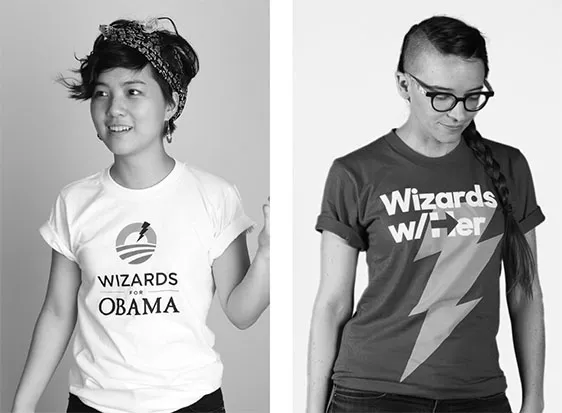
Figure 1. Images from the Nerds for Obama online store (www.nerdsforobama.org).
Third, a fluid world that enables citizens to choose popular texts to authorize civic actions pushes the methods rhetoricians and political communication scholars are accustomed to using. While rhetoricians could faithfully assume that significant political texts would find their way into mainstream discussion determined both by national political actors and journalistic coverage, the texts that emerge in fan-based citizenship achieve neither. Instead, the significant political texts involved in fan-based citizenship emerge from specific online communities of thousands or millions of fans. Understanding these rhetorical texts and political actions requires understanding these fan communities. In this section, I argue that internet-based methods and fieldwork can meet that need. Thus, in a fluid world where civic belonging is found in any number of noncivic communities, fieldwork becomes not just peripheral to the discipline but central.
The theoretical framework and methodology outlined here will be used to analyze the rest of the case studies in this book. A theoretical framework that examines the complexity and depth of these fan-based citizenship performances must integrate research not only from fan studies but also from political communication, internet studies, and social movement studies. While I argue that fluidity makes fan-based citizenship performances easier than ever for citizens to enact, this does not necessarily mean that fan-based citizenship performances have not existed historically—only that they were more difficult and likely existed in smaller numbers.6 As political communication researcher Michael Delli Carpini points out, being confronted with new civic actions in a changing political landscape can call us to develop new theories or modify old ones, helping us to look back historically to see things we, as researchers, might have missed before.7
Overall, this chapter articulates a context, theoretical terms, and a set of methods for research into fan-based citizenship performances. By doing so, I hope to provide a theoretical and methodological foundation for scholars across the communication and media disciplines to consider the myriad ways (positive or negative) in which fan-based citizenship performances impact our public culture, deliberation, and civic identities. To begin, I turn to the context from which these citizenship performances have emerged.
A Fluid World: Choice among Institutions
Scholars have generally recognized that civic actions are deeply connected to social institutions, civic groups, and religious organizations.8 In social institutions and groups like families, churches, schools, unions, and community groups, we learn how to participate in public culture. For example, during the civil rights movement, black churches served as locations where citizens could be mobilized and learn civic skills.9 These social institutions and civic groups are locations for invitations for public participation, discussion of public issues, and guidelines for right action in the world, and as such function as entries to public culture.
However, the relationship between institutions, politics, and social organizations began to change in the 1970s as major social, political, and economic shifts occurred.10 Globalization, neoliberal policies, the privatization of public goods, services, and safety nets, and the diffusion of personal technologies like computers and smartphones contributed to restructuring within government institutions and social organizations.11 These economic, technological, and social changes have had a profound impact on social institutions. Participation in groups and associations like unions, civic clubs, churches, and political parties has taken a significant downward turn.12 Now membership in institutions that had traditionally provided economic security, social orientation, and ethical guidance is anything but guaranteed or automatic.
Zygmunt Bauman, Anthony Giddens, and Ulrich Beck describe this shift in modern life as characterized by a sense of fluidity in which individuals easily choose between multiple institutions, organizations, and groups and fluidly move between those institutional and group frameworks, resources, and requirements.13 Both institutions and individuals are liquid, changing quickly and easily moving into new configurations.14 Whereas in the past, individuals inherited membership within institutions through generations or by way of geographic limits, they now face choices among many institutions and groups.15
A fluid society requires individuals to choose their own worldviews, activities, and ethical systems. The guidance that tradition, family structures, and other institutions or social organizations used to provide for individuals has been weakened.16 Giddens puts it this way: “In a post-traditional social universe, an indefinite range of potential courses of action (with their attendant risks) is at any given moment open to individuals and collectivities. Choosing among such alternatives is always an ‘as if’ matter, a question of selecting between possible worlds.”17 Citing the decreasing influence of social groups, Lance Bennett says, “Contemporary young people enjoy unprecedented levels of freedom to define and manage their self-identities in contrast with earlier generations’ experiences with stronger groups (denominational church, labor, class, party) that essentially assigned broad social identities to their members.”18
One’s choices among institutions, organizations, and groups are not inconsequential or random; rather, they comprise the building blocks of one’s social identity and public subjectivity in a liquid world. Beck explains that “socially prescribed biography is transformed into biography that is self-produced and continues to be produced.”19 By choosing membership in a Methodist church, a volunteer firefighter association, a local gun club, or the Democratic Party, an individual builds her public subjectivity. We pick and choose from many available social organizations and civic groups, living our identities across many “institutional settings of modernity.”20 Thus, in our fluid world, the agent chooses and constructs their own lifeworld from the vast array of options available in an increasingly globalized information society.
Increasing choice among social organizations and civic groups has implications for collective action and public formation. Fluidity among organizations and groups enhances choice but increases individual responsibility.21 The implication for civic action is that this new individualism cuts away at solidarity in community formation and collective political action.22 This produces a world “where few if any people continue to believe that changing the life of others is of any relevance to their own life.”23 Indeed, neoliberal policies reinforce this individualism; individuals are called to assume responsibility for responding to risks and fears themselves.24
Civic Actions in a Fluid World
So if our world is characterized by a fluidity that enables some degree of choice among political, religious, and social institutions and groups, how has this affected the ways in which citizens engage in politics? In this section, I argue that communication scholars from across a variety of subdisciplines have begun to ans...
Table of contents
- Cover
- Title Page
- Copyright Page
- Contents
- Acknowledgments
- Introduction: Fan-Based Citizenship
- 1 Theorizing Citizenship in a Digital, Fluid World
- 2 Connecting: The Husker Football Coaches Challenge
- 3 Expanding: The Nerdfighters’ YouTube Project for Awesome
- 4 Retelling: Greenpeace’s #SavetheArctic #BlockShell LEGO Campaign
- 5 Absent Pairings: Disney, UNICEF, and the Star Wars Force for Change Campaign
- Conclusion: Fan-Based Citizenship Performances and the Future of Public Engagement
- Coda: Takeaways for Practitioners
- Notes
- Bibliography
- Index
Trusted by 375,005 students
Access to over 1.5 million titles for a fair monthly price.
Study more efficiently using our study tools.
Frequently asked questions
Yes, you can cancel anytime from the Subscription tab in your account settings on the Perlego website. Your subscription will stay active until the end of your current billing period. Learn how to cancel your subscription
No, books cannot be downloaded as external files, such as PDFs, for use outside of Perlego. However, you can download books within the Perlego app for offline reading on mobile or tablet. Learn how to download books offline
We are an online textbook subscription service, where you can get access to an entire online library for less than the price of a single book per month. With over 1.5 million books across 990+ topics, we’ve got you covered! Learn about our mission
Look out for the read-aloud symbol on your next book to see if you can listen to it. The read-aloud tool reads text aloud for you, highlighting the text as it is being read. You can pause it, speed it up and slow it down. Learn more about Read Aloud
Yes! You can use the Perlego app on both iOS and Android devices to read anytime, anywhere — even offline. Perfect for commutes or when you’re on the go.
Please note we cannot support devices running on iOS 13 and Android 7 or earlier. Learn more about using the app
Please note we cannot support devices running on iOS 13 and Android 7 or earlier. Learn more about using the app
Yes, you can access Politics for the Love of Fandom by Ashley Hinck in PDF and/or ePUB format, as well as other popular books in Politica e relazioni internazionali & Marketing digitale. We have over 1.5 million books available in our catalogue for you to explore.