eBook - ePub
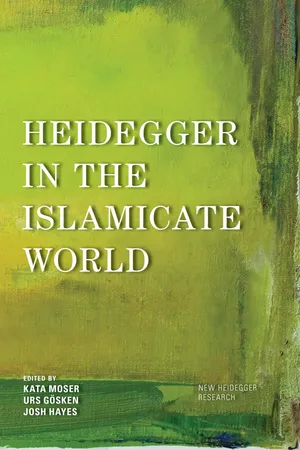
Heidegger in the Islamicate World
- 326 pages
- English
- ePUB (mobile friendly)
- Available on iOS & Android
eBook - ePub
Heidegger in the Islamicate World
About this book
Philosophical debates, many of them involving the appropriation of modern Western philosophical doctrines, are a crucial element shaping the intellectual and practical behaviour of many thinkers in the Islamicate world and their audiences. One Western philosopher currently receiving a particularly lively reception throughout the Islamicate world is Martin Heidegger. This book explores various aspects of the reception of Heidegger's thought in the Arabic, Iranian, Turkish, and South Asian intellectual context. Expert Heidegger scholars from across the Islamicate world introduce and discuss approaches to Heidegger's philosophy that operationalize, recontextualize, or review it critically in the light of Islamic and Islamicate traditions. In doing so, this book imparts knowledge of the history and present situation of Heidegger's reception in the Islamicate world and suggests new pathways for the future of Heidegger Studies – pathways that associate Heidegger's thought with the challenges presently faced by the Islamicate world.
Information
Part I
Lines of Reception in the Islamicate World
Chapter 1
The Receptions of Heidegger in Turkey
Zeynep Direk
Philosophy has played an important role in the modernization of Turkish society. This is not only true for modern Turkey as a secular state but also for the late-nineteenth-century Ottoman Empire. In contrast to older forms of philosophical discourse intertwined with Muslim theology, Western philosophy provided a non-Islamic milieu of reflection. After the reform of universities in 1933, the practice of philosophy was cut off from all connections within Muslim theological culture. The prominent positivist philosopher Hans Reichenbach was invited to design the first department of philosophy at Istanbul University, which gave rise to all secular philosophy in Turkish academia. Jewish and German professors taught in Istanbul University before and after the Second World War. The German philosophical tradition formed the first generation of Turkish philosophers. Among them, the most prominent are Takiyeddin Mengüşoğlu, a student of Nicolai Hartmann; Macit Gökberk, a historian of philosophy in the Hegelian and Marxist tradition; and Nermi Uygur, a phenomenologist in the Husserlian tradition. All three were educated in Germany. We could also add İsmail Tunalı, a specialist in aesthetics, and Bedia Akarsu, a specialist in ethics. Bedia Akarsu, the only woman philosopher in this generation of philosophers, introduced Max Scheler’s philosophy to Turkey.
When we consider this generation, which dominated the philosophical scene before and after the Second World War until the 1970s, the absence of Martin Heidegger’s philosophy is remarkable. In an atmosphere where G. W. F. Hegel, Nicolai Hartmann, Edmund Husserl, and Max Scheler were studied, Heidegger’s absence is in need of explanation: Germany’s defeat, the fall of Nazism, and Heidegger’s ban from teaching by the French authorities until 1952 could be among the causes. After the Second World War, Turkish doctoral students sent to Germany could not encounter Heidegger’s philosophy in academic institutions. Only those who went to France to study philosophy and discovered Sartrean existentialism, such as Selahaddin Hilav, had a chance to acquaint themselves with Heidegger’s philosophy.
Heidegger entered the French philosophical scene through Emmanuel Levinas’s commentaries in the late 1930s, with the publication of En découvrant l’existence avec Husserl et Heidegger.1 However, Levinas’s contribution made its real impact after the war due to Jean-Paul Sartre and Hannah Arendt’s recovery of Heidegger. The second important wave of the reception of Heidegger in France was through Jacques Derrida’s work, which made its impact on the English-speaking world in the 1970s and 1980s. Derrida made it clear that the existentialist reception of Heidegger was based on an anthropological reading, which neglected the questions of being and historicality. The existentialist reception had focused on the existential analytic in Being and Time. In contrast, during the second phase of Heidegger’s reception, the focus shifted to the destruction of traditional ontology and later the destruction of metaphysics: in short, the question of being and the ontological difference.
Heidegger entered Turkey through the first wave of the reception of French thought in the 1950s and 1960s and also through a second wave from the 1990s until today. In this chapter, I will initially discuss the first wave of the Turkish reception of Heidegger’s philosophy in intellectual circles by specifying its main problems and themes. Then I will look at the second wave in Turkish academia in the 1990s. In this reading, Heidegger is invoked along with the Frankfurt School, especially Adorno, for a critique of the cultural industry. Last, I will scrutinize the reception of Heidegger by Islamist intellectuals outside academia and speculate about why Heidegger has been so influential on them. Rather than being a new phase of reception, which can be philosophically and temporally associated with the receptions of Heidegger in the Western world, this trend originates in the Islamicate world.2 With a specific interest in Heidegger’s task of Destruktion, critique of modernity, his thinking of historicality, the problem of authenticity/inauthenticity of a people in a historical sense, and his reflections on religion, the holy, the sacred, and God, Islamist intellectuals found the possibility of casting Islamic religious self-expression in the idiom of Western philosophy, and still distancing themselves from it. In short, it is a desire to philosophize from one’s own cultural and religious standpoint, from where one is, that is, from the Islamicate. I argue that Heidegger is invoked in order to seek ways for fashioning a new Islamic cultural politics. He is appealing to Islamist intellectuals because he is useful in disrupting the domination of modernity over “traditional” Islamic culture. Heideggerianism gives a new public appearance to intellectuals who want to distinguish themselves from “Westernized elites” and takes on an Islamic identity or at least expresses sympathy with cultural Islamism. Heideggerianism makes these intellectuals interesting and intriguing because their discourse does not sound traditional. On the contrary, it is Islamism with a hyper-Western allure.
The Existentialist Reception of Heidegger
During the 1950s and 1960s, existentialism made an impact on Turkish intellectual life outside academia. Its influence lasted until the 1980s and was most remarkable in Turkish scholarship. The philosopher Hilmi Ziya Ülken published the first article on existentialism in 1946.3 Between 1946 and 1960, a number of intellectuals discussed the meaning and fundamental tenets of existentialist philosophy. F. Hüsrev Tökin, Nurettin Nart, Oğuz Peltek, Mete Şar, Seyfi Özgen, Doğan Kılıç, Mehmet Seyda, Orhan Duru, Demir Özlü, Önay Sözer, Nusret Hızır, Aslan Kaynardağ, Osman Oğuz, Peyami Safa, Atilla İlhan, Şerif Hulusi, Başar Sabuncu, Muzaffer Erdost, Ferit Edgü, Fikret Ürgüp, and Pulat Tacar were all part of this discussion.4 From a philosophical point of view, none of these readings of existentialism were as philosophical as Joachim Ritter’s and Nusret Hızır’s interpretation of existentialism.
In 1950, the German philosopher Joachim Ritter, a professor at Istanbul University, gave conferences on existentialism titled “Zum Problem der Existenzphilosophie.”5 In these conferences, Ritter addressed how the war atmosphere that had invaded Europe since the 1930s had made the foundations of European philosophy tremble. The loss of solid foundations meant the loss of confidence in Western philosophy, which was previously viewed as a voice and path to truth. According to Ritter, existentialism is a reaction against totalitarianism—a process that society undergoes in which the individual risks losing her being. Given that the individual fails to find her being in the society or community, she risks losing her identity or ipseity. Hence, the loss of the individual being in the masses is also the loss of the communal identity (Sittlichkeit) to which the individual may belong. Ritter quotes Emmanuel Mounier, who said that “existentialism is a philosophy of despair in which life and being lose their richness.”6 According to Ritter, existentialism asks if there are other possibilities for humanity to overcome the totalitarianism that imposes itself in the technological age.
Nusret Hızır, who started his career as Reichenbach’s assistant before accepting a position at Ankara University, became a renowned philosopher of logic, epistemology, and philosophy of science in Turkish academia, introducing Sartre’s thought in its relation to Husserl’s phenomenology to the broader public in several articles published in the intellectual review Yücel in 1956.7 He argued that Sartre was not faithful to phenomenology. Husserl’s phenomenology employed the phenomenological method, which required setting aside all the constructive theories for a description of the phenomena through which it is possible to accede to essences. In contrast, Sartre defined being in itself as “inexplicable and contingent.” He arrived at this conclusion not through phenomenological descriptions but by means of reasoning, inference, and reduction to absurdity. Hızır emphasized that this determination of being in itself conflicted with and went against the anti-intellectualist tendencies that were found in Sartre’s existentialism. Hence, he read Sartre as a philosopher who created an anti-intellectualist philosophy without being able to avoid using intellectualist instruments. Sartre’s philosophy remained paradoxical. According to Hızır, philosophy is a rational system, and Sartre risked the confusion of philosophy with literature. In relation to Sartre’s Being and Nothingness, Hızır speaks of Heidegger as well and tells the reader that being-in-itself corresponds more or less to what Heidegger calls das Seiende while being-for-itself is equivalent to Dasein. Arguably, this poor reading of Being and Time is not due to Hızır but comes from Sartre’s first reading of Being and Time. Das Seiende translates as a being, which Heidegger analyzes at different layers of his ontological analysis as Dasein, zuhanden (ready-to-hand), and vorhanden (present-at-hand). Dasein is the basis of the existential analytic that rests on a refusal of a philosophy of subjective consciousness for the sake of investigating the being of this being and hence the possibility of raising the question of the meaning of being. This reading of Nusret Hızır indicates the confusion or miscomprehension that marks the first phase of the reception of Heidegger’s philosophy. In the first place, what distinguishes his philosophy from philosophical anthropology? Most notably, the question of the meaning of being is completely missed. Heidegger is read as if he were a humanist and as if his thought primarily aims to explain the being of Dasein. Second, the challenge of Heidegger to modern philosophy as a philosophy of subjectivity has not been given any weight in interpreting him.
In the same year (1956), Peyami Safa, a prominent intellectual of Turkish Islamism, published an article on existentialism in the intellectual review Türk Düşüncesi.8 Safa associated existentialism with the individualism prevalent in the modern Western societies that he described as decadent. Although he identified himself as a religious intellectual, he was open to a synthesis of East and West. In contrast, his right-wing followers, especially after the 1980s, represented him as defending the Turkish-Islamic civilization against Western domination, which came with the charge of corruption. Şerif Hulusi, a left-wing intellectual and a socialist, made use of the same argument to criticize existentialism.9 Hulusi criticized existentialism because it covered over the fundamental problem of economic inequality, whereas Safa’s problem concerned cultural identity, which he believed Turkey suffered from since the 1930s. Safa could be read as critical of atheist existentialism rather than existentialism in general. His Islamic mysticism is combined with the personalism of Christian existentialists that he read in French.
Heidegger in Turkish Academia in the 1990s
In the early 1990s, the interest in the hermeneutical tradition, especially Gadamer’s Truth and Method, paved the way for the discovery of Heidegger’s “ontological hermeneutics” in Being and Time.10 After the military coup of 1980, Turkey crushed activists, students, and intellectuals on the left. Surely, political organizations and prominent figures of right-wing politic...
Table of contents
- Cover
- Half-Title
- Series
- Title
- Copyright
- Contents
- Preface
- Introduction
- PART I: LINES OF RECEPTION IN THE ISLAMICATE WORLD
- PART II: HEIDEGGER AND ISLAMICATE AUTHENTICITY
- PART III: HEIDEGGER AND ISLAMICATE MODES OF EXPRESSION
- PART IV: HEIDEGGER AND THE REVIVAL OF ISLAMICATE PHILOSOPHY
- PART V: CHALLENGING THE ISLAMICATE
- Appendix: Translations of Heidegger’s Works in Arabic, Persian, and Turkish
- Bibliography
- Index
- About the Contributors
Trusted by 375,005 students
Access to over 1.5 million titles for a fair monthly price.
Study more efficiently using our study tools.
Frequently asked questions
Yes, you can cancel anytime from the Subscription tab in your account settings on the Perlego website. Your subscription will stay active until the end of your current billing period. Learn how to cancel your subscription
No, books cannot be downloaded as external files, such as PDFs, for use outside of Perlego. However, you can download books within the Perlego app for offline reading on mobile or tablet. Learn how to download books offline
Perlego offers two plans: Essential and Complete
- Essential is ideal for learners and professionals who enjoy exploring a wide range of subjects. Access the Essential Library with 800,000+ trusted titles and best-sellers across business, personal growth, and the humanities. Includes unlimited reading time and Standard Read Aloud voice.
- Complete: Perfect for advanced learners and researchers needing full, unrestricted access. Unlock 1.5M+ books across hundreds of subjects, including academic and specialized titles. The Complete Plan also includes advanced features like Premium Read Aloud and Research Assistant.
We are an online textbook subscription service, where you can get access to an entire online library for less than the price of a single book per month. With over 1.5 million books across 990+ topics, we’ve got you covered! Learn about our mission
Look out for the read-aloud symbol on your next book to see if you can listen to it. The read-aloud tool reads text aloud for you, highlighting the text as it is being read. You can pause it, speed it up and slow it down. Learn more about Read Aloud
Yes! You can use the Perlego app on both iOS and Android devices to read anytime, anywhere — even offline. Perfect for commutes or when you’re on the go.
Please note we cannot support devices running on iOS 13 and Android 7 or earlier. Learn more about using the app
Please note we cannot support devices running on iOS 13 and Android 7 or earlier. Learn more about using the app
Yes, you can access Heidegger in the Islamicate World by Kata Moser,Urs Gösken,Josh Michael Hayes, Kata Moser, Urs Gösken, Josh Michael Hayes in PDF and/or ePUB format, as well as other popular books in Philosophy & Phenomenology in Philosophy. We have over 1.5 million books available in our catalogue for you to explore.