eBook - ePub
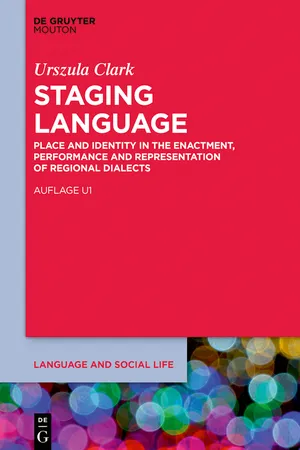
Staging Language
Place and Identity in the Enactment, Performance and Representation of Regional Dialects
- 188 pages
- English
- ePUB (mobile friendly)
- Available on iOS & Android
eBook - ePub
Staging Language
Place and Identity in the Enactment, Performance and Representation of Regional Dialects
About this book
Although there are many studies on linguistic variation as it relates to both "traditional" and "new" media such as film, TV, newspapers, and online behavior, little has been written about spoken performance in overt but face-to-face conversations. This book bridges that gap, and focuses on an "in between" zone between casual face-to-face conversations and the type of heavily scripted language of most traditional spoken media. The book draws upon a substantial amount of empirical data in its investigation of the role played by performance texts in creating, maintaining and challenging imagined communities and focuses upon the ways in which performance contributes to people's sense of the kinds of use for which dialect/variational use is appropriate and those for which it is not. It sheds light on how such stylization intersects with multiple social indexes and how performers and other creative artists challenge and mock hegemonic practices through enregistering a defined set of linguistic variables in the context of their performance and other associated written texts.
Trusted by 375,005 students
Access to over 1.5 million titles for a fair monthly price.
Study more efficiently using our study tools.
Information
1Staging language: Place and identity in the enactment, performance and representation of regional dialects
1.1Introduction
My overall aim in this book is to investigate the relationship between a specific discursive practice – that of creative and imaginative performance played face to face by local performers in front of a local audience – and any connections such performance may have with language and identity linked to place. In line with recent research (Trester 2012; Jaffe 2015; Jaffe et al. 2015; Vigourouz 2015 among others) largely undertaken in relation to languages other than English, I investigate the role of dialect use in English in creating and maintaining specific cultural, social and regional identities in the context of contemporary, localised, live spoken word events performed by regionally based performers and attended by local audiences. In so doing, I also consider issues related to creativity and imagination, by taking account of the degree to which dialect use is incorporated in tune with the locality in which performances take place, together with the wider cultural, historical and socio-political contexts within which they are performed. Such considerations allow for an examination of the beliefs, values, assumptions and ideologies that underpin the performance contexts and dialect use therein, and the nature of the dialectic relationship between linguistic form and function, linguistic ideology and interactional practice.
The lens through which dialect use is viewed in this book then, is not so much concerned with either a comprehensive linguistic analysis of identified dialect features or a discussion of perceived attitudes and beliefs in relation to social and regional dialects of English. Rather, I am concerned more with how performers in a specific region of England, in this instance that of the West Midlands, engage creatively and imaginatively with dialect features in their performances. Firstly, in relation to the ways in which social identities linked to place are constructed and secondly, how such identities align with social class and power structures in contemporary society. Following Eckert (2000), Coupland (2007) Johnstone (2011) amongst others, such consideration is set against the background of the wider historical and socio-political contexts within which language is used and the sets of beliefs, values, assumptions or ideologies that underpin these contexts.
Identification of dialect features then, rather than being an end in itself, acts as a catalyst for examining their role in the discourse within which it takes place. Auer (2013) has made the point that in traditional dialectology, the focus has been largely upon language as it links directly to space, with speakers themselves largely left out of the account. He attributes this to two main assumptions, namely that speakers only speak one language (or dialect) or only the dominant one is taken account of and that speakers are bound to places in immobile ways. However, in an age of globalisation, people’s mobility comes increasingly to the fore, through space as well as time, as Chapter 4 demonstrates. An interactional perspective upon dialect use also entails conceiving of alternatives in language “……not as ‘variants’ of underlying abstract (or more basic) structural units that are distributed in a contextually determined versus free form fashion, but rather as resources in their own right….” (Couper-Kuhlan and Selting 2018: 548).
Equally, a corresponding consideration of the social forces governing or underpinning any individual’s spoken language use has also largely been ignored. It is also often assumed that speakers who draw upon regional accent and dialect in their speech will do so in relation to one dialect and its corresponding accent. For example, in the performance context, a performer born and brought up in the English city of Birmingham to indigenous white parents of a low socioeconomic class but who has, by virtue of education and/or employment become in adult life a member of a higher socio-economic class, may speak standard English with a Birmingham (Brummie) accent. S/he may also, though, enregister specific features of that accent to index Birmingham, known locally as Brum and being Brummie. Locally based performers and in urban areas particularly, may also draw upon a range of accents and dialects from different places both within England and beyond in crafting their personae in their performances. This is evident in Chapter 4, where I discuss performers of Jamaican heritage from the Jamaican community within Birmingham who draw upon Jamaican Creole, Patwa and Brummie in their performances. In this way, performers draw upon what Auer (2011) in the context of mainland European languages has called a linguistic pool and Cheshire et al. (2011) a feature pool, whereby a range of accent and dialect features are used to index different aspects of identities – individual, local, regional, national and global. Such performers may be said to create a new multiethnolect (Clyne 2000) discussed further in that chapter.
My focus also includes examining the ways overt stylization in creative performance sheds light on the multiple social indexes being performed by any performer(s) through a multiplicity of voices; the ways in which audiences react to them and how performers draw upon dialect to challenge hegemonic practices associated with standard English. The face to face performance contexts of the kind I discuss in this book, can be seen as a kind of ‘in-between’ zone between casual face to face conversation and the type of heavily scripted language of most traditional spoken media. Live performance is particularly interesting in terms of the relationship between performers and their audiences. This is because live performance is interactive in nature, ranging from close proximity between any one performer or performers and their audiences in small venues such as rooms in public houses to the distance created between a stage and auditorium in a theatre, amateur or professional. In such settings, and particularly in relation to semi-improvised performance such as comedy, feedback flows from the audience to performer who, in turn, may make adjustments in to what they say response. Discussion of performances therefore, is accompanied by a consideration of what performers in the case of comedy and sketches, playwrights in the case of scripted plays, and members of their audiences have to say about specific performances, and particularly in relation to the reflexivity and metapragmatic awareness (or lack of) involved in preparing and enacting a performance. These conversation interviews provide a ‘behind the scenes’ view of linguistic performance scenarios. They offer insight into the extent to which performers deliberately draw upon certain features of dialect as a resource in not only creating characters and scenarios but also with the iterative dynamic between performances, audiences and the places and spaces within which performances are enacted. Whilst the extent to which individuals do this in the course of day to day interaction has been the focus of much recent sociolinguistic research, my focus is upon the ways performers draw upon dialect use in their staged performances to create and maintain difference from standard English. Particularly, this focus is upon the ways such use can be said to juxtapose the norms and values of those ‘within’ a given community with those ‘outside’ it, thereby subverting traditional notions of linguistic – and thereby social – hierarchy. Consequently, I examine how such overt stylization sheds light on the multiple social indexes being performed by any individual performer through a multiplicity of voices. In so doing, I also address issues of reception in considering the reaction of audience members to performances and performers.
In addition to the performances themselves, conversation interviews were undertaken with the performers and, wherever possible, members of the audience who attended the performance. To supplement these, conversation interviews were also held with playwrights, poets and other people known either nationally or locally for their affiliation to the region. These conversations provide a ‘behind the scenes’ view of the linguistic performance scenarios, offering greater insight into the reflexivity and metapragmatic awareness (or its lack), in preparing and enacting a performance. The main aim of these conversations was to investigate the extent to which audiences have any affinity with the dialect use shown by performers and the ideology produced and reinforced by them and the nature of the relationship between performers of any kind (artists, writers, poets, comedians, broadcasters) and the communities they purported to represent. A further aim was to ascertain if any evidence could be found for the claim that speakers draw upon dialect use dialect associated with a traditional place identity when confronted with social and economic change speakers as a way to resist that change.
The kinds of staged performances I analyse range from stand-up comedy events given as part of variety type performances by single and multiple performers; performance poetry; professionally produced plays to medieval mummers’ plays. The location of the performances in the West Midlands region of England centred upon the four shire counties of Shropshire, Staffordshire, Warwickshire, Worcestershire and a fifth metropolitan country superimposed upon the region called, confusingly, the West Midlands Metropolitan Borough. This latter area encompasses Britain’s second largest city, Birmingham. The region as a whole comprises a landscape made up of large swathes of countryside with small towns and villages through to urban sprawls such as Birmingham, the Black Country, Coventry and Stoke on Trent that have, over time, swallowed up what were once themselves small towns and villages.
As Crul (2016) has pointed out, international migration has dramatically changed large West European cities such as Birmingham in the space of two generations in ways that challenge established sociological theories such as segmented and new assimilation theory. Such change can be accounted for more by Vertovec’s (2007) sociological notion of superdiversity, explored linguistically by Blommaert (2010). Such diversity has led to new forms of linguistic use that go beyond traditional notions of bilingualism, code-mixing or code switching such as that first identified by Rampton (1995) as a more reflexive ‘crossing’. Increasingly in modern, urban societies in particular, people may draw upon features of more than one language that point to plurality in language use. These include, among others, ‘translanguaging’ (Garcia 2009a; Blackledge and Creese 2010; Wei 2011; Garcia and Wei 2015), ‘polylingual languaging’ (Jorgensen 2008a; Moller 2008) and ‘metrolingualism’ (Otsuji and Pennycook 2010; Pennycook and Otsuji 2015) as well as the formation of multiehnolects as discussed above. Such research also intersects with work undertaken on styling in the work undertaken by Coupland (2001, 2007) and Bell (2011) and Bell and Gibson (2011) amongst others, discussed further below. The focus of such endeavour has been mainly upon how people marry multiple ways of speaking with different personae to accomplish certain things.
Such a view of language use put agency at the forefront of sociolinguistic research, including the ways in which people draw upon dialect in different and varying ways as resources in identity construction (e.g. Beal 2009; Johnstone et al. 2006). I explore the impact of such superdiversity upon new forms of linguistic usage, specifically in the context of staged performances enacted by male performers within the Afro Caribbean Jamaican community in Birmingham in Chapter 4. This is alongside the staged performances given by adult ethnic white performers, male and female, discussed in Chapters 3 and 5. Here too, globalised discourses can be seen to be present, by way of references being made to contemporary American popular culture and ethnicities other than English in juxtaposition with locally referenced people and events.
As a social activity, performance is inherently reflexive, constructed discursively and may function as a mechanism of helping performers and their audiences make sense of the rapidly changing world in which we now live. The performances discussed illustrate ways in which dialect use can serve to reinforce reflexivity in striving to maintain a sense of a distinctive working class culture through the lens of the present day, in ways that connect the present with the past, anchor time and space to place and relocate disembedded social institutions back into local communities. Following Giddens (1991), Appadurai (1996) identifies the world in which we now live as one that is very different from all kinds of pasts, a difference or rupture he attributes to the twin forces of media and migration, particularly electronic mediation that has transformed the ways in which we communicate with one another. He points to the ways in which electronic media audiences are no longer bound by local, national or regional spaces, and few of us do not know anyone who is either living or traveling elsewhere. Recent patterns of migration also mean that many of us live in places that are different from those of our parents or grandparents. For example, a striking feature of the performers discussed in the chapters that follow, is how so few of them can trace their ancestors’ places of birth beyond the last one or two generations. In this sense, both persons and images often meet unpredictably, outside the certainties of home and the comfort zone of local and national media effects. As he says: “This mobile and unforeseeable relationship between mass-mediated events and migratory audiences defines the core of the link between globalisation and the modern” (1996: 4).
Imagination, and particularly the creation of imagined communities within the fictional worlds performers create, is central to creative performance. Those discussed share a common theme of viewing an increasing globalised world through the eyes or mirror of a regional place. They illustrate how locally based performers annexe the global and its electronic mediatisation through the prism of the local and its impact upon their audience’s lives, often in comic and semi-serious ways.
1.2Dialect and style
Two key concepts related to performance and performativity are dialect and register or style. As Biber and Conrad (2009) point out, two main kinds of language varieties can be identified in any speech community. Firstly, varieties that are dialects associated with different speaker groups, further subdivided into geographic and social dialects. Secondly, varieties that are registers associated with different uses of language. Traditionally, studying variability in dialects has related to linguistic form and in register in relation to its function. Thus, for example, dialect research in traditional Labovian sociolinguistics centres upon a linguistic variable that has several variants which by definition, preserve meaning and do not relate to function. In dialect studies, linguistic variables are more often than not conceived of as a choice between two variants. To use Biber and Conrad’s example, pronouncing the word car as either [kar] or [ka] indexes membership of different groups but does not affect the word’s meaning and there is no functional difference between them. The extent to which either group uses either variant is given as a proportionate score showing a preference for one over the other and in relation to a certain geographic or social dialect. By contrast in register studies, the higher the rate of occurrence for any one linguistic feature is interpreted as showing a greater need for the function associated with it. Biber and Conrad (2009: 12) point out that it is possible to study functionally motivated linguistic variation across dialects, but provocatively say that most sociolinguists are prevented from so doing because of their theoretical stance that the meaning potential of all dialects is equivalent to their communicative one.
In traditional linguistics, the difference between dialect and register is often taken to be that distinctive formal patterns characterising a dialect cannot be shown to be motivated by the circumstance of speech correlating with it, whereas distinctive formal patterns characterizing a particular register can be shown to be motivated by the factors that correlate with register distinction. Agha’s (2007) definition of register however, differs from such a traditional understanding of the term, in that linguistic forms are inextricably linked with the context in which they occur. As with register, so with style. As Johnstone (2019) also points out, if a linguistic form means anything to anyone, then it is because it has become enregistered. (Chapter 2 discusses this in more detail). Thus, in locally based performance events, performers may evoke a range of genres and associated registers within which dialect features are used in motivated – enregistered – ways because of the very nature of the context within which they are performed. They also, as discussion in the following chapters makes clear, portray ways of being that are rooted in the region and its economic and sociocultural past. It is thus not accidental that in closely knot communities the more local the audience, such as those of the Black Country and the Staffordshire Potteries, the more dialect features are enregistered that are in tune with the locality in which they are being performed. It is also evident that in performance contexts, the further away from the region, the fewer are drawn upon by the performers. A relatively rare occurrence of a few and restricted set of phonological, morpho-syntactic and lexical features can serve as an important indicator of dialect differences. It can be possible to study linguistic variability in a way that encompasses both notions of dialect and register, that come together in the concept of ‘style’ and the ways in which dialects can be viewed as ‘social styles’ (Coupland 2007).
The term style as it is used in sociolinguistics often refers to the ways in which individuals pattern language in distinctive ways in terms of both dialect and register in what Coupland (2007: 30) calls “…an agentive possibility for social identification – how we can style ourselves.” Such a concept of style refers to the ways in which the speech of any one individual varies according to the nature of the interaction of any social situation in which an individual is engaged – in other words, according to its register. Eckert (2008) also takes issue with the traditional definition of sociolinguistic style as different ways of saying the same thing. As she says: “…style is not a surface manifestation, but originates in content” (2008: 456). Eckert’s view of style, and one which I share, is that style precludes the separat...
Table of contents
- Cover
- Title Page
- Copyright
- Acknowledgements
- Contents
- 1 Staging language: Place and identity in the enactment, performance and representation of regional dialects
- 2 Further theoretical considerations
- 3 Staging language in performance: Comedy and parody
- 4 Staging language in performance: Comedy and parody in contemporary Afro Caribbean performances
- 5 Staging language in performance: Performance poetry and drama
- 6 Agentive and situational dialect use: Place and identity in and beyond staged performance
- References
- Index
Frequently asked questions
Yes, you can cancel anytime from the Subscription tab in your account settings on the Perlego website. Your subscription will stay active until the end of your current billing period. Learn how to cancel your subscription
No, books cannot be downloaded as external files, such as PDFs, for use outside of Perlego. However, you can download books within the Perlego app for offline reading on mobile or tablet. Learn how to download books offline
Perlego offers two plans: Essential and Complete
- Essential is ideal for learners and professionals who enjoy exploring a wide range of subjects. Access the Essential Library with 800,000+ trusted titles and best-sellers across business, personal growth, and the humanities. Includes unlimited reading time and Standard Read Aloud voice.
- Complete: Perfect for advanced learners and researchers needing full, unrestricted access. Unlock 1.5M+ books across hundreds of subjects, including academic and specialized titles. The Complete Plan also includes advanced features like Premium Read Aloud and Research Assistant.
We are an online textbook subscription service, where you can get access to an entire online library for less than the price of a single book per month. With over 1.5 million books across 990+ topics, we’ve got you covered! Learn about our mission
Look out for the read-aloud symbol on your next book to see if you can listen to it. The read-aloud tool reads text aloud for you, highlighting the text as it is being read. You can pause it, speed it up and slow it down. Learn more about Read Aloud
Yes! You can use the Perlego app on both iOS and Android devices to read anytime, anywhere — even offline. Perfect for commutes or when you’re on the go.
Please note we cannot support devices running on iOS 13 and Android 7 or earlier. Learn more about using the app
Please note we cannot support devices running on iOS 13 and Android 7 or earlier. Learn more about using the app
Yes, you can access Staging Language by Urszula Clark in PDF and/or ePUB format, as well as other popular books in Languages & Linguistics & Communication Studies. We have over 1.5 million books available in our catalogue for you to explore.