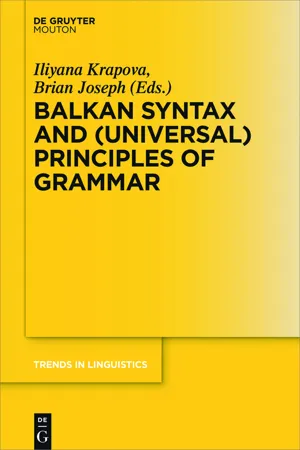
This book investigates morpho-syntactic convergences that characterize the languages of the Balkan Sprachbund: Balkan Slavic, Greek, Romanian, Albanian, Balkan Romani. Apart from new data, the volume features contributions within different theoretical frameworks (contact linguistics, functional linguistics, typology, areal linguistics, and generative grammar).
eBook - ePub
Balkan Syntax and (Universal) Principles of Grammar
- 349 pages
- English
- ePUB (mobile friendly)
- Available on iOS & Android
eBook - ePub
Balkan Syntax and (Universal) Principles of Grammar
About this book
Information

Part I:Contact Phenomena, Causes and Types of Explanations
Petya Asenova
Balkan Syntax: Typological and Diachronic Aspects
Petya Asenova, (University of Sofia), [email protected]
Abstract: According to the principles of Eurolinguistics, the Balkan linguistic union (BLU) forms part of the European linguistic union (SAE). The tendency to view the field of Balkan linguistics as a sub-field of Eurolinguistics has gained momentum for the past two decades specifically on the basis of the fact that similarities between Balkanisms and Europeanisms are most conspicuous in the realm of syntax and also pertain to grammatical categories. This paper offers some considerations in this respect and argues that while Europeanisms are mostly innovations, Balkanisms are manifested on all language levels with morphology being particularly relevant for establishing the existence (or non-existence) of a language union. As an areal-typological unity of languages, both SAE and BLU represent a linguistic union (Sprachbund) and are suitable objects for the application of areal and typological research methods. However, the areal continuum of the Balkan Sprachbund is characterized by common historical development (as demonstrated by its archaic morphological traits), as well as by cultural and linguistic convergences.
Keywords: Balkanism, Linguistic union, Europeanism, Bilingualism, Convergence
1Preliminary considerations. Balkan linguistics and Eurolinguistics
Possible objections notwithstanding, the beginning of Balkan linguistics can be traced to the 18th century. Moreover, if it is accepted that its first manifestation is not the widely known conclusion by Johann Thunmann (1746–1778) from 1774 concerning the relationship between Illyrian and Thracian, and the language relations on the Balkan Peninsula (Thunmann 1774), but rather the observations of Dimitrie Cantemir (1673–1723) made about half a century earlier, in 1716 (Cantemiri 1716: Caput IV. De lingua Moldavorum) concerning the mixture of Aromanian with Albanian and Greek, and about the ways the speakers of these languages communicated (Kostov 1999–2000), we have just recently celebrated the three-hundredth anniversary of Balkan linguistics. This birth date for Balkan Linguistics is suitably placed between the period marking the emerging interest in language in ancient Greece 2500 years ago (provisionally taking the 5th century BC as its starting point) and the official proclamation of Eurolinguistics some twenty years ago.
The coining of the term “Eurolinguistics” belongs to the remarkable Balkan linguist Norbert Reiter (1928–2009), who used it first in 1991 (Reiter 1991). According to him, Eurolinguistics marks a further stage in the development of Balkan Studies (“Die “Eurolinguistik” ist eine konsequente Weiterentwicklung der Balkanologie”); the latter equipped the former with its basic linguistic tools (Reiter 1997).
Prior to the establishment of Eurolinguistics, much research in the domain of areal typology and the theory of linguistic unions aimed at grouping the European languages in a specifiable number of language types or linguistic unions (e.g. Lewy 1942 [1964]; Décsy 1973; Haarmann 1976, the latter posits seven such types/unions). In such cases, Trubetzkoy’s (1928) term Sprachbund (“linguistic union”) is applied in its broad and relative sense, even metaphorically so, without consistently abiding by historical and sociolinguistic criteria and the hierarchy of commonalities in the structure of the languages.
Eurolinguistics has as its subject matter the study of the European linguistic union or, as it is known, Standard Average European (SAE), i.e. the European (or Indo-European ) linguistic invariant as defined by B. L. Whorf, the tertium comparationis he used in the description of the Amerindian languages, Hopi in particular. As Haspelmath (2001: 1504) puts it, “To give Whorf his due, it must be added that he was not interested in demonstrating that SAE languages form a Sprachbund.”
Within the framework of Eurolinguistics, the Balkan linguistic union (henceforth BLU) is part and parcel of the European linguistic union, which logically makes the treatment of Balkan linguistics part of Eurolinguistics, a tendency that has been gaining momentum for the past two decades. This justifies a comparison between the objects and methods of analysis of the two cognate linguistic disciplines, particularly in view of the contributions of Balkan linguistics to the domain of Eurolinguistics (cf. Hinrichs 2009).
2Objects of analysis
The similarities observed in the Balkanisms (the common specificities of the languages of the BLU) and the Europeanisms (the common specificities of the SAE) are manifested in the fact that both are realized on the level of syntax and are related to some grammatical categories. Europeanisms are mostly innovations; the same also goes for the Balkanisms: indeed, the majority of them are innovations, too.
However, the differences between them are substantial. Balkanisms occur on all linguistic levels, starting from the phonological and going to the textual, but the morphological similarities are of particular importance to the BLU because the latter are relevant to the existence (or non-existence) of a linguistic union (if we adhere to Trubetzkoy’s definition). Moreover, among Balkanisms, there are existing archaic features (archaisms) of Indo-European origin (e.g., the rich modal-temporal system and the status of the simple past tenses).
3Research methods
Any linguistic union functioning as an areal-typological unity is the optimal object to which to apply areal and typological methodology in its analysis.
The areal continuum of SAE is certainly more extensive than that of the BLU. Still, the areal continuum of the BLU, geographically bound by three seas, is accompanied by common historical development, and cultural and linguistic symbiosis. The processes of that symbiosis have been manifested by direct, mostly oral, language contacts, mutual influence, and interference (e.g., the occurrence of the future tense forms) which led to the simplification of the language systems (e.g., the replacement of the infinitive in an identical manner). Together with the expected parallels between languages of different origin and development, and subject to typological analysis, the occurrence of the parallels between the Balkan languages has been historically documented to a great extent in their written monuments. This is why the typological method of research of the BLU can be conveniently extended with the application of the historical and comparative-historical method aiming at proving the convergent origin of specific Balkanisms. The application of the diachronic approach to typology results in a kind of diachronic typology (Asenova 1990). Eurolinguistics also poses a like question of “How did the SAE come into being?” and takes into account the significance of a diachronic approach oriented towards “Protо-Indo-European structures”, “common substratum of a pre-Indo-European population”, “contacts” (Haspelmath 2001:1506): these are all issues of different relevance at different times in the history of Balkan linguistics. The objective historical possibilities do not allow for more precise answers to be given to questions related to the convergence processes operative in the Balkans; such questions should not be reduced merely to “Who borrowed from whom?”, and should not be limited to providing general chronological observations such as “from late antiquity to the early Middle Ages” and “from the Renaissance to the Enlightenment”.
The Eurotype model, as put forward by Martin Haspelmath (Haspelmath 2001:1493), consists of twelve “major Standard Average European features”: syntactic and morpho-syntactic parallels between Romance, Germanic and Balto-Slavic languages, the Balkan languages and the easternmost Finno-Ugric languages, as opposed to other languages in the world. On the basis of nine of these features the author defines “degrees of membership in the SAE”, represented on a “cluster map”. The selected morpho-syntactic features are as follows (Haspelmath 2001: 1504ff.):
1.Definite and indefinite articles
2.Relative clauses with (underlined in (1)) relative pronouns:

3.‘Have’- perfect
4.Participial passive
5.Dative external possessors:

6.Negative pronouns and lack of verbal negation (see below for examples);
7.Relative-based equative constructions, cf. the examples in (3), for ‘as big as strong’, alongside those in (4) for ‘beautiful as you (are)’; cf. also (Hinrichs 2009: 20):


8.Subject person affixes as strict agreement markers: ‘you/PL work’: rabotite (Bulg, with no overt subject with which the verb agrees) vs. ihr arbeitet (German)
9.Intensifier-reflexive differentiation (cf. also Hinrichs 2009:20), e.g. se : sam (Bulg), o ίδιος : τον εαυτό (Grk), as in (5):


Although the “major Standard Average European features” are not of the same rank – 1, 3, 4, 8 above are categorial and the others are syntactic structures – they represent explicitly the common characteristics of the European languages. According to their areal distribution, however, the nucleus of the SAE is formed by French and German, which possess nine of the features, whereas the languages of the BLU fall into three different groups with a decreasing proximity to the nucleus: Albanian in the layer closest to the nucleus – with eight features – followed by Greek and Romanian – with seven features – and last Bulgarian, essentially the periph...
Table of contents
- Cover
- Title Page
- Copyright
- Contents
- Introduction – Morpho-Syntactic Convergences and Current Linguistic Theory
- Part I: Contact Phenomena, Causes and Types of Explanations
- Part II: Balkan Syntax and Universal Principles of Grammar
- Part III: Variation in the Sprachbund
- Language Index
- Subject Index
Trusted by 375,005 students
Access to over 1.5 million titles for a fair monthly price.
Study more efficiently using our study tools.
Frequently asked questions
Yes, you can cancel anytime from the Subscription tab in your account settings on the Perlego website. Your subscription will stay active until the end of your current billing period. Learn how to cancel your subscription
No, books cannot be downloaded as external files, such as PDFs, for use outside of Perlego. However, you can download books within the Perlego app for offline reading on mobile or tablet. Learn how to download books offline
We are an online textbook subscription service, where you can get access to an entire online library for less than the price of a single book per month. With over 1.5 million books across 990+ topics, we’ve got you covered! Learn about our mission
Look out for the read-aloud symbol on your next book to see if you can listen to it. The read-aloud tool reads text aloud for you, highlighting the text as it is being read. You can pause it, speed it up and slow it down. Learn more about Read Aloud
Yes! You can use the Perlego app on both iOS and Android devices to read anytime, anywhere — even offline. Perfect for commutes or when you’re on the go.
Please note we cannot support devices running on iOS 13 and Android 7 or earlier. Learn more about using the app
Please note we cannot support devices running on iOS 13 and Android 7 or earlier. Learn more about using the app
Yes, you can access Balkan Syntax and (Universal) Principles of Grammar by Iliyana Krapova, Brian Joseph, Iliyana Krapova,Brian Joseph in PDF and/or ePUB format, as well as other popular books in Filología & Idiomas. We have over 1.5 million books available in our catalogue for you to explore.