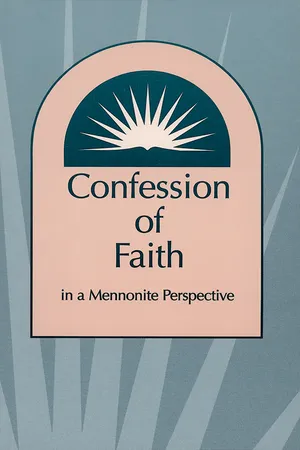
Adopted by the General Conference Mennonite Church and the Mennonite Church at Wichita, Kansas, July 1995. The 24 articles and summary statement were accepted by both groups as their statement of faith for teaching and nurture in the life of the church.
eBook - ePub
Confession of Faith in a Mennonite Perspective
- 112 pages
- English
- ePUB (mobile friendly)
- Available on iOS & Android
eBook - ePub
Confession of Faith in a Mennonite Perspective
About this book
Information
Topic
Theology & ReligionSubtopic
Christian DenominationsArticle 1
God
We believe that God exists and is pleased with all who draw near by faith.1 We worship the one holy and loving God who is Father, Son, and Holy Spirit eternally.2 We believe that God has created all things visible and invisible, has brought salvation and new life to humanity through Jesus Christ, and continues to sustain the church and all things until the end of the age.
Beginning with Abraham and Sarah, God has called forth a people of faith to worship God alone, to witness to the divine purposes for human beings and all of creation, and to love their neighbors as themselves.3 We have been joined to this people through the faithfulness of Jesus Christ and by confessing him to be Savior and Lord as the Holy Spirit has moved us.4
We humbly recognize that God far surpasses human comprehension and understanding.5 We also gratefully acknowledge that God has spoken to humanity and related to us in many and various ways. We believe that God has spoken above all in the only Son, the Word who became flesh and revealed the divine being and character.6
God’s awesome glory and enduring compassion are perfect in holy love. God’s sovereign power and unending mercy are perfect in almighty love. God’s knowledge of all things and care for creation are perfect in preserving love. God’s abounding grace and wrath against sinfulness are perfect in righteous love. God’s readiness to forgive and power to transform are perfect in redemptive love. God’s unlimited justice and continuing patience with human-kind are perfect in suffering love. God’s infinite freedom and constant self-giving are perfect in faithful love.7 To the one holy and ever-loving triune God be glory for ever and ever!
(1) Exod. 3:13-14; Heb. 11:6.
(2) Exod. 20:1-6; Deut. 6:4; Matt. 28:19; 2 Cor. 13:13 [14].
(3) Gen. 12:2-3; Lev. 19:18; Rom. 4:11-25; 1 Pet. 3:9-11.
(4) Gal. 2:20; Rom. 3:22.
(5) Exod. 3:13-14; Job 37; Isa. 40:18-25; Rom. 11:33-36.
(6) John 1:14, 18; Heb. 1:1-4.
(7) Exod. 20:4-6; 34:5-7; Ps. 25:4-10; Isa. 6; 54:10; Matt. 5:48; Rom. 2:5-11; 3:21-26;1 John 4:8, 16.
Commentary
1. We believe that what we know of God through revelation fits with who God really is. To confess that God is Father, Son, and Holy Spirit is to confess that the Son and the Holy Spirit are fully divine. It is also to confess that God is one and that God’s oneness is the unity of Father, Son, and Holy Spirit (for example, John 10:30; 14:18-20; 16:12-15; 20:21-22). In this confession, the word God can refer to the God who is triune or to the first person of the trinity. (On God as the first person of the trinity, compare Matt. 28:19 with 2 Cor. 13:13 [14] and numerous other passages.)
Confessing God as Father, Son, and Holy Spirit also emphasizes the shared work of creation, salvation, and the final consummation. This trinitarian understanding of God has implications for ethics. The ethical standards we receive from God as Creator are not contrary to those which are revealed by God as Redeemer. For example, we cannot claim that God as Creator justifies Christian participation in violence, while God as Re-deemer calls us to make peace without violence. What the Creator intends for human conduct has been most fully revealed in Jesus Christ.
Some early Christian creeds express a trinitarian understanding of God with the terms essence, substance, or person. Early Anabaptist writers such as Menno Simons and Pilgram Marpeck used mainly biblical language to refer to the triune God. They also used some concepts from the early creeds. Some Mennonite confessions of faith have used only biblical terminology to refer to God; others have used both biblical and creedal language. This confession assumes basic agreement with traditional confessions of faith, though it remains with biblical terminology for the most part. The article uses the word triune, which is not found in Scripture. Yet, it is an apt term for the God revealed in Scripture and helps maintain a biblically based theological and ethical balance.
2. The relation between God and the people of faith is the context within which we have received God’s revelation and which provides the basis for our understanding of God. Our knowledge of God comes mainly from this relationship and its history, which began with God calling out the household of Abraham and Sarah. (See Heb. 11:8-12 and note the oldest texts for verse 11: “By faith Sarah … received power to conceive … because she considered him faithful who had promised.”) At the same time, we believe that the God whom we confess is the one and only true God of all creation and of all humanity. Even before calling a particular people, God was revealed through creation and spoke to humanity.
3. God both surpasses human understanding and is truly knowable through revelation. Our knowledge of God rests in this tension. Further, God’s characteristics (or “attributes”) sometimes appear contradictory to us. For example, how can God be both just and merciful, characteristics which in human experience often seem opposed? Yet we confess that in the divine being these attributes are perfectly united. Finally, according to Scripture, the love of God has a certain priority in relation to other divine attributes. The article reflects this emphasis by such phrases as “righteous love” rather than by playing “righteousness” off against “love” or by focusing on one without the other.
Article 2
Jesus Christ
We believe in Jesus Christ, the Word of God become flesh. He is the Savior of the world, who has delivered us from the dominion of sin and reconciled us to God by humbling himself and becoming obedient unto death on a cross. 1 He was declared to be Son of God with power by his resurrection from the dead.2 He is the head of the church, the exalted Lord, the Lamb who was slain, coming again to reign with God in glory. “No other foundation can anyone lay than that which is laid, which is Jesus Christ.” 3
We confess Jesus as the Christ, the Messiah, through whom God has prepared the new covenant for all peoples. Born of the seed of David, Jesus Christ fulfills the messianic promises given through Israel.4 As prophet, he has proclaimed the coming of God’s kingdom and called everyone to repent. As teacher of divine wisdom, he has made known God’s will for human conduct. As faithful high priest, he has made the final atonement for sin and now intercedes for us. As king who chose the way of the cross, he has revealed the servant character of divine power. 5
We accept Jesus Christ as the Savior of the world. 6 In his ministry of preaching, teaching, and healing, he proclaimed forgiveness of sins and peace to those near at hand and those far off.7 In calling disciples to follow him, he began the new community of faith.8 In his suffering, he loved his enemies and did not resist them with violence, thus giving us an example to follow. 9 In the shedding of his blood on the cross, Jesus offered up his life to the Father, bore the sins of all, and reconciled us to God.10 God then raised him from the dead, thereby conquering death and disarming the powers of sin and evil. 11
We acknowledge Jesus Christ as the only Son of God, the Word of God incarnate. He was conceived of the Holy Spirit and born of the Virgin Mary. As fully human and tempted as we are, yet without sin, he is the model human being.12 As fully divine, he is the one in whom the fullness of God was pleased to dwell. During his earthly life, Jesus had an intimate relationship with his heavenly Abba and taught his disciples to pray “Abba, Father.” 13 He is the image of the invisible God, and “all things have been cre-ated through him and for him, for he is before all things.” 14
We recognize Jesus Christ as the head of the church, his body. 15 As members of his body, we are in Christ, and Christ dwells in us. Empowered by this intimate relationship with Christ, the church continues his ministry of mercy, justice, and peace in a broken world. 16
We worship Jesus Christ as the one whom God has ex-alted and made Lord over all. He is our Lord and the not-yet-recognized Lord of the world. We live in the assurance of his coming again as the one by whom all humanity will be judged. He is the one who shall be acknowledged Lord of all, and the Lamb who will reign forever and ever. 17
(1) Phil. 2:5-8.
(2) Rom. 1:4.
(3) 1 Cor. 3:11.
(4) 2 Sam. 7:13-14; Isa. 9:1-6; Rom. 1:3; 2 Cor. 6:18.
(5...
Table of contents
- Cover Page
- Title Page
- Copyright
- Table of Contents
- Introduction
- Article 1 God
- Article 2 Jesus Christ
- Article 3 Holy Spirit
- Article 4 Scripture
- Article 5 Creation and Divine Providence
- Article 6 The Creation and Calling of Human Beings
- Article 7 Sin
- Article 8 Salvation
- Article 9 The Church of Jesus Christ
- Article 10 The Church in Mission
- Article 11 Baptism
- Article 12 The Lord’s Supper
- Article 13 Foot Washing
- Article 14 Discipline in the Church
- Article 15 Ministry and Leadership
- Article 16 Church Order and Unity
- Article 17 Discipleship and the Christian Life
- Article 18 Christian Spirituality
- Article 19 Family, Singleness, and Marriage
- Article 20 Truth and the Avoidance of Oaths
- Article 21 Christian Stewardship
- Article 22 Peace, Justice, and Nonresistance
- Article 23 The Church’s Relation to Government and Society
- Article 24 The Reign of God
- Summary Statement
- Unison Reading A
- Unison Reading B
- Scripture Index
- About the Mennonites
- Additional Resources about the Mennonites
Trusted by 375,005 students
Access to over 1.5 million titles for a fair monthly price.
Study more efficiently using our study tools.
Frequently asked questions
Yes, you can cancel anytime from the Subscription tab in your account settings on the Perlego website. Your subscription will stay active until the end of your current billing period. Learn how to cancel your subscription
No, books cannot be downloaded as external files, such as PDFs, for use outside of Perlego. However, you can download books within the Perlego app for offline reading on mobile or tablet. Learn how to download books offline
Perlego offers two plans: Essential and Complete
- Essential is ideal for learners and professionals who enjoy exploring a wide range of subjects. Access the Essential Library with 800,000+ trusted titles and best-sellers across business, personal growth, and the humanities. Includes unlimited reading time and Standard Read Aloud voice.
- Complete: Perfect for advanced learners and researchers needing full, unrestricted access. Unlock 1.5M+ books across hundreds of subjects, including academic and specialized titles. The Complete Plan also includes advanced features like Premium Read Aloud and Research Assistant.
We are an online textbook subscription service, where you can get access to an entire online library for less than the price of a single book per month. With over 1.5 million books across 990+ topics, we’ve got you covered! Learn about our mission
Look out for the read-aloud symbol on your next book to see if you can listen to it. The read-aloud tool reads text aloud for you, highlighting the text as it is being read. You can pause it, speed it up and slow it down. Learn more about Read Aloud
Yes! You can use the Perlego app on both iOS and Android devices to read anytime, anywhere — even offline. Perfect for commutes or when you’re on the go.
Please note we cannot support devices running on iOS 13 and Android 7 or earlier. Learn more about using the app
Please note we cannot support devices running on iOS 13 and Android 7 or earlier. Learn more about using the app
Yes, you can access Confession of Faith in a Mennonite Perspective by General Board Of The General Conference Mennonite Church, Mennonite Church General Board, General Board Of The General Conference Mennonite Church,Mennonite Church General Board in PDF and/or ePUB format, as well as other popular books in Theology & Religion & Christian Denominations. We have over 1.5 million books available in our catalogue for you to explore.