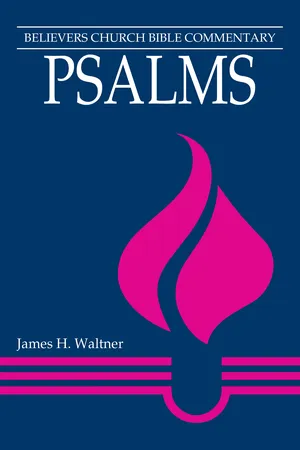
The influence of Psalms is immense, both in terms of the worship of God’s people and in the spiritual experience of countless individuals. James H. Waltner aims to help readers find their way through Psalms, encounter God, and be led into obedience and praise.
- 838 pages
- English
- ePUB (mobile friendly)
- Available on iOS & Android
eBook - ePub
About this book
Information
Topic
Theology & ReligionSubtopic
Biblical CommentaryBook One
Psalms 1-41
Psalm 1
Blessed—the Way of the Righteous
PREVIEW
The first psalm reflects Hebrew wisdom literature from its opening word Happy, “Blessed” (NIV, RSV) and by the message contrasting the character and fate of the wicked and the righteous. The psalm’s focus on the law (torah, tdra] sounds a strong teaching note. The world is organized in such a way that conduct matters. Placed as introduction, the psalm presents the Psalter as a study and prayer book, essential for the ordering of life to God’s purposes.
Psalm 1 commends joyous and continuous engagement with the law of the LORD. Shunning the counsel and influence of the wicked, the person who allows the instruction of the LORD (Yahweh) to nurture life will prosper like the fruit-bearing tree. Striking contrasts abound from the first word, happy (blessed), to the last emphatic word, perish! The psalm uses two powerful similes: a tree that has its roots in the water and therefore bears fruit abundantly as intended, and chaff, the light, flaky refuse that in threshing the grain is blown away as useless!
Book I of Psalms (1-41) may have been assembled under influence of the wisdom writers since both Psalms 1 and 41 are “blessed” psalms, introduced by a beatitude. Likely not part of the original collection, Psalm 1 was placed to open the Psalter following the exile and the work of Ezra, when the law (torah) became a unifying force for the Hebrew people [Composition].
OUTLINE
Portrait of the Righteous, 1:1-3
Portrait of the Wicked, 1:4-6
EXPLANATORY NOTES
Portrait of the Righteous• •1:1-3
An emphatic Happy (’asre) describes the righteous person. The meaning is “O the blessedness, the joy, the good fortune!” The shift by translators from “man” (v. 1 Heb, RSV, NIV) to those (NRSV) represents the attempt to employ phraseology for human beings that is not gender specific. The psalm warns against the evil counsel of the wicked. Note the progression “walks,” “stands,” “sits” (v. 1 RSV). Here too, a translation such as NRSV has moved to convey how the verbs are used metaphorically since “walk” and “way” in Hebrew often imply a lifestyle and how to live. Sinners can increasingly lead a person down the wrong path so that the wrong people become one’s company and counsel.
In contrast, the blessed one’s delight is in the law of the LORD (v. 2). For the Hebrews, the torah (translated into English inadequately as “law“) meant teaching, guidance. The torah was the instruction revealing the covenant story of God’s dealing with his people. Torah referred to the Ten Commandments as a summary of God’s basic instruction for community living. Eventually Torah (capitalized) was/is used to speak of the first five books of the OT. In later times, it came to mean all of Jewish learning and sacred literature [Torahj.
We commonly think of law in the sense of “Thou shalt not .•.•.•” as oppressive and restrictive, as ought and as burden. But the Hebrews looked on torah as a guide to life, as that God-given structure and order that was freeing. The psalm invites people to meditate (h(i g(i h), which implies murmuring and mumbling. Isaiah uses the word for the growling sound a lion makes over its prey (Isa 31:4). Psalm 1 tells of reciting words of the torah throughout the day and during waking moments of the night. Other torah Psalms are 19 and 119, though in Psalm 1 torah likely also refers to the teaching of all of the psalms that follow. If so, then the first psalm offers a specific orientation to the reader for the entire Psalter.
High regard for the law implies not only singing its virtues, but also obeying. The Torah at the center “reminds us that the primal mode of faithfulness and knowing God is obedience. .•.•. Life has a moral coherence on which we can rely” (Brueggemann, 1982:56). What kind of success in life is implied by the word prosper (v. 3; Josh 1:8)? Belief in the link between obedience to God and worldly, material prosperity was widespread (Pss 37:25; 128:3; 144:12-14). To prosper may also mean that as the tree fulfills the purpose for which it was created, so the nature and value of an obedient life are to be found in the fulfillment of the divine will.
Portrait of the Wicked• • 1:4-6
“Not so the wicked!” (NIV) catches the emphatic Hebrew in contrast to verse 1. The way of the wicked is a dead-end street. When called to account either by due legal process in society or spiritually by God here and now, the wicked have no valid defense (v. 5). For those who opt out of the covenant way, how often their way of life becomes destructive. The wicked—often viewed as those who accuse the innocent, afflict the lowly, and undermine the trust of the faithful (Pss 3:7; 10:2; 11:2)—represent the incongruence between the will of God and the will of human beings (Mays, 1994b:43) [Wicked].
The final verse summarizes the two ways. The LORD watches over, “knows,” or “approves, has regard to” the righteous (NASB). “To know” in Hebrew implies a relationship, not just perceiving. Constant meditation on torah nurtures life for fruit-bearing, but the way of the wicked will perish.
A Comparison Between Two Contrasting Groups
| Verses | Subject | Characterization | Focus | Like | Fate |
|---|---|---|---|---|---|
| 1:1-3 | righteous | Blessed! | law | tree | prosper |
| 1:4-6 | wicked | Not so! | counsel of wicked | chaff | perish |
THE TEXT IN THE BIBLICAL CONTEXT AND LIFE OF THE CHURCH
Two Ways
The language of Psalm 1 is reminiscent of the opening chapter of Joshua (1:7-8), and brings to mind the story of finding the “book of the law” (Deuteronomy) in the temple (2 Kings 22:8-23:3). Note also Psalms 32; 41; 112; and 128 as beginning with the emphatic Hebrew word ’asre, “happy.” Later Jesus echoes this language: “Blessed .•.•. are those who hear the word of God and obey it!” (Luke 11:28). In the Sermon on the Mount, Jesus uses the Beatitudes to teach about true righteousness (Matt 5:3-12). In this sermon Jesus also refers to the Law (Torah) and the Prophets, and his coming “not to abolish but to fulfill” (5:17). In concluding his sermon, Jesus refers to the two ways: “the road is easy that leads to destruction” (7:13), and “the road is hard that leads to life” (7:14). The Sermon on the Mount ends with powerful images of the “wise man who built his house on rock” and the “foolish man who built his house on sand” (7:24-27). One stood; the other perished.
In the life of the early church, followers of Jesus came to be called people of “the Way” (Acts 9:2; 19:9, 23; 22:4). Through the centuries believers have thus identified themselves. In Thieleman J. van Braght’s great collection of martyr stories, many imprisoned for their faith took courage in Psalm 1, frequently quoting verses in their letters to encourage family and friends: “Abide with God, and mingle not with the wicked.” “Give yourself up to the Lord, and always join yourself to those who fear the Lord.” “Weary not in the ways of the Lord; have your delight therein day and night” (549, 468, 1053).
Invitation to Dialogue
If the way of the wicked will perish, then why do the wicked sometimes appear to thrive (Ps 73:3-12)? If the righteous are to prosper in all they do, what of those who experience life differently? Famine, ethnic cleansing, the destruction of war and terrorist activity do not distinguish between the just and the unjust. Psalm 1 provides an introduction to the entire Psalter. Many of the psalms that follow seem to enter into dialogue with it, questioning and searching for meaning in the midst of life’s wide range of experiences, including the dark night of the soul (Davidson, 1998:13-14).
This sharp contrast between the righteous and the wicked is not always evident. A mixture of good and bad is found in everyone, and the two ways may not seem that clear. But at every moment people move along one way or the other. It is important to be reminded what the end of each road is. The psalms will tell of a powerful companion along the one road, but along the other people walk alone.
Invitation to Put Our Roots Down
On what do Christians focus their life’s attention? Who are their people? From whom do they get their bearings? What will give stability and fruit-bearing nurture to their soul? The first psalm invites us to put our roots down in the instruction and relationship to God offered us in the word of torah. By reading and praying these psalms, by delighting in them, we are invited to make these Scriptures part of our life of faith. Through these words from the worship life of God’s people, we too can learn to cry out to God in the personal and corporate crises of life. We can learn to place trust in the God of steadfast love and faithfulness. The hymns of thanksgiving and praise can help us voice doxologies that declare hope. An exciting adventure awaits the reader of the Psalms.
Psalm 2
The LORD and His Anointed
PREVIEW
This royal psalm may have been composed for the coronation of a king of Judah, at Jerusalem in the time after David. We cannot identify the specific historic setting. The liturgy celebrates the accession to the throne and the vital place of the king in the life of the community.
The psalm’s recital by the king at enthronement, or at an annual ceremony reenacting the coronation, expressed confidence at a time often marked by political unrest both from within and outside the nation. Its message lies in the clear focus, not on the struggle of earthly powers for their existence, but on God as Lord of the earth, as the King of kings, with whom all nations must reckon. Psalm 2 addresses the question of power: Where does power to control world history ultimately reside? The psalm’s resounding answer: Power resides in the LORD of the heavens, and his anointed set as king on Zion’s holy hill.
The later identification of this psalm with Jesus as the Messiah, the extensive quoting of this psalm in the NT, and its striking message for today—all suggest that the psalm writers often wrote more than they knew. That is the remarkable timelessness of these ancient writings!
OUTLINE
Astonishment at the Rebellion of the Nations, 2:1-3
The LORD’s Response from the Heavens, 2:4-6
The King’s Report of the Decree of the LORD, 2:7-9
Admonition and Invitation, 2:10-12
EXPLANATORY NOTES
Astonishment at the Rebellion of the Nations• • 2:1-3
If the psalm is viewed as liturgy, it is helpful to know who is speaking. A possible outline of the psalm’s speakers may include: verses 1-2, priest; 3, rebel kings; 4-5, priest; 6, God; 7, God’s king; 8-9, God; and 10-12, priest.
The psalm opens with the question of why nations plot against the LORD and his anointed (vv. 1-2). The verb that dominates the action of Psalm 1, meditate (hagah), appears in 2:1 but is translated plot in the sense of devising and scheming. The earthly scene involves conspiracy, troop assembly, and the taunt of those plotting rebellion (v. 3). The immediate reference to his anointed (v. 2) is the newly crowned king. Anointing with oil as a sign of consecration to some function or office was common (Exod 28:41; 1 Kings 19:16; Ps 105:15). Frequently it refers to the king (1 Sam 24:6, 10), who was seen as the LORD’s earthly regent. From anointed (masah) comes the English word “messiah,” a title later used to express the hope of one whom God would send, and a name given to Jesus [Anointed].
The tone of these opening verses is incredulity. How can anyone, even the most powerful earthly rulers, hope to break free from the sovereign LORD and his anointed?
The LORD’s Response from the Heavens• • 2:4-6
Now the scene changes. From the heavens, from God’s perspective, the clamor of the nations and the assembling of their troops is laughable (v. 4)! They have no sense of what the fury of God’s wrath unleashed could mean! In his good time God will come face-to-face with the rebellious forces. The wicked will not escape when the LORD speaks (v. 5; Ps 50:3, 16, 22). In the quotation from the LORD about Zion as his holy mountain (v. 6; 3:4; 15:1; 43:3; 87:1; 99:9), the king’s installation in Jerusalem is declared a divine act. This is not just any city, but the city of the great King (48:1-2), the city of the house of the LORD (122:1, 9) [Zion],
The King’s Report of the Decree of the LORD• •2:7-9
The third stanza, which shifts the focus from the high heavens to the royal palace on earth, begins with the king’s statement of intention (v. 7a), followed by quotation of the LORD’s word (vv. 7b-9). Here are the words legitimizing the king’s reign by the LORD’s decree (hoq), a term from sacral royal law. In the Hebrew understanding of kingship, the ruler was seen as adopted by God (v. 7; 2 Sam 7:14; Ps 89:2627). The ruler is declared to be the son of God (v. 7), with the king’s authority including inheritance, possession, and administration (vv. 89). The rod of iron may refer to a royal scepter, symbol of the king’s power. We know about dashing pottery to pieces from Egyptian coronation rituals: the king demonstrated his worldwide power by smashing earthen vessels bearing the names of foreign nations.
The language seems boastful and extravagant. At no time in Hebrew history was the nation so great and powerful as envisioned here! In these lofty descriptions of the king in Psalms 2 and 110, some see the influence of pre-Israelite Canaanite rituals, while Psalm 89 describes a more specifically Israelite concept of kingship (Westermann, 1980:106). For Judean kings, the model of world empire was the reign of David. “The logic of the psalm is not hist...
Table of contents
- Cover Page
- Title Page
- Copyright Page
- Dedication
- Abbreviations, Transliteration, Ancient Sources
- Contents
- Series Foreword
- Author’s Preface
- Introduction to Psalms
- Book One (Psalms 1-41)
- Book Two (Psalms 42-72)
- Book Three (Psalms 73-89)
- Book Four (Psalms 90—106)
- Book Five (Psalms 107—150)
- Outline of Psalms
- Essays
- Map of Palestine
- Map of the Ancient Near East
- Appendix I The Psalms Arranged by Literary Genre (Type)
- Appendix II Index of Psalms According to Genre (Type)
- Bibliography of Works Cited
- Selected Resources
- Index of Ancient Sources
- The Author
Trusted by 375,005 students
Access to over 1.5 million titles for a fair monthly price.
Study more efficiently using our study tools.
Frequently asked questions
Yes, you can cancel anytime from the Subscription tab in your account settings on the Perlego website. Your subscription will stay active until the end of your current billing period. Learn how to cancel your subscription
No, books cannot be downloaded as external files, such as PDFs, for use outside of Perlego. However, you can download books within the Perlego app for offline reading on mobile or tablet. Learn how to download books offline
We are an online textbook subscription service, where you can get access to an entire online library for less than the price of a single book per month. With over 1.5 million books across 990+ topics, we’ve got you covered! Learn about our mission
Look out for the read-aloud symbol on your next book to see if you can listen to it. The read-aloud tool reads text aloud for you, highlighting the text as it is being read. You can pause it, speed it up and slow it down. Learn more about Read Aloud
Yes! You can use the Perlego app on both iOS and Android devices to read anytime, anywhere — even offline. Perfect for commutes or when you’re on the go.
Please note we cannot support devices running on iOS 13 and Android 7 or earlier. Learn more about using the app
Please note we cannot support devices running on iOS 13 and Android 7 or earlier. Learn more about using the app
Yes, you can access Psalms by James H. Waltner in PDF and/or ePUB format, as well as other popular books in Theology & Religion & Biblical Commentary. We have over 1.5 million books available in our catalogue for you to explore.