Elmer A. Martens explores the message and insights of Jeremiah for today. In Jeremiah, God disciplines people and punishes them. Yet there is also forgiveness and thepromise of a new covenant. This ancient book is strangely relevant to our generation. The more we learn about the stressful times in which Jeremiah lived, about the passionate prophet himself, and about the arrangement of the book that bears his name, the more forceful the message becomes.
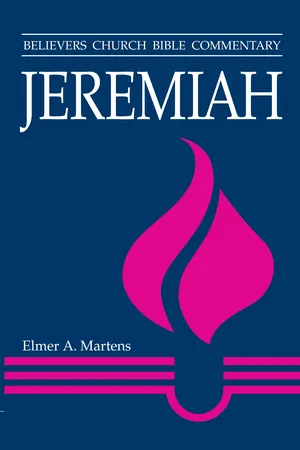
- 328 pages
- English
- ePUB (mobile friendly)
- Available on iOS & Android
eBook - ePub
About this book
Information
Topic
Theology & ReligionSubtopic
Biblical CommentaryJeremiah
Becoming Acquainted
We read a book like Jeremiah for its message and insights. This book has a weighty message. It may shock us into reassessments and realignments; it will almost certainly change our values. The story in this book may strike us as dark and dismal. We shall hear about Israel’s failures, her fascination with substitute deities, her disregard for just dealings. We will hear passionate appeals for change, admonitions, laments, exhortations, and threats.
We will also hear promises. The underlying message has two faces: God disciplines people and punishes them; yet there is also forgiveness—the promise of new covenant. The gospel in Jeremiah reads: “I have loved you with an everlasting love” (31:3).
The book holds up a mirror to any and every society. It moves on a broad platform of world events; it addresses the nations, who are held accountable before God, and threatens annihilation of peoples who persist in evil. This ancient book is strangely relevant to our generation—a relevance which accounts, no doubt, for the recent explosion of dissertations, books, and commentaries on Jeremiah.
Yet here and there we are whisked, suddenly and swiftly, to a closet where the prophet is alone with his God. We hear his most intimate conversations. We learn about the prophet’s pain and grief, his struggle to comprehend God’s message to a faithless people. Thus the book is a mirror, not only of the international scene, but of an individual’s life with God.
The more we leam about the stressful times in which Jeremiah lived, about the passionate prophet himself, and about the arrangement of the book that bears his name, the more forceful the message becomes.
Upheavals at the Turn of the Century
The book spans Judah’s history from the middle of the seventh to the beginning of the sixth century, i.e., 640-580 B.C. Judah rises in one last burst of energy under King Josiah; then a period of uncertainty sets in, followed by further national vacillation, decay, and sudden catastrophe.
King Josiah is the prominent figure in the last half of the seventh century. A century earlier the mighty Assyrian army had terrorized the land and humiliated Israel, the northern state, by capturing in 722 her capital city, Samaria. Now, however, the Assyrian empire was in difficulty. Josiah of Jerusalem seized the moment of Assyria’s weakness and enlarged Judah’s territory. Economically, times were briefly prosperous. Religious reforms were inaugurated after the remarkable discovery of the law scroll in the temple. Josiah wanted to serve God and led his people away from their evil ways.
Then, tragedy. In the battle at Megiddo in 609, this good king was killed. Jehoiakim, one of the important successors, despised Josiah’s efforts at restoring godly living, and the long slide to disaster began. In the middle of his reign the Babylonians defeated the Egyptians at Carchemish and advanced southward to Israel in 605. They overpowered Jerusalem during Jehoiachin’s three-month rule (598-597) and set up a king of their own choice, Zedekiah. His eleven-year rule was marked by vacillation: he would listen to his pro-Egyptian advisers, but also occasionally consult Jeremiah—who, of all things, advised surrender to the Babylonians! When Zedekiah finally attempted to throw off his vassal condition, Babylonian armies, Jeremiah’s “foe from the north,” moved swiftly in revenge. The armies seized Jerusalem, looted the temple, burned the city, and marched its citizens away captive. The year was 587. [Babylon/Babylonians, p. 291]
From a religious point of view, such a tragedy was the outcome of the spiritual deterioration that had set in after King Hezekiah’s reform a century earlier. This good and devout king had been followed by his son Manasseh, Judah’s most godless monarch. His long reign (687-642) left Judah in spiritual shambles. He reintroduced Baal worship. [Baal, p. 291.] He built altars to foreign gods, and to make emphatic his rejection of the Lord, he built these altars in the temple at Jerusalem. The temple courtyard also was dotted with altars to the starry host. He resorted to divination. As an ultimate abomination he sacrificed his own son. “He did much evil in the eyes of the Lord, provoking him to anger” (2 Kings 21:6). Granted, Josiah, Manasseh’s grandson, set an opposite course for Judah. Josiah introduced reforms in accordance with the book of the law found in the temple (2 Kings 22—23). While the reforms were sincere, they seem not to have reached deeply into the fabric of society, and they were ultimately short-lived. Jehoiakim, who followed shortly after Josiah, was not God-fearing (Jer. 36). Thus the kings and people paved their own way to the disaster that came with the fall of Jerusalem in 587.
For Judah, the turn of the century was clearly a time of transition marked by storm and stress. Judah had five different kings in its last two decades, few of them God-fearing. The prophets presented a false message, the priests were corrupt, the scribes wrote with a “lying pen.” Jeremiah as God’s spokesperson tried in vain to bring a spiritually wayward people back to God. He failed; they did not respond. The social fabric of society crumbled until national existence ended, not to be continued until the second century (and then only briefly) under the Maccabees. Jeremiah, then, is the book that recounts the final moments of a nation’s 250-year history. [Chronology, p. 293, Kings of Judah, p. 300.]
Jeremiah, an Unusual Prophet
The book begins as the international balance of power was shifting from Assyria to Babylon. God called a youth, probably in his late teens, Jeremiah by name, son of Hilkiah the priest, to be his prophet (627 B.C.). The young man wished to be excused and pleaded inexperience. However, before long he was preaching with passion. You have forsaken God, he told his people. You have forsaken the fountain of living waters, and as a second evil you have hewed out cisterns that can hold no water (2:13). You are an adulterous people. He declared, “An enemy is coming.” He preached at the temple gate (7:1-15), pressed God’s message upon the elders in the valley of Topheth (19:1-13), and had his message read in the king’s court, where it was irreverently dissected with a penknife and cast into the fire (36:1-26). He wore an ox yoke in the streets to publicize coming bondage to an enemy power (27:2-11).
Then, in the middle of the gloom and doom, he spoke about God’s consolation and comfort. Another day was coming, he said, when the land would be restored to the people and the people to their God, when brides and grooms would be celebrating in the streets (31:7-14). He purchased a field, even though he was in prison and the Babylonian army was at that moment laying siege to the city (32:1-15).
God gave him a message not only for Judah and Israel but for surrounding nations: Egypt, Babylon, Edom, Moab (46—51). This unusual prophet was involved in the international political scene of his day for a longer time (four decades) and with greater intensity than any other Old Testament prophet.
Still, he was not a politician, but God’s servant. His true antagonists were the false prophets, whom he opposed with the claim that it was he, not they, who stood in God’s council and proclaimed God’s true message. It is not out of idle repetition that in his book “thus says the Lord,” or similar phrases, occur more than 150 times.
Some of the events of Jeremiah’s life can be briefly sketched. The book contains a surprising amount of information about the prophet personally. Jeremiah was bom in the decade of 650-640 B.C. His call from God to be a prophet came in 627, though some scholars have suggested (but not compellingly) that 627 was the date of Jeremiah’s birth.
He was of a priestly family in Anathoth, some three miles north of Jerusalem. This priestly family could trace its roots to Eli, who ministered at Shiloh, once the central worship place for Israel. King Solomon had disenfranchised this Levitical priestly family because Abiathar had supported Solomon’s rival to the throne (1 Kings, 1:19; 2:27). As a sign to Judah of the terrible times soon to come, Jeremiah was forbidden to marry (16:1).
The reform by King Josiah beginning in 622 must have been followed by Jeremiah with interest, though direct statements about it are difficult to isolate. Some of the oracles in the early part of the book belong to Josiah’s reign. Jeremiah became quite vocal during the reign of King Jehoiakim (609-598). In the roll call of kings, Jehoiakim receives major attention (22:11-23). Jeremiah’s temple sermon was preached during his reign (7:1-15; 26:1-24). After Nebuchadnezzar of Babylon attacked Jerusalem in 597 and carried off captives, Jeremiah engaged in correspondence with the exiles, cautioning them against false prophets but also urging them not to participate in revolt-like activities (chapter 29).
During Zedekiah’s rule (597-587) Jeremiah repeatedly counseled the king to submit to the world power, Babylon (e.g., 27:12). King Zedekiah, while occasionally seeking out the prophet’s advice, did not deter his gate guards and other officials from arresting Jeremiah and confining him (37:16; 38:6). Zedekiah replied helplessly, “The king can do nothing to oppose you” (38:10). When Jerusalem fell, Jeremiah was given a choice: he could go with the exiles to Babylon or stay in the land (40:4). He stayed, lived through the assassination of Gedaliah the governor, and then despite his counsel to the contrary, went with the group that sought refuge in Egypt. It was in Egypt that Jeremiah died.
Rarely has there been a man so singularly pitted against the whole world. The people of his home city plotted his assassination. The general populace opposed him, mocking him for his gloomy message on a sunny day. The Jerusalem crowd of religious folk who heard his templegate sermon were ready to lynch him (26:7-11). His peers, the prophets, spoke an opposite message announcing peace—for example, the prophet Hananiah declared in God’s name that the Babylonian domination would be only temporary (28:14). Pashhur the priest jailed him (20:1-3). The kings were (understandably) ill-disposed toward this prophet who urged treason. They imprisoned him with the intent of killing him; and had it not been for the help of a friend, Jeremiah would have died in a muddy dungeon (38:11-13). As if all this were not enough, Jeremiah felt at times opposed by the very almighty God whose message he faithfully carried (20:7-9).
Jeremiah was unique among the prophets in that he disclosed more of his private emotional life than any of the others. He was personally devastated when his message over a 25-year span was rejected out of hand. He felt trapped. In his “confessions” he described his spiritual anguish, his tussle with God. Moreover, he agonized because all along he saw clearly the coming disaster and the awful destruction of his people.
O that my head were a spring of water
and my eyes a fountain of tears!
1 would weep day and night
for the slain of my people. (9:1)
Jeremiah preached in three modes: (1) he preached with his life, for by God’s command he remained unmarried (16:1); (2) he preached orally; and (3) he wrote a book by dictating to Baruch what he had preached (36:4). That record was burned, but was rewritten.
A Difficult Book
The book of Jeremiah is not only the longest prophetic book in the Bible (1,364 verses) but the most difficult to sort out. An initial encounter leaves the reader bewildered for several reasons. There is a strangeness in reporting: sometimes the book is about Jeremiah, at other times Jeremiah is the speaker. The book is chronologically disarranged. The principle of organization is neither fully chronological nor topical: its organization continues to be a challenge to all, especially to scholars who keep proposing organizational schemes and theo...
Table of contents
- Cover Page
- Half Title Page
- Title Page
- Copyright
- Dedication
- Contents
- Series Foreword
- Author’s Preface
- Jeremiah
Trusted by 375,005 students
Access to over 1.5 million titles for a fair monthly price.
Study more efficiently using our study tools.
Frequently asked questions
Yes, you can cancel anytime from the Subscription tab in your account settings on the Perlego website. Your subscription will stay active until the end of your current billing period. Learn how to cancel your subscription
No, books cannot be downloaded as external files, such as PDFs, for use outside of Perlego. However, you can download books within the Perlego app for offline reading on mobile or tablet. Learn how to download books offline
Perlego offers two plans: Essential and Complete
- Essential is ideal for learners and professionals who enjoy exploring a wide range of subjects. Access the Essential Library with 800,000+ trusted titles and best-sellers across business, personal growth, and the humanities. Includes unlimited reading time and Standard Read Aloud voice.
- Complete: Perfect for advanced learners and researchers needing full, unrestricted access. Unlock 1.5M+ books across hundreds of subjects, including academic and specialized titles. The Complete Plan also includes advanced features like Premium Read Aloud and Research Assistant.
We are an online textbook subscription service, where you can get access to an entire online library for less than the price of a single book per month. With over 1.5 million books across 990+ topics, we’ve got you covered! Learn about our mission
Look out for the read-aloud symbol on your next book to see if you can listen to it. The read-aloud tool reads text aloud for you, highlighting the text as it is being read. You can pause it, speed it up and slow it down. Learn more about Read Aloud
Yes! You can use the Perlego app on both iOS and Android devices to read anytime, anywhere — even offline. Perfect for commutes or when you’re on the go.
Please note we cannot support devices running on iOS 13 and Android 7 or earlier. Learn more about using the app
Please note we cannot support devices running on iOS 13 and Android 7 or earlier. Learn more about using the app
Yes, you can access Jeremiah by Elmer A. Martens in PDF and/or ePUB format, as well as other popular books in Theology & Religion & Biblical Commentary. We have over 1.5 million books available in our catalogue for you to explore.