Mothers and midwives reveal the wonders and difficulties of early twentieth century childbirth in this informative and insightful healthcare history.
Before the foundation of the United Kingdom's National Health Service (NHS) in 1948, expectant mothers relied on midwives to help them through childbirth. Based on interviews conducted with dozens and mothers and retired midwives over several years, Billie Hunter and Nicky Leap's
The Midwife's Tale shares the stories of these women in their own words, shedding light on their experiences and on the realities of childbirth in the first half of the twentieth century.
Intriguing, poignant, and sometimes humorous, this oral history covers the experiences of women from the 1910s through the 1950s including accounts of the difficulties of rearing large families in poverty-stricken environments and the lack of information about contraception and abortion—even as midwifery changed from an unqualified "handywoman" skill to an actual profession.
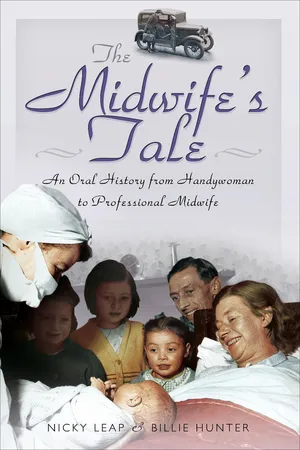
eBook - ePub
The Midwife's Tale
An Oral History from Handywoman to Professional Midwife
- 256 pages
- English
- ePUB (mobile friendly)
- Available on iOS & Android
eBook - ePub
About this book
Information
Topic
MedicineSubtopic
20th Century History1
From Handywoman to Midwife: the development of a profession
Before the First World War and, in some areas, until the mid-1930s, the majority of working-class women in Britain were attended in childbirth not by a professional midwife but by a local woman. She was likely to be an older woman, a respected member of the community. Her role would often include looking after the sick and dying and laying out the dead. Sometimes she also provided a sort of ‘home-help’ service, taking in washing and helping with housework and childcare.
Today we tend to refer to the traditional childbirth attendant as ‘the handywoman’, but women whom we interviewed either referred to her as ‘the woman you called for’ or gave her the title by which she would have been known for centuries – ‘the midwife’. Indeed, before legislation placed midwifery firmly in the hands of professionals, the main focus of the handywoman’s work was that of midwifery. Childbirth was not seen as a medical process, and in working-class areas, doctors were rarely called for, except in severe emergencies, since people could not afford to pay their fees. As Molly B., who grew up in South Shields, Tyneside, explains:
‘We very seldom called for a doctor because you had to pay for it. Everyone was so hard up, you just couldn’t afford a doctor. I mean, the only time you were ever taken to hospital was when you were blinkin’ on your death bed! The last knockings, you know [laughter]!’
Flora Thompson, in her book Lark Rise to Candleford, describes a rural midwife at the end of the nineteenth century:
‘She was, of course, not a certified midwife; but she was a decent, intelligent old body, clean in her person and methods and very kind.
‘Complications at birth were rare; but in the two or three cases where they did occur during her practice, old Mrs Quinton had sufficient skill to recognise the symptoms and send post haste for the doctor. No mother lost her life in childbirth during the decade.
‘In these more enlightened days the mere mention of the old, untrained village midwife raises the vision of some dirty, drink-sodden old hag without skill or conscience. But not all of them were Sairey Gamps [Charles Dickens’s notorious birth attendant in Martin Chuzzlewit]. The great majority were clean, knowledgeable old women who took a pride in their office. Nor had many of them been entirely without instruction. The country doctor of that day valued a good midwife in an outlying village and did not begrudge time and trouble in training her. Such a one would save him many a six- or eight-mile drive over bad roads at night, and if a summons did come, he would know that his presence was necessary.
‘The trained district nurses, when they came a few years later, were a great blessing in country districts, but the old midwife also had her good points for which she now receives no credit. She was no superior person coming into the house to strain its resources to the utmost, and shame the patient by forced confessions that she did not possess this or that, but a neighbour, poor like herself, who would make do with what there was, or, if not, knew where to send to borrow it.’1
Flora Thompson hints at class barriers and gives an impression of the impact of the predominantly middle-class, certified midwives, when she uses words such as ‘superior’, ‘strain’, ‘shame’ and ‘forced confessions’.
In the first decades of the twentieth century, an elite group of philanthropic women from middle-class, upper middle-class and aristocratic backgrounds spearheaded a campaign to regulate the training and practice of midwives. They had formed the Midwives Institute in 1881, and under its auspices, they used the political muscle of their connections with social reformers, politicians and the medical profession to manoeuvre the first Midwives Act in 1902. The act was negotiated within a firm understanding that all cases that were not strictly ‘normal’ should be referred to doctors, thereby ensuring a steady income for the medical profession and minimalising any professional threat to it.
The Midwives Institute aimed to ensure that all women, rich and poor alike, had access to both a qualified midwife and a doctor. Articles in Nursing Notes, the journal of the Midwives Institute, describe how their authors also sought to reform working-class habits and values. Central to their campaign was the wish to drive out the handywomen, whom they saw as a source of great evil and danger to childbearing women because they were untrained and had no academic knowledge about the prevention of infection.
The aim of the Midwives Institute was to replace the handywomen with trained professionals drawn from their own ranks. There was also the attraction of creating new opportunities for women at a time when few professions were open to them. Midwifery offered the possibility of responsible work with practitioner status, in a field where there was limited direct competition with men. Undoubtedly, the pioneers of the midwifery profession also saw themselves as the saviours of the poor. Alice Gregory, daughter of the Dean of St Paul’s, demonstrates in her writing, the almost missionary zeal and imperialist fervour with which they approached their campaign:
‘Whether the work is taken up by women who love their country and desire the progress of the race, or merely by ignorant self seekers who hope by banding together to exploit working women at their leisure – all this is now hanging in the balance and depends in a measure on the actions of every one of us. While this is so, let no one complain that life has lost its zest or the present time its romance.’2
‘Our bodies are active enough, they run, they lift, and get very tired, and then we feel satisfied that we have done our duty, and spent a useful day, but we won’t look deeper to see the world as it really is. A great battlefield – on one side principalities and powers, the rulers of darkness, spiritual wickedness in high places. The devil, sending out his emissaries, superstition, dirt, germs that bring disease, taking advantage of the superficiality and carelessness of the nurse, the ignorance and laziness of the mother – all the powers on that side fighting for their existence. And on the other, the Kingdom of God, coming, irresistibly coming, because God is stronger than the devil, but by virtue of His self-imposed limitations – hindered, set back, delayed in its coming by every one of us, every time we do our work in a perfunctory manner without real purpose and whole heartedness of endeavour.’3
The First Midwives Act of 1902 instigated the Central Midwives Board (CMB). The Board formulated restrictive practice requirements, a powerful supervisory apparatus and a disciplinary system, all of which were successfully designed to make it impossible for working-class midwives to continue to practise in the long term.
All midwives who had a recognised qualification in midwifery, either from the London Obstetrical Society or from certain lying-in hospitals, could enrol on the register of qualified midwives. Women who had been in practice for at least one year and who could show proof of good character by producing a reference from their clergyman, could also apply for admission to the Roll. They were known as the bona fides and were accepted by the authorities as a stop-gap measure in order to cover a temporary shortage of midwives.
All other women who wanted to practise as midwives had to pass an examination in competence before a certificate would be issued to them. The cost of training was far beyond the means of most working-class women, and the language used in the examination, such as medical Latin, made it impossible for all but the highly educated to pass. A sobering account of the shame and humiliation experienced by a working-class midwife, Mrs Layton, who failed the examination, can be found in Life as We Have Known it- by Co-operative Working Women:
‘Several doctors advised me to go in for midwifery, but I could not go into hospital for training. The fees were a bar to me. I found that the cheapest training I could get would cost anything from £30 to £50, and then I would have to be away from home for three months. This was quite impossible for my husband’s health needed all the care I could bestow on it to keep him anything like fit for work part of his time. I had no money, only as I earned it week by week, and it was impossible to save.
‘The doctors trained me and sent me up for examination in midwifery. But alas! I failed, as about 130 did at the same examination. The written examination took place at 9pm in a closely packed room. We had two hours to answer the questions, and a fortnight later an oral examination. It was just five minutes past 10pm when I went into the examiners’ room; at ten minutes past I came out with a slip of paper to give the secretary with the word “failed” written on it. I was told I could pay another fee and go through another exam, but I refused to do so. I was always a little nervous when writing or answering questions, and when I had to do both in a room full of doctors, I felt I should not make a better job of another exam. When the Midwives Act became law, I was recommended for a certificate as a bona fide midwife. I have never let anyone see my certificate.’4
Regulation also laid down rules concerning the equipment and clothing considered essential for safe practice. In 1905, the journal of the Midwives Institute, Nursing Notes, published an article that estimated that the cost of the required equipment and lined midwifery bag would be approximately one guinea – a prohibitive amount for most handywomen, especially as many of them were paid in kind.
The rules laid down in the Midwives Act were enforced by a strict method of supervision. Local dignitaries, many of whom were not trained in midwifery, medicine or nursing, were appointed to investigate the practice of midwives in their area. In reality, this often meant an invasion of the working-class midwife’s privacy. Value judgements made about her life-style at best may have made her feel humiliated; at worst, they threatened her livelihood. Midwives’ homes were inspected and expected to be spotlessly clean, but the midwife was warned not to carry out cleaning duties herself to avoid making chapped or traumatised hands a potential source of infection:
‘She should be sure that she lives in a healthy house, that her rooms are clean and well ventilated and the drains in order … The midwife … should avoid very rough work such as scrubbing, grate-cleaning or polishing. If she has to do much work of this sort it is wise to wear housemaids’ gloves.’5
A sympathetic inspector writing in Nursing Notes about the difficulties of inspecting midwives, had this to say:
‘It is obviously impossible for some of these bona fide midwives to comply with some of the rules. To begin with, some of them cannot read or write. We cannot teach them to do this, and it follows, of course, that they cannot take notes or read a thermometer, or indeed be trusted to give accurate details of any of their cases. Some are too poor to get the necessary cotton dresses, or the simplest things for their bags, some have always been dirty, and probably always will remain so, while some appear to drink, though they never seem to be so fuddled that they cannot do their work. It puzzles me to think how some of these ever got on the register at all, but I have found that their cases do as well as the others, and they are often great favourites with their patients … How are we to insist on these ignorant women carrying the things in their bags that are required by the Act? The douching apparatus that they could not use, and which might be a real source of danger if they attempted to do so, the catheter, and many other things that in unskilled hands are so risky? Some of these country midwives are very kind, and have been doing their work honestly and unselfishly for years.
‘It is interesting, in any case, to note that a great many of the old midwives, who are now on the register, are not in any way scared by the new Act into running away from a friend in her time of need, be it a real emergency or not, and I have a distinct recollection of a regular virago standing before me at her cottage door, arms akimbo, and a face full of wrath, as she exclaimed, “Well, the proper midwife wouldn’t come so far, and I wasn’t going to see a poor thing lie and die!”’6
It was not just standards of hygiene that were of concern. Reports from the Penal Board show that midwives were often struck off the register for not complying with middle-class standards of morality. For example, midwives who were reported for having given birth to children outside of marriage had their certificates immediately revoked.7
Campaigners such as Alice Gregory continued to pour scorn on the bona fides in subsequent years:
‘A large number of the old Gamps consented to enrol themselves as certified midwives and continued to deal out death and destruction as they had done in the past, only now under the aegis of the Government.’8
Charles Dickens’s colourful image of Sairey Gamp – sloppy, dirty, drunkard and hired attendant of the poor – was used time and again as a title to discredit the handywomen.9 They were not in a position to defend themselves, since they were often illiterate and certainly without a voice in the upper echelons of society. Under the Midwives Act of 1902, after 1910 no person could ‘habitually and for gain’ attend a woman in childbirth except under the direction of a doctor, unless she was a certified midwife. (For an overview of the various Midwives Acts see the appendix Milestones in Midwifery.) Many doctors, particularly those working in rural areas where there were no certified midwives, continued to give the handywomen official cover. There was loose interpretation of the words ‘under the direction of a doctor’, which meant that in reality the doctor was rarely called to a birth except in an emergency. A government report of the time demonstrates that this situation did not go unnoticed:
‘It is unfortunately true that certain medical practitioners are willing to work with handywomen as midwifery assistants. The patient engages a doctor and a handywoman and in some cases the doctor agrees to accept a low fee, it being well understood that he will not be called upon to deliver the patient except in case of emergency. The handywoman manages the labour and the doctor visits the mother on the following day. If nothing goes wrong, it is difficult to prove that the case was not an “emergency” or a genuine “born before arrival” or that medical help could have been obtained in time had an effort been made.
‘It is quite certain that the standard of maternity nursing for the working-class mother will never be raised effectually while these women are allowed to pursue unchecked slipshod, uncleanly methods, especially as...
Table of contents
- Cover
- Title Page
- Copyright
- Contents
- Acknowledgements: New Edition
- Acknowledgements: Original (1993) Edition
- Foreword
- New Introduction
- Introduction: Original (1993) Edition
- Who’s Who: midwives, mothers and other contributors
- Chapter 1: From Handywoman to Midwife: the development of a profession
- Chapter 2: Handywomen: ‘the woman you called for’
- Chapter 3: Midwives in Pre-NHS Britain
- Chapter 4: Women’s Knowledge about ‘the Facts of Life’
- Chapter 5: Birth Control
- Chapter 6: Abortion: ‘There was no other way’
- Chapter 7: Unmarried Mothers
- Chapter 8: Wartime Midwifery: ‘Everybody was for everybody else’
- Chapter 9: Working Lives: the effect on childbearing women
- Chapter 10: The Experience of Birth: women and midwives tell their stories
- Chapter 11: Midwifery Practice in pre-NHS days: ‘the tricks of the trade’
- Postscript: a tribute to the women and midwives in this book
- Methodology: using oral history in midwifery research
- Milestones in British Midwifery 1902–1948
- Glossary
- Reference List
- Author Biographies
Trusted by 375,005 students
Access to over 1.5 million titles for a fair monthly price.
Study more efficiently using our study tools.
Frequently asked questions
Yes, you can cancel anytime from the Subscription tab in your account settings on the Perlego website. Your subscription will stay active until the end of your current billing period. Learn how to cancel your subscription
No, books cannot be downloaded as external files, such as PDFs, for use outside of Perlego. However, you can download books within the Perlego app for offline reading on mobile or tablet. Learn how to download books offline
Perlego offers two plans: Essential and Complete
- Essential is ideal for learners and professionals who enjoy exploring a wide range of subjects. Access the Essential Library with 800,000+ trusted titles and best-sellers across business, personal growth, and the humanities. Includes unlimited reading time and Standard Read Aloud voice.
- Complete: Perfect for advanced learners and researchers needing full, unrestricted access. Unlock 1.5M+ books across hundreds of subjects, including academic and specialized titles. The Complete Plan also includes advanced features like Premium Read Aloud and Research Assistant.
We are an online textbook subscription service, where you can get access to an entire online library for less than the price of a single book per month. With over 1.5 million books across 990+ topics, we’ve got you covered! Learn about our mission
Look out for the read-aloud symbol on your next book to see if you can listen to it. The read-aloud tool reads text aloud for you, highlighting the text as it is being read. You can pause it, speed it up and slow it down. Learn more about Read Aloud
Yes! You can use the Perlego app on both iOS and Android devices to read anytime, anywhere — even offline. Perfect for commutes or when you’re on the go.
Please note we cannot support devices running on iOS 13 and Android 7 or earlier. Learn more about using the app
Please note we cannot support devices running on iOS 13 and Android 7 or earlier. Learn more about using the app
Yes, you can access The Midwife's Tale by Nicky Leap,Billie Hunter in PDF and/or ePUB format, as well as other popular books in Medicine & 20th Century History. We have over 1.5 million books available in our catalogue for you to explore.