![]()
![]()
© 2019 Sheldon Krasowski
All rights reserved. No part of this work covered by the copyrights hereon may be reproduced or used in any form or by any means—graphic, electronic, or mechanical—without the prior written permission of the publisher. Any request for photocopying, recording, taping or placement in information storage and retrieval systems of any sort shall be directed in writing to Access Copyright.
Printed and bound in Canada at Friesens. The text of this book is printed on 100% post-consumer recycled paper with earth-friendly vegetable-based inks.
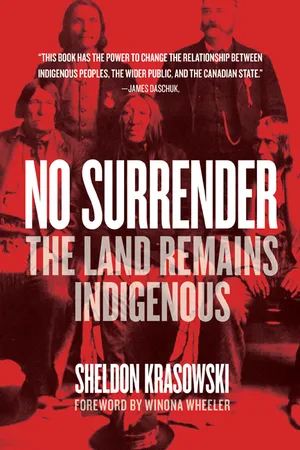
Cover art: Four Saskatchewan Chiefs on a Visit to Brantford, Ontario, in 1886 for the Unveiling of the Joseph Brant Memorial. Standing, from left to right, Chief Osoup and Peter Hourie. Sitting, from left to right, Chief Ahtahkakoop, Chief Flying in a Circle, and Chief Mistawasis. Source: Library and Archives Canada, C-019258.
Cover and text design: Duncan Campbell, University of Regina Press
Copy editor: Dallas Harrison
Proofreader: Nadine Coderre
Indexer: Judy Dunlop
Library and Archives Canada Cataloguing in Publication
Krasowski, Sheldon, 1968-, author
No surrender : the land remains indigenous / Sheldon
Krasowski ; foreword by Winona Wheeler.
Includes bibliographical references and index.
Issued in print and electronic formats.
ISBN 978-0-88977-606-7 (hardcover).—ISBN 978-0-88977-596-1 (softcover). —ISBN 978-0-88977-597-8 (PDF).—ISBN 978-0-88977-598-5 (HTML)
1. Indians of North America—Land tenure—Prairie Provinces. 2. Indians of North America—Prairie Provinces—Claims. 3. Indians of North America—Prairie Provinces—Treaties. 4. Indians of North America—Prairie Provinces—Government relations. 5. Indians of North America—Prairie Provinces—History. I. Title.
E92.K73 2019 971.2004’97 C2018-906032-8 C2018-906033-6
10 9 8 7 6 5 4 3 2 1
University of Regina Press, University of Regina Regina, Saskatchewan, Canada, s4s 0a2 tel: (306) 585-4758 fax: (306) 585-4699 web: www.uofrpress.ca We acknowledge the support of the Canada Council for the Arts for our publishing program. We acknowledge the financial support of the Government of Canada. / Nous reconnaissons l’appui financier du gouvernement du Canada. This publication was made possible with support from Creative Saskatchewan’s Book Publishing Production Grant Program.
![]()
for Robin
![]()
Contents
List of Maps and Figures
Foreword by Winona Wheeler
Preface and Acknowledgements
Introduction: The Numbered Treaties in Historical Context: “Our Dream Is That One Day Our Peoples Will Be Clearly Recognized as Nations”
Chapter 1: Treaties One and Two and the Outside Promises: “The Loyalty Which Costs Nothing Is Worth Nothing”
Chapter 2: Treaty Three: The North-West Angle Treaty: “I Take Off My Glove to Give You My Hand to Sign the Treaty”
Chapter 3: Treaties Four and Five: The Fort Qu’Appelle and Lake Winnipeg Treaties, 1874 and 1875: “The Treaties Should Be Canada’s Magna Carta”
Chapter 4: Treaty Six: The Treaty of Forts Carlton and Pitt: I Want to Hold the Treaty We Made with the Queen”
Chapter 5: Treaty Seven: The Blackfoot Crossing Treaty: “The Great Spirit and Not the Great Mother Gave Us This Land”
Conclusion: As Long as the Sun Shines: “An Everlasting Grasp of Her [the Queen’s] Hand”
Notes
Selected Bibliography
![]()
MAPS and figures
map 1 Treaty Areas Map
figure 1 Generic Treaty Medal, 1873–99
figure 2 The Selkirk Treaty, 1817, Original Manuscript and Map
figure 3 Red River Expedition: Camp at Sault Ste. Marie, 1870
figure 4 Lower Fort Garry, circa 1871
figure 5 The Manitoba Indian Treaty, 1871
figure 6 Conference with the Indian Chiefs during the Manitoba Indian Treaty, 1871
figure 7 Adams G. Archibald, 1814–92
figure 8 Simon James Dawson, 1879
figure 9 Chief Henry Prince, Councillors, and Interpreter, St. Peter’s, 1880
figure 10 Indian Commissioner Joseph Alfred Norbert Provencher
figure 11 Reverend John McDougall, Chief Samson, Chief James Seenum (Pakan), Reverend Henry Bird Steinhauer, and Chief Goodstoney, 1886
figure 12 Treaty Six Negotiations at Fort Carlton, 1876
figure 13 Mistahi Maskwa, Big Bear
figure 14 Peter Erasmus, the Main Interpreter for Treaty Six
figure 15 Four Saskatchewan Chiefs on a Visit to Brantford, Ontario, in 1886 for the Unveiling of the Joseph Brant Memorial
figure 16 James McKay, 186?
figure 17 William Joseph Christie, circa 1873
figure 18 Painting by Bruce A. Stapleton Titled Treaty Number Seven
figure 19 Portrait of Métis Man (Jerry Potts), 1911
figure 20 James F. Macleod, NWMP Commissioner, 1876–80
figure 21 Mary Macleod, Wife of James Macleod, 1878
![]()
Foreword
I was privileged to be raised in a strong Treaty Rights family that valued oral history. We grew up hearing stories about our great-great-grandfather Askinootow, Charles Pratt, who was an interpreter for Treaty Four (1874) from our grandfather, Colin Pratt. Colin Pratt grew up hearing stories of the Treaty negotiations from his father, Josiah Pratt, who was in his mid-twenties when he witnessed the negotiations his father interpreted. The oral history in our family line, direct from the interpreter of Treaty Four and his adult son, an eyewitness, tells us that our people never agreed to “cede, surrender, and release” our traditional territories and natural resources. Our family oral history consistently stressed that our people agreed to share the land, to the depth of a plow, in exchange for gifts, rents, and assistance when in need and when we were ready to make the transition to a new way of making a living. What we know today is that the federal government of Canada is steadfastly wedded to the written texts of the Treaties and their interpretations of the content, has reneged on its fiduciary Treaty obligations, and has made little to no movement toward reaching a common understanding with Treaty First Nations that reflects First Nations oral accounts. Reaching a place where the original intent of the Treaty Relationship will be acknowledged and implemented sometimes feels like a pipe dream, but we keep at it, in the spirit of our Treaty ancestors and sacred promises. It’s more than fighting for Treaty Rights; it’s also about upholding our ancestors’ vision for us and the integrity of their words, it’s about renewing ...