eBook - ePub
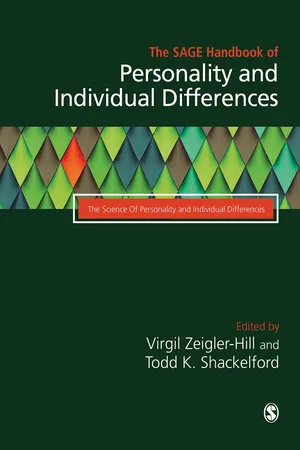
The SAGE Handbook of Personality and Individual Differences
Volume I: The Science of Personality and Individual Differences
- 672 pages
- English
- ePUB (mobile friendly)
- Available on iOS & Android
eBook - ePub
The SAGE Handbook of Personality and Individual Differences
Volume I: The Science of Personality and Individual Differences
About this book
The examination of personality and individual differences is a major field of research in the modern discipline of psychology. Concerned with the ways humans develop an organised set of characteristics to shape themselves and the world around them, it is a study of how people come to be 'different? and 'similar? to others, on both an individual and a cultural level. This volume explores the scientific foundations of personality and individual differences, in chapters arranged across three thematic sections:
Part 1: Theoretical Perspectives on Personality and Individual Differences
Part 2: Research Strategies for Studying Personality and Individual Differences
Part 3: The Measurement of Personality and Individual Differences
With outstanding contributions from leading scholars across the world, this is an invaluable resource for researchers and graduate students.
Information
Part I Theoretical Perspectives on Personality and Individual Differences
1 Defining Traits
In common usage, ‘trait’ can refer to any relatively enduring feature of an individual, universal (e.g., sentient), physical (e.g., blue-eyed), or psychological (e.g., intelligent). In this chapter I will restrict the term ‘trait’ to certain individual differences in personality. To put such traits in perspective, it is useful to locate them within the broader category of individual differences. Figure 1.1 offers a hierarchical classification, in which individual differences divide first into extrapsychological variables (although still of great interest to psychologists), such as gender, age, and socio-economic status, versus psychological variables. The latter, at least from the perspective of Five-Factor Theory (FFT; McCrae and Costa, 2008), can be subdivided into acquired adaptations, such as skills, attitudes, and roles, and innate tendencies, including abilities and dispositions. It is in the subcategory of dispositions that FFT places personality traits, which themselves are hierarchically organized from a few broad factors, to many narrow and specific traits. Much of this chapter will be devoted to a justification of this set of distinctions through an explanation of FFT and a review of the evidence on which it is based. In the meantime, it orients the reader to where the author sees the subject matter in the context of this Handbook.
Figure 1.1 A sketch of a taxonomy of individual difference variables

Source: McCrae (2013). From ‘Exploring trait assessment of samples, persons, and cultures,’ by R. R. McCrae, 2013, Journal of Personality Assessment, 95, p. 557. Copyright 2013 by Taylor and Francis.
The Nature of Traits
Few terms in psychology are as simple and familiar as ‘trait'. Laypersons and professionals alike understand that traits are features of the individual, that they endure over time, that they can be used to class some individuals together and distinguish them from others, and that they correspond to observable regularities in people's actions and reactions. Adult speakers of any language have mastered a huge vocabulary of trait names and routinely use them to describe themselves and others and to account for particular behaviors. In a pre-systematic, implicit way, almost everyone has mastered trait psychology.
At a scientific level, there is a vast body of knowledge about traits from research dating back to the nineteenth century (Galton, 1884). Psychologists know much about their heritability, developmental course, distribution by gender, factor structure, cross-cultural generalizability, and relation to a multitude of psychosocial and biomedical outcomes. Most of these findings are, in broad outline, undisputed, because they have been repeatedly replicated using a variety of methods and diverse samples.
It is therefore somewhat surprising that there is no consensus on what a trait is – how it is to be characterized and how it is to be distinguished from other individual difference concepts. A surprising variety of views have been and currently are held (Zuroff, 1986). Pervin (1994) considered traits to be overt patterns of behavior akin to habits, and believed that the explanation for individual differences in behavior should be traced to psychologically deeper motives. Fleeson (2001) proposed that traits be construed as distributions of states – cheerful is simply a word to describe someone who often feels optimistic and happy. Yang and colleagues (2014) argued that traits are composed of eliciting situations, behaviors, and explanations. McCrae and Costa (2003: 25) claimed that traits were ‘dimensions of individual differences in tendencies to show consistent patterns of thoughts, feelings, and actions’ (italics omitted).
An Evolving Definition
To understand what traits are, it may be useful to begin with an extensional definition, one that simply points to the entire set of personality traits. Something like this has been attempted in lexical approaches (John et al., 1988). The lexical hypothesis proposes that all important personality traits will have been noticed by someone and codified in the words, especially adjectives, of natural languages. By combing through a dictionary, researchers hoped to identify an exhaustive set of traits. The problem with this approach, of course, is that one needs criteria to identify which words refer to personality traits, and, in the absence of an accepted definition of traits, most lexical researchers have relied on lay intuition: people may not know how to define a trait, but they know one when they see one. Dutch investigators, for example, asked judges to call a word a personality trait if it could be used in the sentence ‘He (She) is … by nature’ (Brokken, 1978: 17, quoted in John et al., 1988: 195).
Using this approach, thousands of trait descriptive adjectives were identified (e.g., Allport and Odbert, 1936). Through a series of steps involving a number of investigators (John et al., 1988) these lists were reduced to broad trait dimensions. Depending on the researchers and the languages examined, the number of lexical factors ranges from three (De Raad and Peabody, 2005) to six (Ashton et al., 2004), but most researchers have concluded that an adequate taxonomy is provided by the Five-Factor Model (FFM; Digman, 1990). One might therefore provisionally define personality traits as individual differences related to Neuroticism, Extraversion, Openness, Agreeableness, or Conscientiousness. But such a definition turns out to include much more than trait-descriptive adjectives.
A Trait by Any Other Name …
Mischel's (1968) critique, Personality and assessment, had such a devastating effect on the field of personality psychology that for years most psychologists shunned the very word ‘trait'. At a conference of personality psychologists held at the University of Michigan in 1988 (see Buss and Cantor, 1989), participants were ask...
Table of contents
- Cover
- Half Title
- Editorial Board
- Title Page
- Copyright Page
- Contents
- List of Figures
- List of Tables
- Notes on the Editor and Contributors
- Part I Theoretical Perspectives on Personality and Individual Differences
- 1 Defining Traits
- 2 Personality in Nonhuman Animals: Comparative Perspectives and Applications
- 3 The Psychodynamic Perspective
- 4 The Transdisciplinary Philosophy-of-Science Paradigm for Research on Individuals: Foundations for the Science of Personality and Individual Differences
- 5 Socioanalytic Theory: Basic Concepts, Supporting Evidence and Practical Implications
- 6 Why Do Traits Come Together? The Underlying Trait and Network Approaches
- 7 Implicit Theories of Personality Across Development: Impacts on Coping, Resilience and Mental Health
- 8 Contemporary Integrative Interpersonal Theory of Personality
- 9 Evolutionary Perspectives on Personality and Individual Differences
- Part II Research Strategies for Studying Personality and Individual Differences
- 10 Measuring Personality Processes in the Lab and the Field
- 11 Movement Pattern Analysis (MPA): Decoding Individual Differences in Embodied Decision Making
- 12 The Various Roles of Replication in Scientific Research
- 13 Implicit Measures
- 14 Ambulatory Monitoring and Ambulatory Assessment in Personality Research
- 15 Behavioral Observation in the Study of Personality and Individual Differences
- 16 What Do We Know When We LIWC a Person? Text Analysis as an Assessment Tool for Traits, Personal Concerns and Life Stories
- 17 Longitudinal Data Analysis for Personality Psychologists
- 18 The Network Structure of Personality Psychology: What The SAGE Handbook of Personality and Individual Differences1 Tells Us about the Nature of the Field
- Part III The Measurement of Personality and Individual Differences
- 19 Pathological Personality Traits: The Movement toward Dimensional Approaches to Psychopathology
- 20 Conceptualizing and Measuring Intelligence
- 21 Measurement of Situational Influences
- 22 Taxometric Analysis
- 23 Within-person Variability in Narcissism
- 24 Interpersonal Perception Models
- 25 Accounting for Socially Desirable Responding in Personality Assessment
- 26 Personality Assessment in Forensic Psychology
- 27 Measuring the Dark Side of Personality
- 28 Putting Time in a Wider Perspective: The Past, the Present and the Future of Time Perspective Theory
- Index
Trusted by 375,005 students
Access to over 1.5 million titles for a fair monthly price.
Study more efficiently using our study tools.
Frequently asked questions
Yes, you can cancel anytime from the Subscription tab in your account settings on the Perlego website. Your subscription will stay active until the end of your current billing period. Learn how to cancel your subscription
No, books cannot be downloaded as external files, such as PDFs, for use outside of Perlego. However, you can download books within the Perlego app for offline reading on mobile or tablet. Learn how to download books offline
Perlego offers two plans: Essential and Complete
- Essential is ideal for learners and professionals who enjoy exploring a wide range of subjects. Access the Essential Library with 800,000+ trusted titles and best-sellers across business, personal growth, and the humanities. Includes unlimited reading time and Standard Read Aloud voice.
- Complete: Perfect for advanced learners and researchers needing full, unrestricted access. Unlock 1.5M+ books across hundreds of subjects, including academic and specialized titles. The Complete Plan also includes advanced features like Premium Read Aloud and Research Assistant.
We are an online textbook subscription service, where you can get access to an entire online library for less than the price of a single book per month. With over 1.5 million books across 990+ topics, we’ve got you covered! Learn about our mission
Look out for the read-aloud symbol on your next book to see if you can listen to it. The read-aloud tool reads text aloud for you, highlighting the text as it is being read. You can pause it, speed it up and slow it down. Learn more about Read Aloud
Yes! You can use the Perlego app on both iOS and Android devices to read anytime, anywhere — even offline. Perfect for commutes or when you’re on the go.
Please note we cannot support devices running on iOS 13 and Android 7 or earlier. Learn more about using the app
Please note we cannot support devices running on iOS 13 and Android 7 or earlier. Learn more about using the app
Yes, you can access The SAGE Handbook of Personality and Individual Differences by Virgil Zeigler-Hill, Todd K. Shackelford, Virgil Zeigler-Hill,Todd K. Shackelford,Author in PDF and/or ePUB format, as well as other popular books in Psychology & History & Theory in Psychology. We have over 1.5 million books available in our catalogue for you to explore.