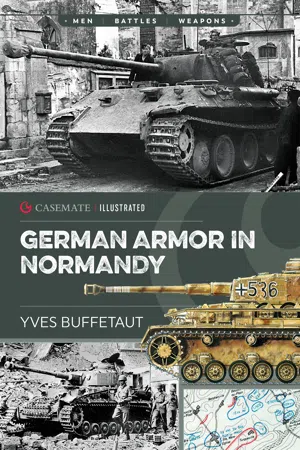
Throughout the Second World War, a shift occurred in the composition of the large armored units of armies which lead to an increase in the power of their tanks in particular. The Germans were no exception. Many of its recently formed Panzer divisions, from the 12th SS-Panzerdivision Hitlerjugend to the 2nd SS-Panzerdivision Das Reich, were thrust into the effort to repel the Allies from June to August 1944 in Normandy. Within just ten weeks they would be defeated. This volume of Casemate Illustrated starts by exploring the initial struggle to gain control of Caen after the Allies had landed on the beaches of Normandy which resulted in the ferocious German Tiger tanks destroying the 7th Armored Division, with British losses totaling twenty-seven tanks. The subsequent strategies the commanders devised for the Panzer tanks during Operations Goodwood and Cobra were not so successful, ultimately ending in disaster for the Germans as the Allies broke through the German line by the end of July. With over 100 photos, diagrams showing the composition of German armored divisions, and color profiles of tanks and other armored vehicles, this is a detailed examination of the German armored forces in Normandy in 1944, focusing on the organization of the 10 Panzer divisions that took part, the vehicles they relied on and the battles they fought in and why ultimately their combined strength was not enough.
- 128 pages
- English
- ePUB (mobile friendly)
- Available on iOS & Android
eBook - ePub
German Armor in Normandy
About this book
Information
Subtopic
Military & Maritime HistoryIndex
HistoryThe Panzers in Normandy
During the campaign in France of May/June 1940, the Germans had attacked with ten armored divisions and were victorious within six weeks. Coincidentally, ten armored divisions tried to repel the Allied invasion between June and August 1944 and were defeated within ten weeks.
There the parallel ends. Indeed, in the two campaigns almost everything differed, starting with the composition of the armored divisions. The previous chapter outlined the theoretical composition of a model panzer division; this chapter will examine the reality of each panzer division engaged on the Normandy front, showing its exact composition at the time of the battle, including how many tanks were available to each. Rather than concentrating on combat, a brief history of each division focuses instead on the evolution of the unit in terms of its forces, its organization and its armor.
The sequence of the divisions presented corresponds to the order of their engagement on the Normandy front. The heavy Tiger battalions are dealt with separately at the end of the chapter, as is the 17th SS Panzergrenadier Division Götz von Berlichingen.
A company of the 2nd Battalion, 130th Panzer Lehr Regiment, equipped with type-A Panthers, regroups, early June 1944. This photograph was surely taken before the landings as the tanks here would have been a prime target for Allied aircraft, and none of the men is looking skyward with any kind of concern. Moreover, the tanks are brand new, with complete schürzens. (Bundesarchiv)
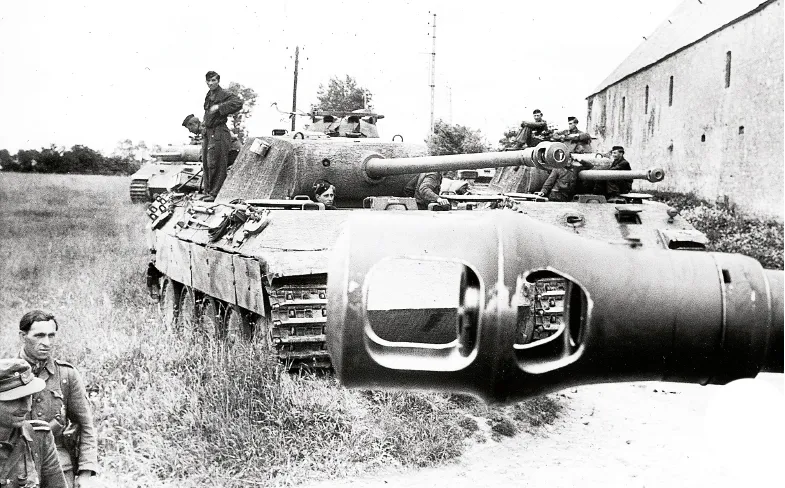
The choice of photographs has been influenced by the following considerations: first, to showcase the matériel allocated to each division; second, to showcase such matériel in context in Normandy, or at least in France; and third, to showcase such matériel at the appropriate moment in time, i.e. on the eve of the Allied landings. For this reason, many photos taken after the battle have been deliberately excluded.
21st Panzer Division
The 21st Panzer Division made a name for itself with the Afrika Korps in 1941/42. Surrounded in the Tunis Pocket alongside the 10th and 15th Panzer Divisions, it surrendered on May 12, 1943.
Some months later, the division was recreated in France, out of the Schnelle Brigade 931 (or West), but it was a pale imitation of the old division that surrendered in Tunisia. The matériel, mostly French, was disparate in the extreme, allowing for many different interpretations of the allocation of equipment in its composite elements. It was the only division present on the front on the day of the landings.
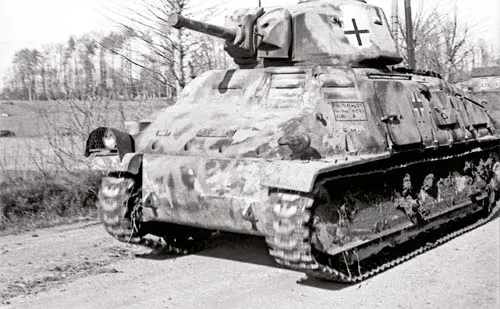
A Somua S35 from either the 22nd or 100th Panzer Regiment: the name change occurred late, in May 1944. By June 6, 1944, the 21st Panzer Division had at least 23 of these tanks in its 2nd Panzer Battalion. The camouflage on this Somua is unusual, with clearly defined spots that stand out against its yellow background. (Bundesarchiv)
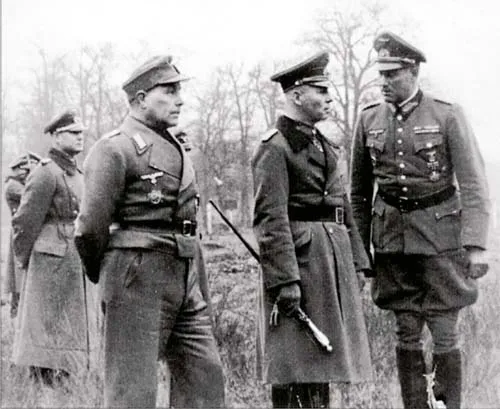
Rommel in discussion with Lieutenant-General Edgar Feuchtinger, commander of the 21st Panzer Division, a few weeks before the landings. To Rommel’s right, slightly back, is Major Becker who is uninvolved in the discussion. Becker was the man behind hundreds of modifications to French tanks and armored vehicles that gave a new lease of life to otherwise obsolete matériel. (Bundesarchiv)
Creation and Evolution
The new 21st Panzer Division was officially created on July 15, 1943. Schnelle Brigade 931/ West formed the core, comprising the 931st Panzergrenadier Regiment, two motorcycle companies and the armored artillery regiment of Colonel Feuchtinger, the future commander of the division. The 100th Panzer Regiment replaced the 5th Panzer Regiment that had been lost in Tunisia. Veterans of the North Africa campaign made up some of the manpower— only about 700 men had slipped the Allied net in Tunisia—with the rest comprising soldiers who had been sick or wounded at the time.
Divisional staff came mostly from the HQ of Artillery Brigade West (931) and the 10th Panzer Brigade. It was therefore only natural that Feuchtinger be appointed commander of the division.
The 433rd Panzergrenadier Regiment furnished the three battalions for the 125th Panzergrenadier Regiment. The second panzergrenadier regiment, the 192nd, was formed from elements of the 931st Panzergrenadier Regiment and diverse units from Oberbefehlshaber West (OB West or the German Army Command in the West).
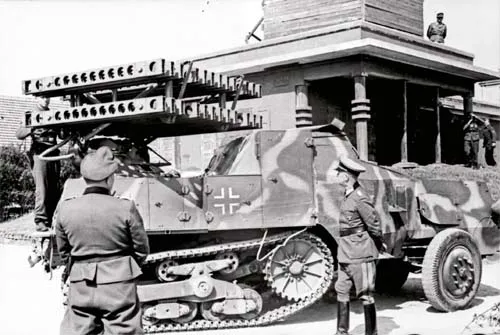
In addition to artillery, a number of panzer artillery regiments possessed one or more batteries of self-propelled rocket launchers. This one, belonging to the 21st Panzer Division, was mounted onto a French Somua half-track chassis. This German copy of the famous “Stalin’s Organ” carried 24 ramps. (Bundesarchiv)
The reconnaissance unit, the 21st Panzer Reconnaissance Battalion, received two motorcycle companies from 931st Brigade, before being reinforced toward the end of 1943 by the bulk of the motorized Panzer Lehr Reconnaissance Battalion.
The 100th Panzer Regiment had been formed before the creation of the division, in January 1943, from the 81st and 82nd armored companies of the 223rd Panzer Battalion, Panzer Company “Paris” and companies of the 100th Panzer Replacement Battalion. Initially, all the regiment’s tanks were French, predominantly Hotchkiss H39s and Somuas that were totally outdated. Modernization was to begin in early 1944. In May 1944, the 100th Panzer Regiment became the 22nd Panzer Regiment.
Composition at June 6, 1944
On June 6, the 22nd Panzer Regiment was right in the middle of a refit, with between 110 and 121 available tanks, less than its usual complement. The HQ Company had five Panzer IV Hs and various command vehicles. The 1st Battalion’s four companies had their full complement of 17 Panzer IV Hs or Js. The 2nd Battalion had no Panthers, having been replaced in part by the Panzer IV Hs, five each in the 5th, 6th and 7th Companies.
9th Company was the worst off, with six Panzer IV Bs or Cs (short gun). Between 32 and 35 Somua S35s made up the last four companies; not forgetting the presence of the 315th Funklenk Panzer Company, equipped with 10 StuG IIS and corresponding remotely operated explosive tracked devices. Antiaircraft defense comprised 12 self-propelled Flakpanzer 38s.
According to Didier Lodieu, the composition of the 22nd Panzer Regiment on the eve of Operation Overlord was HQ Company (three Panzer IIIs, a command Panzer III and a platoon of Panzer IVs), 1st Battalion (17 Panzer IVs each in 1st, 2nd and 4th Companies and 13 in 3rd Company) and 2nd Battalion (22 Panzer IVs and 35 Somuas).
The 200th Assault Gun Battalion was composed, according to Rolf Stoves, of five batteries equipped with six Pak 40s on Hotchkiss or Somua chassis and four 10.5cm howitzers on Lorraine chassis. According to other sources, there were only four batteries. As for the 10.5cm guns, it has been established that at least 12 of them were mounted on Hotchkiss H39 chassis.
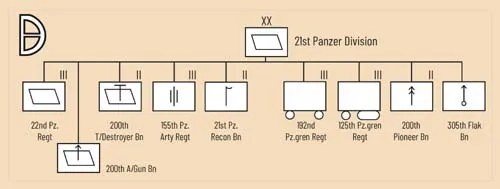
The composition of the Panzer Artillery Regiment, however, is somewhat more certain:
•1st Battalion: two batteries of four 12.2cm towed Yugoslav guns
•2nd Battalion: three batteries of six 10.5cm leFH 18/40s (light howitzers) on self-propelled Geschutzwagen 38H (f)s
•3rd Battalion: idem
•10th Rocket Battery: four batteries of multiple rocket launchers (“Stalin’s Organs”), each with 24 ramps, on modified French chassis. There is some uncertainty over the caliber of these guns: 2.1cm according to some, 8cm according to others, though admittedly it seems unlikely that a 2.1cm battery could support 24 ramps.
•The 200th Tank Destroyer Battalion was unarmored, with three companies of eight 8.8cm towed guns, which gave it formidable firepower but little mobility.
In Profile:
Somua and Flakpanzers
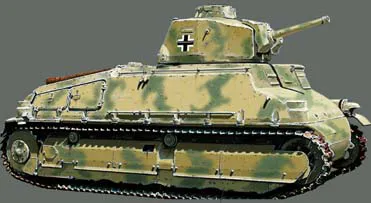
A Somua S35 tank from the 1st Battalion, 22nd Panzer Regiment 21st Panzer Division.
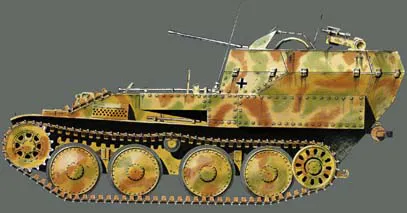
A Flakpanzer 38 (t) from the 12th SS Panzer Division Hitlerjugend, armed with a 2cm gun.
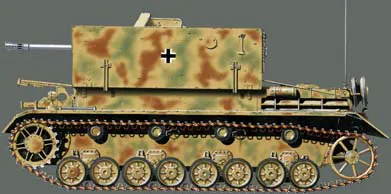
A Flakpanzer IV Möbelwagen (lit.“box” wagon) armed with a 3.7cm gun.
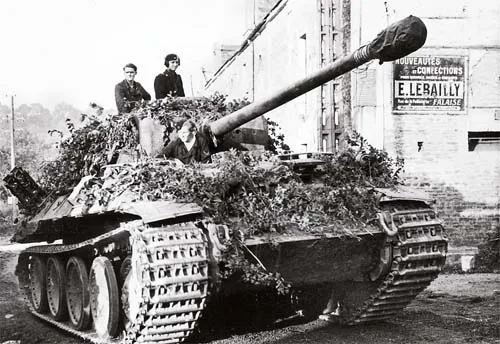
The images on this page and overleaf were taken at Saumont-Saint-Quentin, near Potigny, around ten kilometers north of Falaise. The two tanks are A-type Panthers from the 12th SS Panzer Regiment. The tank above is pictured in front of a farm belonging to M. Fernand Lefèvre, which marked the entrance to the village but which no longer exists. Each of the seven white rings near the muzzle of the gun represent a kill. The tank opposite in front of the church at Saumont-Saint-Quentin is a command tank, equipped with an umbrella antenna as well as the usual FuG 5 radio antenna. These two photographs were taken in the afternoon of August 14, 1944. For a more in-depth analysis of these two shots, see Jean-Luc Leleu’s Falaise (Editions Ysec). (ECPAD)
12th SS Panzer Division Hitlerjugend
Like the 21st Panzer Division, the Hitlerjugend Division was formed, during the summer of 1943, in Western Europe.
It w...
Table of contents
- Cover
- Title
- Copyright
- Contents
- Timeline of Events
- The “1944-Type” Panzer Division
- Panzer in Normandy
- The Panzer in Battle of June and July
- Goodwood and Cobre:The Pancers Face the Destiny
- Afterword
- Further Reading
Trusted by 375,005 students
Access to over 1.5 million titles for a fair monthly price.
Study more efficiently using our study tools.
Frequently asked questions
Yes, you can cancel anytime from the Subscription tab in your account settings on the Perlego website. Your subscription will stay active until the end of your current billing period. Learn how to cancel your subscription
No, books cannot be downloaded as external files, such as PDFs, for use outside of Perlego. However, you can download books within the Perlego app for offline reading on mobile or tablet. Learn how to download books offline
Perlego offers two plans: Essential and Complete
- Essential is ideal for learners and professionals who enjoy exploring a wide range of subjects. Access the Essential Library with 800,000+ trusted titles and best-sellers across business, personal growth, and the humanities. Includes unlimited reading time and Standard Read Aloud voice.
- Complete: Perfect for advanced learners and researchers needing full, unrestricted access. Unlock 1.5M+ books across hundreds of subjects, including academic and specialized titles. The Complete Plan also includes advanced features like Premium Read Aloud and Research Assistant.
We are an online textbook subscription service, where you can get access to an entire online library for less than the price of a single book per month. With over 1.5 million books across 990+ topics, we’ve got you covered! Learn about our mission
Look out for the read-aloud symbol on your next book to see if you can listen to it. The read-aloud tool reads text aloud for you, highlighting the text as it is being read. You can pause it, speed it up and slow it down. Learn more about Read Aloud
Yes! You can use the Perlego app on both iOS and Android devices to read anytime, anywhere — even offline. Perfect for commutes or when you’re on the go.
Please note we cannot support devices running on iOS 13 and Android 7 or earlier. Learn more about using the app
Please note we cannot support devices running on iOS 13 and Android 7 or earlier. Learn more about using the app
Yes, you can access German Armor in Normandy by Yves Buffetaut in PDF and/or ePUB format, as well as other popular books in History & Military & Maritime History. We have over 1.5 million books available in our catalogue for you to explore.