Nursing has always been a challenging but rewarding profession. As part of the core healthcare team, nurses take responsibility for the care they provide to patients, displaying both compassion and discipline in their daily work.Demanding professions require rigorous training, and nursing is no exception. As the real story to 'Call the Midwife', Nursing Through the Years is a unique book that spans eight decades to reveal the fascinating lives of nurses who trained and worked at The Royal London Hospital, serving the community of the East End of London.Having interviewed over 85 nurses, whose experiences span from the 1940s to the 2000s, this important account captures the memories of their time at The Royal London. Exploring each decade, the extent to which nursing has developed and changed, and the highs and lows of training to be a nurse in a renowned teaching hospital are recalled in detail.It is a treasure chest of recollections which are informative, entertaining, inspiring, enlightening and also controversial, often challenging the myths and misconceptions that continue to surround nursing today.
eBook - ePub
Nursing Through the Years
Care and Compassion at the Royal London Hospital
- 248 pages
- English
- ePUB (mobile friendly)
- Available on iOS & Android
eBook - ePub
Nursing Through the Years
Care and Compassion at the Royal London Hospital
About this book
Information
Topic
Scienze socialiSubtopic
SociologiaChapter 1
The 1940s – War and Peace
When the war broke out I was in the sixth form at school and all noble-like I said I’d nurse. … I was doing modern languages, nothing like nursing, English, French, German and Spanish … and my aim was to be a secretary to a diplomat and travel. So in the end I ended up, like a lot of people, volunteering to nurse. Joan
The whole of this decade was dominated by the Second World War (1939–45), its impact and consequences. Life during the war in the East End of London, the history of the devastation suffered, and the resilience of the population still resonates today, so many years later. This chapter captures a snapshot of life for some nurses, during, and immediately after the war.
It’s very strict but the standard is the highest in the world
During the 1940s nursing may have seemed an obvious choice for a young woman as either a temporary or a lifelong career. However, with the majority of men signing up for military service, there were increasing opportunities for women to contribute to the war effort. Women of all ages and marital status now stepped into what had previously been considered ‘a man’s job’. There were, though, those such as Edna, who from childhood, had always wanted to nurse:
It was a childhood ambition. I did nothing but play nurses with my dollies. I visited my mum … at The London Hospital when I was three, and apparently said I’m going to be a nurse when I’m a lady. Well, I achieved the nurse bit, but never mind about the lady.
Whether it was to fulfill a childhood ambition, contribute to the war effort or for an entirely different reason, what remains puzzling is why, at that time, did young women choose to train as a nurse at The London Hospital? The hospital stands in close proximity to both the Docks and the City of London. These commercial, financial and trade centres of the capital were key enemy targets. It would seem that the reputation of the hospital far outweighed the risks that they faced:
Oh a friend of my father’s said, ‘There’s only one place for a nurse to train really well and that’s The London Hospital … you don’t hear so much about it and it’s very strict but the standard is the highest in the world’. Joan
The impact of war
During the Second World War, the hospital played a central role in organising emergency medical services to the north and east of London. It also suffered heavy damage due to enemy action during the Blitz, as Dorothy relates:
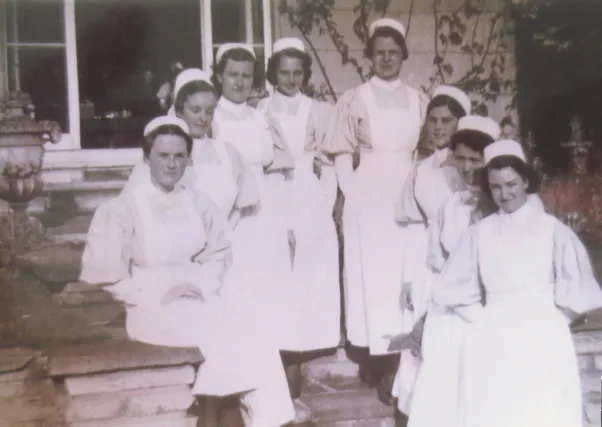
1940s: Student Nurses in pre-war style unmodified uniform at Hylands House, Chelmsford.
(Image appears by courtesy of Daphne Elliot)
On the 7th of September, 1940, the major blitz on London started, and continued without a break for fifty-seven days. Hundreds of bombs fell on the East End, particularly around the docks, which were situated a short distance from the hospital. On one occasion, myself and another nurse were instructed to open up a ward that had been closed … a high caseload was expected, as a burning [closed] ward had fallen on seventeen firemen [firewatchers]. Bomb after bomb fell, and many incendiary bombs, on the hospital, which were expertly dealt with by the many trained volunteers. From the hospital window, the sky was aglow with dock fires. The fires caused such a wind that all the large windows cracked, that were fortunately covered with mesh wire. These mesh wires had been put around all the windows. The next day, the King and Queen came and visited the very burnt firemen on the ward, and I was sure that the King and Queen gave comfort to the suffering firemen.
When there was an air raid you stayed on duty, you knew the patients that had got to stay in bed and you knew the patients that you could get up from bed, but you stayed where you were. Marjorie
Many staff and patients were evacuated to sector hospitals outside London, but essential services like A&E, midwifery and outpatients remained at Whitechapel. About 200 patients remained at The London with skeleton ward and teaching staff.
I was returned to The London [from working at Chase Farm Hospital] on July 10th, 1943 … only been back a few days when we had ‘that bomb’, as we called it. I shot under the bed with several people … and the glass all came under the bed as well but I wasn’t hurt really and I remember the next morning, as I was coming from the hospital back to Cavell Nurses’ Home, a man was sweeping up the road and there among his rubbish was my needlework basket, so I went and reclaimed it and I had that basket for years afterwards and I used to look at it and say, you went through the bombing … It was the ward that was bombed and it was the blast from that that took the windows out of Cavell Nurses’ Home. Eileen
After one of the terrible nights of bombing I went into central London and will never forget St Paul’s, it stood majestic, surrounded by such devastation, rubble and dust everywhere. Dorothy
The London received injured and sick civilians and military staff, as Marjorie recalls:
Turner Ward had Dutch sailors, [some] … were very sick indeed and of course none of them knew what had happened to their families at home so they were very anxious and apprehensive men…. Now the soldiers and the sailors … the ones who were basically orthopaedics, were allowed to go out and have a little bit of normality … they used to go down to Charringtons, the brewery, and the brewery used to give them plenty to drink so we were often coping with drunks. But this particular sailor who had his left arm in plaster and right leg in plaster [also] wanted a pass and Sister [X] … said, ‘No, you were disobedient and you were late coming in last time you had a pass, you’re not having a pass’. The ceilings, because of the war, had huge metal poles to keep them up and didn’t this young man shin up to the top of the metal pole and he sat there and said, ‘Sister, ze pass, Sister, ze pass’. ‘No, you’re not having a pass, come down at once’. And he sat there until he got his pass because that was the only way he intended to come down. And he had been in the Dutch opera company, he had a lovely, lovely voice. And he very often sang at night, I think just to relieve his miseries. And in the ward on Christmas Eve there was a young sailor … dying of tuberculosis and he begged him to sing Ave Maria … he sang that Ave Maria…. And the lad died … and I can hear that voice now.
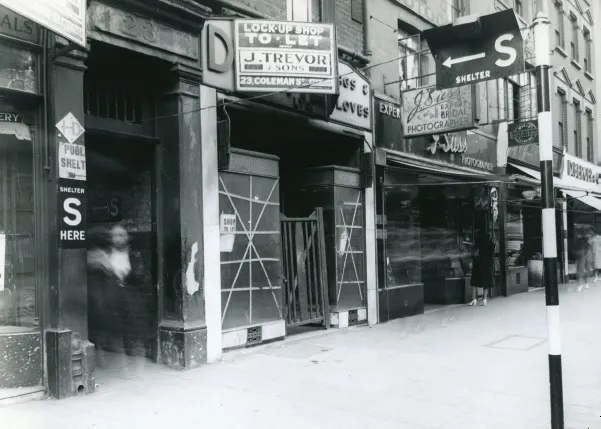
1940s: Wartime Whitechapel High Street, with bomb shelter sign and taped shop windows. (Image appears by courtesy of Tower Hamlets Local History Library and Archives)

Location of bombs that landed on or in the vicinity of The London Hospital during World War Two
Nurse training continued with the training school now spread between eleven different hospitals encompassing the outlying sector hospitals. Memories of the Doodlebugs, which rained down on the East End towards the end of the war, were very vivid. Marjorie again:
I started at The London at the end of the war when the doodle-bombs [flying bombs] were still falling…. The east wing of The London had been hit by a bomb and so there was only half of that wing working. The third floors of The London were not in operation and Croft Ward was used entirely for casualties…. One of the first things that I had to do was to fill sixteen stone hot water bottles and put them in those sixteen beds ready for the casualties.
And … the last doodle-bomb happened … it fell behind the … private wards. And I was on night duty so I knew that it had happened, I mean we heard the wretched thing coming and we’d counted to thirty and we were still alive … we went out into the street … to see if we could help and … there was a little ...[child] about four who had the most enormous broom that you ever did see and it was sweeping up the glass saying, ‘Bloody old Hitler, bloody old Hitler’!
Edna too remembers:
sheltering babies under their cots in David Hughes … when there was an air raid … Doodlebugs, V1s and V2s. And they were nasty because they were insidious, they were quiet, and we didn’t often have an air raid warning because they came out of the blue.
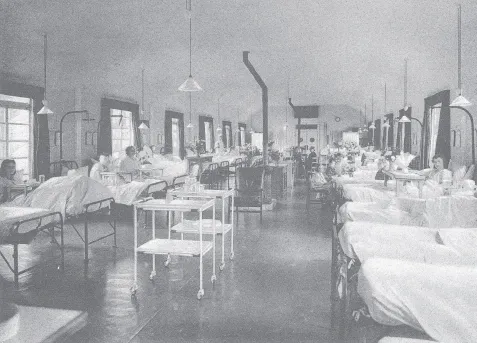
1940s: A wartime ward at Brentwood Annexe with blackout blinds and heating stoves in the centre.
The introduction of penicillin and streptomycin
War accelerated the development of new drugs. The sulphonamide drugs were introduced in the 1930s, augmented by Penicillin in 1943.
I remember Penicillin being introduced, and we had to gown and glove and mask, because they didn’t know what it would do to us. Edna
Penicillin by … injection which was very painful indeed. …. [O]nly soldiers were allowed to have Penicillin, it was just for the Army. And it was a brown solution…it was grown in the lab and the mould on the top was basically saved and the solution was taken off and put in the vessel to give [to patients]. Marjorie
The poor living conditions of the East End community contributed to the spread of tuberculosis. Streptomycin was eventually used to treat this disease. However, for some patients there were significant side effects, as Kathleen recalls:
I’ll never forget … a young boy … we did a ward round … and we came to … where this young man … was sitting up in bed, and he smiled at us all, and Dr X said, ‘He can’t hear us. He’s deaf, and that has been caused because we’ve given him Streptomycin for his … tubercular meningitis. … [A]t that time, Streptomycin of course hadn’t been refined … so this fellow, he’d got his brain back, but he was totally deaf.
The war also contributed to the rapid spread of tuberculosis:
people won’t believe this but I actually nursed … in a ward where there were twenty-five young women under the age of 25 and I happen to know that all those girls were dead within a year…. It was the living conditions. You have to remember that people went down into the Tube [underground station] and slept in the Tube so that it spread. Marjorie
Food rationing and why I don’t like Marmite
Well the food was very good. Bacon, we only got one rasher and I used to laugh and say, rather than waste a plate they should have held it on a fork and we just took it … But what amazed me, we were allowed a bottle of beer! I think it was provided by Mann, Crossman & Paulin, the brewers. That surprised me a lot because I’d never drunk beer and I didn’t have it then but yes, there was beer provided. Eileen
Marjorie describes the food available for both the nurses and the patients:
very strict rationing. You know we had our own two ounces of butter, four ounces of sugar and two ounces of tea … and when you’d eaten it or drunk it, it had gone. We were well fed … breakfast, we always had a cereal of some description, we always had something hot and we always had toast and marmalade. And we had some very good orange jelly that had been sent from America and we were allowed it because we were under twenty-one … [and] had to have the extra vitamin C…. At half past nine in the morning we had bread and margarine and Marmite, hence the reason why I really do not like Marmite … for lunch we had soup, a meat course and a pudding…. At four o’clock we had a sticky bun or we had jam to go with our bread. In the evening we had soup, a meat course and a pudding … and wi...
Table of contents
- Cover
- Dedication
- Title
- Copyright
- Contents
- List of Illustrations
- Acknowledgements
- Foreword
- Timeline
- Introduction
- Chapter 1 The 1940s – War and Peace
- Chapter 2 The 1950s – ‘Getting over the war’
- Chapter 3 The 1960s – ‘The Times They Are a-Changin’’ (Bob Dylan 1964)
- Chapter 4 The 1970s – The old and the new
- Chapter 5 The 1980s – Transition and turbulence
- Chapter 6 The 1990s – From apprentice to graduate nurse
- Chapter 7 The Millennium and beyond
- Chapter 8 Moving on
- Chapter 9 How things have changed
- Conclusion
- Glossary
- Bibliography
Trusted by 375,005 students
Access to over 1.5 million titles for a fair monthly price.
Study more efficiently using our study tools.
Frequently asked questions
Yes, you can cancel anytime from the Subscription tab in your account settings on the Perlego website. Your subscription will stay active until the end of your current billing period. Learn how to cancel your subscription
No, books cannot be downloaded as external files, such as PDFs, for use outside of Perlego. However, you can download books within the Perlego app for offline reading on mobile or tablet. Learn how to download books offline
Perlego offers two plans: Essential and Complete
- Essential is ideal for learners and professionals who enjoy exploring a wide range of subjects. Access the Essential Library with 800,000+ trusted titles and best-sellers across business, personal growth, and the humanities. Includes unlimited reading time and Standard Read Aloud voice.
- Complete: Perfect for advanced learners and researchers needing full, unrestricted access. Unlock 1.5M+ books across hundreds of subjects, including academic and specialized titles. The Complete Plan also includes advanced features like Premium Read Aloud and Research Assistant.
We are an online textbook subscription service, where you can get access to an entire online library for less than the price of a single book per month. With over 1.5 million books across 990+ topics, we’ve got you covered! Learn about our mission
Look out for the read-aloud symbol on your next book to see if you can listen to it. The read-aloud tool reads text aloud for you, highlighting the text as it is being read. You can pause it, speed it up and slow it down. Learn more about Read Aloud
Yes! You can use the Perlego app on both iOS and Android devices to read anytime, anywhere — even offline. Perfect for commutes or when you’re on the go.
Please note we cannot support devices running on iOS 13 and Android 7 or earlier. Learn more about using the app
Please note we cannot support devices running on iOS 13 and Android 7 or earlier. Learn more about using the app
Yes, you can access Nursing Through the Years by Loretta B Bellman,Sue Boase,Sarah Rogers,Barbara Stuchfield in PDF and/or ePUB format, as well as other popular books in Scienze sociali & Sociologia. We have over 1.5 million books available in our catalogue for you to explore.