- 320 pages
- English
- ePUB (mobile friendly)
- Available on iOS & Android
eBook - ePub
About this book
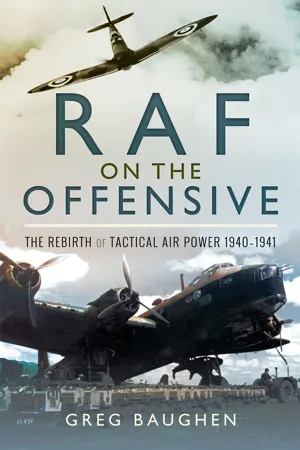
Long before the start of the Second World War it had been believed that strategic bombing would be the deciding factor in any future conflict. Then Hitler launched the Blitzkrieg upon France and the Low Countries in 1940, and the much-vaunted French Army and the British Expeditionary Force were swept away in just six weeks.This new form of warfare shook the Air Ministry, but the expected invasion never came and the Battle of Britain was fought in the air. It seemed that air forces operating independently could determine the course of the war. An Army scarcely seemed necessary for the defence of the UK and no British army could ever be powerful enough to mount an invasion of Europe on its own. Bombing Germany into defeat seemed Britain's only option. In North Africa, however, Commonwealth armies and air forces were demonstrating that they too could use blitzkrieg tactics to crush opponents. Britain was also no longer alone; Greece and then the Soviet Union joined the fight.RAF on the Offensive describes how British air power developed after the Battle of Britain. Attitudes were beginning to change – the fighter, rather than the bomber, was re-emerging as the principal means of gaining air superiority. As 1941 drew to a close, the strategic air offensive appeared to be achieving little and conventional land warfare seemed poised to replace it as the way to defeat the enemy. Which direction, then, would the war take?
Information
Chapter 1
Fighters for the Future
Throughout the Twenties and Thirties, the Air Staff had nailed their colours to the strategic bomber mast. The year 1940 had been one of fluctuating fortunes for this policy. It had started with the Air Staff certain in their belief that the stalemate on the Western Front would continue indefinitely, just as it had in the First World War, and it would be left to the opposing bomber fleets to decide the war. As soon as the Anglo-French alliance had more bombers than Germany, they thought, then the war would move inexorably towards an Allied victory. With bomber superiority, victory on the ground would be a mere formality.
Then the German blitzkrieg seemed to change everything. Poland and Norway had been defeated rapidly, but nobody imagined the panzers, supported by the Luftwaffe, would trouble the mighty French Army. Nobody expected what followed. In a mere six weeks, France was defeated; instead of the air assault Britain had prepared for, the danger was an invasion the country had not prepared for. For a brief period, the talk was of how the RAF might support the Army in defence of British shores. Hardened bomber advocates like Air Commodore John Slessor, a future Chief of Air Staff, conceded that perhaps after all there was a place in the RAF for something like the Stuka.1 Air Marshal Charles Portal, in charge of Bomber Command, was coming up with fantastic schemes for turning ancient Vickers Virginia bombers into low-flying, anti-tank gunships.2
But the invasion never came and instead the country found itself engaged in the ‘air-only’ Battle of Britain. The war was very quickly returning to how the Air Staff had always believed wars of the future would be fought – with armies and navies playing secondary roles. Victory in the Battle of Britain restored RAF pride and confidence in its importance. The German strategy in the Battle of Britain, and the Blitz that followed, seemed to be a vindication of the Air Ministry’s belief that air power was the decisive factor in war. Were not the Germans turning to the very strategy the Air Staff had always advocated? All Britain had to do to guard against invasion was maintain powerful bomber and fighter forces in Britain. Germany would never dare launch an invasion fleet without air superiority, and if they did, then Bomber Command would crush it. An army was scarcely needed. It was what Hugh Trenchard – the first Chief of the Air Staff, often labelled the ‘father of the Royal Air Force’ – had always claimed. Domination of the air made conventional land battles impossible. Churchill agreed; he had been mesmerized for years by the seemingly unlimited power of the bomber. As far as the Prime Minister was concerned, the sole purpose of the British Army was to force the enemy to concentrate its invasion force at a particular point so that the RAF and Royal Navy could destroy it. Churchill had good reason to believe the Navy could cause havoc amongst an invasion armada. There was less justification for thinking the RAF would be as effective. In the first year of war, Bomber Command had not sunk a single enemy ship of any description.
In the summer of 1940, however, Churchill still credited the bomber with extraordinary powers of destruction. The pre-war prophets of doom had predicted bombers might end civilization; by comparison, destroying an invasion fleet seemed a relatively simple matter. Bombers also provided a route to victory. Once Britain had more bombers than Germany, victory would surely follow. Churchill’s faith in the bomber gave the RAF the war-winning central role Trenchard and his apostles had fought so hard for in the Twenties. Churchill proclaimed:
‘The Navy can lose us the war, but only the Air Force can win it. Therefore our supreme effort must be to gain overwhelming mastery in the air. The Fighters are our salvation but the Bombers alone provide the means of victory.’3
The Army was not mentioned. It did not have a major role either in preventing defeat or winning the war.
It was not the sort of thinking that was going to help Lieutenant General Alan Brooke, the commander of British forces in the UK, prepare for a 1941 invasion or build the sort of army that might try to win back the ground lost in1940. Much to Brooke’s dismay, Churchill’s insistence that the Air Force should be expanded at the expense of the Army did not provoke much disappointment in the War Office. The fate that had befallen the mighty French Army and the speed with which British expeditionary forces had been evicted from Norway and France did not encourage any enthusiasm for an early rematch with the Wehrmacht. The Army would prepare as best it could to defeat an invasion, but if the Air Ministry wanted to take responsibility for winning the war, that was fine by the War Office.
`This all led to a rather peculiar overall war strategy. By 1942 it was hoped the British Army would possess at least fifty divisions worldwide, but these would not be used to invade Europe. The British Army’s offensive operations would be confined to overseas theatres, and to maximize these forces, the War Office was quite happy to maintain the smallest possible army in the United Kingdom. With support from the Home Guard and, in an emergency, training units, the War Office believed that just fourteen divisions were sufficient to defend the United Kingdom in 1941. Some thought this could drop to as low as four by 1942, when it was expected the RAF would have complete air superiority in Europe. The War Office thought seven was a more realistic minimum force, but even this was a remarkably low number to defend the entire country.4 However, it freed the rest of the British Army for offensive action overseas. The role of the Army would be to defeat Axis forces in the Middle East and possibly later, if the conflict spread, the Far East.
This mirrored inter-war defence policy, with the bomber being the principal weapon in a major European war and the Army being required for colonial policing: in the Second World War, with Italy the enemy in North Africa, the latter would just be on a somewhat grander scale. War in the European theatre would be waged one way, but in the rest of the world it would be waged another, and nobody seemed to question this strange dichotomy. It left Brooke with the task of defeating any invading German Army with a wafer-thin force.
Even the ‘air superiority’ he was supposed to be relying on was not what Brooke really wanted. In the First World War, ‘air superiority’ had been achieved by having a superior fighter force. However, in the Trenchard doctrine, air superiority meant having more bombers. Air forces won control of the skies by bombing aircraft factories, oil refineries, airfields and communications, and making it impossible for the enemy air force to operate. Trying to defend against bomber attack was a mistake, so building fighters instead of bombers was thus also a mistake. Building more fighters just meant you were losing the bomber war. In this Air Staff model of future wars, the number of fighters you had was a measure of how close to defeat you were.5 In the inter-war years, the Air Staff had fought fiercely to keep fighter production to a minimum. When Lord Beaverbrook took over responsibility for aircraft production, there was bitter opposition to the priority he gave fighter production, even when the Battle of Britain was raging in the skies over southern England. For the Air Staff, air superiority in the European theatre meant the ability of bombers to operate at will anywhere they pleased, and it was the bomber that would achieve this, not fighters.
While the Air Ministry tried to build the massive bomber fleet that winning the war would require, Air Chief Marshal Hugh Dowding, head of Fighter Command, was trying to halt the continuing German air offensive. He had always seen his battle with the Luftwaffe as an ongoing offensive against the country rather than a battle for air superiority as a prelude to an invasion. He was so caught up in the struggle that he was scarcely aware that with the dispersal of the German invasion fleet in September 1940, his Fighter Command had won the battle. For Dowding, this dispersion was merely a clarification of the situation – there could now be no doubt that the German aim was victory by air action alone. This was seen as a far greater threat than any invading army and, as far as Dowding was concerned, the continuing struggle in the air was as critical as it had ever been.
For as long as the weather permitted, the Luftwaffe kept Fighter Command at full stretch with fighter sweeps, heavily escorted bombing raids and fighter-bomber attacks, with the British aircraft industry the primary target. Even before the planned invasion was postponed, the Luftwaffe had achieved some notable successes. On 15 August 1940, a raid on the Shorts plant at Rochester in Kent badly damaged the factory. On 4 September, the Weybridge Wellington factory in Surrey had been hit, inflicting 700 casualties. On 25 September, He 111 bombers and Bf 110 fighter-bombers halted production at the Bristol factory at Filton in Gloucestershire;6 up to three weeks’ output of Beauforts and Beaufighters was lost.7 The next day, the Supermarine works in Southampton were the target; the two factories producing Spitfires were gutted and both had to be abandoned.
When Beaverbrook described these events to his Cabinet colleagues as ‘disasters’, he did not seem to be exaggerating. The Shorts attack, he estimated, had meant the loss of three months’ worth of Stirling bomber output. The Weybridge raid had cost another 175 Wellingtons.8 Fears that the German bomber force was capable of wiping out the aircraft industry seemed justified. However, it was not the disaster it seemed. When the debris was cleared away, it was found that the machine tools had survived. Where factories had to be abandoned, new dispersed production facilities were quickly set up in the region to take their place. The attack on the Supermarine works caused the loss of six weeks’ worth of production,9 but once production got going again, there was no longer a single target for German bombers to aim at. By early 1941, aircraft production was back to its previous level and increasing. German bombing had merely accelerated plans that already existed to disperse the industry. It was an early indication that bombing your way to victory was not as easy as it seemed to the inter-war theorists.
The last day of September 1940 saw the final major daylight effort against London by the Luftwaffe, when two waves totalling 200 bombers in the morning and another 100 in the afternoon headed for the capital. Late in the afternoon, forty more He 111s made for the Westland factory in Yeovil. All the raids were turned back, and fifteen bombers and no less than twenty-seven of the escorting fighters were shot down. In an attempt to reduce losses, the Luftwaffe turned to small formations of high-flying fighter-bombers. Bf 110s or Bf 109s, armed with bombs, would head for their targets at 25,000ft, with escorts operating above at 30,000ft. At these heights the Bf 109 was able to make full use of its superior altitude performance. Even the Spitfires struggled to intercept them. Attacks were less frequent than during the summer months, but the strain these high-attitude interceptions involved meant that Dowding’s force was still under pressure. They also encouraged Fighter Command and the Air Ministry to focus on the high-level bomber threat, rather than other issues which in the long term would prove to be more serious. One of these neglected issues was the importance of fighter-versus-fighter combat.
The way the struggle between the opposing fighter forces had dominated the aerial battles of 1940 had not been anticipated. This was partly because Britain had prepared for a bomber assault on the entire country, rather than a battle for air superiority over a tiny corner of England. With bases in northern France, German fighters could operate over the south-east of England. Indeed, with fighters now cruising at far higher speeds, fighters could fly much further with the same endurance. For the Air Staff, however, there was a more fundamental issue. They had never believed that fighter escorts, especially single-seater escorts, could ever work. It was not just the handicap of having to carry extra fuel. Single-seaters would always be vulnerable to attacks from the rear when the time came to withdraw. As there would be no escorts, there would be no fighter-versus-fighter combat, so the Air Staff had only required heavily armed specialist bomber interceptors. The Bf 109 escorts that accompanied German bombers during the Battle of Britain had demonstrated how wrong these ideas were. Britain was indeed fortunate to have fighters as manoeuvrable as the Spitfire and Hurricane, and even more fortunate that the less manoeuvrable Whirlwind, Beaufighter and Defiant that were supposed to replace them were all behind schedule. These turreted and cannon-armed fighters might be ideal for dealing with unescorted bombers, but they could not deal with fighter escorts.
By the end of the summer of 1940, there seemed no question of heavy twin-engined or two-seater fighters forming any part of Fighter Command’s future daytime fighter force, at least not where enemy single-seaters were likely to be encountered. The Defiant had been a disaster, and there would be no more talk of Beaufighters replacing Spitfires on the Supermarine production line. Even the much smaller Whirlwind was not manoeuvrable enough. With Hawker and Supermarine insisting they could now fit cannon in the wings of their single-engined fighters, there was no longer any need for twin-engined fighters. The Battle of Britain had shown the importance of agility and the ability to climb fast, and on both counts the single-engined fighter had the edge. The single-engined, single-seater seemed set to remain the standard fighter configuration.
Britain was lucky to have the Spitfire and Hurricane, but both were intended only for short-range interception. Neither had been designed for fighter-versus-fighter combat, and as a result both had their drawbacks. Trials with an American Curtiss H75 Mohawk borrowed off the French had demonstrated how inferior the British fighters were in terms of agility and control. The low weight and wing area of the Bf 109 was also food for thought. The Bf 109 had much better acceleration, and the relatively high wing area of the Spitfire and Hurricane slowed the rate of roll, making it more difficult to change direction quickly. These failings were no fault of the designers; they were simply not qualities needed by fighters required to shoot down unescorted bombers flying straight and level. Now that fighters were expected to engage in dogfights, there seemed to be a case for going back to the drawing board and considering what the ideal air superiority fighter might look like.
In fact the need for a review was even greater than the Battle of Britain had suggested. Over Britain, air combat took place at ever higher altitudes, because that is how fighters gain the upper hand, and with no fighting on the ground there was no reason to fly low. When armies are engaged, and low-level observation, reconnaissance and ground-attack planes are in action, fighters have to fly much lower if they are to influence events. ‘Air only’ campaigns tend to take place at high altitudes; over a battlefield, the air action is more often at much lower altitudes. In an invasion scenario or with British armies in action overseas, agile low-level tactical fighters would be needed as well as high-altitude air superiority fighters. There were plenty of reasons for reviewing whether the thinking behind the next fighter on the ‘cab rank’, the Hawker Typhoon/Tornado family, was right for the kind of war the RAF now found itself in.
Tactics needed to change too. The large unwieldy ‘vic’ formations pilots were trained to fly were designed for mass attacks on bomber formations. Some squadrons had rethought their tactics and started to operate in the more flexible pairs that German pilots used, but most finished the Battle of Britain flying the same pre-war tight formations. Fighter Command had not changed that much and Dowding saw no need for it to do so. When Air Marshal Sholto Douglas took over from Dowding, he too did not see the tactics his pilots were using as a problem.
With German attacks coming in at ever-higher altitudes, what was worrying Douglas and the Air Ministry was not how to dogfight with escorts but how to reach the bombers. The fear was that when the German day offensive resumed the following spring, it would be at extreme altitudes, where any sort of manoeuvring might be extremely difficult and fighter escorts might not be necessary or possible. The nightmare scenario was German bombers cruising at 45,000ft, in clear skies, flying higher than anti-aircraft guns or interceptors could reach and having as much time as they needed to pick off aircraft factories at their leisure.10 The problems of getting bombs anywhere near their target from 9 miles up were not really considered. The Air Ministry was very aware of the advantages of high-altitude bombing and had its own ambitions in this direction. Since the late Thirties, the Air Ministry had been looking into the option of bombing targets from altitudes as high as 40,000ft. The Air Ministry’s interest in high-altitude bombing ensured that intelligence reports that the Germans were working along similar lines were taken very seriously.
Dealing with the high-altitude bomber threat was the Air Ministry’s major concern, not developing the qualities required by an air superiority fighter. In 1940, there was no Air Ministry interes...
Table of contents
- Cover
- Title
- Copyright
- Contents
- Acknowledgements
- Introduction
- Chapter 1 Fighters for the Future
- Chapter 2 The Bomber Route to Victory
- Chapter 3 The Air Ministry Digs In
- Chapter 4 Greek Discontent
- Chapter 5 Desert Blitzkrieg
- Chapter 6 Preparing for Invasion
- Chapter 7 Discord in the Ranks
- Chapter 8 The War Office Strikes Back
- Chapter 9 Disunited
- Chapter 10 A New Ally – New Approach
- Chapter 11 Butt Bombshell
- Chapter 12 Air Strategy at the Crossroads
- Conclusion
- Notes
- Appendices
- Bibliography
- Plate section
Trusted by 375,005 students
Access to over 1.5 million titles for a fair monthly price.
Study more efficiently using our study tools.
Frequently asked questions
Yes, you can cancel anytime from the Subscription tab in your account settings on the Perlego website. Your subscription will stay active until the end of your current billing period. Learn how to cancel your subscription
No, books cannot be downloaded as external files, such as PDFs, for use outside of Perlego. However, you can download books within the Perlego app for offline reading on mobile or tablet. Learn how to download books offline
Perlego offers two plans: Essential and Complete
- Essential is ideal for learners and professionals who enjoy exploring a wide range of subjects. Access the Essential Library with 800,000+ trusted titles and best-sellers across business, personal growth, and the humanities. Includes unlimited reading time and Standard Read Aloud voice.
- Complete: Perfect for advanced learners and researchers needing full, unrestricted access. Unlock 1.5M+ books across hundreds of subjects, including academic and specialized titles. The Complete Plan also includes advanced features like Premium Read Aloud and Research Assistant.
We are an online textbook subscription service, where you can get access to an entire online library for less than the price of a single book per month. With over 1.5 million books across 990+ topics, we’ve got you covered! Learn about our mission
Look out for the read-aloud symbol on your next book to see if you can listen to it. The read-aloud tool reads text aloud for you, highlighting the text as it is being read. You can pause it, speed it up and slow it down. Learn more about Read Aloud
Yes! You can use the Perlego app on both iOS and Android devices to read anytime, anywhere — even offline. Perfect for commutes or when you’re on the go.
Please note we cannot support devices running on iOS 13 and Android 7 or earlier. Learn more about using the app
Please note we cannot support devices running on iOS 13 and Android 7 or earlier. Learn more about using the app
Yes, you can access RAF On the Offensive by Greg Baughen in PDF and/or ePUB format, as well as other popular books in History & British History. We have over 1.5 million books available in our catalogue for you to explore.