eBook - ePub
The Literature of the Lebanese Diaspora
Representations of Place and Transnational Identity
- 288 pages
- English
- ePUB (mobile friendly)
- Available on iOS & Android
eBook - ePub
The Literature of the Lebanese Diaspora
Representations of Place and Transnational Identity
About this book
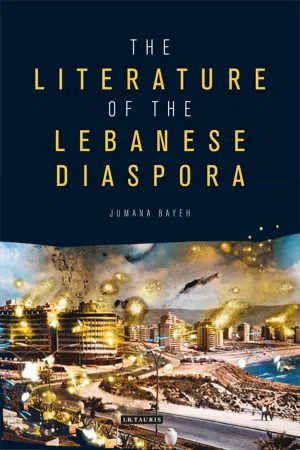
The Lebanese civil war, which spanned the years of 1975 to 1990,caused the migration of hundreds of thousands of Lebanese citizens, many of whom are still writing of their experiences. Jumana Bayeh presents an important and major study of the literature of the Lebanese diaspora. Focusing on novels and writings produced in the aftermath of Lebanon's protracted civil war, Bayeh explores the complex relationships between place, displacement and belonging, and illuminates the ways in which these writings have shaped a global Lebanese identity. Combining history with sociology, Bayeh examines how the literature borne out of this expatriate community reflects a Lebanese diasporic imaginary that is sensitive to the entangled associations of place and identity. Paving the way for new approaches to understanding diasporic literature and identity, this book will be vital for researchers of migration studies and Middle Eastern literature, as well as those interested in the cultures, history and politics of the Middle East.
PART I
WAR AND THE CITY
CHAPTER 1
THE URBAN SPACE: BEIRUT AT WAR
If, as Iman Khalil claims, a “distinctive part of literature on war and warfare is the narration of civil war experiences” then it is no surprise that so many Lebanese authors continually write about the civil violence that shattered Beirut in the 1970s and 1980s.1 According to Jad Tabet, when the war first broke out in 1975 it quickly settled in the heart of the capital city, and even though the war seeped into peripheral parts of the country, Beirut remained the major focal point of destruction.2 Thus, the significance of Beirut, both the place and its character, cannot be underestimated in the two civil war narratives examined below. Both Unreal City and De Niro’s Game reveal the complex nature of “place”, particularly when the place in question is a city subject to war and war’s various side-effects. In light of the specificity of the city within these novels, this chapter will examine various theories of the city and consider how the war-riven urban space of Beirut relates to them.
Much of the contemporary scholarship on urban development notes that cities in the past three centuries have changed dramatically due to a proliferation of inhabitants and an exponential increase in geographical size.3 Until the late 1700s urban studies maintained a traditional approach, laid out in ancient philosophy and carried through to the Middle Ages. Accordingly, the city was merely seen as “the image of society itself, and not some special, unique form of social life”.4 However, with the onset of the Industrial Revolution in the late 1700s social commentators, such as Henry Mayhew (1812–87), Charles Booth (1840 – 1916) and Friedrich Engels (1820 – 95), reconsidered the complex and specific social dynamics taking place within the cityscape. Focusing on nineteenth century London, the main hub of the Industrial Revolution, these writers concluded that in “both its ecology and its class relations, [the] ‘classic’ city was a product of the Age of Capital, whose internal dynamics could be specified”.5
The study of urban culture in the twentieth century was dominated by German theorists like Max Weber (1864 – 1920) and George Simmel (1858 – 1918). Building on the scholarship of their predecessors, who saw the role of capitalism as a central feature of urban development, this group, collectively referred to as the German School, perceived alienation and marginalisation as key aspects of urban life. Weber argues that the metropolitan space is underpinned by a concept of cosmopolitanism and that cosmopolitan culture is a necessary corollary of urbanism. Weber’s theories of the city are shaped by the concept of “difference”. Difference is, according to Weber, a necessary feature of a cosmopolitan society because it allows for coexistence to thrive in societies that contain a diverse range of peoples. By taking this concept of cosmopolitanism and applying it to his discussions of urban life Weber, as Richard Sennett explains, perceived the city as a “social form which permits the greatest degree of individuality and uniqueness [...] [and includes] the set of social structures that encourage social individuality and innovation”.6 This Weberian “ideal-typical” definition of the city did not conform to the nineteenth and twentieth century urban space mainly because, as Weber and many of his contemporaries thought, industrialised centres took on a uniform mould and were unable to develop a unique character or culture.7 As a result, cities were intensely impersonal places which lacked “the reciprocal personal acquaintance of the inhabitants, elsewhere characteristic of the neighbourhood”.8 Furthermore, the modern city could only ever amount to a primitive, underdeveloped space because it failed to fulfil the promises of individuality, uniqueness and innovation. This failure was connected to the force of modern capitalism which, because of its rationalism and intense bureaucracy, had produced a cold and less than civilised urban environment. Concentrating on the economic activity within the industrialised town, whose “inhabitants live primarily from commerce and the trades [. ..] [and whose] local population satisfies an economically significant part of its everyday requirements in the local market”, Weber argues that the city “is always a market center”.9
George Simmel, one of Weber’s contemporaries, viewed the city in similar terms but advocated that its chief elements should be psychological rather than economic. His argument was that the “eighteenth century found the individual in oppressive bonds which had become meaningless – bonds of a political, agrarian, guild, and religious character”.10 Liberation from these bonds meant that individuals “now wished to distinguish themselves from one another” and to emphasise their “qualitative uniqueness and irreplaceability”.11 The struggle, then, to achieve real freedom and develop a sense of individuality was to be located in the modern city: “It is the function of the metropolis to provide the arena for this struggle.”12 Despite the stress placed on the opportunities that may prevail in the city, Simmel’s work was consistent with the assumptions laid out by the German School, namely that the metropolis was the paradigm of an inhuman social environment that was entirely impersonal and governed by an excess of rationality.13
If the subsequent group of theorists, like Robert Park (1864 – 1944) and Louis Wirth (1897 – 1952), sought to build on the work of Weber and Simmel, they did so by taking a divergent position with regard to the assumptions the Germans had established. Collectively known as the Chicago School, these social scientists emerged in the aftermath of World War I and were interested in the internal character of the city. Perhaps the most influential essay to appear among this second generation of scholars was Robert Park’s “The City: Some Suggestions for the Investigation of Human Behavior in the Urban Environment”.14 Park took the view that the city was more than a physical artefact, a collection of individuals and administrative devices. Rather, the city is “a state of mind, a body of customs and traditions, and of the organized attitudes and sentiments that inhere in these customs and are transmitted with this tradition”.15 By studying the nature of the urban space through “human ecology” Park was able to stress “that the city is rooted in the habits [...] of the people who inhabit it”.16 So, unlike his German counterparts, Park refused to privilege the physical organisation of a city in shaping its culture over and above the role of humanity. It is the interaction of the physical and moral aspects of the city that mould the city space in Park’s work.
Park’s discussion of segregated areas within the urban environment reflects the importance of this interaction. He argues that “the isolation of [...] racial colonies of the so-called ghettos and areas of population segregation tend to preserve and, where there is racial prejudice, to intensify the intimacies and solidarity of the local neighborhood groups”.17 The segregation of the city therefore enacts, or embodies, a politics of race in two ways: first, it encourages sentiments of racial prejudice to develop within the wider community towards the ghettoised population, and second it strengthens racial solidarity within each isolated community. Given the highly sectarian nature of Lebanon, it is possible to extend Park’s emphasis on racial communities to include religious segregation. During the war Beirut became a city divided along religious lines. The Christian community increasingly congregated on the city’s Eastern side, while the Muslim community was more concentrated on its Western front. This physical division resulted, first, in the connection between territorial space and sectarian identity and, second, not unlike Park’s assertions regarding segregated racial communities, it intensified and exacerbated religious prejudices.
Beirut and War Amnesia
The reduction of Beirut into these two sectarian quarters is a clear reflection of the city’s particular historical development. Beirut, until modern times, was a very modest settlement. According to Samir Kassir, in his magisterial study of Lebanon’s capital, Beirut prior to 1840 was a walled medieval town with a population of approximately 15,000.18 The influx of Maronite Christian refugees from Mount Lebanon, due to the civil strife in 1860 between rural Maronite and Druze communities, saw Beirut increase in size and density. After this crisis the rural exodus was relentless. Within 36 years, by 1896, Beirut’s population had risen dramatically to 120,000 and by 1930 the city became the permanent residence of one quarter of Lebanon’s population.19 This rapid spike in inhabitants did not immediately produce an increase in construction activity and urbanisation. In fact it was not until the 1950s that real evidence of urbanisation began to emerge. At this stage Beirut began to expand vertically with high- rise buildings and apartment blocks disturbing the city’s once horizontal and even skyline.
By the mid-1970s, shortly before the outbreak of hostilities, 70 per cent of Lebanon’s population inhabited the cities, with Beirut alone absorbing almost 45 per cent. By this period the city was comprised of all the sectarian communities that inhabited the country.20 However, despite this rapid and intense urbanisation Beirut failed to embrace or develop a sense of “urbanism”.21 The research of Samir Khalaf, Fuad Khuri and John Gulick reveals that urbanism as a way of life did not accompany urbanisation due to the endurance of kinship ties, communal loyalties and confessional affinities.22 The level of communal trauma associated with Beirut’s urban development, starting with the mass influx of rural-based Christians in the 1860s, explains why kinship and confessional affinities remained strongly intact within the urban setting.23 If these traditional attachments worked their way into Beiruti society, however, they did so not in spite of urbanisation but because of it. As Mike Davis explains, urbanisation and the major demographic changes that accompany it pit different groups in direct competition for contested and scarce resources.24 This is especially prevalent in a developing and multi-confessional country like Lebanon, where the necessary fault-lines of the competition are organised primarily around sectarian loyalties.
The endurance of confessional loyalties within the city space conforms to an assertion put forward by the Chicago-based scholar Louis Wirth. He argues that cities are formed by an ongoing process of growth and that, correspondingly, urban spaces “should not be [expected] [...] to wipe out completely the previously dominant modes of human association”.25 This is one reason why the Lebanese urban experience has maintained the imprint of rurally-based sectarian relations. The particular and peculiar Lebanese political system encourages its citizens, especially Beirutis who are at the centre of this system, to maintain their confessional affinities. In other words, it is not simply the case that Lebanon’s rural migrants are unable to shed their cultural practises and primordial formations when they move into the urban environment. Rather, their reliance on rural primordial relations is compounded by the Lebanese political system of consociational democracy. Consociationalism, as defined by Arend Lijphart, reflects a political arrangement of power sharing that can accommodate diverse ethnic and sectarian societies. For Lijphart, consociationalism is the preferred model of democracy in plural societies where “government by elite cartel [is] designed to turn democracy with a fragmented political culture into a stable democracy”.26 Since the National Pact of 1943, the Lebanese system has privileged confessionalism as the organising principle of political identification, thereby forcing Lebanese nationals “to group themselves into their sectarian communities as a precondition for becoming vocal and effective within the Lebanese polity”.27 So rather than promote a sense of “urbanism” as a way to undo confessional affiliations, city life in Beirut strengthens and ratifies old kinship relations.
Consequently, in the mid-1900s, Beirut was not a site that embraced the forces of social modernisation and urbanism - rather it reflected “an environment that [was] always already structured around primordial formations”.28 When rural folk moved away from their village homes, for whatever reason, they entered this environment and maintained or solidified their religious codes of affiliation. The short-lived civil war of 1958, commonly seen as a “dry run” for the civil war “proper”, was fuelled by sectarian tension within the urban context of Beirut.29 This was similarly the case in the subsequent civil war that embedded itself within the urban space and physically divided it. The demarcation point was referred to as the Green Line because of the greenery that grew along the buffer zone after buildings and roads were destroyed and abandoned. As the
Green Line emerged in stages it is probably more accurate to describe it by the Arabic phrase khoutout al tammas, which translates in the plural as “confrontation lines”. The first front in 1975 stretched between the predominately Shi’a Muslim neighbourhood of Shayah in south Beirut (an impoverished community that migrated from rural South Lebanon) and the adjacent Maronite Christian area of Ain al-Rummaneh in the Eastern sector of the city. By the 1980s the Green Line had expanded and exacerbated the cantonisation of the urban centre. Even areas that were once relatively mixed by Lebanese standards became increasingly homogenous as residents moved across the dividing line to their appropriate side of the city. According to Ester Charlesworth:
the number of Muslims living in “Christian” East Beirut, who had made up 40 per cent of the 1975 population, dropped to just 5 per cent of the 1989 population. A similar redistribution occurred in West Beirut, where the Christian population dropped from 35 per cent of the total in 1975 to 5 per cent in 1989.30
In the post-civil war era, where the East/West divide no longer officially exists, Beirutis have been unable to transcend the “mental geography” of the city’s protracted division.31 Michael Davie notes that in the post-war era ideas continue to “persist that ‘West Beirut’ is Muslim, fundamentalist, overrun by terrorists, under the control of foreign renegade countries, disorganized, dangerous, and that ‘East Beirut’ is Christian, prosperous, organized, pro-Western, tolerant, and safe”.32 The persistence of the Green Line as a mental and cultural referent of separation is now accompanied by other layers of division. These new divisions, while not as formally demarcated as the wartime Green Line, are based on issues related to security and class. In regard to the former, Mona Fawwaz, Mona Harb and Ahmad Gharbieh argue that post-war Beirut contains conflicting security systems and equally conflicting perceptions of what constitutes a threat. Hezbollah, whose security system is largely unchallenged in Beirut’s southern suburbs, perceive local right-wing politicians allied to a foreign agenda, namely a US-driven neo-liberal one, as a threat. Conversely, those conservative politicians, who dominate the security system of the Solidere area, view Hezbollah’s...
Table of contents
- Front Cover
- Autho Bio
- Title Page
- Copyright Page
- Contents
- List of Illustration
- Introduction
- Part I : War and the City
- Part II Home, Mobility, Immobility
- Part III Contesting the Nation-State
- Conclusion: Place and Diaspora Literature
- Notes
- Bibliography
- Back Cover
Trusted by 375,005 students
Access to over 1.5 million titles for a fair monthly price.
Study more efficiently using our study tools.
Information
Publisher
I.B. TaurisEdition
1Year
2014Print ISBN
9781780769981
Subtopic
20th Century HistoryeBook ISBN
9780857736178
Frequently asked questions
Yes, you can cancel anytime from the Subscription tab in your account settings on the Perlego website. Your subscription will stay active until the end of your current billing period. Learn how to cancel your subscription
No, books cannot be downloaded as external files, such as PDFs, for use outside of Perlego. However, you can download books within the Perlego app for offline reading on mobile or tablet. Learn how to download books offline
Perlego offers two plans: Essential and Complete
- Essential is ideal for learners and professionals who enjoy exploring a wide range of subjects. Access the Essential Library with 800,000+ trusted titles and best-sellers across business, personal growth, and the humanities. Includes unlimited reading time and Standard Read Aloud voice.
- Complete: Perfect for advanced learners and researchers needing full, unrestricted access. Unlock 1.5M+ books across hundreds of subjects, including academic and specialized titles. The Complete Plan also includes advanced features like Premium Read Aloud and Research Assistant.
We are an online textbook subscription service, where you can get access to an entire online library for less than the price of a single book per month. With over 1.5 million books across 990+ topics, we’ve got you covered! Learn about our mission
Look out for the read-aloud symbol on your next book to see if you can listen to it. The read-aloud tool reads text aloud for you, highlighting the text as it is being read. You can pause it, speed it up and slow it down. Learn more about Read Aloud
Yes! You can use the Perlego app on both iOS and Android devices to read anytime, anywhere — even offline. Perfect for commutes or when you’re on the go.
Please note we cannot support devices running on iOS 13 and Android 7 or earlier. Learn more about using the app
Please note we cannot support devices running on iOS 13 and Android 7 or earlier. Learn more about using the app
Yes, you can access The Literature of the Lebanese Diaspora by Jumana Bayeh in PDF and/or ePUB format, as well as other popular books in Politics & International Relations & 20th Century History. We have over 1.5 million books available in our catalogue for you to explore.