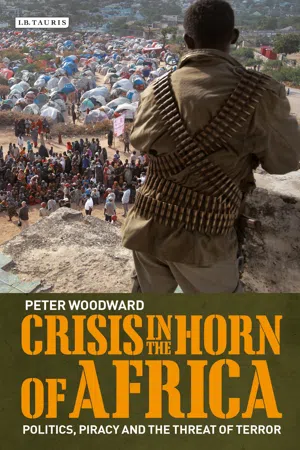
The most dangerous corner of Africa is its north-eastern Horn where instability reigns and terrorism thrives on the antagonisms of all it governments.The Horn of Africa comprising Ethiopia,Sudan and now South Sudan,Somalia,Djibouti,Eritrea,and stretching to include Kenya and Uganda, is a pivotal geopolitical pressure point in world politics.It stands at the hinge of Africa and the Middle East.It was of vital interest to the superpowers during the Cold War,attracting constant and unprofitable intervention.In the post-Cold War period regional political chaos,including failed states,terrorism and international piracy,has struck the death blow to the ambitions of the International Community's New World Order. The problems of the Horn,political,ideological,religious and ethnic, are compounded by natural disasters of widespread drought and famine,and have invited intervention by governments and NGOs.Tony Blair in his speech on the 'Doctrine of the International Community' referred to the suffering of Africa as 'a scar on the conscience of humanity'.But the New World Order's aim of 'good governance'-free elections,a free press,independent judiciary,recognition of human rights,gender equality and effective government free of corruption- seems as far off as ever.
Of the many striking examples perhaps Somalia stands out as a failed state-and predatory state to the majority of its peoples-and as a seat of international terror and a society which has even spawned the present scourge of international piracy.International attention on the Horn is not limited to altruism in face of suffering with the burgeoning economic superpowers,China and India, exploiting mineral and land resources. So international rivalry-a traditional factor in the Horn's instability-will continue to haunt both its peoples and the international community. Peter Woodward's survey of the history, and regional and international relations of the Horn of Africa shows the crises have deep historical roots predating present state boundaries.These have been shaped by imperialism,sharpened by independence and by the Cold War.Chaos in the Horn has frustrated the ambitions of the post-Cold War's New World Order.This book is essential reading for all students of history,international relations and policy planners.
- 256 pages
- English
- ePUB (mobile friendly)
- Available on iOS & Android
eBook - ePub
About this book
Information
CHAPTER 1
Introduction
‘Crisis in the Horn of Africa’ tends to invite the obvious response: ‘So what’s new?’ An analysis published in 2009 began, ‘The most dangerous corner of Africa is its north-eastern Horn, where instability reigns and terrorism thrives on the antagonisms of its governments’.1 It could have been written at just about any time since the end of the Cold War, and before it as well. However, the end of the Cold War is not a bad place to start because it was seen as opening up a new era in which the liberal West, led by the USA, had proved itself victorious and would now be in a position to shape the future of the world: the notorious ‘end of history’ moment. Two systems had struggled, and behind them academics had pondered the respective merits of two broad ideological camps: variants of Marxism through Leninism and Maoism on the one hand, and ‘modernization theory’, perceived as liberal approaches to politics and economics, on the other. In true Hegelian spirit a new era of synthesis had taken place, in that the victorious West would emerge from the traumas of conflict to carry its values into the re-shaping of the rest of the world.
But what was that world really like? The Cold War was over, but there were many other armed conflicts around the world, some spawned in part at least by the Cold War itself. For a while there was talk at the highest level in Washington, the capital of the world’s one remaining superpower, of a New World Order. However, as the 1990s wore on it seemed that some wars at least continued resisting any such new order; from time to time new wars broke out in the Third World, as ‘developing’ countries were still often referred to collectively, and even in Europe itself in the case of the new wave of Balkan wars. This gave rise to talk of a coming global anarchy in some quarters suggesting situations of ‘permanent emergency’, and of the necessity and right of the international community to decide to intervene. Thus the liberal victors of the Cold War sought to grapple with the reality of new and continuing conflicts: what should be done, when, for what objectives, by whom and by what methods? It added up to issues of liberal/humanitarian interventionism which were to challenge the prevailing understanding of national sovereignty. Initially it was presented mainly in ‘liberal’ terms: many peoples suffered at the hands of their governments which was bad in itself and justified a humanitarian response, whether or not the governments involved sought it. But humanitarian intervention was not enough, as governments might repeat their bad ways, and reform in the direction of improved policies and practices was required which could justify greater involvement. Democratic transitions could have the dual effect of improving governments, through accountability and empowerment of populations, and reducing international conflicts, since it was an oft-repeated mantra that democracies do not go to war with one another. In addition, the perpetrators of violence, including state violence, were themselves to be made more accountable.
11 September 2001 was to add to the claim that liberal states faced serious new and growing threats, and that intervention, including outright invasion, would not only liberate the peoples of at least some countries, but make the world safer for liberal democracies as a whole. It was to herald what was seen by some as a potential revolution in international relations, including a consolidation of the power of the Western liberal democracies led by the USA. One high-profile leader in this direction was Britain’s Tony Blair. From his Chicago speech in 1999 on the ‘Doctrine of the International Community’ questioning the sanctity of national sovereignty, through to his later justifications of Britain’s role in the invasions of Afghanistan and then Iraq, he was to contribute to debates about ‘the right to protect,’ often abbreviated to R2P.
The Horn was one of the more obvious areas of the world in which to address these issues given its levels of conflict and suffering of every kind: it was certainly a region that was well qualified to meet Blair’s view that Africa was ‘a scar on the conscience of the world’. These issues in turn needed careful analysis, both theoretically and empirically, if effective decisions were to be taken, and there has been a great deal of analysis of various aspects of conflicts and crises, some of which has spawned sub-disciplines and associated research in a number of universities and think tanks. The London School of Economics (LSE) even established a Crisis States Research Centre in which the Horn has featured.
One of the first new or revived areas of study to carve out a niche, with the Horn playing a central role, was that of famine. There is, of course, nothing new about famine, but it was hoped – perhaps expected – that with the rapid growth of the global economy after the end of World War II famine would have been left behind. There was famine in Africa’s Western Sahel in the 1970s, but it was in the Horn that it caught international media attention in the mid 1980s and ‘famine studies’ really took off. Some of it was concerned with definitions of famine and Famine that Kills, the title of a notable book on Western Sudan of that period; some with ‘coping mechanisms’ by which local communities could be assisted rather than made ‘aid dependent’; and some with early warning systems and pre-emptive action.2 Realization in 2011 that hunger, if not full blown famine, continues to hang over large areas of the Horn a quarter of a century later, from Somalia in the east to Darfur in the west, is a reminder that food crises have not been eradicated. Such crises in turn raise more issues of humanitarian intervention. When, where and how should intervention take place in famine and near-famine conditions, and are there any political circumstances which should influence such decisions?
In a wider context it seemed to many writers that food provision was part of economic development. Economic development as a subject had also been around for decades, encouraged by the attainment of political independence by so many of the world’s poorer countries after World War II. Various theories were taught, some of which had political implications linked to the Cold War and the possibilities of new sources of aid. The end of the Cold War and the apparent victory of Western capitalism gave impetus to the Washington Consensus and what has been called the ‘three decades of market triumphalism’. It was to feed into new thinking about marketization and economic development, not least in international organizations such as the World Bank and the IMF, and this affected the Horn as everywhere else.3 It was an aspect of the new globalization centred around the growth of ever more powerful international corporations. Like much of the rest of Africa, the new globalization in the Horn was to be mainly another chapter in the scramble for minerals, and later for agricultural land, including Sudan’s emergence as sub-Saharan Africa’s third largest oil producer after Nigeria and Angola. However, ideas on economic development were in turn questioned by issues of global warming that sought to at least amend the unfettered ‘free market’ in the direction of sustainable growth, and by the global financial crisis of 2008 which brought the state back in to save the financial markets from themselves. In the Horn it seemed possible that global warming played some part in food shortages, while the state – or lack of it – in one way or another had always been linked to economic development. While market economics has been the dominant paradigm of the past two decades, the rise of Asia in particular has given rise to analyses of the ‘developmental state’, in which state intervention has been as much a feature of the direction of economic growth as has simply opening up to the shifting winds of free-market globalization. As ever, ‘development economics’, like all economics, is less an exact science than an ever-changing understanding of shifting economic, social and political realities.
Issues of economic development have been closely linked to debates about aid. The humanitarian case in extremis is hard to deny, but much more controversial has been long-term aid and the danger of it fostering dependency. Likewise, there are critics who have linked aid to foreign policy: it is hard to deny some relationship when the figures suggest a close correlation in the Cold War, although subsequently the connection has been less obvious. The question has also been raised of distinguishing ‘relief’ aid, and ‘development’ aid, with the claim that the latter can assist the long-term alleviation of the former. Both forms of aid have also been associated with closer relations between donor states and international non-governmental organizations (INGOs), raising questions about the independence of the latter and possible construction of ‘welfare colonialism’.4
Another area of studies has been concerned with conflict. Africa’s numerous wars have been variously explained.5 In the early years it was often about nationalist struggles: while much de-colonization proceeded by negotiation, there were a number of significant armed struggles. Probably the most notable in the Horn was that of Eritrea: not against a European colonial power but against imperial Ethiopia to which it had been attached by the UN in 1952. But there have also been ‘sub-nationalisms’ within imperially defined states, such as those of southern Sudan and later Somaliland, which have raised the possibility of the division of an existing state; as indeed has happened in Ethiopia and Sudan. Much has also been written about other ideological dimensions of armed struggles, including various strands of socialism such as have been seen in Ethiopia, or religion as in Sudan’s north–south wars. More recently ethnicity has become associated with conflicts. Almost all of the conflicts of the Horn can be described as having an ethnic dimension, but often as part of a larger, more complex explanation. Perhaps the closest to ethnicity as ‘the answer’ has been the role of clan and sub-clan groups in analyses of the years of conflict in Somalia. However, such sources of conflict may not represent historic or primordial rivalries so much as more recent constructs, and mobilization arising from economic disparities, and especially the state’s role in creating and sustaining such disparities: conflict may breed ethnicity as much as result from it.6 This has given rise in recent years to a substantial body of literature which itself opens up questions of ‘greed or grievance’ in relation to conflicts that are deemed to have an economic motivation. In recent years issues pertaining to minerals and land in the Horn have magnified this aspect of the literature on its several conflicts.
Conflicts have become the best-known sources of refugees. In reality people cross Africa’s porous borders for numerous reasons, but conflict bestows a particular status as an internationally recognized refugee, entitled to support from the United Nations High Commission for Refugees (UNHCR). Its numerous conflicts have meant that the Horn has had the highest concentration of refugees in Africa, if not in the world, for decades. And if and when conflict has ended then issues of refugee resettlement have arisen. These situations have in turn contributed to the growth of another sub-discipline, ‘refugee studies’, which has long had an established home in Oxford University in particular.7 More recently there has been recognition that many victims of conflict may seek refuge in their own countries rather than crossing borders. This has given rise to the internationally recognized category of Internally Displaced Persons (IDPs), who require assistance both during and after conflicts. In the Horn, the Darfur conflict after 2003 gave fresh coverage of IDP issues.
In parallel with the discussion of conflict, a body of literature on conflict resolution has developed. What kinds of conditions make a negotiated conclusion of a conflict more or less likely? How should negotiations be started, sustained and concluded? Faced with sometimes decades of apparently intractable conflict various parties, often from the international community, have endeavoured to become involved. Such activities contribute to the growth of both theorists and practitioners, and once more a specialized literature has emerged. Just about every conflict in the Horn has seen attempts at conflict resolution at one time or another, with varying degrees of success.8 Emerging from conflict resolution has also been the recent theme of post-conflict studies, rightly seen as a necessary part of attempting to prevent the reopening of conflict.
In the wake of the Cold War in particular many politicians have proclaimed the need for ‘good governance’. This rather eighteenth-century term, deployed in some political theory literature in the past, has now taken on a new life of its own. For the past 20 years there has been a rapidly growing body of academic literature, for which the aid industry, both governmental and non-governmental, has shown an active enthusiasm. Various ingredients have been put forward including: forms of governmental accountability, such as the holding of free and fair elections; freedom of thought and expression, including a free media; an independent judiciary; the recognition of human rights; building civil society; gender equality; decentralization of government; improved performance of executive and bureaucratic tasks, including reduction of corruption; and enhanced responsibility of the state for the provision of basic services. Increasingly, progress on governance was seen as part of the conditionality of international aid, sometimes to be used rather crudely in packages of sticks and carrots for recipients. In the post-Cold War Horn, debates about good governance have arisen with regard to democratization and decentralization in Ethiopia in particular, while Sudan and Eritrea have often been criticized for their poor governance records.
In the same period it has become more apparent that, while good governance may be a desirable objective, there is a threat not just of ‘bad’ government but of no government at all. The literature has again been growing for some three decades with reference to ‘quasi states’, ‘failed states’ and ‘state collapse’. Sometimes it is seen in black-and-white terms, as in Somalia where the collapse of the internationally recognized state in 1991 has been seen as a major factor in the later emergence of piracy amongst other things. Elsewhere state malfunctioning may be presented as a matter of degree, perhaps with greater ‘statehood’ in core areas, but elements of ‘failure’ in more outlying or peripheral areas. Sudan has been an obvious case of this kind, although Ethiopia shows some characteristics as well. Thinking about state crises beyond the agenda normally associated with good governance, including questions of basic security, has arisen and may give rise to some difficult political and moral judgements as international engagement with Somalia has shown.
Even piracy has managed to go down the path of specialization. In 2011 a colloquium on ‘piracy studies’ was held, most appropriately at Greenwich University in London which is housed in the former Royal Naval College.
Many of these specialisms have given rise to books in which chapters drawn from the Horn are included. They are, however, often presented in terms of the particular specialism rather than concerned with their inter-connections in the broader context of whole states or regions. There is a danger of ‘single-issue management’ and particular specialisms reflecting the ‘flavour of the month’ with the media, NGOs, the public and politicians, which can turn into in academic fashions and fads with implications for research funding. At the state level there are works published which may embrace aspects of several or even all of these specialisms, however, the problem with this is treating states in Africa in isolation from one another. So many aspects of what are often comparatively weak and porous states have important regional inter-connections, even if the particular problems and issues appear to be grounded in a specific country.
This immediately brings in the literature of international relations. For much of the post-World War II period the subject seemed dominated by the Cold War, and certainly the Cold War intruded significantly on the Horn. Ethiopia, Somalia and Sudan were all allied with both superpowers at different times (as was neighbouring Egypt) which was a unique record in the world politics of that era. The reason was essentially the Horn’s geo-strategic position on the Red Sea, the Arabian Sea and the Indian Ocean, together with its proximity to the oil-producing Gulf region. The switching of sides was not just a matter of superpower choices, but largely reflected developments in domestic politics, including switches precipitated by regime changes in the states of the Horn. Such were their regional animosities that a change from one superpower to another in one country could lead to a corresponding switch in another. Probably the clearest example was in the late 1970s when, following the advent of military rule in 1974, Ethiopia’s switch from the USA to the USSR was followed by Somalia’s move in the opposite direction.
However, the post-Cold War era brought questions about a new order in international relations. One theme that was to emerge was the perceived growing importance of regionalism, perhaps even amounting to regional security complexes, an approach that soon developed theoretically as well as empirically, including Africa.9 It was not long before this approach was being addressed to the inter-state relations of the Horn. Regionalism is always in flux as situations change both in relations within regions, and as external factors have an influence upon them. There is a sense of an historic Horn, especially centred on Ethiopia, or Abyssinia as it was generally known before World War II. Ethiopia projected an ancient history based on the highlands with its settled agriculture, sometimes loosely referred to as of a feudal character. In that context. statebuilding had developed into a monarchy supported by local lords (ras) and the ancient Coptic Christian church. Around the highlands were various societies, including large pastoral communities, amongst which to the east and the north – in modern-day Somalia, Eritrea and Sudan – Islam was the predominant religion. Relations between the Coptic Christians and the Muslims were to prove contentious, with tradition focusing especially on the sixteenth-century figure Imam Ahmed Gran who led an unsuccessful attempted invasion of Abyssinia from the Somali plains. That in turn had been linked to the wider ambitions of the Ottomans, while Abyssinia was aided by the Portuguese, both superpowers of the time. For centuries afterwards Abyssinia/Ethiopia was to present itself as a Christian bulwark in a sea of hostile Muslims. In the nineteenth century it not only resisted European imperialism by defeating Italy at Adowa in 1896, but also embarked on its own empire-building, spreading its control over surrounding lowlands and their Muslim inhabitants.
However, the Horn as a geo-political feature of more modern international politics has been largely due to later developments in Europe. It was the late nineteenth-century imperial rivalries of Britain, France and Italy which were to register the Horn’s geo-politics on the map of Africa. As these powers disengaged after World War II, contributing much to the boundaries left behind, new problems were to emerge that helped to define the Horn as an area of conflict in particular. Ethiopia had managed to incorporate large areas occupied by Somalis in the south-east as well as Eritrea in the north, and both borders were to be contested. The Eritrean conflict in particular was to involve Sudan, while Ethiopia in turn was involved in conflict in southern Sudan. Thus by the 1960s, literature on the Horn embraced a growing area. Some even referred to the ‘Greater Horn’ a concept that seemed to gain traction from 1986 when a new regional organization was formed; the Inter-Governmental Authority for Drought and Development (IGADD – though ‘Drought’ was later dropped from its title so that it was commonly known as IGAD) comprising Ethiopia, Sudan, Somalia, Djibouti, Kenya and Uganda, as well as Eritrea following its independence in 1993. But any regional organization faces the internal politics, problems and consequent interests of its constituent members, as well as the international environment in which it seeks to operate.
For the Horn that environment is both that of the states immediately surrounding i...
Table of contents
- Cover
- About the Author
- Title Page
- Copyright
- Contents
- Acknowledgements
- Chapter 1. Introduction
- Chapter 2. The Evolution of the Horn
- Chapter 3. Ethiopia
- Chapter 4. Somalia
- Chapter 5. Sudan
- Chapter 6. Eritrea and Djibouti
- Chapter 7. Regional Relations
- Chapter 8. International Politics
- Chapter 9. Conclusion
- Select Bibliography
- Notes
Trusted by 375,005 students
Access to over 1.5 million titles for a fair monthly price.
Study more efficiently using our study tools.
Frequently asked questions
Yes, you can cancel anytime from the Subscription tab in your account settings on the Perlego website. Your subscription will stay active until the end of your current billing period. Learn how to cancel your subscription
No, books cannot be downloaded as external files, such as PDFs, for use outside of Perlego. However, you can download books within the Perlego app for offline reading on mobile or tablet. Learn how to download books offline
Perlego offers two plans: Essential and Complete
- Essential is ideal for learners and professionals who enjoy exploring a wide range of subjects. Access the Essential Library with 800,000+ trusted titles and best-sellers across business, personal growth, and the humanities. Includes unlimited reading time and Standard Read Aloud voice.
- Complete: Perfect for advanced learners and researchers needing full, unrestricted access. Unlock 1.5M+ books across hundreds of subjects, including academic and specialized titles. The Complete Plan also includes advanced features like Premium Read Aloud and Research Assistant.
We are an online textbook subscription service, where you can get access to an entire online library for less than the price of a single book per month. With over 1.5 million books across 990+ topics, we’ve got you covered! Learn about our mission
Look out for the read-aloud symbol on your next book to see if you can listen to it. The read-aloud tool reads text aloud for you, highlighting the text as it is being read. You can pause it, speed it up and slow it down. Learn more about Read Aloud
Yes! You can use the Perlego app on both iOS and Android devices to read anytime, anywhere — even offline. Perfect for commutes or when you’re on the go.
Please note we cannot support devices running on iOS 13 and Android 7 or earlier. Learn more about using the app
Please note we cannot support devices running on iOS 13 and Android 7 or earlier. Learn more about using the app
Yes, you can access Crisis in the Horn of Africa by Peter Woodward in PDF and/or ePUB format, as well as other popular books in History & African History. We have over 1.5 million books available in our catalogue for you to explore.