Nineteenth-century Britain was one of the birthplaces of modern vegetarianism in the west, and was to become a reform movement attracting thousands of people. From the Vegetarian Society's foundation in 1847, men, women and their families abandoned conventional diet for reasons as varied as self-advancement via personal thrift, dissatisfaction with medical orthodoxy, repugnance towards animal cruelty and the belief that carnivorism stimulated alcoholism and bellicosity. They joined in the pursuit of a more perfect society in which food reform combined with causes such as socialism and land reform.
James Gregory provides an extensive exploration of the movement, with its often colourful and sometimes eccentric leaders and grass-roots supporters. He explores the rich culture of branch associations, competing national societies, proliferating restaurants and food stores and experiments in vegetarian farms and colonies.
'Of Victorians and Vegetarians' examines the wider significance of Victorian vegetarians, embracing concerns about gender and class, national identity, race and empire and religious authority. Vegetarianism embodied the Victorians' complicated response to modernity. While some vegetarians were averse to features of the industrial and urban world, other vegetarian entrepreneurs embraced technology in the creation of substitute foods and other commodities. Hostile, like the associated anti-vivisectionists and anti-vaccinationists, to a new 'priesthood' of scientists, vegetarians defended themselves through the new sciences of nutrition and chemistry.
'Of Victorians and Vegetarians' uncovers who the vegetarians were, how they attempted to convert their fellow Britons (and the world beyond) to their 'bloodless diet' and the response of contemporaries in a variety of media and genres. Through a close study of the vegetarian periodicals and organisational archives, extensive biographical research and a broader examination of texts relating to food, dietary reform and allied reform movements, James Gregory provides us with the first fascinating foray into the impact of vegetarianism on the Victorians. In doing so he gives revealing insights into the development of animal welfare, other contemporary reform movements and the histories of food and diet.
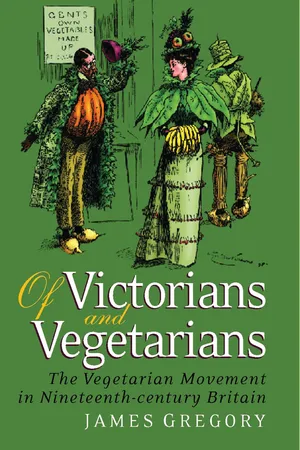
eBook - PDF
Of Victorians and Vegetarians
The Vegetarian Movement in Nineteenth-century Britain
- 326 pages
- English
- PDF
- Available on iOS & Android
eBook - PDF
About this book
Information
Table of contents
- Cover
- Contents
- List of Illustrations
- Abbreviations
- Acknowledgements
- Introduction
- 1. The Vegetarian Movement, c. 1838-1901
- 2. Physical Puritanism and Medical Orthodoxy
- 3. Beasts and Saints: Zoophilia and Religion in the Movement
- 4. Radicalism and Fadicalism
- 5. Feeding the Vegetarian Mind and Body
- 6. Class, Gender and Vegetarians
- 7. Representing the Vegetarian
- Conclusion
- Notes
- Bibliography
- Index
Trusted by 375,005 students
Access to over 1.5 million titles for a fair monthly price.
Study more efficiently using our study tools.
Frequently asked questions
Yes, you can cancel anytime from the Subscription tab in your account settings on the Perlego website. Your subscription will stay active until the end of your current billing period. Learn how to cancel your subscription
No, books cannot be downloaded as external files, such as PDFs, for use outside of Perlego. However, you can download books within the Perlego app for offline reading on mobile or tablet. Learn how to download books offline
Perlego offers two plans: Essential and Complete
- Essential is ideal for learners and professionals who enjoy exploring a wide range of subjects. Access the Essential Library with 800,000+ trusted titles and best-sellers across business, personal growth, and the humanities. Includes unlimited reading time and Standard Read Aloud voice.
- Complete: Perfect for advanced learners and researchers needing full, unrestricted access. Unlock 1.5M+ books across hundreds of subjects, including academic and specialized titles. The Complete Plan also includes advanced features like Premium Read Aloud and Research Assistant.
We are an online textbook subscription service, where you can get access to an entire online library for less than the price of a single book per month. With over 1.5 million books across 990+ topics, we’ve got you covered! Learn about our mission
Look out for the read-aloud symbol on your next book to see if you can listen to it. The read-aloud tool reads text aloud for you, highlighting the text as it is being read. You can pause it, speed it up and slow it down. Learn more about Read Aloud
Yes! You can use the Perlego app on both iOS and Android devices to read anytime, anywhere — even offline. Perfect for commutes or when you’re on the go.
Please note we cannot support devices running on iOS 13 and Android 7 or earlier. Learn more about using the app
Please note we cannot support devices running on iOS 13 and Android 7 or earlier. Learn more about using the app
Yes, you can access Of Victorians and Vegetarians by James Gregory in PDF and/or ePUB format, as well as other popular books in History & Social History. We have over 1.5 million books available in our catalogue for you to explore.