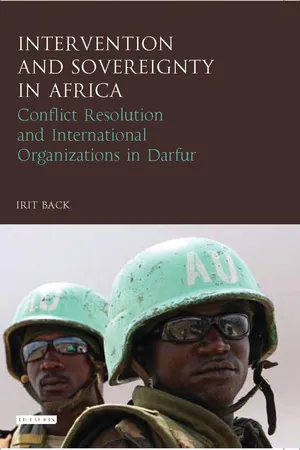
eBook - ePub
Intervention and Sovereignty in Africa
Conflict Resolution and International Organisations in Darfur
- 224 pages
- English
- ePUB (mobile friendly)
- Available on iOS & Android
eBook - ePub
Intervention and Sovereignty in Africa
Conflict Resolution and International Organisations in Darfur
About this book
In response to the civil war in Darfur, the African Mission in Sudan (AMIS) force was established in May 2004, and by June its first contingents were on the ground. For the first time since the founding of the African Union, a resolution about direct intervention in a conflict that involved wide-ranging abuse of human rights was accepted on a pan-continental level. Here, Irit Back looks at the changes in attitudes towards the ever-problematic tension between the concepts of humanitarian intervention and state sovereignty, using the example of the African Union's intervention in Darfur to illustrate this unique pan-continental approach to conflict resolution and peace-keeping. Additionally, Back analyses the challenges which international task forces, including AMIS and its successor the United Nations-African Union Mission in Darfur (UNAMID), have faced ever since. Including an examination of the situation in the wake of the declaration of independence of South Sudan in 2011, this book offers a unique perspective on the problem of internationally organised intervention in local conflicts.
Information
CHAPTER 1
SOVEREIGNTY VERSUS INTERVENTION IN AFRICA: HISTORICAL AND IDEOLOGICAL BACKGROUND
In the early 1960s, at the peak of the African states' independence phase, Ghana's President Kwame Nkrumah's popular cry to establish a “United States of Africa” seemed to be facing a major challenge.1 The second and third clauses of the Convention of the Organization of African Unity (OAU), an organization founded in 1963, dealt with the principles of non-intervention in the internal affairs of independent states and respect for state sovereignty and territorial integrity. As most African states gained independence from colonial rule, it became evident that the sovereign African states' commitment to these principles served as a source of legitimacy for their disregard of intrastate conflicts, in spite of clear evidence of grave human rights violations.2 The OAU's unwillingness to formulate a clear joint position on such violations first emerged with regard to the Nigerian–Biafran War between 1967 and 1970, and was reflected repeatedly in the organization's response to numerous cases of intrastate conflicts in the 1970s.3
In the 1980s and the 1990s, however, the OAU states' fierce commitment to the principle of non-intervention developed some cracks. After close to two decades of adherence to non-intervention, critical discourse in the OAU demanded instituting a “culture of accountability” to replace the instrumental role of non-intervention in promoting a “culture of impunity” for heads of state who committed atrocities.4 The demand to promote human rights issues instead of a commitment to the interests of the sovereign states and régimes produced the African (Banjul) Charter of Human Rights of Peoples, adopted in 1981, and the framework for an African Commission on Human Rights.5 Despite this shift, its practical effect on OAU policy on intrastate conflicts appeared negligible.
The firm institutionalization of the OAU's norm of non-intervention was more clearly revealed during the Liberian civil war between 1989 and 1997 (and, subsequently, between 1999 and 2003). In contrast to most African states, Liberia had never been subject to European colonial rule. Nevertheless, the 144-year period of political, economic, and social domination of the Americo-Liberian ruling oligarchy (mostly freed slaves from the United States) and its combined policy of authoritarianism and ethnic deprivation, was widely considered “Black Colonialism”. Thus, Samuel Doe's coup d'état in April 1980 was viewed as a genuine national revolution symbolizing the end of the Americo-Liberian hegemony and the transition of power to the indigenous people of Liberia.6 Soon after the coup d'état it became clear, however, that the old oligarchy had been replaced by an ethnic junta that had no intention of establishing a democratic republic with equal representation for Liberia's 16 ethnic groups, and was not averse to using violent and oppressive measures to establish its dominance.
Opposition groups quickly formed to challenge the new regime's oppressive and dictatorial measures. The rebel attack of the National Patriotic Front of Liberia (NPLF), comprising Libyan-trained Liberian dissidents led by Charles Taylor, in Nimba County on 24 December 1989, was considered the starting point of Liberia's civil war. By June 1990, NPLF forces reached the outskirts of Monrovia and controlled most of the state's territory, but Taylor's promises to restore full constitutional democracy through free and fair elections and rebuild the Liberian economy were crushed almost immediately by NPLF acts of pillage and plunder among the civilian population. During that period, Prince Johnson established a second opposition group, the Independent National Patriotic Front of Liberia (INPFL). The three military forces turned on each other, leading to the total destruction of Liberia, and, as warlords dominated different parts of the country, ethnic slaughter reached a massive scale and created a huge refugee problem, which also affected Liberia's neighboring countries and raised concerns about regional stability. With the collapse of the Liberian state, and the grave internal and external implications of the situation, attention focused on the issue of who should be in charge in Liberia.
Although the then chairman of the OAU, Yoweri Museveni of Uganda, advocated intervention in the Liberian conflict, the continental organization “merely dusted up its articles on noninterference in the internal affairs of member-nations”.7 The response of the regional Economic Community of West African States (ECOWAS) was completely different. As early as May 1990, ECOWAS heads of state met in Banjul, Gambia, and established the ECOWAS Ceasefire Monitoring Group (ECOMOG). That ECOWAS was strongly committed to intervene in the Liberian domestic conflict was evident from its explanation for the establishment of a Standing Mediation Committee:
The wanton destruction of human life and property and the displacement of property […] the massive damage of various forms being caused by the armed conflict to the stability and survival of the entire Liberian nation; and concern […] about the plight of foreign nationals, particularly citizens of the Community who are seriously affected by the conflict; and considering that law and order in Liberia had broken down […] to find a peaceful and lasting solution to the conflict and put an end to the situation which is seriously disrupting the normal life of innocent citizens in Liberia.8
ECOMOG's mission in Liberia was to achieve an immediate cease-fire, establish an interim administration in Monrovia, and set in motion a process of nation wide elections that ECOMOG would also monitor;9 yet it soon became clear that the cease fire monitoring and diplomatic efforts were insufficient to resolve the chaotic situation in Liberia. In July 1990, a blueprint for an ECOWAS military intervention was announced, and the first ECOMOG force landed in Monrovia the following month. The force's failure to control the situation on the ground paved the way for United Nations Security Resolution 866, adopted in September 1993.
Since the role foreseen for UNOMIL [United Nation Observers Mission in Liberia] is to monitor and verify the implementation of the [Cotonou] Agreement, its concept of operation necessarily must be parallel of that of ECOMOG […] UNOMIL would thus […] deploy observer teams in concert with ECOMOG deployment, including border crossings, airports and seaports [… In short], UNOMIL and ECOMOG would collaborate closely in their operations.10
This resolution was considered precedential as it determined a joint framework of cooperation between the UN and ECOWAS, and, more broadly, it created a foundation for coordination between international and regional organizations regarding intervention in domestic conflicts in Africa. While an evaluation of the failures and successes of the joint ECOMOG–UNOMIL (United Nations Observer Mission in Liberia) force is beyond the scope of this book,11 several lessons from this case are important for an understanding of future developments. First, as the first intervention by a regional organization in a domestic conflict, the joint ECOMOG–UNOMIL force defined a basic framework for future interventions. Second, internal controversies and acrimony within ECOWAS, such as the conflicting views of Côte d'Ivoire and Burkina Faso on the legitimacy of intervention in internal conflicts, was one of the main causes of the intervention's ineffectiveness, and consequently prolonged the civil conflict and its devastating consequences.12 The polarized debate over the intervention's legality and procedures, which ultimately undermined ECOWAS's efforts to protect civilians, recurred in subsequent cases of intervention in intrastate conflicts, including the African Union (AU) intervention in Darfur. Finally, as the first relatively successful partnership between a regional African organization and the UN since the failure of the United Nations Operation in Congo (UNOC) in the 1960s, the Liberian case offers a useful empirical benchmark for evaluating subsequent cases of task-sharing between the UN and the regional organization, such as in Sierra Leone.13
In fact, African intervention in the civil conflict in Sierra Leone, which lasted from 1991 until 2002, reflected many of the achievements and failures of Liberia. Similarly to other colonies, the small former British colony in West Africa suffered from over-exploitation of its natural resources and underdevelopment. After its independence in 1961, Sierra Leone experienced political instability, poor economic development, and insufficient external aid, even compared to other African states, and, by 1991, Sierra Leone had dropped to lowest position on the UN Human Development Index.14 That year, a group named the Revolutionary United Front (RUF), led by former army corporal Foday Sankoh and supported by Charles Taylor of Liberia, instigated massive attacks against civilians. The rebels' ideological motives, which initially focused on justice and democracy, were soon channeled into attempts to seize control of the country's economic resources, especially its rich diamond fields. By 1995, the year the National Provisional Ruling Council was installed, country wide destruction reached overwhelming proportions, with thousands of killings, and hundreds of thousands of refugees and internally displaced persons (IDPs). The devastation not only crushed the economy, which racked up an external debt equal to 177 percent of the GNP, but also caused the total destruction of infrastructures, including 70 percent of the country's schools and the almost total elimination of healthcare centres.15 RUF's horrific violence against civilians was characterized by barbaric acts that included the widespread use of sex slaves, child soldiers, and especially mass amputations of civilians, which came to be known as the symbol of that war.16
Despite grave reports of humanitarian violations in Sierra Leone, the UN refused to acknowledge the situation there as a “complex political emergency”17 that requires a system-wide aid response by the international community that might include coordination and collaboration between UN agencies, donor governments, NGOs, and military establishments. Moreover, the UN allocated only a limited amount of financial aid to the country, an act that caused relief agencies to refer to the situation in Sierra Leone as the “forgotten emergency”.18 In stark contrast to international unwillingness to act in Sierra Leone, a South African mercenary company called Executive Outcomes deployed a small force to Sierra Leone in 1995. With its superior equipment and training, the force pushed back RUF fighters from key areas such as Freetown and the diamond fields within weeks. This small force proved the importance of an immediate response in the early stage of the conflict, and had the November 1996 Abidjan ECOWAS peace negotiators not demanded their expulsion, the Executives Outcomes might have made a difference in ultimate resolution of the conflict. Analyzing the subsequent developments in Sierra Leone, Ian Smillie and Larry Minear admitted in retrospect that the force's expulsion (a negotiating condition of the peace talks), compounded by the International Monetary Fund's (IMF) rejection of a request for US$1.8 million to maintain the force, was a fatal mistake. This amount later proved to be the daily cost of maintaining peacekeeping forces in Sierra Leone.19
The important lessons learned from international inaction in the initial phases of the civil war and failure to support a successful intervention proved to be relevant for future conflicts for several reasons.20 First, from a regional perspective, the civil war in Sierra Leone clearly illustrated the dangers of a spillover effect. From the onset it was evident that the conflict in Sierra Leone was interwoven with the conflict in Liberia. Close ties between Charles Taylor and the RUF fueled the Sierra Leone war to create what was described as a “post-Cold War proxy war”.21 The growing number of refugees seeking asylum in Sierra Leone's neighbouring countries was another aspect of the regionalization of this internal conflict. As such, ECOWAS felt compelled to provide solutions to these acute problems to prevent the conflict from spilling over beyond state borders; the organization's commitment to resolve the IDP problem also relates to the second lesson.
Second, “African Solutions to African problems” became a rallying cry in response to the international community's failure to address the growing refugee and IDP population, control widespread hunger and disease, and stop unchecked violence in Sierra Leone. The UN Security Council was unable to pass effective resolutions concerning Sierra Leone, and only partially carried through on its financial promises. United States mediation efforts led to the dubious Lomé Agreement of 1999, forcing Sierra Leone President Tejan Kabbah to include RUF fighters as potential members of the government, award an “absolute and free pardon and reprieve to all”, and grant the vice presidency to RUF commander Foday Sankoh. Such results reinforced the appreciation that Africans must be more active in their own affairs.22 The “African solutions to African problems” cry was soon translated into the establishment of ECOMOG II in 1999, and the ECOWAS Peace Plan for Sierra Leone was announced the following year in Conakry. Still, it remained debatable whether the “African solutions” cry was more than a hollow slogan. The civil war in Sierra Leone ended only with the establishment in 1999 of the United Nation Mission in Sierra Leone (UNAMSIL),23 and direct British military intervention, and not as a result of African efforts.24
Third, an analysis of the relations within ECOWAS and the organization's policy on Sierra Leone demonstrated the importance of cooperation within regional organizations and its impact on the effectiveness of intervention. Nigerian dominance in ECOWAS dictated the country's prominent role in the diplomatic efforts to settle the conflict, as well as its contribution to ECOMOG troops and financial aid. In some cases, Nigeria's dominance drew criticism from other ECOWAS members such as Ghana. Nigeria's pro-democratic intervention, reflected in its promise to reinstate President Kabbah in 1998, sparked fierce criticism against the efforts of a military regime (Nigeria) to impose democracy on another state.25 Today, after more than a decade of democracy in Nigeria (and elsewhere in Africa), it is important to re-examine interventions of this type and their significance as precedents for the future.
The case of Sierra Leone offered further evidence of the marginalization of Africa's security needs in the post-Cold War era, particularly compared to international attention and peacekeeping efforts directed to Kosovo and East Timor in the same period.26 From this perspective, the cry for “African solutions” expressed a genuine need to resolve Africa's internal security needs. It is not surprising that it was the genocide in Rwanda in 1994, rather than the violent conflicts in Liberia or Sierra Leone, which appears to be the major event responsible for changing African attitudes toward the principle of non-intervention.
The events in Rwanda differed from previous cases of intrastate conflicts in post-colonial Africa in their intensity and their cruelty: In a span of approximately 100 days, more than 800,000 Tutsis (and Hutus suspected as moderates) were murdered. The background and the events surrounding the genocide in Rwanda are widely discussed elsewhere.27 While these events triggered an international debate on the international community's responsibility to protect civilians in the event of grave violations of human rights, an analysis of intervention patterns in the case of Rwanda confirms that the criticism directed against the international community's conduct was justified. Although international efforts to prevent the ethnic clashes had been in place before the conflict in Rwanda escalated to genocide, during the actual perpetration of the atrocities the international community ignored its commitment to the “Never Again” promise, and failed to uphold its commitment to “prevent and to punish” genocide.28
The first United Nations Assistance Mission for Rwanda (UNAMIR), a force of 2,500 ...
Table of contents
- Front Cover
- Title Page
- Copyright Page
- Dedication
- Contents
- Acronyms and Abbreviations
- Timetable of Events in Darfur (and related events) 2004–10
- Acknowledgments
- Introduction
- 1. Sovereignty versus Intervention in Africa: Historical and Ideological Background
- 2. Darfur: From Resource-Based Conflicts to Crimes against Humanity
- 3. Intervention from Theory to Practice: The African Union Mission in Sudan (AMIS)
- 4. From Abéché to Abuja: The African Union Mediation Efforts
- 5. The Government of Sudan Responds to African Union Intervention
- 6. The Transition to UNAMID – A Hybrid Force Experiment
- 7. Darfur and Sudan from the ICC Ruling to Southern Independence – 2009–11
- 8. The Arab Spring, Darfur, and Beyond
- Conclusion
- Notes
- Bibliography
Trusted by 375,005 students
Access to over 1.5 million titles for a fair monthly price.
Study more efficiently using our study tools.
Frequently asked questions
Yes, you can cancel anytime from the Subscription tab in your account settings on the Perlego website. Your subscription will stay active until the end of your current billing period. Learn how to cancel your subscription
No, books cannot be downloaded as external files, such as PDFs, for use outside of Perlego. However, you can download books within the Perlego app for offline reading on mobile or tablet. Learn how to download books offline
Perlego offers two plans: Essential and Complete
- Essential is ideal for learners and professionals who enjoy exploring a wide range of subjects. Access the Essential Library with 800,000+ trusted titles and best-sellers across business, personal growth, and the humanities. Includes unlimited reading time and Standard Read Aloud voice.
- Complete: Perfect for advanced learners and researchers needing full, unrestricted access. Unlock 1.5M+ books across hundreds of subjects, including academic and specialized titles. The Complete Plan also includes advanced features like Premium Read Aloud and Research Assistant.
We are an online textbook subscription service, where you can get access to an entire online library for less than the price of a single book per month. With over 1.5 million books across 990+ topics, we’ve got you covered! Learn about our mission
Look out for the read-aloud symbol on your next book to see if you can listen to it. The read-aloud tool reads text aloud for you, highlighting the text as it is being read. You can pause it, speed it up and slow it down. Learn more about Read Aloud
Yes! You can use the Perlego app on both iOS and Android devices to read anytime, anywhere — even offline. Perfect for commutes or when you’re on the go.
Please note we cannot support devices running on iOS 13 and Android 7 or earlier. Learn more about using the app
Please note we cannot support devices running on iOS 13 and Android 7 or earlier. Learn more about using the app
Yes, you can access Intervention and Sovereignty in Africa by Irit Back in PDF and/or ePUB format, as well as other popular books in Politics & International Relations & African History. We have over 1.5 million books available in our catalogue for you to explore.