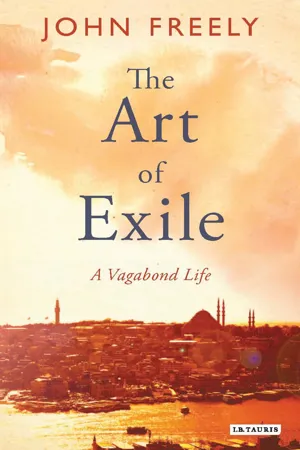
By the time he was six, John Freely had crossed the Atlantic four times. His childhood was spent on the mean streets of 1930s Brooklyn, where he scavenged for junk to sell and borrowed money for books; his first love being Homer's Odyssey. He was 15 when Japan attacked Pearl Harbor and 17 when he enlisted in the US Navy and embarked on the first great adventure of his life: joining a clandestine unit that helped the Kuomintang fight the Japanese. He served for two years, 96 days in combat and a total of 344 days overseas, which sparked a lifelong passion for travel. Returning home after the war, Freely fell in love with a beautiful girl who sang the blues. His own Penelope. Together they signed a blood pact to spend their life travelling the world. This unforgettable memoir takes the reader from the streets of New York to the corridors of provincial campus life; from World War II in the Pacific to the shores of the Bosphorus and from Ancient Troy to the isles of Dionysus and Ariadne. It is the story of a remarkable odyssey that has spanned nine decades, several continents and one great love.And still the odyssey continues, "as I ponder the meaning of an Ithaka and of exile as an art that takes a lifetime to master.
"
- 256 pages
- English
- ePUB (mobile friendly)
- Available on iOS & Android
eBook - ePub
About this book
Trusted by 375,005 students
Access to over 1.5 million titles for a fair monthly price.
Study more efficiently using our study tools.
Information
1
TWENTY YEARS AGROWING
My travels began even before I was born. According to my mother, I was conceived in Boston and arrived in New York by train three months before my birth, concealed in her womb, travelling without a ticket on the first of my life’s journeys.
My mother was born in Ireland as Margaret Murphy, but everyone called her Peg. She never used her married name, Mrs John Freely, always identifying herself as Peg Murphy. This was not uncommon among the Irish women of her time, but it was mostly her fierce spirit of independence that made her keep her own name, for she was Peg Murphy and not Missus Somebody Else, she always said. We were led by her to believe that she had been born in 1904, but I eventually discovered that her true date of birth was 1897, though I never learned why she subtracted seven years from her age. Perhaps it was to be eternally young, for she often spoke of going off to Tír na nÓg, ‘The Land of the Young’, where in Celtic myth no one grows old. Years later I read of this land of eternal youth in the first lines from ‘The Wooing of Etain’:
Fair woman, will you come with me
to a wondrous land where there is music?
Hair is like the blossoming primrose there;
smooth bodies are the colour of snow
There, there is neither mine nor yours;
bright are teeth, dark are brows,
A delight to the eye the number of our hosts,
the colour of fox-glove every cheek.
Peg was one of 11 children, all but one of whom left Ireland and emigrated to the US. They were helped by relatives in Lawrence, Massachusetts, from an earlier family migration. Her paternal grandfather had ‘died on the roads’ when he and his family were evicted from their home during the Great Hunger, after which his widow and surviving children had emigrated to America and found refuge in Lawrence. But her eldest son, Peg’s father Tomas Murphy, had not taken to life in America and returned to Ireland, though there was no one of his family left there.
Tomas was born in County Kerry on the Dingle Peninsula, the south-westernmost extension of Ireland. When Tomas returned from America he found work as a porter for the Irish Railways on the narrow-gauge line that operated between Tralee, capital of County Kerry, and Dingle, the main town on the peninsula. At the beginning of his first day at work, an English tourist, getting on at Tralee, pointed out his trunk on the platform and arrogantly ordered Tomas to put it up on the luggage rack. ‘Put it up yourself,’ said Tomas proudly, walking away to help an old Irishwoman board the train. The conductor, observing this, said, ‘Murphy, you will not grow grey in the service of the Irish Railways.’
Tomas kept the job for about a year, but then he was dismissed for giving another English tourist a piece of his mind about Britain’s treatment of Ireland. It was just as well that he did, for the following Whitsunday there was a terrible accident on the Tralee– Dingle railway. Locomotive Number One swerved off the tracks on the Curraduff Bridge and fell 30 feet into the river, killing the engineer, the conductor, the porter and 90 pigs, who were the only passengers that day. An old woman in Dingle remarked to Tomas that he had been spared by the hand of God, to which he responded, according to Peg, ‘I’m sure the Almighty had more important matters to think about that day than the fate of three Irishmen and 90 pigs.’
Soon afterwards Tomas met and fell in love with a pretty young schoolteacher named Mary Ashe, whose father was the postmaster in Anascaul, the only town of any size between Tralee and Dingle. Tomas and Mary married and settled down in a tiny cottage by the sea four miles east of Inch, the enormous transverse sand cape on the south coast of the Dingle Peninsula. Tomas became a fisherman, making himself a small currach, a wickerwork boat covered with tarred canvas. He also built a little dock to moor his currach, in a cove below his cottage that is still called Murphy’s Landing. On the hillside behind the cottage he cleared and walled in a small plot of land and planted it with potatoes, cabbage, wheat, corn and hay, building a small barn that sheltered a cow, a donkey and a score of chickens. He farmed his little plot and at intervals set his nets and lines for codfish and herring in Dingle Bay, searching the rocky strand at low tide for periwinkles and mussels. And with these resources Tomas and Mary raised 11 children, five of them boys and six girls, all of whom survived their childhood, something of a miracle in rural Ireland at the time.
The Murphy children learned reading, writing, arithmetic and not much more at the Kerry District school, a two-room schoolhouse three miles west along the coast from where they lived, making the journey barefoot in all seasons.
The Murphy children all left school in turn after four or five years and went to work, usually on their own or neighbouring farms. Peg found a place at Foley’s Public House at Inch, where she looked after the publican’s infant son, Jerry, and also helped out in the bar. She gave some of her wages to her parents and saved the rest in the hope that she would eventually have enough to go off to America, the dream of every young person in rural Ireland at the time, for their homeland had nothing to offer them.
Peg was the only one of the children who inherited her mother’s love of reading. Mary Ashe had been sent to a convent school by her father, Thomas, who had been appointed postmaster of Anascaul after he returned from the Crimean War, in which he had served in the British Army. He had been badly wounded in the last battle of the war, the attack on the Redan, and had recuperated in Florence Nightingale’s hospital on the Asian side of the Bosphorus across from Constantinople. He was illiterate when he joined the 88th Regiment of Foot at the age of 17 years and nine months, but while he was in the Army he seems to have learned how to read and write and speak English, which qualified him to serve as postmaster in Anascaul when he returned to Ireland. Mary was a teacher for a few years before her marriage to Tomas, who was illiterate. I only discovered this many years later when I first saw Peg’s birth certificate, where her father’s signature appears as a scrawled X.
All but one of the children went off in turn to America. Peg was the sixth to leave, after her sisters Hannah, Bea, Annie, Mary and Nell, with her brothers Jerry, Tommy, Mauris and Gene following in turn soon afterwards. Her younger brother John was the only one who remained at home with Tomas and Mary, helping them to look after their farm. He too would have gone had he not been suffering from tuberculosis.
Peg had saved enough money from her wages at Foley’s to pay for her passage to America in steerage, and she had set aside a bit to buy her first pair of shoes, but the friends who emigrated with her went barefoot. The same thing was happening all over Ireland, as the Irish once again left their native land, just as they had during and after the Great Hunger in the mid-nineteenth century, when tenants were evicted and either ‘died on the roads’ or emigrated, diminishing the population of Ireland from eight to four million in just a decade.
The story was much the same in the cottage where my father John was born, near the town of Ballyhaunis in County Mayo, in the north-west of Ireland. All the Freelys in the world come from in and around Ballyhaunis, the descendants of an O’Friel who had moved there from County Donegal in the north around 1600, the date of the thatched cottage in which my father was born. O’Friel was illiterate, and the English authorities in registering his name had written it down as Freely. Otherwise, like most Irish of the soil, the Freelys were a family without a history, just a succession of simple farmers, who at least owned their own plot of land, which is why they survived the Great Hunger.
John was uncertain about the date of his birth. He always said that he had been born the ‘year of the great wind’, which he thought was 1898, but eventually we learned that he too was born in 1897. He was the second of nine children of Michael and Ellen Freely, who had eight boys and one girl: Jim, John, Willie, Tom, Pat, Mike, Charlie, Mary and Luke. All nine emigrated from Ireland in turn, some to England but most to America, though Jim, the eldest, eventually returned from the US with his wife Agnes to run the family farm after the death of his parents.
John left home in the spring of 1916, along with his brother Willie, hoping to find work in England. They had not tuppence between them when they decided to leave, as John told me many years later. The only cash in the house was their mother’s ‘egg money’, a few pennies which she had accumulated by selling eggs now and then at the weekly market in Ballyhaunis. One morning, well before dawn, John awoke and dressed quietly, waking Willie, and then went to the cupboard and took his mother’s egg money, vowing to replace it as soon as he found work in England. Then they left the cottage and headed for Ballyhaunis, five miles distant, to catch the weekly train that stopped there at six in the morning. They cut across the fields to intercept the train a mile or so before it reached the town, and when they saw it approaching they stepped out on to the track to flag it down. The train duly stopped for them and the conductor let them come aboard, for he was from Ballyhaunis and knew the family. He didn’t bother to ask them for their tickets, for he knew they wouldn’t have been able to afford them.
The train had two cars, one for mail and the other for passengers. The seats were all taken, and so John and Willie sat down on the floor at the back, covering their faces when the train stopped at Ballyhaunis so that they wouldn’t be recognized by anyone who might get on there. But no one did, and after the mail was put aboard, the train chugged off, just as the sun rose over the hills of Roscommon, the next county to the east. Then Willie went to sleep while John took one last look at Ballyhaunis, which he would never see again. It was Easter Sunday, and he could hear the church bell tolling for the first mass of the day. He blessed himself and then he too fell asleep.
A while later the other passengers in the car began waking up, and some of them in the back seats began talking to John and Willie. It turned out that all of them were Irish sailors who had been aboard a British freighter that had been sunk by a German submarine off the north-west coast of Ireland. They had come ashore in lifeboats and were put on the first train leaving for Dublin. They had been given their full pay, and when they were all awake they began passing around a bottle of Irish whiskey, and it was then that John had his first taste of hard drink, which started him on the ‘downward path to ruination’, as Peg would later say.
When they arrived in Dublin John asked for directions to a ‘Model Rooming-House’, which he had been told about in Ballyhaunis, and he and Willy spent the night there for a single penny, paying a ha’penny each. They and the other occupants did not sleep on beds nor even on the floor, but hung by their armpits on ropes suspended from the walls in parallel lines. The rooming-house and others like it was known as a ‘Ha’penny Hanger’, catering to the hordes of young Irishmen who came to Dublin on their way to England in search of work.
When the ropes were let loose the next morning John and Willie went out to buy a loaf of bread for their breakfast. As they headed for the centre of Dublin they heard the sound of gunfire and cannonades, and soon they came within sight of the General Post Office, where the Irish Republican Army was being besieged by British forces. It was the beginning of the Irish Revolution, they learned, and a ‘terrible beauty’ was being born in Dublin, but John and Willie knew naught of that, as my father told me long afterwards, for on their isolated farm they had had little news of the outside world, with no radio or newspaper.
They quickly made themselves scarce, for the British forces were rounding up every young Irishman they came upon, shooting some of them down. They walked all the way to the port at Dun Laoghaire, still barefoot and on empty stomachs. They were lucky enough to find a British freighter due to leave for Liverpool the following day, and they were hired as cargo handlers to pay for their passage across the Irish Sea.
They found work in Liverpool as longshoremen, for the port was full of troopships and freighters carrying British soldiers and supplies to France. Willie wanted to enlist in the British Army, but John talked him out of it, for they had to save enough from their wages to pay for their passage to America and also to send money home, for the theft of his mother’s egg money was weighing heavily on John’s conscience.
Willie eventually married an Irish girl in Liverpool, where he lived for the rest of his life. John, however, was determined to get to America, and by 1921 he had finally saved enough to buy a one-way ticket to Boston on a Cunard liner, crossing the Atlantic in steerage, the lowest-class accommodation in the bowels of the ship in which immigrants always travelled. He soon found work as a ditch-digger in Boston, staying in a rooming-house that catered to young Irishmen recently arrived in the US, a big improvement on the ‘Ha’penny Hangers’ of Dublin and Liverpool.
The Irish immigrants in Boston held dances on Saturday evenings, and at one of these caleighs, as they were called, John met Peg Murphy, who was working as a maid for a wealthy family on Beacon Hill. They were married in September 1924 and moved into a furnished room in Roxbury, where I was conceived about a year later.
Peg was dismissed from her job on Beacon Hill the moment that her employers learned of her pregnancy. That same day she told John that they had to pack their bags and leave Boston without delay. She felt that there would be more freedom and opportunity in New York, particularly in Brooklyn, where John had an aunt who could help him find a better job than ditch-digging.
Early in the spring of 1926 they took the train to New York and moved in with John’s aunt Helen Moran, whose husband Paddy was a supervisor for the BMT, the Brooklyn–Manhattan Transit Company. Paddy used his influence to have John hired as a conductor on the trolley-line that ran between Canarsie Bay and the Williamsburg Bridge, and Peg began looking for an apartment somewhere along the route. She finally found a ground-floor flat halfway along the route on Cooper Street at the corner of Wilson Avenue in the Bushwick section of Brooklyn, a predominately German neighbourhood. They moved in just before I, already an experienced traveller, was born, on 26 June 1926.
Peg told me that whenever John’s trolley passed he would ring the trolley-bell and she would rush to the window and wave to him, and sometimes on a fine day we would ride with him to the Williamsburg Bridge and back.
Years later Peg told me that the main reason she decided to leave Boston was that there were too many Irish there, penned up in shantytowns and looked down upon by upper-class Yankees like the Brahmins she worked for on Beacon Hill. ‘I did not leave Ireland to live among the Irish,’ she said, usually when we moved from one apartment to another when the rent was overdue, to neighbourhoods with varying mixtures of Germans, Italians, Poles and Eastern European Jews, but never to one where the Irish predominated. Our successive apartments were all in what were once working-class neighbourhoods. When I first heard this term as a boy I asked my mother if we were working class, and she said, ‘We would indeed be of the working class if your father could find steady work.’
But the Irish soon began moving into Bushwick, beginning with John’s younger brothers Tom, Pat and Mike, and Peg’s younger brother Mauris, all of whom married girls recently arrived from Ireland. Then all the girls began bringing out their younger brothers and sisters from the ‘old country’, and before long we had created what Peg called a ‘Gaelic Ghetto’ in German Brooklyn.
We were still living on Cooper Street when my sister Dorothy was born on 19 December 1927. John’s brother Tom and his wife Chris were looking after me while Peg was in the hospital, where she had been taken by her sister Nell. Tom waited outside on the front steps of our apartment to tell John the news when his trolley passed. John then left the trolley, telling the passengers that he would be right back, while he and Tom went into a ‘speakeasy’ saloon on the corner run by Paul Hesse, who poured them each a schooner of beer on the house. One drink led to another and the party went on until the saloon was raided by the police, who had been called in because of the long line of trolleys that had stopped behind John’s abandoned one. A reporter and photographer from the Daily News arrived together with the police, and a photo of the scene appeared on the front page of the newspaper the next day under the headline ‘STORK SNARLS TRAFFIC’.
John returned to his trolley, but at the end of his run was fired by the supervisor in Canarsie. During the next two years he worked intermittently as a longshoreman on the Hudson River docks whenever a cargo ship arrived. But his pay was very irregular and eventually we were evicted from the Cooper Street apartment.
Peg felt that the situation was hopeless, so she decided that she would take me and Dorothy with her and go back to live with her parents in Ireland until John found steady work. Peg’s sister Nell gave her the money for our one-way third-class tickets on a Cunard liner, which came to $80, $40 for Peg and half-fare for me and Dorothy. Nell gave Peg some extra money to buy new clothes for us all, for she didn’t want their parents to know that the Irish in America were as poor as they were in Ireland.
I remember very little of that first round trip to Ireland, which Peg later told me began early in 1931. We were in Ireland only a few months when John wrote to say that he had found work and that he had saved and borrowed enough money to pay for our return tickets. He had found a cheap apartment on Chauncey Street, he said, a block away from where we had lived before, and we moved in there as soon as we returned.
John’s job was with a gardening firm called Perpetual Care, which looked after burial plots in the Evergreens Cemetery, one of the largest burial grounds in the city, stretching for miles along Brooklyn’s border with Queens. The work wasn’t steady, peaking in summer, particularly on Memorial Day, tapering off in the autumn except for All Souls Day, and then leaving him virtually no work in the winter except shovelling snow for the city when blizzards struck New York.
Peg never had enough money to pay the rent, and she continually had to ask the landlord for an extension. Eventually we were evicted from our apartment and all...
Table of contents
- Cover
- Title page
- Copyright
- Dedication
- Contents
- List of Illustrations
- Acknowledgements
- Introduction
- 1. Twenty Years Agrowing
- 2. Blood Pact
- 3. The Odyssey Begins
- 4. Around the Eastern Mediterranean
- 5. Lotus Eating
- 6. Beyond the Pillars of Hercules
- 7. The Odyssey Changes Course
- 8. The Odyssey Interrupted
- 9. The Odyssey Resumed
- 10. The Odyssey Continues
Frequently asked questions
Yes, you can cancel anytime from the Subscription tab in your account settings on the Perlego website. Your subscription will stay active until the end of your current billing period. Learn how to cancel your subscription
No, books cannot be downloaded as external files, such as PDFs, for use outside of Perlego. However, you can download books within the Perlego app for offline reading on mobile or tablet. Learn how to download books offline
Perlego offers two plans: Essential and Complete
- Essential is ideal for learners and professionals who enjoy exploring a wide range of subjects. Access the Essential Library with 800,000+ trusted titles and best-sellers across business, personal growth, and the humanities. Includes unlimited reading time and Standard Read Aloud voice.
- Complete: Perfect for advanced learners and researchers needing full, unrestricted access. Unlock 1.5M+ books across hundreds of subjects, including academic and specialized titles. The Complete Plan also includes advanced features like Premium Read Aloud and Research Assistant.
We are an online textbook subscription service, where you can get access to an entire online library for less than the price of a single book per month. With over 1.5 million books across 990+ topics, we’ve got you covered! Learn about our mission
Look out for the read-aloud symbol on your next book to see if you can listen to it. The read-aloud tool reads text aloud for you, highlighting the text as it is being read. You can pause it, speed it up and slow it down. Learn more about Read Aloud
Yes! You can use the Perlego app on both iOS and Android devices to read anytime, anywhere — even offline. Perfect for commutes or when you’re on the go.
Please note we cannot support devices running on iOS 13 and Android 7 or earlier. Learn more about using the app
Please note we cannot support devices running on iOS 13 and Android 7 or earlier. Learn more about using the app
Yes, you can access The Art of Exile by John Freely in PDF and/or ePUB format, as well as other popular books in Histoire & Biographies militaires. We have over 1.5 million books available in our catalogue for you to explore.