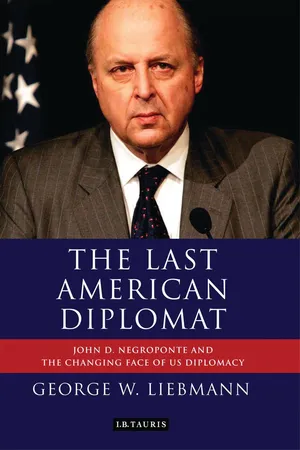
Can John D. Negroponte be described as 'The Last American Diplomat'? In a career spanning 50 years of unprecedented American global power, he was the last of a dying breed of patrician diplomats - devoted to public service, a self-effacing and ultimate insider, whose prime duty was to advise, guide and warn - a bulwark of traditional diplomatic realism against ideologue excess.
Negroponte served as US ambassador to Honduras, Mexico, the Philippines and Iraq; he was US Permanent Representative to the UN, Director of National Intelligence and Deputy Secretary of State to George W. Bush. His was a high-flying and seemingly conventional career but one full of surprises. Negroponte opposed Kissinger in Vietnam, supported a 'proxy war' but opposed direct American military action against Marxists in Central America - facing
bitter Congress opposition in the process. He swam against the floodtide of George W. Bush's
neocon-dominated administration, warning against the Iraq war as a possible new 'Vietnam'
and criticising aspects of Bush's 'War on Terror'. He disconcerted the administration by arguing
that the re-establishment of Iraq would take as long as five years. And he was influential in international social and economic policy - working for the successful re-settlement of millions of refugees in Southeast Asia following the Vietnam War, issuing early warnings about the scourge of AIDS in Africa and successfully launching the North American Free Trade Agreement (NAFTA).
George W. Liebmann's incisive account is based on personal and shared experience but it is no
hagiography; beyond the author's discussions with Negroponte, this book is deeply researched in US state papers and includes interviews with leading actors. It will provide fascinating reading for anyone interested in the inside-story of American diplomacy, showing personal and policy struggles, and the underlying fissures present even in the world's last remaining superpower.
eBook - ePub
The Last American Diplomat
John D Negroponte and the Changing Face of US Diplomacy
- 384 pages
- English
- ePUB (mobile friendly)
- Available on iOS & Android
eBook - ePub
The Last American Diplomat
John D Negroponte and the Changing Face of US Diplomacy
About this book
Information
NOTES
Acknowledgments
1 A. Feininger, New York in the Forties (New York: Dover, 1978), 1.
2 D. Wakefield, New York in the Fifties (Boston: Houghton Mifflin, 1992), 3, 6.
3 A. De Conde, “Forward,” in K. Jones (ed.), US Diplomats in Europe, 1919–41 (Santa Barbara, CA: ABC Clio, 1981), xiv.
Chapter One
1 Transcript of December 3, 2006, C-Span, Question and Answer with JN, available at www.politics.stephaniedray.com/?q=node/183
2 Department of State, Opening Ceremony for Global Classrooms DC Model UN, April 28, 2008.
3 Transcript of December 3, 2006, www.politics.stephaniedray.com/?q=node/183
4 P. Calvocoressi, Threading My Way (London: Duckworth, 1994), Chapters 1 and 2.
5 I. Theotokas and G. Harloftis, Leadership in World Shipping: Greek Family Firms in International Business (New York: Palgrave Macmillan, 2009), 238, 288.
6 “Greek Women’s Heroism Recalled as Underground Pleads for Aid,” New York Times, February 4, 1943, 26: 2.
7 J. Nordlinger, “Negroponte at Large,” National Review Online, March 24, 2009.
8 N. Hoplin, et al., Funding Fathers: The Unsung Heroes of the Conservative Movement (Washington: Regnery, 2008), 64.
9 R. Cornwell, The [London] Independent, July 3, 2004.
10 Nordlinger, “Negroponte at Large.”
11 J. Nordlinger, “Negroponte Speaks,” National Review, March 23, 2009, 19.
Chapter Two
1 Department of State (DOS), Theodore Heavner Oral History, May 28, 1997.
2 DOS, Opening Ceremony for Global Classrooms DC Model UN, April 28, 2008.
3 FRUS 1961–3, vol. IX (Washington: GPO, 1995), 459.
4 F. Snepp, Decent Interval: The American Debacle in Vietnam and the Fall of Saigon (London: Allen Lane, 1980).
5 Ibid., 141–4.
6 FRUS, Northeast Asia, 1961–3, vol. XXII (Washington: GPO, 1996), 687; Green to State Department, June 22, 1962.
7 M. Castells (ed.), The Shek Kip Mei Syndrome: Economic Development and Public Housing in Hong Kong and Singapore (London: Pion, 1990).
Chapter Three
1 Gibson to Secretary of State, January 27, 1949, National Archives, Record Group 84, Entry 3344, Box 1.
2 J. Kennedy, The Strategy of Peace (New York: Harper, 1960).
3 C. Sulzberger, A Long Row of Candles: Memoirs and Diaries 1934–54 (New York: Macmillan, 1969), 1016.
4 The Gibson memorandum, together with those of Young and Heath, appears at FRUS, vol. XXII, 1952–4 (Washington: GPO, 1982), 2330.
5 http://en.wikipedia.org/wiki/Michigan_State_University_Vietnam_Advisory_Group
6 Jack Lydman to Robert Hoey, July 26, 1954, in National Archives, Office of Southeast Asian Affairs, Cambodia and Vietnam, Entry UD51, Box 3, Folder 404.2 (Record Group 59/250/51/26).
7 “Round-Up of Events in Vietnam Political Crisis, 9/1-24/54,” in National Archives, Office of Southeast Asia Affairs, Cambodia and Vietnam, Entry UD51, Box 3, Folder 361.21 (Record Group 59/250/51/26).
8 C. Sulzberger, The Last of the Giants (New York: Macmillan, 1970), 118.
9 Ibid., 172.
10 P. Calvocoressi, World Politics, 1945–2000 (New York: Pearson, Longman, 2000), 537.
11 Ibid., 538.
12 R. Turner, “Reassessing the Causes: Gulf of Tonkin Incident Not the Real Start,” Washington Times, August 2, 2009, citing an article said to have appeared in the Vietnam Courier for May 1984 recounting a decision to open the Ho Chi Minh trail said to have been made by the Lao Dong Party on May 19, 1959.
13 See R. Beisner, Dean Acheson: A Life in the Cold War (New York: Oxford, 2006), Chapter 11.
14 Gibson to Acheson, September 16, 1949, National Archives, Record Group 84, Entry 3344.
15 Article in the London Observer, quoted in C. Hitchens, Why Orwell Matters (New York: Basic Books, 2002), 27.
16 National Archives, Office of Southeast Asian Affairs, Cambodia and Vietnam, Entry UD51, Box 3, Folder 362.2 (Record Group 59/250/51/26).
17 Quoted in G. Loescher and J. Scanlan, Calculated Kindness: Refugees and America’s Half-Open Door, 1945 to the Present (New York: Free Press, 1986), 104.
18 Quoted in D. Lancaster, The Emancipation of French Indo-China (Oxford: Oxford University Press, 1961), 347.
19 J. Buttinger, Vietnam: A Dragon Embattled (New York: Praeger, 1967), 251.
20 W. Bundy, Notes on the Republican White Paper on Vietnam, August 24, 1965, in National Archives, Entry 5305, Box 2, Chron file August–December 1965.
21 Memorandum, June 28, 1965, in ibid.
22 K. Bird, The Color of Truth: McGeorge Bundy and William Bundy, Brothers in Arms (New York: Simon and Schuster, 1998), 256.
23 P. Honey, “Vietnamese Notebook,” 21 Encounter No. 6, 64, 65, 66 (December 1963).
24 R. Morris, Uncertain Greatness: Henry Kissinger and American Foreign Policy (London: Quartet Books, 1977), 34.
25 US Department of State, US Chiefs of Mission, 1778–1973 (Washington: Department of State, 1973).
26 J. Davies, Foreign and Other Affairs (New York: Norton, 1964), 175–6.
27 Ibid., 198.
28 The first quotation is quoted in A. Preston, The War Council: McGeorge Bundy, the NSC and Vietnam (Cambridge...
Table of contents
- Cover
- About the Author
- About the Book
- Title Page
- Copyright Page
- Dedication
- Epigraph
- Contents
- List of Illustrations
- Preface
- Acknowledgments
- Early Years
- Hong Kong
- Vietnam
- Stanford Interlude
- Kissinger and the National Security Council
- Ecuador
- Thessaloniki
- Deputy Assistant Secretary for Fisheries
- Deputy Assistant Secretary for East Asian and Pacific Affairs
- Honduras
- Assistant Secretary for Oceans, Environmental and Scientific Affairs
- Deputy National Security Advisor
- Mexico
- The Philippines
- Panama
- Mcgraw-Hill
- United Nations
- Iraq
- Director of National Intelligence
- Deputy Secretary of State
- Conclusion
- Glossary of Acronyms
- Notes
Trusted by 375,005 students
Access to over 1.5 million titles for a fair monthly price.
Study more efficiently using our study tools.
Frequently asked questions
Yes, you can cancel anytime from the Subscription tab in your account settings on the Perlego website. Your subscription will stay active until the end of your current billing period. Learn how to cancel your subscription
No, books cannot be downloaded as external files, such as PDFs, for use outside of Perlego. However, you can download books within the Perlego app for offline reading on mobile or tablet. Learn how to download books offline
Perlego offers two plans: Essential and Complete
- Essential is ideal for learners and professionals who enjoy exploring a wide range of subjects. Access the Essential Library with 800,000+ trusted titles and best-sellers across business, personal growth, and the humanities. Includes unlimited reading time and Standard Read Aloud voice.
- Complete: Perfect for advanced learners and researchers needing full, unrestricted access. Unlock 1.5M+ books across hundreds of subjects, including academic and specialized titles. The Complete Plan also includes advanced features like Premium Read Aloud and Research Assistant.
We are an online textbook subscription service, where you can get access to an entire online library for less than the price of a single book per month. With over 1.5 million books across 990+ topics, we’ve got you covered! Learn about our mission
Look out for the read-aloud symbol on your next book to see if you can listen to it. The read-aloud tool reads text aloud for you, highlighting the text as it is being read. You can pause it, speed it up and slow it down. Learn more about Read Aloud
Yes! You can use the Perlego app on both iOS and Android devices to read anytime, anywhere — even offline. Perfect for commutes or when you’re on the go.
Please note we cannot support devices running on iOS 13 and Android 7 or earlier. Learn more about using the app
Please note we cannot support devices running on iOS 13 and Android 7 or earlier. Learn more about using the app
Yes, you can access The Last American Diplomat by George W. Liebmann in PDF and/or ePUB format, as well as other popular books in Politics & International Relations & Historical Biographies. We have over 1.5 million books available in our catalogue for you to explore.