This is an important and prestigious volume showcasing leading progressive Islamic thinkers. It includes new essay by controversial public intellectual and Muslim scholar Tariq Ramadan. It offers strong appeal to policymakers and as well as students and scholars of religion and the Middle East.How are Muslims to reconcile their beliefs with the pressures and imperatives of the modern world? How should they handle the tension between their roles as private citizens and their religious affiliations and identities? This groundbreaking volume shows in what ways prominent Muslim intellectuals have themselves attempted to bridge the gap by recasting traditional Islamic notions in the light of contemporary understandings of equality, justice and pluralism. The contributors to the book examine the tradition that they seek to reform in relation to the human rights ethic of the modern world. The new wave of Islamic thinking which they represent emerges as multi-stranded rather than defined by a single trend or doctrine.Themes covered include a deconstruction of patriarchal interpretations of the Qur'an; the distinctions between universal and context-specific parts of Islamic texts; a re-contextualisation of Shari'a law; and a critique of religious jurisprudence, particularly where this impacts on matters of sex and gender.
Old texts are re-interpreted through the lived situations of real people today. The result is an indispensable portrayal of progressive Islamic thought in the twenty-first century, which will be an invaluable resource for students and scholars of religion, ethics and Middle East studies.
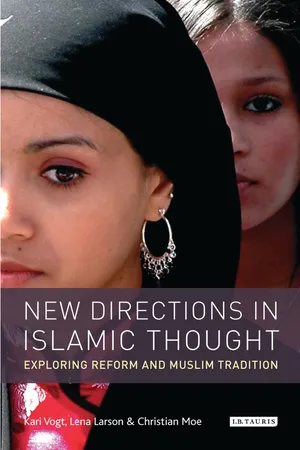
eBook - ePub
New Directions in Islamic Thought
Exploring Reform and Muslim Tradition
- 288 pages
- English
- ePUB (mobile friendly)
- Available on iOS & Android
eBook - ePub
New Directions in Islamic Thought
Exploring Reform and Muslim Tradition
About this book
Information
Part One
The Changeable and the Unchangeable
1 The changeable and the unchangeable
Abdolkarim Soroush
The changeable and unchangeable in Islamic thought and practice is a topic with its own reformist lineage. About 45 years ago, there were articles written by a very prominent Muslim philosopher in Iran, namely Ayatollah ʿAllama Tabatabaʾi, the celebrated author of the Tafsir al-Mizan. The articles bore the title, “The Changeable and Unchangeable in Islamic Thought”. ʿAllama Tabatabaʾi was a persistent reader of Rashid Rida, and those who have read his Tafsir will realise that to a very great extent he was under Rida’s influence and had an eye on his arguments. Sometimes, perhaps most of the time, he opposed him, disliked his ideas and criticised him, but, nevertheless, he was always mindful of the arguments put forward by Rashid Rida. The idea of al-thābit wa al-mutaḥawwil or al-thābit wa al-mutaghayyir, the changeable and the unchangeable, can be found in Rida’s writings.
I do not think any of our past prominent thinkers, such as al-Ghazali, Fakhr al-Din al-Razi, Nasir al-Din Tusi, and so on, have used the same categorisation, whether in the domain of fiqh (jurisprudence), or in philosophy, or elsewhere. I am not saying that they were negligent or ignorant of it, or that the idea of ijtihād (exerting one’s utmost efforts to find the truth) was absent. To be sure, the notions of mujtahid and ijtihād were well known to everybody, both to the layman and the learned.
However, this very division or classification of Islamic thought in theory, or Islamic teachings in practice, into al-thābit wa al-mutaḥawwil is a very modern classification. This modern classification, of course, means that we, as Muslims, have encountered and faced some modern challenges and problems that have induced us to introduce this idea and this categorisation of the changing and unchanging.
The essential and the non-essential
Something in traditional fiqh which does comes very close to the idea of the unchangeable, of course, is the idea of al-ḍarūrī. The jurists divided al-aḥkām, the regulations, into two, the ḍarūrī and the non-ḍarūrī, the essential and the non-essential. There has always been debate and controversy about the instances of this ḍarūrī, the essential and the non-essential. Everybody agreed on the fact that there are essentials and non-essentials, in principle, but as to the application of the principle, i.e. determining what the essentials and the non-essentials are, there has always been a huge controversy both in the Shiʿi branch of Islam and the Sunni branch of Islam, to the extent that the idea has come under doubt. I mean to say that the words essential and non-essential have come to be somewhat loosely used, because everybody knows that it depends on individual taste or individual argument, rather than on a general, universal consensus.
The distinction between thought and practice is important here, because there are essentials in the domain of thought, and there are essentials in the domain of practice. For example, everybody says that prayer (ṣalāh) is essential, in the sense that it is one of the pillars of Islamic practice, so is the alms tax (zakāh) for example, and many other things. Essentials in the realm of thought and principles include: belief in the unity of God and belief in the prophethood of the Prophet Muhammad.
Then again, we are not very sure what falls under these essentials. The whole idea of apostasy hinges on this: If you reject one of the essentials, you are an apostate. Whether you will be considered an apostate, then, depends on what is to be counted as an essential and, since that is subject to great controversy, there will accordingly be further dispute and disagreement over the idea of apostasy. That is why it is not that simple to accuse somebody of being an apostate, i.e. of refusing their belief and rejecting Islam.
It may come as a surprise to learn that Ayatollah Khomeini – in his writings, debates and lectures in Qom as a Grand Marjaʿ, even before he became the leader of the Islamic Revolution – came very close to the idea that even rejecting the hereafter would not make you an apostate. He suggests it is sufficient that you believe in the unity of God and in the prophethood of the Prophet; if you so believe, you are a Muslim, even if you do not believe that there is a next life. Khomeini did not consider belief in an afterlife an essential.
I think both Muslims and non-Muslims would agree on the importance of the belief in the world after death, in the next life, in the punishment of God, in heaven and hell. It is everywhere in the Qurʾan: you find more than a thousand verses in the Qurʾan about life after death. Nevertheless, a Grand Mufti like Khomeini held this view. He did not hide it, but presented it in his books and let it be published, even after he became the Leader. It is clear that the idea of essentials varies from one faqīh to another, from one scholar to another, so there is no universal agreement on what is to be counted.
As to the essentials in practice, one may believe that pillars of Islam such as ṣalāh, prayer, zakāh, alms tax, etc., are all essentials and so, perhaps, is ḥijāb (the veil), for example. But according to Khomeini, who is very explicit on this point, someone today could say: “Yes, the Prophet has commanded us to say our prayers, to pay our zakāh and so on, but all these belong to his age, and we are not under this command any longer, and we are not the addressee of the sayings of the Prophet in this time.” Even so, that person would be a perfect Muslim. He is not denying or rejecting any essentials, because he is endorsing the belief that the prophethood of Muhammad is intact and that he has ordered his followers to pray and pay zakāh. He is only saying that there are conditions attached to these matters and that now there may be new conditions.
I am only relating the ideas of Ayatollah Khomeini. I am sure that, if I were to make these claims, I would be accused of apostasy, but since the claims have the backing of a Grand Mufti, one will perhaps give it a second thought.
The discussion so far may all seem very theoretical, but a very clear and vivid historical example is the jumʿa (the Friday prayers). The Friday prayer is not prescribed in a ḥadīth, but in the Qurʾan everybody knows it: “... When the call is proclaimed to prayer on Friday, hasten earnestly to the Remembrance of Allah, and leave off business ...” (62:9).
Now, the Shiʿites actually abandoned and cancelled this jumʿa prayer for twelve centuries. Even though it was in the Qurʾan, even though everybody knew that the Prophet himself held the Friday prayers, and that the khulafāʾ (caliphs) held Friday prayers, the Shiʿites did not do it at all. It was not because they did not think that it was Islamic, and it was not because they did not think that it was an essential part of Islam. After all, the Shiʿi fuqahāʾ (jurists) were pious ʿulimāʾ (scholars), but they thought and argued that there are conditions for holding Friday prayers. For twelve centuries after the Twelfth Imam, they held that those conditions were not, and could not, be fulfilled. They thought that the Friday prayers should be held by the Islamic state, and, if there was no Islamic state, there would be no Friday prayer whatsoever. I am not saying that this argument was right, nor that it was wrong – I am only recalling a very important piece of the history of fiqh in Islam.
So, there are essentials and non-essentials, changeables and unchangeables, but exactly what those changeables and unchangeables are, is at the mercy of the faqīh, and not in a loose sense of the words: it depends on the arguments and conditions one puts forward and on the principles one goes along with. Jumʿa prayer offers a very vivid example, and there are other examples.
There are now jurists in Iran, grand jurists, who think that religious penalties, such as cutting off the hand of the thief, should not be applied at all. Some of these kinds of brutal physical punishment are in the Qurʾan and some are in the ḥadīth. Cutting off the hands of thieves is in the Qurʾan, not in a ḥadīth, and the text is very strong. Stoning is not in the Qurʾan, but of course, it is present in the ḥadīth and in the practice of Muslims. Nevertheless there are fuqahāʾ in Iran now, and there have been some in the past, who think that these punishments should not be applied: like the Friday prayer, their application depends on the state, and since we do not have an Islamic state in the sense that a Prophet or an Imam is the head of the state, all this should be cancelled and abandoned. This is not a reformist idea, it is held by the traditional jurists. They have their own arguments, distinguishing the essential from what is not essential.
So, though we share the idea of the ḍarūrī and the non-ḍarūrī, one should be very careful and be aware that the instances are very varied. They vary from one faqīh to another, each of whom has his own argument.
The ambiguous and the non-ambiguous
These were some examples of the archaeology, so to speak, of the problem of the changeable and unchangeable. To consolidate my argument, one important point to which I would like to draw your attention is this: we have the classification of the āyāt (verses) of the Qurʾan into muḥkamāt and mutashābah...
Table of contents
- Cover
- Title page
- Copyright page
- Contents
- Credits
- A note on transliteration
- Introduction: Kari Vogt, Lena Larsen and Christian Moe
- Part One: The Changeable and the Unchangeable
- 1 The changeable and the unchangeable: Abdolkarim Soroush
- 2 “Hold(ing) fast by the best in the precepts” – The Qur’an and method: Asma Barlas
- 3 Law and ethics in Islam – The role of the maqāsid: Mohammad Hashim Kamali
- 4 Human rights and intellectual Islam: Mohsen Kadivar
- Part Two: The Challenge of Equality
- 5 Classical fiqh, contemporary ethics and gender justice: Ziba Mir-Hosseini
- 6 Timeless texts and modern morals – Challenges in Islamic sexual ethics: Kecia Ali
- 7 Gender equality and Islamic law – The case of Morocco: Aïcha El Hajjami
- 8 Historical and political dynamics of the “women and Islam” issue – The Turkish case: Nazife Şişman
- Part Three: Authority and Islamic Normativity
- 9 Islamic authority: Khaled Abou El Fadl
- 10 A theory of Islam, state and society: Abdullahi A. An-Na‘im
- 11 A call for a moratorium on corporal punishment – The debate in review: Tariq Ramadan
- 12 Negotiating gender rights under religious law in Malaysia: Zainah Anwar
- 13 The changing concepts of caliphate – Social construction of Shari‘a and the question of ethics: Muhammad Khalid Masud
- Part Four: Dialogue on New Directions
- 14 Can the State enforce Shari‘a? – A discussion in Yogyakarta: Kari Vogt, Lena Larsen and Christian Moe
- Contributors
- Notes
Trusted by 375,005 students
Access to over 1.5 million titles for a fair monthly price.
Study more efficiently using our study tools.
Frequently asked questions
Yes, you can cancel anytime from the Subscription tab in your account settings on the Perlego website. Your subscription will stay active until the end of your current billing period. Learn how to cancel your subscription
No, books cannot be downloaded as external files, such as PDFs, for use outside of Perlego. However, you can download books within the Perlego app for offline reading on mobile or tablet. Learn how to download books offline
Perlego offers two plans: Essential and Complete
- Essential is ideal for learners and professionals who enjoy exploring a wide range of subjects. Access the Essential Library with 800,000+ trusted titles and best-sellers across business, personal growth, and the humanities. Includes unlimited reading time and Standard Read Aloud voice.
- Complete: Perfect for advanced learners and researchers needing full, unrestricted access. Unlock 1.5M+ books across hundreds of subjects, including academic and specialized titles. The Complete Plan also includes advanced features like Premium Read Aloud and Research Assistant.
We are an online textbook subscription service, where you can get access to an entire online library for less than the price of a single book per month. With over 1.5 million books across 990+ topics, we’ve got you covered! Learn about our mission
Look out for the read-aloud symbol on your next book to see if you can listen to it. The read-aloud tool reads text aloud for you, highlighting the text as it is being read. You can pause it, speed it up and slow it down. Learn more about Read Aloud
Yes! You can use the Perlego app on both iOS and Android devices to read anytime, anywhere — even offline. Perfect for commutes or when you’re on the go.
Please note we cannot support devices running on iOS 13 and Android 7 or earlier. Learn more about using the app
Please note we cannot support devices running on iOS 13 and Android 7 or earlier. Learn more about using the app
Yes, you can access New Directions in Islamic Thought by Kari Vogt,Lena Larsen,Christian Moe in PDF and/or ePUB format, as well as other popular books in Theology & Religion & Middle Eastern History. We have over 1.5 million books available in our catalogue for you to explore.