- 352 pages
- English
- ePUB (mobile friendly)
- Available on iOS & Android
eBook - ePub
About this book
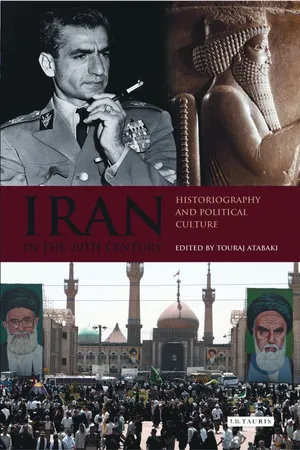
Political upheaval has marked Iran's history throughout the twentieth century. Wars, revolutions, coups and the impact of modernism have shaped Iran's historiography, as they have the country's history. Originally based on oral and written sources, which underpinned traditional genealogical and dynastic history, Iran's historiography was transformed in the early 20th century with the development of a 'new' school of presenting history. Here emphasis shifted from the anecdotal story-telling genre to social, political, economic, cultural and religious history-writing. A new understanding of the nation state and the importance of identity and foreign relations in defining Iran's place in the modern world all served to transform the perspective of Iranian historiography. Touraj Atabaki here brings together a range of rich contributions from international scholars who cover the leading themes of the historiography of 20th-century Iran, including constitutional reform and revolution, literature and architecture, identity, women and gender, nationalism, modernism, Orientalism, Marxism and Islamism.
Trusted by 375,005 students
Access to over 1.5 million titles for a fair monthly price.
Study more efficiently using our study tools.
Information
1
Historiography of Twentieth Century Iran: Memory, Amnesia and Invention
Touraj Atabaki
Twentieth century historiography on nation-state correlation to a large extent has been shaped by politically contentious projects. Writing the national history of the people who matured from a passive existence (Passiver Volkheit) to a people bound through a modern state with consistent and internationally recognized borders relied decisively on remembered, invented and recorded past which is sturdily and increasingly refashioned by present politics. The quest for roots and for historical background not only becomes essential for the people living in certain territory and for being identified as a territorial nation to claim territorial continuity, but it also often leads them to statehood.
In modern state building, however, it is not only the present politics that reconstruct the past, but it is also the historiography’s task to provide recognition to a regime and legitimize its authority by refashioning the political culture through construction of the selected recollection of a certain past. Linking to real or imagined past, appending to genuine or fake ancestries or even fabricating documents are not exceptional in the politics of transferring from a territorial identity or a territorial state to a national identity and nation-state. These are all legitimized in the historiography’s agenda in order to shape a significant and unbroken link with the nation’s seminal past that could fill the gap between its origin and its actuality.1
Thus, the practice of such a quest often ends up with a high degree of disorientation and intellectual confusion. This persistently raises the questions of who is looking for whose roots and writing whose past? Whose memory is it and what are their memories?2 Do the class, gender, ethnic or religious affiliations really matter in recording the nation’s past? If history, as E.H. Carr argues, is ‘a dialogue between the past and the present’, then to what extent did the present political culture lead the historians to certain presentation of the past that meets the very political needs of today? Could one talk about history or histories of a nation? Elite history or subaltern history? Gendered history or non-gendered history? Titular history or histories of minorities? These are among numerous questions confronting the historiography that in one way or another intends to refashion the political culture and construct the new identity or identities for the emerging nation-states.
However, we should not delude ourselves that our judgment of the past is not immutable. While the historians are often reluctant to write about the contemporaries; their narration and analysis of the past, their opted agencies and subjectivities in recording of the past are shaped by today’s needs and deeds. It is the present that crafts the recording of the past; a certain past, which through our today’s prism reaches the present, a selected past. This may be more evident in all-inclusive projects such as writing national history of a nation where each social and political group of the present has its own reading and recording of the past. Accordingly, the reputation of great historical episodes such as a revolution, coup d’état or any change of the rule fluctuate in diverse assessments. The historiography of the twentieth-century Iran is among the many verdicts of this assertion.
In the course of her history, Iran has experienced many eventful epochs. The twentieth century was far from exceptional in this respect: the ravages of three major wars (1914–18, 1941–5 and 1980–8) resulting in the death of hundreds of thousands of people; three coups (1908, 1921 and 1953) transforming power relations within the political and military elite and two revolutions (1905–9 and 1978–82) leading to radical changes in socio-political arrangements.
Similar to the European historiography, such drastic changes in Iran were manifested, more than anywhere else, in the new perceptions of historiography. Up to the twentieth century, the historiography of Iran was, evidently, dominated by political, dynastical and genealogical elements as well as by narratives of the lives of the elite. However, around the turn of the twentieth century, and especially in the post-Constitutional Revolution (1905–9) period, Iran witnessed the birth of a new political culture which aimed to form a modern state; thus paving the way gradually for the establishment of a new school of Iranian historiography.
Historical research into Iran’s spectacular social upheavals in the twentieth-century has developed very erratically. Basically, one can distinguish three areas of historical research. The first area depicts the macro-political picture, i.e., foreign relations, military, diplomatic representations and patterns of belief system. This top-down approach has played a significant role for at least a hundred years, leading to interesting research on the institutional aspects of the Constitutional Revolution. The second area consists of a number of research contributions to economic, urban and demographic history that showed growth during the second half of the twentieth century. The third area is that of the social history of Iran. Although the latter is the least developed trend in Iran, the worldwide prevalence in sociological theories led to the recognition of the Iranian social history by some academics.
In the 1960s and the 1970s, a significant trend in the Iranian historiography, focusing mainly on the events of the nineteenth and the twentieth centuries, developed among the Iranian and non-Iranian historians, during which time the British, French and Iranian diplomatic archives were utilized by historians. Following the Islamic Revolution of 1978–82, which caused a momentous rupture with the political past, there has been a growing interest in reading the country’s past, both the immediate and distant. The availability of new archival materials, on the Qajar and the Pahlavi periods, has encouraged this emerging desire. Moreover, many scholars have extensively dealt with the historical interpretations of the roots and causes of the Islamic Revolution while inspired, in many cases, by theories drawn from sociology and politics. Outside Iran, particularly in Britain and the United States, a small community of scholars emerged, especially after the Second World War, which made important contributions to the Iranian historiography. Nonetheless, they showed distinct preferences for certain aspects and issues. In the Soviet Union, there have always been historians interested in Iran but their publications were constrained by the Procrustean framework of Marxism-Leninism.
A careful study of the Iranian historiography in the last 150 years, especially during the course of the twentieth century, reveals the integrative endeavor by both native and non-native historians to craft the Iranians’ new identity by observing selected memories and recollections in recording the past. The amnesia and recovery of selected past was accomplished by powerful ideological motivations, both in the era of monarchy as well as during the rule of the Islamic Republic, in order to furnish a new form of self-awareness. Such awareness was essential for the political establishment, both in the case of the ancien régime and the newly established Islamic political system in Iran, to disassociate themselves from the certain past, to which they assume not to adhere. It was equally important for both of the establishments to craft a new apocalyptic culture in the determinist form of the prediction and ultimately controlling the future. In such historiography, history was seemingly reconstructed in an attempt to build a new vision of the past, securing the aspirations for the future.
The collection of the essays in this volume is the outcome of a conference that I organized at the University of Oxford on the Historiography and Political Culture in Twentieth Century Iran. In my preliminary call, while I urged each contributor to opt for a certain sphere in the Iranian modern historiography, I emphasized that our common denominator would be to examine the way the present has refashioned our reading of the past. At the same time, I highlighted the need to investigate how the Iranian historiography interacted with the political culture of the country in the twentieth century. The conference made a significant contribution to the reading of modern Iranian historiography, such as Islamist, fatherland-nationalist, conspiratorial, Marxist, peripheral and gendering. It prepared the ground for future projects on the role of historiography in shaping the country’s political culture.
International Institute of Social History,
Amsterdam
2
Historiography and Crafting Iranian National Identity1
Mohamad Tavakoli-Targhi
The crafting of a modern Iranian identity was linked to the configuration of history and restyling of language. The nationalist ‘emplotment’2 of Iran’s ancient history as a tragedy was based on the comprehension of the Muslim conquest as a force engendering ‘the reverse progress of Iran’ (taraqqi-i ma’kus-i Iran).3 Linking the end of the ‘enlightened’ pre-Islamic times to origins identified with Iran through Mahabad or Kayumars, a new memory, identity, and political reality were fashioned. By inducing the desire and the will to recover ‘lost glories’ of the past, the nationalist struggle for a new social order became intrinsically connected to the politics of cultural memory and its de-Arabizing projects of history and language. Juxtaposing Iran and Islam, these projects prompted the emergence of a schizochronic view of history and the formation of schizophrenic social subjects who were conscious of their belonging to two diverse and often antagonistic times and cultural heritages.4 During Iran’s Constitutional Revolution of 1905–9, these autonomous ‘Iranian’ identities prefigured into the line up of political forces to antagonistic ‘Constitutionalist’ (Mashrutahkhwah) and ‘Shari’atist’ (Mashru’ahkhwah) camps. The shift in the 1970s from a regime glorifying Iran’s ancient civilization to a revolutionary regime extolling Islamic heritage is only the most recent example of the creative possibilities and insoluble dilemmas engendered by the contested memories of pre-Islamic Iran.
Informed by dasatiri texts and inspired by the Shahnamah of Firdawsi, modern historical writings harnessed the Iranian homeland (vatan) to an immemorial past beginning with Mahabad and Kayumars and pointing toward a future unison with Europe. Iran’s pre-Islamic past was celebrated as a glorious and industrious age, and its integration into the Arab-Islamic world was shunned as a cause of its ‘reverse progress’ (tarraqi-i ma’kus). To catch up with the ‘civilized world’, the architects of Iranian nationalism sought to ‘reawaken’ the nation to self-consciousness by reactivating and inventing memories of the country’s pre-Islamic past. The simplification and purification of Persian were corollaries of this project of national reawakening. Like the glorification of the pre-Islamic past, these language-based movements helped to dissociate Iran from Islam and to craft a distinct national identity and sodality.
In an increasing number of eighteenth- and nineteenth-century Persian historical texts, ‘Iran’ was constituted as the shifter and organizer of chains of narration and emplotment. For instance, Rustam al-tavarikh, completed in 1800, referred to Karim Khan Zand (d. 1779) as ‘the architect of the ruined Iran’ (mi’mar-i Iran-i viran) and ‘the kind father of all residents of Iran’ (pidar-i mihraban-i hamah-’i ahl-i Iran). Among other compound constructions with Iran that were politically significant, Rustam al-Hukama, the author of this text, used Iranmadar (Iran-protector), dawlat-i Iran (government of Iran), farmanrava’i-i Iran (governing of Iran), ahl-i Iran (the people/residents of Iran), and territorial couplets such as kishvar-i Iran, mamalik-i Iran, qalamraw-i Iran, and bilad-i Iran.5 Muhammad Hassan Khan I’timad al-Saltanah, like many other nineteenth-century historians, set himself the task of writing a geographical and historical ‘biography of Iran’ (sharh hal-i Iran).6 The narratological centrality of the entity ‘Iran’ signified the emergence of a new conception of historical time that differed from the prevalent cyclical arrangement found in chronicles. While Iran had been previously conceived of as the center of the universe in the pre-modern Persian geographic imagination,7 pre-nineteenth-century chronicles rarely temporized Iran. Rather, they were primarily concerned with chronicling the cycles of the rise and fall of dynasties. Making Iran the ‘ultimate referent’ for the sequence of historical events allowed for the emergence of new modes of historical emplotment. Ancient history, which was for so long equated with the sacred history and the cycles of messengers and prophets from the time of Adam to the rise of Muhammad, was re-envisaged. The cyclical time of messengers and prophets gave way to an Iran-time connecting the ‘glorious pre-Islamic past’ to a reawakened present and a rejuvenating future. These newer histories challenged the universality of Biblical/Qur’anic stories. The new historians granted that Adam might have been the father of the Arabs, but he was not the father of humanity. The forefather of humanity, they argued, was the Persian Kayumars.
In the emerging Iran-time, the mythical tempos of Dasatir, Dabistan-i Mazahib, Sharistan, and Shahnamah increasingly displaced the sacred time of Islam. Reading and (re)citing these Iran-glorifying texts in a period of societal dislocation, military defeats, and foreign infiltration during the nineteenth century allowed for the re-articulation of Iranian identity and the construction of alternative forms of historical narrations and periodizations. The authorization and popular (re)citation of these narratives resulted in a process of cultural transference that intensified the desire for a recovery of the ‘forgotten history’ of ancient Iran. This awakening of interest in the country’s pre-Islamic history provided a formative element in the discourse of constitutionalism. The Islamic master-narrative dividing history into civilized Islamic and uncivilized pre-Islamic periods was increasingly displaced with the meta-narratives and periodizations of Dasatir and Shahnamah. The eras of Adam, Noah, Moses and Jesus were substituted with those of Kayumars, Hushang, Tahmuris, and Jamshid.
The dissemination of dasatiri texts heightened the interest in the Shahnamah, which was published in more than twenty editions in Iran and India in the nineteenth century.8 The Shahnamah provided valuable semantic and symbolic resources for dissociating Iran from Islam and for fashioning an alternative basis of identity. Its accessibility contributed to its increased recitation in the coffeehouses, important sites for cultural and political production and dissemination. In fact, reciting the Shahnamah in the coffeehouses increasingly displaced the narration of popular religious epics such as Hussain-i Kurd-i Shabistari, Iskandar Namah, Rumuz-i Hamzah, and Khavar Namah.9 A number of nineteenth century poets such as Sayyid Abu al-Hassan Harif Jandaqi (d. 1814), Hamdam Shirazi, and Mirza Ibrahim Manzur were, among others, well-known reciters of the Shahnamah.10 The Qajar Aqa Muhammad Khan, Fath’ali Shah, Nasir al-Din Shah, and Muzaffar al-Din Shah were known to have had their own reciters or Shahnamah’khvanan.11 Hearing that John Malcolm’s History of Persia Mirza Taqi Khan Amir Kabir (d.1852) is reported to have suggested that the ...
Table of contents
- Cover
- Title Page
- Copyright Page
- Contents
- List of Illustrations
- Acknowledgments
- List of Contributors
- Note on Transliteration
- 1. Historiography of Twentieth Century Iran: Memory, Amnesia and Invention
- 2. Historiography and Crafting Iranian National Identity
- 3. Memory and Amnesia in the Historiography of the Constitutional Revolution
- 4. Disintegrating the ‘Discourse of Disintegration’: Some Reflections on the Historiography of the Late Qajar Period and Iranian Cultural Memory
- 5. Agency and Subjectivity in Iranian National Historiography
- 6. The Nation’s Poet: Ferdowsi and the Iranian National Imagination
- 7. The Pahlavi School of Historiography on the Pahlavi Era
- 8. Architectural Historiography 1921–42
- 9. The Paranoid Style in Iranian Historiography
- 10. Women, Gender, and Sexuality in Historiography of Modern Iran
- 11. Marxism, Historiography and Historical Consciousness in Modern Iran: A Preliminary Study
- 12. Islamist Historiography in Post-Revolutionary Iran
- Notes
Frequently asked questions
Yes, you can cancel anytime from the Subscription tab in your account settings on the Perlego website. Your subscription will stay active until the end of your current billing period. Learn how to cancel your subscription
No, books cannot be downloaded as external files, such as PDFs, for use outside of Perlego. However, you can download books within the Perlego app for offline reading on mobile or tablet. Learn how to download books offline
Perlego offers two plans: Essential and Complete
- Essential is ideal for learners and professionals who enjoy exploring a wide range of subjects. Access the Essential Library with 800,000+ trusted titles and best-sellers across business, personal growth, and the humanities. Includes unlimited reading time and Standard Read Aloud voice.
- Complete: Perfect for advanced learners and researchers needing full, unrestricted access. Unlock 1.5M+ books across hundreds of subjects, including academic and specialized titles. The Complete Plan also includes advanced features like Premium Read Aloud and Research Assistant.
We are an online textbook subscription service, where you can get access to an entire online library for less than the price of a single book per month. With over 1.5 million books across 990+ topics, we’ve got you covered! Learn about our mission
Look out for the read-aloud symbol on your next book to see if you can listen to it. The read-aloud tool reads text aloud for you, highlighting the text as it is being read. You can pause it, speed it up and slow it down. Learn more about Read Aloud
Yes! You can use the Perlego app on both iOS and Android devices to read anytime, anywhere — even offline. Perfect for commutes or when you’re on the go.
Please note we cannot support devices running on iOS 13 and Android 7 or earlier. Learn more about using the app
Please note we cannot support devices running on iOS 13 and Android 7 or earlier. Learn more about using the app
Yes, you can access Iran in the 20th Century by Touraj Atabaki in PDF and/or ePUB format, as well as other popular books in History & Historiography. We have over 1.5 million books available in our catalogue for you to explore.