'The natural sympathy and understanding of people everywhere must be the soil in which the new humanism can thrive.' For Daisaku Ikeda, whose words these are, education has long been one of the fundamental priorities of his work and teaching. And his emphasis on the intellectual legacy bequeathed to humanity by the great teachers of civilization is in this volume encapsulated by the notion of a 'new humanism': a significant residue of wisdom that in the right circumstances may be passed on to future generations, expanding horizons, making connnctions between different cultures and encouraging fresh insights and new discoveries across the globe. These circumstances are perhaps most fully realised in the context of universities. And in promoting his core values of education and peace, the author has delivered speeches and lectures at more than twenty-five academies, colleges and research institutes worldwide.
This stimulating collection, which includes the author's most recent lectures, ranges widely across topics as diverse as art, religion, culture and time, and draws creatively on the sages of ancient India, China and Japan as well as on visionary thinkers from every nation, including Tolstoy, Victor Hugo and Gandhi.
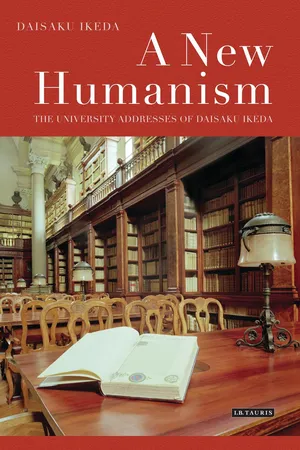
- 304 pages
- English
- ePUB (mobile friendly)
- Available on iOS & Android
eBook - ePub
About this book
Information
PART I
ART, LITERATURE AND EDUCATION
1
CREATIVE LIFE
A speech delivered at the Academie des Beaux-Arts (Academy of Fine Arts) of the Institut de France, 14 June 1989.
As I reflect on the many individuals who have walked here at the Academy where I am walking now and stood where I am standing, I feel awe, respect, and an intense awareness of what the creative human being means. I have tried to express that feeling in a poem I wrote:
Deep, deep on the remote sea floor
lies a huge spring
whose pure waters pour forth unceasingly,
broader, bluer than any lake,
flowing on with a gentle and wondrous music.
This pure stream that has flowed
inexhaustibly since time began,
if we can touch it,
we can draw upon its eternal power of life;
if we can drink there,
it will nourish in us unfettered powers of creativity.
This spring that bursts forth
from the depths of the cosmos,
flowing into the wide sea of life,
this spring that is the mysterious source of the universe,
from its bottomless abyss
wells up the great sea of life,
and the melody of history resounds there.
That solemn and sacred music,
is it not the inner rhythm of humankind,
the language spoken by all men and women?
Can we not hear them,
the clear notes of this sacred symphony
that echo over the waves?
Can we not see it,
the pulsing rhythm that springs
from the depths of the spirit,
this profoundly deep, this unfathomable
fountain of creation?
Integrating Force
Art is the irrepressible expression of human spirituality. So it is now, and so it has always been. Into each one of the myriad concrete forms of art is impressed the symbol of ultimate reality. The creation of a work of art takes place within spatial boundaries, but through the process of creating, the soul of the artist seeks union with that ultimate reality, what might be called cosmic life. A living work of art is life itself, born from the dynamic fusion of the self (the microcosm) and the universe (the macrocosm).
Art is to the spirit what bread is to the body; through art we find oneness with a transcendental entity, breathe its rhythm, and absorb the energy we need for spiritual renewal. Art also functions to purify the inner being, to bring the spiritual uplift that Aristotle called catharsis. What is this quality in art that has ordained it to play such an elemental and enduring role in human life? I believe it is the power to integrate, to reveal the wholeness of things. In an early scene of Faust, Goethe (1749–1832) has Faust rapturously declare, ‘into the whole how all things blend, each in the other working, living’.1 If we accept this marvellous statement of the interconnection of all living things, then art becomes the elemental modality through which humans discover their bonds with humans, humanity with nature, and humanity with the universe.
Whether it is poetry, painting or music, a jewel of artistic expression can stir within us an ineffable impulse that carries us soaring through the empyrean, letting us share the experience with others while confirming its reality. Art’s force of integration works in living beings by opening the way for the finite to become infinite, for the specificity of actual experience to assume universal meaning. Religion has always worked through art to affirm identity with the universal, as we can see in the intertwining of art and religious ritual in ancient drama. The English author Jane E. Harrison writes, ‘it is at the outset one and the same impulse that sends a man to church and to the theatre’.2
According to an anecdote I once heard, a Japanese actor sensed that impulse when he made a trip to Europe many years ago. During a visit to the Louvre, after seeing a number of masterpieces of Western art, he was asked about his impressions. His immediate observation was, ‘Everything is so Christian!’ Such a reaction, though overstated, conveys honest surprise at how pervasively the spirit of Western art has been nourished by Christian tradition. To observe how ‘Christian’ the art seemed was perhaps the way this visitor from Asia, thrust into the heartland of Western art, tried to express his encounter with the ultimate reality he sensed there. The cathedrals of Notre-Dame and Chartres, a summation in architecture of the worldview of medieval Christianity, embodied the awesome power of art to integrate the world’s reality and ultimate reality. In the Middle Ages, art was religion, and religion was art, and in the fusion of the two, people carried out their passionate quest for a more fulfilling life.
Connecting Space
Compared with the rigorous monotheism of Christianity, Japan’s religious tradition is vague and undefined in many areas, but there is a strong aesthetic dimension in Japanese religiosity that forms a link with the universal. The French writer André Malraux, one of the great minds of the postwar world, understood that dimension. He saw the traditional Japanese aesthetic as different from the Western, calling it an ‘inner reality’. That insight reflects his clear sense of the religious motivation behind the Japanese perception of unity, of common life, in nature and the universe. Somewhat earlier, another French intellectual, Paul Claudel, compared Western and Japanese aesthetics; he described the latter as concerned with becoming one with nature rather than dominating it. An inclination to reach out for wholeness, whether it is conscious or not, permeates all of Japanese culture.
For some time now, the force of integration that once infused art and religion in both Eastern and Western civilisations has been waning as modernisation overtakes us. Since the end of the nineteenth century, people sensitive enough to see this coming have been issuing warnings, and I do not wish to rehearse them here. But when human beings cut themselves off from nature and the universe, their bonds with each other also shrivel and die. The consequence is that people are isolated and alone; worse, their situation has become so ‘normal’ that it is not even recognised as a problem.
The environment of art, also, has steadily been transformed as the modern era moves onward. Think of contemporary theatre compared with the classical age of Greek drama, when the audience, gathered in the amphitheatre around the stage, sometimes participated in plays more enthusiastically than the actors themselves. Today, when a solitary artist faces a blank piece of paper or white canvas, how can he or she connect with the unknown audience? No matter how talented the artist, the environment today offers no area of mutual encounter, no organic community of interest where the integrating force of art can work to connect us with ultimate reality.
Some people seek to rescue a dying, prehistoric vitality, trying to rediscover the stout hardiness of ancient people. Others dream of a rugged, indomitable nature unfettered by modernisation. The struggle to regain wholeness takes many forms. On the other hand, since late in the last century, it sometimes seems as though the very troubles of each era have brought forth a galaxy of stars marching past in an opulent parade of brilliant minds. While today there is greater possibility than ever before of freedom and artistic diversity, we find the ability to transcend the visible and penetrate ever deeper into reality weakening, and the yearning to heal disconnected spirits drying up.
Connected with Totality
The idea of integration is expressed in the Buddhist term kechi-en (literally to ‘join’ a ‘connection’, it denotes a causal relationship or a function that joins life and its environment). The concept arises from the theory of ‘dependent origination’, a philosophical construct important in Buddhism since the time of Shakyamuni. The theory of dependent origination holds that every phenomenon, be it social or natural, is the result of its connection with something else. Nothing can exist in total isolation; everything is interrelated. Usually we think of interactions in spatial terms, but the Buddhist conception is multidimensional, including the dimension of time. At the source of the Japanese aesthetic consciousness of empathy and coexistence with nature, which appealed to both Claudel and Malraux, is a primitive animism, but even more, an outlook rooted in the Buddhist concept of dependent origination.
Traditional art forms such as the tea ceremony, flower arranging, gardens, decorated sliding doors or folding screens are not created to have inherent value or meaning on their own. They derive their full meaning only when placed in a ‘space’ at the heart of ordinary, everyday life. Their value is dependent on kechi-en, the connection they establish with the space around them. Traditional forms of Japanese poetry, also, such as renga (linked verse) and haiku, could not have come into being without a space where many people could gather and literally bring out connections among the place, themselves, and their verses.
In Mahayana Buddhism the term kū (sometimes glossed as emptiness or void) describes the reality of all things as arising from kechi-en. There is still a tendency even today to associate the idea of kū with the notion of nothingness. Buddhism, particularly Hinayana Buddhism, is itself partially responsible. Hinayana thought encourages a kind of nihilism by teaching that enlightenment is sought through the negation of worldly value. Mahayana Buddhism places the concept of kū in a framework quite different from this static, nihilistic understanding. Mahayana Buddhists see reality as being in eternal flux; it is the flowing movement of life itself. The philosophy of Henri Bergson, in which reality is found in the continuity of phenomena rather than their eternal character, is actually closer to the Mahayana ideal than Hinayana Buddhism is.
I call the dynamism that ceaselessly pulsates through the Mahayana idea of kū ‘creative life’. Creative life is devoted entirely to transcending the individual self by continually reaching beyond the limits of space and time in pursuit of the universal self. The creative life makes a new breakthrough, achieves self-renewal, every day, always attuned to the original rhythm of the universe, and by so doing it brings about a complete transformation. Ten years ago, a volume containing conversations I held with René Huyghe of the Académie Française was published. There, Huyghe arrived at the heart of Mahayana Buddhism when he described its essence as ‘spiritual life’, which he explained by saying that ‘we are connected with the totality . . . [and] united with the creative action of the future, toward which the universe advances’.3
Sutra of this World
The Lotus Sutra, the core of Mahayana teaching, describes the dynamism of creative life in a number of ways to allow a comprehensive understanding of what it means. In one respect, creative life is free of the bounds of time and space, free to expand and grow. At the same time, creative life i...
Table of contents
- Cover
- Author biography
- Title page
- Copyright page
- Contents
- List of Illustrations
- Editors’ note
- Preface to the first edition
- PART I: ART, LITERATURE AND EDUCATION
- 1 CREATIVE LIFE
- 2 A MATTER OF THE HEART
- 3 BEYOND THE PROFIT MOTIVE
- 4 THE KEMALIST REVOLUTION: A MODEL
- 5 FLIGHT OF CREATIVITY
- 6 MAGNIFICENT COSMOS
- 7 THOUGHTS ON EDUCATION FOR GLOBAL CITIZENSHIP
- PART II: DIMENSIONS OF CULTURE
- 8 A NEW ROAD TO EAST–WEST CULTURAL EXCHANGE
- 9 THE MEXICAN POETIC SPIRIT
- 10 A HARMONIOUS BLEND OF CULTURES
- 11 CROSSROADS OF CIVILISATION
- 12 THE MAKING OF HISTORY
- 13 A NEW GLOBAL AWARENESS
- 14 SURMOUNTING DARKNESS AND THE FAUSTIAN AGONY: LIGHT FOR TWENTY-FIRST-CENTURY CIVILISATION
- 15 BUILDING A GREAT SPIRITUAL BRIDGE TO THE NEW CENTURY
- PART III: RELIGION AND OUR TIME
- 16 A GODLESS CIVILISATION
- 17 THE ENDURING SELF
- 18 GANDHISM AND THE MODERN WORLD
- 19 ETHOS OF SYMBIOSIS
- 20 MAHAYANA BUDDHISM AND TWENTY-FIRST-CENTURY CIVILISATION
- 21 HOMAGE TO THE SAGARMATHA OF HUMANISM: THE LIVING LESSONS OF GAUTAMA BUDDHA
- PART IV: IMPERATIVE OF PEACE
- 22 THE AGE OF ‘SOFT POWER’
- 23 RADICALISM RECONSIDERED
- 24 INFINITE HORIZON
- 25 GARDEN OF IMAGINATION
- 26 GLOBALISM AND NATIONALISM
- 27 PEACE AND HUMAN SECURITY: A BUDDHIST PERSPECTIVE FOR THE TWENTY-FIRST CENTURY
- 28 MAKIGUCHI’S LIFELONG PURSUIT OF JUSTICE AND HUMANE VALUES
- Glossary
- Notes
Trusted by 375,005 students
Access to over 1.5 million titles for a fair monthly price.
Study more efficiently using our study tools.
Frequently asked questions
Yes, you can cancel anytime from the Subscription tab in your account settings on the Perlego website. Your subscription will stay active until the end of your current billing period. Learn how to cancel your subscription
No, books cannot be downloaded as external files, such as PDFs, for use outside of Perlego. However, you can download books within the Perlego app for offline reading on mobile or tablet. Learn how to download books offline
Perlego offers two plans: Essential and Complete
- Essential is ideal for learners and professionals who enjoy exploring a wide range of subjects. Access the Essential Library with 800,000+ trusted titles and best-sellers across business, personal growth, and the humanities. Includes unlimited reading time and Standard Read Aloud voice.
- Complete: Perfect for advanced learners and researchers needing full, unrestricted access. Unlock 1.5M+ books across hundreds of subjects, including academic and specialized titles. The Complete Plan also includes advanced features like Premium Read Aloud and Research Assistant.
We are an online textbook subscription service, where you can get access to an entire online library for less than the price of a single book per month. With over 1.5 million books across 990+ topics, we’ve got you covered! Learn about our mission
Look out for the read-aloud symbol on your next book to see if you can listen to it. The read-aloud tool reads text aloud for you, highlighting the text as it is being read. You can pause it, speed it up and slow it down. Learn more about Read Aloud
Yes! You can use the Perlego app on both iOS and Android devices to read anytime, anywhere — even offline. Perfect for commutes or when you’re on the go.
Please note we cannot support devices running on iOS 13 and Android 7 or earlier. Learn more about using the app
Please note we cannot support devices running on iOS 13 and Android 7 or earlier. Learn more about using the app
Yes, you can access A New Humanism by Daisaku Ikeda in PDF and/or ePUB format, as well as other popular books in Philosophy & Eastern Philosophy. We have over 1.5 million books available in our catalogue for you to explore.