eBook - ePub
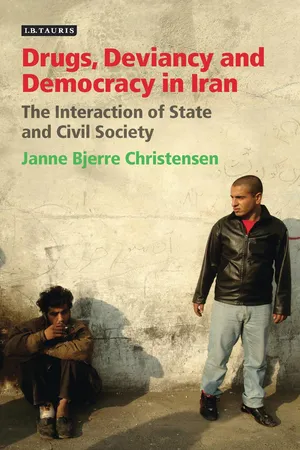
Drugs, Deviancy and Democracy in Iran
The Interaction of State and Civil Society
- 304 pages
- English
- ePUB (mobile friendly)
- Available on iOS & Android
eBook - ePub
Drugs, Deviancy and Democracy in Iran
The Interaction of State and Civil Society
About this book
In the aftermath of the Iranian Revolution, the government of the Islamic Republic initiated a stringent anti-drug campaign that included fining addicts, imprisonment, physical punishment and even the death penalty. Despite these measures, drug use was, and is still, commonplace. Based on her most recent fieldwork, Janne Bjerre Christensen explores the mounting problems of drug use in Iran, how treatment became legalized in 1998, how local NGOs offer methadone treatment in Tehran and face continuous political challenges in doing so, and how drug use is critically discussed in Iranian media and cinema. Drugs, Deviancy and Democracy in Iran is thus a unique account of Iran's recent social and political history, drawing important conclusions about the complexity of state power, and the growing impact of civil society, vital for all those interested in Iran's history, politics and society.
Information
CHAPTER 1
(DIS)LOCATING THE STATE: ORDER AND POWER
The idea of society is a powerful image.
It is potent in its own right to control or to stir men to action.
This image has form; it has external boundaries, margins, internal structure.
Its outlines contain power to reward conformity and repulse attacks.
There is energy in its margins and unstructured areas.
Mary Douglas (1966: 114)
How to govern?
The Iranian reform movement of the 1990s was exceptional because it raised the question: how to govern? The reformists attempted to change the rationalities of governance. Rather than conceptualizing the reform movement as simply a quest for freedom against an oppressive state, I believe these changing rationalities of governance are a better way of analysing the power negotiations taking place. The political fight, which emerged with the election of President Khatami in 1997, has been a continuous negotiation of the Islamic social order as well as the methods of power, the means of governance.
In this chapter, I will outline a theoretical framework for conceptualizing this change of social order and ‘governmentality’ and how this can be used to analyse the Iranian state. My starting point is recent studies which investigate the ‘career of governmentality in the postcolonies’, as Inda terms it (2005b: 12), and which focus on negotiations of state–society relations (Das and Poole 2004b; Gupta 1995, 2001; Navaro-Yashin 2002). By dislocating the conceptual coherence of the state as an analytical object, and localizing the effects of state policies ethnographically in everyday practices, I focus on the interactions of state and civil society and how the ‘state effect’ appears in contemporary Iran (Mitchell 1999).
I draw extensively on Foucault’s notions of power and his genealogical methods of understanding how a ‘space to be governed’ comes into being (Shore and Wright 1997: 30). I seek to outline how different notions and methods of power intersect in the Iranian ‘governmentality’ – sovereign, disciplinary and biopolitical power – and how the Iranian state is a distinctive response to the combination of these notions (Dean 2001: 53). By analysing how Foucault’s normalizing ‘dividing practices’ are implemented (and resisted) in Iran, I will show how they make certain ideas and ideals of the state appear.
More specifically I look at how the state is made visible and powerful at its ‘margins’. Bringing in anthropological conceptions of liminality to emphasize the morality, legitimacy and control related to the state’s ‘margins’, I analyse the processes by which social order is produced, and how drug users and NGOs invoke and provoke the margins not just between state and civil society but just as importantly between normalcy and deviancy.
This theoretical literature raises the questions: How are drug users classified, normalized, marginalized and criminalized by state policies, and what consequences do these policies have? How are social and political inclusion and exclusion negotiated locally, informed by an ambiguous ‘language of stateness’ (Blom Hansen and Stepputat 2001a: 5)? How do people navigate in a society where power is both disciplining and sovereign, where the state is both an object of fear and desire (ibid. 9; Nelson 2004)? How are drug users and NGOs enmeshed in, opposed to and involved in reproducing the state? What do these policies, and attempts to reinterpret and resist them, tell us about the Iranian state?
Anthropology of the state
Recently, there has been an increase in ethnographic inquiries into postcolonial state formations. These studies have probed into how states are imagined (Blom Hansen and Stepputat 2001b), how states are constructed in an ongoing dialogue with their ‘margins’ (Das and Poole 2004b), and how the boundaries between what is termed state and non-state are being blurred and stressed (Gupta 1995, 2001; Sharma and Gupta 2006a).15
These inquiries stress the necessity to theoretically deconstruct the state as a singular, coherent, naturalized entity and locus of power. As Abrams famously put it, ‘We have come to take the state for granted as an object of political practice and political analysis while remaining quite spectacularly unclear as to what the state is’ (2006 [1988]: 112).
Abrams distinguishes the state as an ‘idea’ from the governmental institutions, which ‘can be studied effectively without postulating the reality of the state’ (ibid.). Rather than seeing the state as a structure, he concludes that ‘The state is at most a message of domination – an ideological artefact attributing unity, morality and independence to the disunited, amoral and dependent workings of the practice of government’ (ibid. 125). As Blom Hansen and Stepputat note, modern states are ‘not the source of power but the effect of a wider range of dispersed forms of disciplinary power that allow “the state” to appear as a structure that stands apart from, and above, society’ (2001a: 4). This is ‘the powerful, apparently metaphysical effect of practices’, which Timothy Mitchell terms the ‘state effect’ (1999: 89). The interesting question for Mitchell is how this imagined unity, morality and independence of the state is created.
Following Abrams’ notion of the state as an ‘idea’ rather than an actual structure, and drawing on Foucault, Timothy Mitchell probes into how this effect is generated – the political process ‘through which the uncertain yet powerful distinction between state and society is produced’ (ibid. 77). This distinction does not demarcate two ‘discrete entities’, Mitchell emphasizes, but is ‘a line drawn internally, within the network of institutional mechanisms through which a social and political order is maintained’ (ibid.).
Several scholars emphasize the need to scrutinize this powerful, binary opposition between the state and society. Whereas Blom Hansen and Stepputat aptly show how states are imagined and ‘languages of stateness’ are shaped in public discourses and daily social encounters (2001b), Das and Poole criticize them for largely neglecting what lies outside or at the margins of the state. Das and Poole therefore frame their anthropological study of states by evoking the state’s ‘margins’. They point to the ‘sort of practices that seem to undo the state at its territorial and conceptual margins’, but which, at the same time, ‘are a necessary entailment of the state’ (2004a: 4). As Das and Poole rightly emphasize,
local worlds and the state do not stand as binary opposites. Even though they are locked in unequal relations, they are enmeshed in one another. Thus, on the one hand, law is seen as a sign of a distant but overwhelming power. On the other hand, it is also seen as close at hand – something to which local desires can be addressed (ibid. 22).
Along the same lines, but from a more institutional perspective, Christian Lund highlights the role of semi-statal organizations, what he terms ‘twilight institutions’. They are characterized by taking on the ‘public authority’ of the state (2006: 675). In failed or fragile states, as Lund points out, the ‘state’ becomes ‘the quality of an institution being able to define and enforce collectively binding decisions on members of society’ (ibid. 676). These institutions both blur and enhance the range of the state.
My aim is to investigate this state–society ‘enmeshment’ and ‘state effect’ ethnographically: How are ‘languages of stateness’ brought into play in reproducing and opposing the state locally, by local institutions and actors? What processes are involved in the constant demarcations between state and society, despite the fact that the ‘margins’, the ‘boundary of the state (or political system) never marks a real exterior’, as Timothy Mitchell says (1999: 83)?
Producing social order and normalcy
In applying the notion, or metaphor, of ‘margins’ I am inspired in part by Das and Poole (2004b), and I employ ‘margins’ here on two levels. One is an institutional or organizational margin, related to the NGOs and the extent to which they operate on the margins of state permissiveness and control, at the same time opposing and enhancing the range of the state. Another margin, which both the NGOs and drug users inform and reflect, relates to the processes by which social and moral order is construed and politicized through discourses, practices and disciplinary measures.
My focus on margins therefore owes as much to Foucault’s notion of ‘biopolitical’ power – aimed at categorizing, controlling, disciplining and optimizing the population through institutions (Foucault 1967, 1977, 1978, 1983, 1991a), to which I will return later – as it does to ‘classic’ anthropological symbolic analyses of marginality, liminality, morality, risk, purity, and danger (Douglas 1966, 1992; Turner 1974).
Both perspectives are necessary at the same time. Too often the institutional perspective on state policies is employed single-handedly, but my argument is that it is crucial to combine this perspective with the processes of constructing social and moral order. This moral order is striking in Iran, because it is a religious state, bound to Islamic ideals and provisions – a repertoire constantly activated by both state and non-state actors – but a focus on order is relevant more generally too in order to understand the ‘language of stateness’, which serves to reinforce political legitimacy. As Shore and Wright say, ‘Looked at anthropologically, the relationship between policy and morality sheds interesting light on the art of government. Both policy and morality attempt to objectify and universalize ideas. Both are guided by broader sets of cultural ideas’ (1997: 10). The question, then, is which broader cultural ideas are generated in producing Iranian state policies, and how these change over time.
To Mary Douglas, ‘margins’ are not perceived as institutional or juridical, but as cultural, political, and moral processes of delineating group boundaries and marking core values of the group. These processes exist in all societies. As she points out: ‘ “Purity” and “danger” are condensed arguments passionately flung against opponents in every dialogue that every community has about its own constitution’ (1992: 14). Assessing risk and danger, and attributing blame, is a politicized process, central to determining what type of society or regime is being constructed:
Each distinctive kind of regime will invoke a distinctive set of active powers in the universe to do three things, one cognitive, to explain disasters, one political, to justify allegiances, one system-maintaining, to stabilize the distinctive workings of the regime (ibid. 60).
As I will show, these demarcations of danger and risk are used to produce – to explain, justify, and stabilize – the moral social order in Iran, and they are negotiated in many ways. The danger of drug use and the threat to the social order, which drug users entail, are negotiated in the practice of treatment NGOs, in state policies and propaganda, and in public cultural narratives such as newspapers and films (Sharma and Gupta 2006b: 18). Likewise, the ‘danger of democracy’ and threat to ‘national security’, which civil society activists constitute to authoritarian state control, also draw limits to permissible and illegitimate kinds of public participation, all of which point to what society and what state are in the process of being made. ‘There is energy in [the society’s] margins and unstructured areas’, as Douglas points out (1966: 114), and these energies are always deeply moralized and politicized.
Douglas emphasizes that ‘The argument is not about the reality of the dangers, but about how they are politicized’ (1992: 29). I do not seek to question the ‘realities’ of these dangers either. The interesting question is how and when this process of politicization occurs; how and when drug use and NGOs are termed dangerous. This politicization points to ‘the lines of political legitimacy’, as Douglas says (ibid. 88): ‘Risk, danger, and sin are used around the world to legitimate policy or discredit it, to protect individuals from predatory institutions or to protect institutions from predatory individuals’ (ibid. 26).
Although Douglas is not concerned with the state, there are overlaps between the boundary-drawing processes she refers to and those of Das and Poole, when they discuss the ‘margins of the state’. Negotiations of state legitimacy take place as a constant invocation of the dangers at the margins, as Das and Poole emphasize. Referring to Weber’s notion of the state as a monopoly of violence, they note:
legitimacy [ ... ] emerged as a function of this boundary-marking effect of state practices [ ... ] In this vision of political life, the state is imagined as an always-incomplete project that must constantly be spoken of – and imagined – through an invocation of the wilderness, lawlessness, and savagery that not only lies outside its jurisdiction but also threatens it from within (2004a: 7).
This invocation of wilderness takes place relentlessly in regards to drugs and NGOs in Iran. It is one of the ways in which the state ‘idea’ and what Abrams calls a ‘message of domination’ are manifested (2006 [1988]: 125). But at the same time, the state cannot be reduced to a Weberian monopoly of violence, and in that respect Foucault’s notion of ‘governmentality’ is useful.
Governmentality and ‘dividing practices’
Whereas Mary Douglas outlined how concepts of religious defilements are used to form social relations and social order universally, Foucault portrayed the introduction of ‘dividing practices’ between deviancy and normalcy as an effect of modernity (1983: 208). Foucault outlined how power was historically transformed from the medieval, spectacular displays of violence and sovereignty to a modern, disciplining, hidden, yet even more effective ‘art of government’ taking place with the advent of institutions such as prisons, hospitals, schools, factories, and the military.
Much work has been done on state formation, policies, and governance, which draw on Foucault, his notions of power and de-emphasis on the state. Foucault specifically criticized the ‘reductionist vision’ of the state, condensing it to a ‘certain number of functions’ (Foucault 1991a: 103). ‘But the state [ ... ] does not have this unity, this individuality, this rigorous functionality, nor, to speak frankly, this importance’, he emphasized. Instead, Foucault invents the concept ‘governmentality’ to analyse the ‘art’ and rationality of government, which from the sixteenth century turns to governing and ‘normalizing’ the population (ibid.).
Whereas sovereignty ‘operates through spectacle and ritual, it prohibits forms of action, it seizes things, bodies, and ultimately life itself’ (Dean 2001: 49), ‘governmentality’ works as a productive, seducing power, aimed at the health and wellbeing of the population. ‘In contrast to sovereignty, government has as its purpose not the act of government itself, but the welfare of the population, the improvement of its condition, the increase of its wealth, longevity, health, etc.’, Foucault says (1991a: 100).
It is the methods rather than the institutions of power, which draw Foucault’s attention, but at the same time these methods of power do have structural, institutional effects. Timothy Mitchell seeks to bridge the literature on the state, which uses Foucault’s productive notion of power, yet is somehow at odds with the fact that Foucault was largely uninterested in the state. Mitchell’s argument is that it is exactly through the disciplinary powers instigated by modern means of governance that the state comes to appear as an external ‘structure’. As Mitchell says,
despite their localized and polyvalent nature, disciplinary powers are somehow consolidated into the territorially based, institutionally structured order of the modern state. Foucault does not dismiss the importance of this larger structure; he simply does not believe that the understanding of power should begin there (1999: 87).
I am inspired here by Foucault’s method to study power, and thereby (following Mitchell) the ways in which the ‘state effect’ and the state’s ‘capacity to govern’ appear (Rejali 1994). In addition, I am inspired by Foucault’s genealogical approach to understand how problems emerge historically, how ‘normalcy’ and ‘deviancy’ are produced in institutions and discourses, and the (unintended) consequences these policies have.
Foucault’s primary focus was not power as such, he said, but rather the constitution of the modern subject: how power inscribes itself on human bodies by disciplining them within a specific regime (Foucault 1967, 1977, 1983: 208). Although known for his analyses of institutions, neither was he concerned with the institutions themselves (Foucault 1983: 222). His focus was on the practices and discipline that took place within the institutions: ‘the target of analysis wasn’t “institutions”, “theories” or “ideologies” but practices – with the aim of grasping the conditions which make these acceptable at a given moment’ (Foucault 1991b: 75). Especially relevant here is Foucault’s emphasis on the ways in which these practices are made acceptable. By locating the genealogy of practices – how phenomena come into being and become ‘natural’ at a specific point in time – we can understand the moral and social orders they work to produce. How are things, practices, and policies made ‘doable’, legitimate or illegitimate?
Although tediously repeated, what is still deeply relevant to any analys...
Table of contents
- Cover
- Title Page
- Copyright Page
- Contents
- Acknowledgements
- Note on Transliteration
- Abbreviations
- Introduction: Drugs, NGOs and the Iranian State
- 1 (Dis)locating the State: Order and Power
- 2 The Iranian State and the Reform Movement: Debating Governance
- 3 Countering the Discourse of Dialogue: NGOs and the State of Ahmadinezhad
- 4 Changing Drug Policies: Institutionalizing a New Social Order
- 5 Negotiating Normalcy: NGOs Treating Drug Users
- 6 Shooting Drugs: Re-imagining the ‘Moral Public’
- Conclusion: What is ‘Reform’?
- Postscript: The 2009 Election
- Notes
- Bibliography
Trusted by 375,005 students
Access to over 1.5 million titles for a fair monthly price.
Study more efficiently using our study tools.
Frequently asked questions
Yes, you can cancel anytime from the Subscription tab in your account settings on the Perlego website. Your subscription will stay active until the end of your current billing period. Learn how to cancel your subscription
No, books cannot be downloaded as external files, such as PDFs, for use outside of Perlego. However, you can download books within the Perlego app for offline reading on mobile or tablet. Learn how to download books offline
Perlego offers two plans: Essential and Complete
- Essential is ideal for learners and professionals who enjoy exploring a wide range of subjects. Access the Essential Library with 800,000+ trusted titles and best-sellers across business, personal growth, and the humanities. Includes unlimited reading time and Standard Read Aloud voice.
- Complete: Perfect for advanced learners and researchers needing full, unrestricted access. Unlock 1.5M+ books across hundreds of subjects, including academic and specialized titles. The Complete Plan also includes advanced features like Premium Read Aloud and Research Assistant.
We are an online textbook subscription service, where you can get access to an entire online library for less than the price of a single book per month. With over 1.5 million books across 990+ topics, we’ve got you covered! Learn about our mission
Look out for the read-aloud symbol on your next book to see if you can listen to it. The read-aloud tool reads text aloud for you, highlighting the text as it is being read. You can pause it, speed it up and slow it down. Learn more about Read Aloud
Yes! You can use the Perlego app on both iOS and Android devices to read anytime, anywhere — even offline. Perfect for commutes or when you’re on the go.
Please note we cannot support devices running on iOS 13 and Android 7 or earlier. Learn more about using the app
Please note we cannot support devices running on iOS 13 and Android 7 or earlier. Learn more about using the app
Yes, you can access Drugs, Deviancy and Democracy in Iran by Janne Bjerre Christensen in PDF and/or ePUB format, as well as other popular books in Social Sciences & Middle Eastern History. We have over 1.5 million books available in our catalogue for you to explore.