This latest volume in "The Idea of Iran" series concentrates on the Sasanian period. Seizing power from the previous dynasty - the Parthians - the Sasanians ruled Iran and most of the ancient Near East from 224 until 642 CE. They are particularly fascinating because of their adherence to Zoroastrianism, an ancient dualistic Iranian religion named after the prophet Zarathustra (or, in Greek, Zoroaster). The Sasanians expressed the divine aspect of their rule in a variety of forms, such as on coins, rock reliefs and silver plates, and architecture and the arts flourished under their aegis. Sasanian military success brought them into conflict with Rome, and later Byzantium. Their empire eventually collapsed under the force of the Arab army in AD 642, when Zoroastrianism was replaced with Islam.Engaging with all the major aspects of Sasanian culture, twelve eminent scholars address subjects which include: early Sasanian art and iconography; early Sasanian coinage; religion and identity in the Sasanian empire; later Sasanian orality and literacy; and state and society in late antique Iran.
The volume in question arguably comprises the most complete and comprehensive treatment of the Sasanian civilization yet to be published in English.
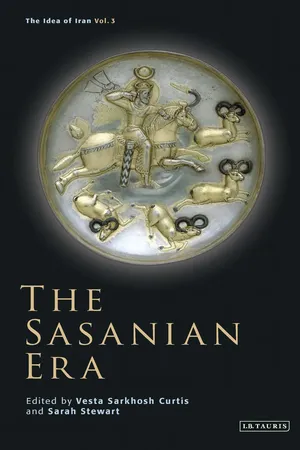
eBook - ePub
The Sasanian Era
- 192 pages
- English
- ePUB (mobile friendly)
- Available on iOS & Android
eBook - ePub
The Sasanian Era
About this book
Information
Notes
How Pious Was Shapur I?
1. Ferdowsi 2003: 1179.
2. History III: 61–80.
3. Ibid.
4. For the text, translation and commentary see Gignoux 1968: 387–417.
5. cygwn krtyr hnglpy; cygwn krtyr, SM 36, 38 et passim. See Gignoux 1968: 407–408.
6. Ibid.
7. See Gignoux 1984a and 1984b.
8. Nyberg 1938.
9. Herodotus, History I: 107–108.
10. Thus, according to the Letter of Tansar, Ardashir I was “more richly endowed with virtues than the ancients and his custom [was] better than the customs of old.” (Boyce 1968: 36).
11. Boyce 1968: 36–37.
12. Ibid.
13. Boyce 1979: 113.
14. On the term hērbed see Chaumont 1960; Kreyenbroek 1987a; 1987b.
15. The meaning of dstkrt seems clear from the context. Old Persian dastakarta meant “handmade, handywork”, see Kent 1953: 190. The Greek equivalent ktisma (Back 1978: 210) means “creature”.
16. See e.g. Shapur’s inscription at the Ka‘be-i Zartošt (ŠKZ); Back 1978: 284–371.
17. KKZ 2–3. The inscriptions are discussed in detail by Back (1978: 390–391).
18. The term “Bahram fire” may perhaps refer to fire-temples intended for the community as a whole, rather than private fires. More research is needed, however, to establish the precise meaning of the term in early Sasanian times.
19. Back (1978: 430) translates Phl. wizār as “canon”, but the widely accepted interpretation of the word as “explanation” (McKenzie 1971: 92) seems to make good sense here.
20. Communal ceremonies that were celebrated at certain points in the religious year, see Modi 1922: 419–428.
21. KKZ 11–14; Back 1978: 418–431.
22. So Boyce 1984: 112.
23. KKZ 8–10; Back 1978: 408–417.
24. “And there was much studying of the religion in many ways” (KKZ 15).
25. See Stöllner and Mir Eskanderi 2003.
26. Thus the offerings of food to the waters are referred to in Nērangestān 48–49 (Kotwal and Kreyenbroek 2003: 218–29).
Early Sasanian Coinage
1. For a detailed survey of Ardashir’s coinage see Alram and Gyselen 2003 (= SNS I).
2. SNS I: type I/1 (mint A).
3. For the meaning of the term bay see O. Skjærvø in Alram, Blet-Lemarquand and Skjærvø 2007: Appendix 3.
4. SNS I: type IIa/2 (mint B).
5. SNS I: type II/3.
6. SNS I: types IIa–d/3a (mint B).
7. SNS I: types IIe–d/3a (mint C).
8. SNS I: type III/3.
9. For a detailed discussion of the title see O. Skjærvø in Alram, Blet-Lemarquand and Skjærvø 2007: Appendix 3.
10. SNS I: types IV–VII/3.
11. Alram 2007.
12. For Shapur I see the detailed study of R. Gyselen in Alram and Gyselen 2003 (= SNS I), as well as Alram, Blet-Lemarqand and Skjærvø 2007.
13. SNS I, types II/1–2.
14. On the interpretation of this see SNS I: 36 with references to further literature; cf. also the issues which bear the name of Shapur on both sides of the reverse.
15. On the coin inscriptions of Shapur cf. also Skjærvø’s remarks in SNS I: 57–69.
16. SNS I: type I/1a. For the frawahr symbol see O. Skjærvø in Alram, Blet-Lemarquand and Skjærvø 2007: Appendix 1.
17. Cf.also Gyselen 2004: nos 77–78, where the frawahr symbol can be clearly made out on the khola.
18. Cf. also Schindel 2006 and the somewhat divergent view by Gariboldi 2005.
19. SNS I: nos 129–142 (Types IIc/1b; Style P, Groups c/1and c/2).
20. SNS I: 81–87 and 269 with Fig. 58.
21. SNS I: 85–87 with Table 8.
22. Göbl 1971: 25; cf. also Gyselen’s remarks in SNS I: 268–271.
23. This coin is published in Alram, Blet-Lemarquand and Skjærvø 2007.
24. For the reading and a detailed philological analysis of the inscriptions see O. Skjaervo in Alram, Blet-Lemarquand and Skjærvø 2007.
25. Göbl 1974. Last confirmed by Meyer 1990; cf. also von Gall 1990: 99–104.
26. Cf. my brief description in Seipel 1996: p. 399, 78.
27. SNS I: pl. 35, A51 and Gyselen 2004: no. AV8.
28. On this see Loginov and Nikitin 1993.
29. The typological classification of the coins from Ohrmazd I to Ohrmazd II is based on Alram and Gyselen (forthcoming); see also Gyselen 2004.
30. See Nikitin 1999.
31. See Herrmann 1998 and Herrmann 2000.
32. Gyselen 2004: no. 146 (SNS II: type I/1).
33. Gyselen 2004: no. 151 (SNS II: type II/2).
34. Choksy 1989. See also Curtis 2007a.
35. See Gyselen 2004: 56 and no. 158.
36. See SNS II = Alram and Gyselen (forthcoming).
37. See Göbl 1959 as well as Göbl 1971 for a typological overview.
38. See DeShazo 1993.
39. For Shapur II cf. Schindel 2004, 227 (= SNS III).
Formation and Ideology of the Sasanian State in the Context of Archaeological Evidence
1. Göbl 1971: Alram 1999: 67–76; Curtis 2007b: 7–20.
2. Tabari 1879: XIV–XVI Introduction by Nöldeke; Gutschmid 1880: 721–749; Christensen 1944: 59–83; Widengren 1971: 711–784.
3. Tabari 1879: 1–4; for the English translation see Widengren 1971: 732–734 and 760–767.
4. Karnamak 1879: 36–38; for the English translation see Widengren 1971: 776–778; Tha´alibi 1900: 473–4...
Table of contents
- Cover
- Dedication page
- Title page
- Copyright page
- Contents
- List of Figures
- Acknowledgements
- Introduction
- How Pious Was Shapur I?
- Early Sasanian Coinage
- Formation and Ideology of the Sasanian State in the Context of Archaeological Evidence
- Kingship in Early Sasanian Iran
- Image and Identity: Art of the Early Sasanian Dynasty
- The Sasanians in the East
- Religion in the late Sasanian Period: Eran, Aneran, and other Religious Designations
- State and Society in Late Antique Iran
- Prices and Drachms in the Late Sasanian Period
- Late Sasanian Society between Orality and Literacy
- List of Abbreviations
- Bibliography
- Notes
Trusted by 375,005 students
Access to over 1.5 million titles for a fair monthly price.
Study more efficiently using our study tools.
Frequently asked questions
Yes, you can cancel anytime from the Subscription tab in your account settings on the Perlego website. Your subscription will stay active until the end of your current billing period. Learn how to cancel your subscription
No, books cannot be downloaded as external files, such as PDFs, for use outside of Perlego. However, you can download books within the Perlego app for offline reading on mobile or tablet. Learn how to download books offline
Perlego offers two plans: Essential and Complete
- Essential is ideal for learners and professionals who enjoy exploring a wide range of subjects. Access the Essential Library with 800,000+ trusted titles and best-sellers across business, personal growth, and the humanities. Includes unlimited reading time and Standard Read Aloud voice.
- Complete: Perfect for advanced learners and researchers needing full, unrestricted access. Unlock 1.5M+ books across hundreds of subjects, including academic and specialized titles. The Complete Plan also includes advanced features like Premium Read Aloud and Research Assistant.
We are an online textbook subscription service, where you can get access to an entire online library for less than the price of a single book per month. With over 1.5 million books across 990+ topics, we’ve got you covered! Learn about our mission
Look out for the read-aloud symbol on your next book to see if you can listen to it. The read-aloud tool reads text aloud for you, highlighting the text as it is being read. You can pause it, speed it up and slow it down. Learn more about Read Aloud
Yes! You can use the Perlego app on both iOS and Android devices to read anytime, anywhere — even offline. Perfect for commutes or when you’re on the go.
Please note we cannot support devices running on iOS 13 and Android 7 or earlier. Learn more about using the app
Please note we cannot support devices running on iOS 13 and Android 7 or earlier. Learn more about using the app
Yes, you can access The Sasanian Era by Vesta Sarkhosh Curtis, Sarah Stewart, Vesta Sarkhosh Curtis,Sarah Stewart in PDF and/or ePUB format, as well as other popular books in History & Middle Eastern History. We have over 1.5 million books available in our catalogue for you to explore.