- 264 pages
- English
- ePUB (mobile friendly)
- Available on iOS & Android
eBook - ePub
About this book
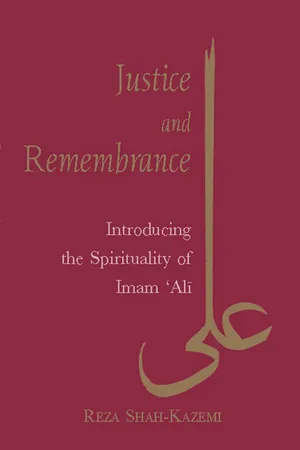
Ali b. Abi Talib, son-in-law and cousin of the Prophet Muhammad, first Shi'i imam and fourth caliph, is a monumental figure within the Islamic tradition. But despite the immense importance of Imam Ali, there is a dearth of literature in Western languages about his life and thought. This book - the first serious engagement in English with the intellectual principles underpinning his teachings - is therefore a welcome and valuable addition to the sources available. It consists of three parts. Part one introduces the person of Ali in a general manner, and focuses particularly on the spiritual and ethical content of his teachings. Part two evaluates Ali's 'sacred conception of justice'. Part three addresses the theme of spiritual realization through the remembrance of God, the central mystical practice of the Sufis. Justice and Remembrance will be of great value to students and scholars of Islamic thought, as well as to those interested in the relationship between spirituality and ethics.
Information
CHAPTER ONE

Introducing Imam ʿAlī and his Spiritual Ethos
I am the city of knowledge and ʿAlī is its gate;
so whoever desires knowledge, let him enter the gate.
(Anā madīnatu’l-ʿilm wa ʿAlī bābuhā;
Fa-man arāda’l-ʿilm fal-yaʾti’l-bāb).1
To speak of ʿAlī b. Abī Ṭālib—cousin and son-in-law of the Prophet Muḥammad, fourth caliph of Islam and first in the line of Shiʿi Imams—is to speak of the quintessential spirituality of the Islamic tradition. For in this seminal figure of nascent Islam, one finds an integral expression of the two fundamental sources of Islamic spirituality, the Qur’ānic revelation and the inspired Sunna of the Prophet.2 By his Sunna we do not mean simply the outward imitation of the Prophet’s actions—a reductionism all too prevalent in our times—rather, we mean the spiritual substance of the prophetic perfection to which the Qur’ān itself refers: ‘Verily, thou art of a tremendous nature’ (68: 4).3 The Prophet’s words and deeds express but do not exhaust this spiritual substance. The inner assimilation of this substance, rather than the merely formal imitation of the words and deeds, is the goal of every spiritually inclined Muslim. There is a profound affinity between the believer’s soul and the prophetic nature, a mysterious proximity that goes beyond time and space, as expressed in the verse: ‘The Prophet is closer to the believers than they are to themselves’ (33: 6). The Prophet, thus, outwardly manifests the perfection which the spiritually sensitive believer intuits, to some degree or another, as determining the very essence of his or her own soul.4
It is not surprising, therefore, to find the Prophet saying that ʿAlī ‘is as my own soul (ka-nafsī)’,5 affirming thereby not only the extraordinarily close relationship between ʿAlī and himself, but also the affinity—and ultimately, identity—between every sanctified soul and the prophetic nature. More mysteriously, he said to ʿAlī, ‘You are from me, and I am from you (anta minnī wa anā minka).’6 Likewise, as regards ʿAlī’s assimilation of the substance of the Qur’ān, we have this prophetic saying: ‘ʿAlī is with the Qurʾān and the Qurʾān is with ʿAlī. They will not separate from each other until they return to me at the [paradisal] pool (al-ḥawḍ).’7 The spirit of the Qur’ān and the soul of the Prophet were thus fully interiorized by ʿAlī, and it is this interiorization of the twin sources of the Islamic revelation which constitutes the spiritual path of Islam.
Our principal way of investigating and meditating upon the spirituality of Imam ʿAlī is to consider the corpus of teachings attributed to him. Even if not all of the thousands of sayings attributed to him can be confidently ascribed to him, the very magnitude of the corpus testifies to the fact that he must indeed have articulated a very large number of profound teachings. No other companion of the Prophet has anything approaching the corpus attributed to ʿAlī. Similarly, even if his foundational role in the development of a whole range of sciences be debatable—sciences such as jurisprudence (fiqh), theology (kalām), Qurʾānic exegesis (tafsīr), rhetoric (balāgha), grammar (naḥw) and calligraphy (khaṭṭ), the mystical knowledge associated with Sufism, as well as such arcane sciences as numerology (jafr) and alchemy (al-kīmiyāʾ)8—the fact that he is considered by later authorities in these fields as having provided the initial impetus for their sciences bespeaks the far-reaching and penetrating influence of both his formal teachings and personal radiance.
Given that the Islamic intellectual sciences as a whole are so closely identified with ʿAlī, the Prophet’s definition of ʿAlī as the ‘gate’ to prophetic wisdom, cited as our epigraph, takes on the appearance of both a description of what ʿAlī was in relation to the Prophet in their own age, and also a prophecy of the role ʿAlī would play in relation to the subsequent unfolding of the sciences of the tradition—all such sciences being understood as so many formal, outward manifestations of the essential, inward spirit of the Islamic revelation, that spirit which was synthetically assimilated and faithfully transmitted by Imam ʿAlī. But before proceeding any further, the main historical outlines of his life should be sketched out.
BIOGRAPHICAL SKETCH
ʿAlī was a ‘follower’ of the Prophet in the deepest sense of the term. He lived physically in the shadow of the Prophet and absorbed spiritually all that radiated from him. The intimacy of the relationship between them is summed up in the words of one of the Imam’s sermons:
When I was but a child he took me under his wing ... I would follow him [the Prophet] as a baby camel follows the footsteps of its mother. Every day he would raise up for me a sign of his noble character, commanding me to follow it. He would go each year into seclusion at [the mountain of] Ḥirā’. I saw him and nobody else saw him. At that time no household was brought together for the religion of Islam, except [that comprising] the Messenger of God, Khadīja and myself as the third. I saw the light of the revelation and the message, and I smelt the fragrance of prophecy ...9
It is ʿAlī as the faithful follower and transmitter of the prophetic norm that we wish to address in this biographical sketch. Thus, we shall take a glance at the early period of his life, from his birth (c. 599 CE) to the death of the Prophet (11/632). Neither the second period of his life, from the death of the Prophet to his own assumption of the caliphate (35/656), nor the third period, consisting of his brief caliphate, dominated by tragic civil wars and culminating with his assassination in 40/661, will be dealt with here, as the issues raised in this part of his biography are fraught with historical and historiographical complexities.10 Such controversies will deflect us from the primary aim of this book, which is to introduce the spiritual ethos of this extraordinary figure in such a way as to demonstrate its universal relevance, both within Islam itself and also beyond the Islamic tradition. For this ethos transcends formal religious boundaries, just as it rises above the political issues upon which the outward aspect of the Shiʿi-Sunni divergence is based—such issues serving only to distract attention from the essential spiritual message of ʿAlī.
What we wish to draw attention to here, on the contrary, is the unifying force of his spiritual teachings, upon the immense importance and profundity of which all Muslims, whatever their school of thought, are in agreement. In what follows, then, we shall briefly survey the earlier period of ʿAlī’s life, that spent with the Prophet, together with the way in which the Prophet described ʿAlī in well-attested sayings, as this constitutes the indispensable background against which his role as gate to prophetic wisdom should be viewed. The second part of this introductory chapter will then address some key principles of his spiritual ethos, with a particular stress on the role of the intellect in that ethos.
According to all Shiʿi authorities and several Sunni sources, ʿAlī had the unique distinction of being born in the Kaʿba in Mecca.11 His mother was Fāṭima bt. Asad, and his father, Abū Ṭālib, son of ʿAbd al-Muṭṭalib, was a leading member of the clan of the Hashimites. Abū Ṭālib had taken care of the young orphan, Muḥammad, son of his brother ʿAbd Allāh, and was later to be his chief protector when the message of Islam was openly being pr...
Table of contents
- Cover
- Dedication page
- Title page
- Author biography
- Copyright page
- The Institute of Ismaili Studies
- Table of Contents
- Acknowledgements
- Prologue: The Sources of Imam ʿAlī’s Intellectual Legacy
- 1. Introducing Imam ʿAlī and his Spiritual Ethos
- 2. A Sacred Conception of Justice in Imam ʿAlī’s Letter to Mālik al-Ashtar
- 3. Realization through Remembrance: Imam ʿAlī and the Mystical Tradition of Islam
- Dhikru’Llāh as a Polish for Hearts
- I. The First Sermon of Nahj al-balāgha
- II. The Letter of Imam ʿAlī to Mālik al-Ashtar
- Bibliography
Trusted by 375,005 students
Access to over 1.5 million titles for a fair monthly price.
Study more efficiently using our study tools.
Frequently asked questions
Yes, you can cancel anytime from the Subscription tab in your account settings on the Perlego website. Your subscription will stay active until the end of your current billing period. Learn how to cancel your subscription
No, books cannot be downloaded as external files, such as PDFs, for use outside of Perlego. However, you can download books within the Perlego app for offline reading on mobile or tablet. Learn how to download books offline
Perlego offers two plans: Essential and Complete
- Essential is ideal for learners and professionals who enjoy exploring a wide range of subjects. Access the Essential Library with 800,000+ trusted titles and best-sellers across business, personal growth, and the humanities. Includes unlimited reading time and Standard Read Aloud voice.
- Complete: Perfect for advanced learners and researchers needing full, unrestricted access. Unlock 1.5M+ books across hundreds of subjects, including academic and specialized titles. The Complete Plan also includes advanced features like Premium Read Aloud and Research Assistant.
We are an online textbook subscription service, where you can get access to an entire online library for less than the price of a single book per month. With over 1.5 million books across 990+ topics, we’ve got you covered! Learn about our mission
Look out for the read-aloud symbol on your next book to see if you can listen to it. The read-aloud tool reads text aloud for you, highlighting the text as it is being read. You can pause it, speed it up and slow it down. Learn more about Read Aloud
Yes! You can use the Perlego app on both iOS and Android devices to read anytime, anywhere — even offline. Perfect for commutes or when you’re on the go.
Please note we cannot support devices running on iOS 13 and Android 7 or earlier. Learn more about using the app
Please note we cannot support devices running on iOS 13 and Android 7 or earlier. Learn more about using the app
Yes, you can access Justice and Remembrance by Reza Shah-Kazemi in PDF and/or ePUB format, as well as other popular books in Teologia e religione & Teologia islamica. We have over 1.5 million books available in our catalogue for you to explore.