eBook - ePub
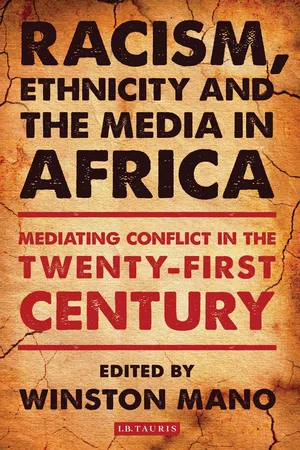
Racism, Ethnicity and the Media in Africa
Mediating Conflict in the Twenty-first Century
- 368 pages
- English
- ePUB (mobile friendly)
- Available on iOS & Android
eBook - ePub
Racism, Ethnicity and the Media in Africa
Mediating Conflict in the Twenty-first Century
About this book
In today's Africa racism and ethnicity have been implicated in serious conflicts - from Egypt to Mali to South Africa - that have cost lives and undermined efforts to achieve national cohesion and meaningful development. Racism, Ethnicity and the Media in Africa sets about rethinking the role of media and communication in perpetuating, reinforcing and reining in racism, absolute ethnicity and other discriminations across Africa. It goes beyond the customary discussion of media racism and ethnic stereotyping to critically address broader issues of identity, belonging and exclusion. Topics covered include racism in South African newspapers, pluralist media debates in Kenya, media discourses on same-sex relations in Uganda and ethnicised news coverage in Nigerian newspapers.
1
RACISM, ETHNICITY AND THE MEDIA IN AFRICA
Winston Mano
The book deals with racism, ethnicity and the media in Africa within the context of increasing local and global transformations. It is published at a time when political and media discussions on the outbreak of Ebola focused primarily on the risk it poses to developed countries and the efforts to contain it by strictly monitoring and isolating ‘Africans’ at their boarders. The ‘Western’ response also fitted in with the growing anti-immigrant narrative response. It can be observed that responses to crises, conflicts and other events in Africa seem to add to centuries of racial profiling and ‘othering’ (Said, 1978; Mudimbe 1988). Representations matter because they can influence perceptions, investment decisions or policy directions. However, it is beyond the scope of this book to discuss all the crises facing Africa, to map out all the injustices facing its inhabitants, to deal with conspiracy theories on African crises or to attempt to develop detailed responses to all of them.
Racism and ethnic absolutism are recurrent issues that need to be taken seriously by all, especially citizens, students, journalists, activists, politicians, researchers and policymakers. So far, the existence of high moral grandstanding, forward-facing sentiments and progressive laws has not stopped totemic or colour-of-skin discriminations, xenophobia, unwarranted attacks on women and many other sickening racial tragedies. ‘Arguments over racial division, over who is human enough to qualify for rights and recognition, have impinged upon the formation of epistemological and ethical as well as historical and political categories’ (Gilroy 2004: 10). There is an urgent need to firmly restate Fanon’s (1963: 314) call for mankind to “reconsider the question of cerebral reality and of the cerebral mass of all humanity, whose connections must be increased, whose channels must be diversified and whose messages must be re-humanized’. Racism has had a long history driven by interwoven social, economic and political factors even though it is science that is often brought in to mask it. Critical analysis of racism needs to be updated so that humankind can ‘go forward all the time, night and day, in the company of Man, in the company of all men [and women]’ (ibid, 315) (My emphasis). This book is an attempt to put racism and ethnicity firmly back on the policy and academic agenda with the aim of generating new knowledge and encouraging more balanced approach to the key issues.
By combining racism, ethnicity and the media, the book attempts to introduce new empirical and theoretical dimensions to the debate. In a way it responds to Gilroy’s (2004: 31) critique of work on ethnicity and racism when he notes that: ‘Few new ways of thinking “race” and its relationship to economics, politics and power have emerged since the era of national liberation struggles to guide the continuing pursuit of a world free of racial hierarchies.’ This book also deals with racism, ethnicity and the media from an interdisciplinary approach, using fresh and unique case studies from Africa and beyond.
At the start of this millennium, people who live in Africa have already witnessed growing uncertainties, anxieties and deepening crises. These include debilitating ethnic conflicts, discriminations and prejudices against minorities, deadly armed insurrections and full-scale wars, recurrent racism, deadly xenophobic attacks, to cite but a few examples. Saying this does not imply a rosy past in contrast to frantic models of the present and future. Rather it is a poignant reflection of a more connected Africa, both internally as well as with other parts of the world. The rapid developments in Africa are giving rise to new cultural questions and possibilities some of which this book attempts to deal with.
Africans have generally refused to be bystanders or victims of the transformations in spite of their impoverishment and weak observance of their basic human rights. As Nyamnjoh (2009: 71) usefully reminds us, ‘political, cultural, historical and above all, economic realities, determine what form of meaning and discussion and articulation of citizenship and rights assume in any given context’. The transitional character of nations on the continent has meant that racism, ethnicity and an obsession with belonging are a permanently active part in many African contexts. Individuals and collectives in Africa, in line with others in the Global South, have had to be creative, innovative and convivial in their response to relentless forces of change, despite their often perceived passivity. This book arises out of debates on the interplay between racism, ethnicity and the media, all of which are important cultural questions in Africa at the start of this millennium. The intention is not to discuss Africans as victims or even to simply celebrate African agency. It is also not only to reject deeply held pejorative perceptions of Africa as an ‘other’, that is, a world ‘apart from the world, or as a failed and incomplete example of something else’ (Mbembe and Nuttall 2004: 348). Rather the book attempts to also tackle issues to do with racism and ethnicity as part of lived experiences of people in Africa today, both in an historicised sense and as part of an increasingly interconnected society.
In much of contemporary Africa, contestations of ethnicity, citizenship and belonging have failed to disappear as there has been a ‘resurgence of identity politics and overt tensions over belonging’ (Nyamnjoh 2005: 19). The resultant struggles are behind some of the most protracted conflicts, without clear starting and terminating points, involving communities deprived of their basic needs such as ‘security, recognition and acceptance, fair access to political institutions and economic participation’ (Azar 1990: 8). Mobile elites, in these situations, ‘can physically leave the squalor while those who cannot afford to move are stuck in’ (Morley 2000: 202). It is increasingly the case that politically powerful elites are monopolising and manipulating the allocation of resources in ways that deny the needs of others, including on the basis of their communal belonging. This has arguably fuelled problems associated with identity politics in Africa.
The resurgence of identity politics in Africa also comes at a time when the continent is facing huge development challenges, not least to do with economic growth, poverty reduction, human development and governance (Devarajan and Fengler 2013). The widespread infrastructural deficiencies are evidence that Africa’s poor have not fully benefited from national development initiatives. Unstable prices for extractive economies, unequal global trade terms and local corruption have also worked to prevent the benefits from accruing to the intended recipients. An everyday issue such as the provision of basic infrastructure, including water and electricity, is linked to political problems, with priority given to regions or neighbourhoods politicians favour. Such immense problems call into question the meaning of national independence, and when coupled with recurrent tensions, war and conflicts could easily erode the sovereignty that has been so far achieved. Arguably, the challenges have exacerbated religious, ethnic and political instability, contributing to the politics of belonging in contemporary Africa.
It is recognised, in the interdisciplinary contributions in this book, that countries in Africa are ‘post-colonies’, that is, societies recently emerging from the experience of colonisation and the violence which the colonial relationship, par excellence, involves (Mbembe 1992: 3). Gilroy (2004: 31) notes that ‘our post-colonial environment reverberates with the catastrophes that resulted from militarized agency and unprecedented victimization of racial and ethnic groups’. It is within such transitional post-colonial frameworks that reported and unreported racial conflicts, xenophobic attacks, acts of terrorism and ethnic bigotry seem to be rising (see Hawkins 2008; Mamdani 2009; Franks and Shaw 2012). Racialism in Africa has become a persistent problem, in some cases requiring contemporary local, national and global responses to historical issues.1 As is discussed by Banda (2015), in the Foreword to this book, the resurgence of politics of belonging is rife regardless of United Nations’ high-level international meetings against racism, including the World Conference on Racism (WCAR) in 1978, 1983, 2001 and also in 2009. International efforts to tackle racialism have helped manage the problem but in reality ethnic biases, racial segregation and discriminations continue in many spheres of life. It is fair to say that the problems are exacerbated by political oppression, human rights abuse, cultural injustice, poverty, rampant global capitalism and uneven globalisation. Some of these issues are discussed by the contributors to the book.
While the book is aware of economic problems, it is more focused on socio-cultural factors and the role played by media in representing, undermining or reinforcing past and contemporary racial and ethnic conflicts in Africa. It is aware that the questions of race and racism have a long history in Cultural Studies, which, for example, involved moments of undermining normative assumptions and original concerns with class and cultural privileges to now include aspects such as gender and ethnicity (Scannell 2007: 215). The book also recognizes the utility of ‘intersection-ality theory’ (Yuval-Davis 2011: 4), which in expanding Stuart Hall’s work on identity, ‘analyses social stratification as a whole’ and as ‘mutually constitutive’, instead of ‘prioritising one facet or category of social difference’. As will be discussed, Yuval-Davis (2011: 4) also makes an important distinction between ‘belonging’ and ‘the politics of belonging’, which is useful in understanding the approach taken by contributors to this book. For her, belonging is about emotional attachment, about ‘feeling at home’ which allows safety and at times anger and other sentiments. Belonging is natural and part of the everyday but can become ‘articulated, formally structured and politicised only when threatened in some way’ (ibid.). Individuals can ‘ “belong” in many different ways and to many different objects of attachment. These can vary from a particular person to the whole community, in a concrete or abstract way, by self or other identification, in a stable or contested way’ (Yuval-Davis 2011: 5). Morley (2000: 209) similarly argues that the ‘creation of a more internally integrated and coherent community often goes alongside the creation of even more excusive policies along the border of that community’. For Yuval-Davis (2011: 4–5), ‘the politics of belonging comprise of specific political projects aimed at constructing belonging to particular collectivity/ties which are themselves being constructed in these projects in very specific ways and in very specific boundaries’. She adds that not all belonging are important and that only in extreme cases are people willing to ‘sacrifice their lives – and the lives of others – in order for their narrative of their identities and objects of their identifications and attachments to continue to exist’ (ibid.). Interestingly, Morley (2000: 223) also points out that ‘it is not the presence of others per se which is problematic, but only that of undomesticated otherness’, demonstrating how non-threatening roles and identities appear acceptable in xenophobic situations. The constructivist approach to race and ethnic identity taken here is also cognizant of ‘shifting, situational, subjective identifications of self and others, which are rooted in ongoing daily practice and historical experience, but also subject to transformation and discontinuity’ (Jones 2003: 13). This will be discussed in more detail below. The contributors are passionate and vigorous in their discussion of the interplay between racism, ethnicity and the media in Africa and on Africans in Europe.
The role of the mass media in reinforcing or undermining ethnicity and racism is also considered to be central. The media are an important but understudied institution in this debate. Today’s struggles against racism are a continuation of social justice undertakings in which the ‘media have a critical task in human rights education as they should contribute to the teaching and respect of human rights’ (Hamelink 2001: 4). The media select what to represent and shape attitudes to existing realities. So, for example, one could question why some major conflicts have either been unreported or underreported. Of note were underreported highly ethnicised killings of close to 300,000 people in Burundi in 1993 and the belatedly publicised Rwandan killings in 1994 which left 800,000 dead. In the Democratic Republic of Congo, an estimated 8 million people have perished in recurrent civil wars since the 1990s (Franks and Shaw 2012; Hawkins 2008; Frere 2007) but this has been largely underreported. The gruesome xenophobic attacks on ‘black foreigners’ in South Africa and the slaughter of ‘Muslim-Christians’ by Boko Haram in Nigeria are examples of complex cases of belonging (Abubakar 2012; Musa 2012). Part of the problem has been interpretation of these ‘racialised and ethnicised identities’ in the media. The new struggles of belonging, citizenship, entitlement, distribution and ownership of resources are largely driven by racism and ethnicity (Ndlovu-Gatsheni 2012). As will be discussed, mass media can help expose violations resulting from racism and ethnic bigotry. Far from being observers, the media have been reflecting and affecting some of the struggles.
The book debates insights and perspectives from local and international journalists and editors as well as academics, human rights activists, researchers and regulators. The contributors are equally from diverse backgrounds and are most knowledgeable about past and current ‘racial and ethnic’ upheavals in Africa and within evolving socio-economic and political historical frameworks.
The key questions addressed in the book include the following: How are the post-colonial mass media implicated in the growing ethnic and racial conflicts and violence in Africa? In what ways are the media challenging, undermining or reinforcing issues relating to racism and ethnicity in Africa? How have African media and journalists covered racial and ethnic topics? Both old and new media have opened new spaces for debates that were formerly suppressed, but have they not also encouraged extremism?
The next section attempts to conceptualize the terms of reference for the book, particularly African identity, racism and ethnicity. The approach is sympathetic to intersectionality theory which cautions against treating categories of cultural identity as separate and independent of each other. The terms are analysed as part of social stratification as a whole and taken to be connected at different levels.
African Identity
Situated within the constructivist approach to identity, this book proceeds from the perception that identities are contingent, in flux and also subject to change. Identities can be several and contested. People in Africa have known histories, geographies, ethnic groups, languages, genders, skin colours and continental identities. However, such belonging is not unified or homogeneous for as Hall reminds us, ‘the one thing we are not is one, only one thing’ (1997: 12). The diversity of Africa’s peoples and its cultures is remarkable: ‘Whatever Africans share, we do not have common traditional culture, common languages, a common religious or conceptual vocabulary [ ... ] we do not even belong to a common race’ (Appiah 1992: 15). Achebe also points out that ‘African identity is still in the making. There is no final identity that is African. But, at the same time, there is identity coming into existence. And it has a certain context and meaning’ (in Appiah 1992: 173).
Contemporary African identity can be seen as plural, evolving and dynamic and as one that ‘keeps redefining itself with new experiences and contacts with other people and cultures’ (Nyamnjoh 2005: 91). When it comes to the term ‘African’ and its meaning, ‘African is [ ... ] to be a social actor/actress enmeshed in a particular context that has been and continues to be shaped by a unique history that, among others, is marked by unequal encounters and misrepresentations often informed by arrogance and ignorance of the economically and politically powerful who take the liberty to abrogate a cultural superiority to themselves’ (Nyamnjoh 2008: 101). Africanity and African citizenship ought to go beyond labels of ‘citizens’ and ‘subjects’ (Mamdani 1996) to include essentials of lived experience shaped by daily struggles. Any definition of African identity must include ‘the sum of ways in which we’ve been willing to be recognised. We are the sum of claims we’ve been willing to make. We are the sum of where we hope we are going’ (Hall 1997: 13). While not refuting historical and geographical specificities, this socio-cultural approach firmly challenges racist biological identifications. It means how one who is, for example, a Yoruba, Afrikaner, white, black, Ndebele, Kikuyu, Ashante, Zulu or Shona must also be unpacked in terms of rooted but shifting processes of identification. It must also be based on respect for African humanity, creativity and realities which in themselves are neither in ‘question nor a question’ (Nyamnjoh 2008: 101). In line with the previously mentioned intersectional approach, ‘Africa’ is perceived as a...
Table of contents
- Cover
- Title Page
- Copyright Page
- Contents
- List of Illustrations
- List of Contributors
- Acknowledgements
- Foreword by Fackson Banda
- 1. Racism, Ethnicity and the Media in Africa
- 2. Media and Belonging in Africa: Reflections on Exclusionary Articulation of Racial and Ethnic Identities in Cameroon and South Africa
- 3. Discourses of Race in the Afrikaans Press in South Africa
- 4. ‘Where the Streets Have No Names’: Mediating Name Change in Post-Apartheid South Africa
- 5. ‘It’s Our Paper!’ Ethnic Identity Politics and Indigenous Language Newspaper Readers in Zimbabwe: The Case of uMthunywa
- 6. Reporting Ethnic Minority Issues in Africa: A Study of Nigerian Newspapers
- 7. Regionalism and Ethnicity in the Nigerian Press: An Analysis of the Coverage of Boko Haram and the Niger Delta Conflicts in the Guardian and Daily Trust
- 8. Programming for National Unity: The Paradox of Television in Nigeria
- 9. Influencing the Information Domain: The United Nations’ Information Intervention in the Democratic Republic of Congo
- 10. ‘Thus Saith the Prophet’: The Media, Ethnic Myths and Electoral Politics in Kenya
- 11. A Critical View of the Kenyan Media System through the Lens of the Journalists
- 12. The Rise and Fall of the Ugandan Anti-Homosexuality Bill in Domestic Press: A Study on the Importance of International Allies
- 13. Sakawa – The Spirit of Cyberfraud: Analysis of a Rumour Complex in Ghana
- 14. Black African Diasporic Cinemas: Identities and the Challenge of Complexity
- 15. Race and the Reproduction of Colonial Mythologies on Land: A Post-colonial Reading of British Media Discourse on Zimbabwe
- 16. Representation of Otherness: Africans and Crime in the Norwegian Media
Trusted by 375,005 students
Access to over 1.5 million titles for a fair monthly price.
Study more efficiently using our study tools.
Information
Publisher
I.B. TaurisEdition
1Year
2015Topic
Scienze socialiPrint ISBN
9781780767062
Subtopic
Storia africanaeBook ISBN
9780857735652
Frequently asked questions
Yes, you can cancel anytime from the Subscription tab in your account settings on the Perlego website. Your subscription will stay active until the end of your current billing period. Learn how to cancel your subscription
No, books cannot be downloaded as external files, such as PDFs, for use outside of Perlego. However, you can download books within the Perlego app for offline reading on mobile or tablet. Learn how to download books offline
Perlego offers two plans: Essential and Complete
- Essential is ideal for learners and professionals who enjoy exploring a wide range of subjects. Access the Essential Library with 800,000+ trusted titles and best-sellers across business, personal growth, and the humanities. Includes unlimited reading time and Standard Read Aloud voice.
- Complete: Perfect for advanced learners and researchers needing full, unrestricted access. Unlock 1.5M+ books across hundreds of subjects, including academic and specialized titles. The Complete Plan also includes advanced features like Premium Read Aloud and Research Assistant.
We are an online textbook subscription service, where you can get access to an entire online library for less than the price of a single book per month. With over 1.5 million books across 990+ topics, we’ve got you covered! Learn about our mission
Look out for the read-aloud symbol on your next book to see if you can listen to it. The read-aloud tool reads text aloud for you, highlighting the text as it is being read. You can pause it, speed it up and slow it down. Learn more about Read Aloud
Yes! You can use the Perlego app on both iOS and Android devices to read anytime, anywhere — even offline. Perfect for commutes or when you’re on the go.
Please note we cannot support devices running on iOS 13 and Android 7 or earlier. Learn more about using the app
Please note we cannot support devices running on iOS 13 and Android 7 or earlier. Learn more about using the app
Yes, you can access Racism, Ethnicity and the Media in Africa by Winston Mano in PDF and/or ePUB format, as well as other popular books in Scienze sociali & Storia africana. We have over 1.5 million books available in our catalogue for you to explore.