In recent years, media coverage of the European Union has faced its most serious test. The interlinked crises in the Union have severely tested the expertise of the EU press corps, many of whom have struggled to cope with its complexities, and have thrown into sharper relief the differences among the national coverages. At the same time, the crises have deepened trends towards euro scepticism in many EU member states - thus putting pressure on correspondents to be more sceptical, analytical, argumentative and even hostile, in their reporting. This development has revealed a greater gulf between reporters - who are now more sceptical than their predecessors - and the press service and officials of the EU, who remain strongly committed to the narrative of an 'ever-closer union'. Yet - in contrast to the rising euro scepticism - the crises have emphasised the need perceived by European officials and many European politicians for deeper integration, at least among Euro currency members, to cope with the crisis.
This book, based on extensive interviews with EU correspondents, editors, public relations and other EU executives, will reveal for the first time how this powerful group of institutions at the heart of the Union are covered - or are not covered. The analysis and critique of the present coverage also carries a series of recommendations on how it might be made to better serve the citizens of the EU members. The authors highlight the structural and historic difficulties in covering a multinational institution, and the struggle - generally unsuccessful - to develop a journalism which can fully hold the institutions to account, and find an audience which goes beyond the narrow circles of professionals and politicians who are closely concerned with the business of the Union.
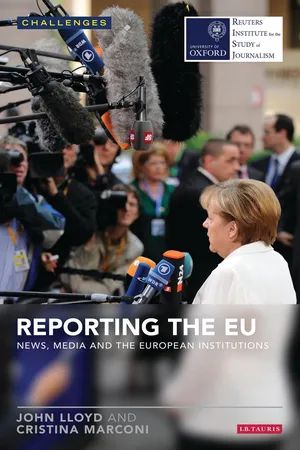
- 128 pages
- English
- ePUB (mobile friendly)
- Available on iOS & Android
eBook - ePub
About this book
Information
1
Introduction: Feast and Famine
Commoner: Just think. Which one of these stories do you believe?
Woodcutter: None makes any sense.
(Rashomon, Akira Kurosawa, 1950)
The European Union occupies a central position in the politics and economic life of its 28 members and an important one in much of the rest of the world. Few other institutions of governance have such a contested role, and its very existence is increasingly called into question by uncompromising critics, while a growing constituency want it radically reformed. A debate on the legitimacy of the EU’s action has always existed and has been quite trenchant in the past, but it has never reached the current level. The EU public has never been so engaged with and opinionated about the EU project as it is now: news media have to take this into account.
It is clearly important that citizens from the 28 EU countries understand what effect the EU Commission, the Parliament, and the Council of Ministers have on their lives – what policies they discuss and approve, what relationship they have with national governments, what assistance they offer to the member states, how much they pay to them, what power they have and what powers they seek to have.
The findings of this study of the journalists whose job it is to cover the institutions of the EU are contradictory. Until the economic crisis hit Europe in the late 2000s, with severe effects on many of the member states and a major threat to the viability of the 14-year-old euro currency used by the 18 member states in the eurozone, most national media covered the EU much less than their own political centres of power, which in some cases meant that they covered it very little. News editors and producers came to view European stories as boring for readerships and viewers. Even after the crisis broke, the coverage remained patchy, and in some cases suffered from a lack of understanding of the issues and mechanisms under discussion, and/or a lack of sufficient staff to give more than a sketch of even critically important issues.
On the other hand, the amount published about and by the European Union is vast. The Union’s institutions are lavish with news announcements, with briefings, with prepackaged but often detail-rich interviews with commissioners; think tanks in Brussels and in all the main capitals pour out analyses and advice; the many specialised journals and websites are knowledgeable, up-to-the-minute, and distant enough from their subject to be critical; the global newspapers and wire services continue to support relatively large and active bureaux, whose output enjoys a high reputation.
The problem is with the larger public which is only sporadically interested in politics and public institutions. In times of crisis or of important decisions, the attention reaches a peak, but in good times news coming from Brussels is the first to disappear from newspaper pages and from TV programmes. This seems to us the largest problem facing the news media which have the responsibility of covering the EU: its very structure and mode of operation renders the task of engaging the general European public with it, in journalistic terms, difficult.
Thus ‘who cares?’ becomes a pertinent question, and the consequences of the general lack of interest in the EU – except at times of crisis, which have brought a more critical, even hostile, attention than before – underpin much of the report’s findings. It is first on the list below: but other issues, also set out briefly here and treated in greater detail in the main body of this study, also seem to us to be major ones facing the journalism of the European Union.
A note on the form of this report. It relies on a series of interviews done by the two authors – mainly Cristina Marconi – over a period at the end of 2013 and the first months of 2014. Most of the interviewees are journalists. Though we refer to some of the large academic and expert literature on the EU and the news media, this report is not in the academic tradition.
Who Cares?
The problem of interesting a wide public has different facets.
| 1. | The coverage of the EU is inherently difficult for journalism, above all for broadcasters and for popular papers. Most journalism has long assumed that it must woo the reader into the story told, since s/he reads or watches, usually, at leisure without any externally imposed need to do so: a few moments of boredom will mean a decision to move on. This is especially true of the most popular news medium, TV. It is difficult because the Union and its institutions – including, and sometimes most of all, the Parliament – are largely devoid of the dramas, confrontations, rows, large and well-known characters and issues which make up much of the political coverage within the nation states. Instead, the journalists must deal with (changing) officials who are mostly, and remain, unknown to most Europeans. The processes of the Union and especially the Commission are slow, complex, and hard to grasp by a layman; many of the issues handled are technical and detailed; there are constant and often opaque negotiations in the Council of Ministers which brings together departmental ministers and the European Council which unites the heads of state and government of the member states, both of which meet in closed session and retain the largest power. Even news which significantly impacts on everyday life – a decision which can affect a community in a positive or negative way, and there are many – is delivered in different steps over an extended period, and it can take years before the measures enter into force. If on one hand this shows how carefully every step is taken by the EU authorities, on the other hand it is hard to retain wide interest in the enforcement of a decision taking place years after it has been announced for the first time. The Parliament especially – unlike national assemblies, where the actors are known and the dramas often vivid – has been hard to televise and often soporific. After the May 2014 European elections, with a much increased Eurosceptic representation, the debates have become less tedious, the arguments much fiercer: though the designation ‘Eurosceptic’ covers a spectrum from anti-euro on economic grounds (the Alternative für Deutschland in Germany) to overtly fascist (Jobbik in Hungary and Golden Dawn in Greece). |
| 2. | Popular media – mass-circulation newspapers and television – could in theory do much to convey the central issues being discussed and agreed in the EU to a wide audience. There are two reasons why this is true only to a very limited extent. The most powerful and influential among the European popular newspapers – Bild in Germany and the Daily Mail and the Sun in the UK – are strongly critical of the EU or of some aspects of it, take a combative posture vis-à-vis the EU and, especially the UK papers, are accused by the Commission and by many journalist colleagues of distortion and gross inaccuracies. More importantly they – especially the British papers – convey little of the substance of the Union. However, this press has at times revealed, even if through exaggeration and sometimes falsehood, something of the underlying contradictions and silences of the EU – especially the contradiction between the long-term aim of ‘ever closer union’ and the reality of continuing national control. Yet a usually confrontational approach, with neither news nor commentary informed by having a permanent correspondent in Brussels, means that polemic and a focus on errors and absurdities is preferred to facts. At the same time, the practised skill with which the popular tabloids present the news means that their message comes through much more powerfully than that of the quality media, influencing voters and public opinion in a way that inevitably has to be taken into account by politicians. Television coverage is much less polemical – and is legally barred from being so in many European states – but is generally brief. In addition, in nearly every state, the regular habit of watching the news is in decline, especially among the young, with the news accessed when one is interested in specific issues. This might include the EU, but probably only when crises seem imminent. |
| 3. | The growing conviction among editors that news about the EU is unpopular with readers and viewers led to a shrinkage, during the 2000s, of the permanent correspondent corps based in Brussels and a greater dependence on coverage from the news media’s home base, or from other capitals, such as Paris. EU information depended much more on freelancers and fixers, a less expensive workforce which replaced the established correspondents. In addition, the crisis itself forced further cuts on the news media – leaving the worst-hit countries, which arguably needed the news and analysis the most, with a shrunken representation. |
All news is local
Most news organisations, when reporting the EU, produce coverage which is not aimed at Europeans, but at French, Dutch, Polish, and other national citizens. The subtext is: what is the EU doing for, and to, us? Journalists, who find themselves assigned to cover the EU, or ‘Europe’, thus do what seems to come naturally: they bring their nation with them.
Most journalism from Brussels covers the central institutions of the EU with both eyes on the business of determining how far they act in or against the interests of the home country. To cover it in this fashion is, of course, to miss most of what these institutions do – jerking them into life in print, sound, or images only to judge how far they are useful to the national interest; who are the losers and winners, the opponents and allies; what the national ministers, especially the prime minister, have achieved at their meetings, with the content generally briefed to the national news media representatives by the public relations officials of the government in question. ‘Europe’ thus becomes an adjunct to the nation, and is simply another chamber in which the latter ‘speaks to itself’ – or a chamber which each nation can blame when something goes wrong.
The exceptions to this rule are the transnational media – the global wire services, such as Reuters, Bloomberg, AP, and AFP; the global economic papers, such as The Economist, the FT, and the Wall Street Journal; and – to a lesser extent – the global broadcasters, such as the BBC, CNN, and others. These organisations see their mission, and their business model, as providing coverage which has little or no national focus: ‘news from nowhere’.
Holding to harsher account
The journalists who covered what became the EU in its first decades were pioneers of a new kind of reporting. Brussels was not only the headquarters of a supranational organisation which had constantly developing powers, but also the crossroads where different journalistic cultures met and worked together on a common project over an indefinite period. In the aftermath of the war, the new correspondents were largely supportive of the organisation and felt they had a role to play in its construction: they saw the institutions through the prism of their founders – Jean Monnet, Paul-Henri Spaak, Altiero Spinelli, and others – who in turn believed that it was a way to stop Europe from again descending into war.
From the 1980s onwards, new generations of journalists adopted a more distant attitude towards the institutions, seeing the Union as a legitimate source of political and economic power which still had to be held to more severe account – whatever their own views were about it. This critical approach deepened and turned harsher in the 2000s, as more evidence emerged of an increasing public disillusionment with the EU in countries, such as France and the Netherlands, where the bulk of the political classes had professed themselves keenly pro-integration. In many cases it became aggressive from 2008, when the EU’s most ambitious innovation, the euro currency, demonstrated its fragility and its malign effect – at least in the short term – on (especially) Southern European economies.
As this attitude took firmer hold, the public relations officials charged with communicating with the world via the news media became more embattled and defensive, and were increasingly seen by journalists as overprotective of their masters, and at times unhelpful in explaining the urgent issues of the crisis. The latest moves in terms of economic and financial measures were sometimes developed outside of the EU structures. This marginalisation did not prevent them from trying to convey a strong message on the benefits of the measures taken, even when they were proving largely unpopular in member states. As Hans Magnus Enzensberger puts it in his pamphlet Brussels, the Gentle Monster, given the lack of a ‘EU public sphere of debate worthy of the name’, there has been ‘an increasing temptation for the Union to take opinion-shaping in hand for itself’.1
The gap in understanding
The economic crisis has significantly altered the work of journalists who cover the EU. It has
| • | Forced them to keep up with the pace of a decision-making which was highly technical and complex. They had to undergo a steep learning curve and had their relative ignorance exposed. Most were not well versed in economics and finance, and even those who were could hardly understand, at least initially, the new debates, policies, and mechanisms which quickly reached an uncommon degree of complexity. They also had to translate a very complicated message into simple words, given that many of the decisions taken often directly affected their public. |
| • | Encouraged many of them to shift the focus of their reporting from the Brussels/Strasbourg centres to other cities in Europe – especially Athens (for the riots), Berlin (for the decisions), and Frankfurt (for the European Central Bank). |
| • | Widened the gulf between them and the EU, especially the Commission, since it came to seem less relevant to addressing the crisis and its communications were constrained by the market sensitivity of the issues. |
| • | Created a genuine and unprecedented interest among the public looking with concern for fresh and reliable news about new taxes, austerity measures, welfare cuts. Viewers and readers became increasingly demanding, but increasingly sceptical too. |
Look what the voters brought in
Journalists covering the EU now see it as undergoing a series of changes unprecedented in its near-sixty-year (since the 1957 Treaty of Rome) history. The strains put upon it by the economic crisis have, at least in the first moment, encouraged many politicians and officials to point the way to ‘more Europe’ – a much greater fiscal coordination at the centre of the eurozone, both to address the continuing problems in many of the eurozone countries and to give the euro the political backing it has lacked since its invention in 2000. Then, quite abruptly, the political narrative surrounding the EU changed and ‘more Europe’ became, in many quarters, suspect.
The centrifugal pressures have never been so evident, and the popularity of the anti-EU parties in several countries brought into the Brussels Parliament groups of parties, of the far right and the far left, who agree on one big thing – much ‘less Europe’ for many, the ideal for most of these being no European Union at all. This happened both in Southern countries as a protest against the austerity measures, and in Northern countries as an expression of the malaise for, as many see it, having to pay for other countries’ profligacy.
This means that, for the first time, the European Parliament has the potential for both real drama and a real debate about the most fundamental of issues: the right for the EU to...
Table of contents
- Endorsements
- Blurb
- RISJ Challenges
- Title Page
- Copyright Page
- Contents
- Acknowledgements
- 1. Introduction: Feast and Famine
- 2. The Limits of Utopia: Leaving Loyalty, Embracing Scepticism
- 3. Communicating to the Communicators: How the EU Presents Itself
- 4. Growing Apart: The Argument over Objectivity
- 5. The Limits: The EU from ‘Dull’ to ‘Crucial’ in a Time of Crisis
- 6. Living in Financial Times: Getting to Grips with Financial Complexity
- 7. Video Games: The Challenges for TV Journalists and the Role of ‘Mass’ Media
- 8. Absent Enemies: Reporting on Brussels out of Brussels
- 9. The Globalists: Reporting for the Elite
- 10. Dog Does Eat Dog: Peer Pressure and Peer Reviews
- 11. Tweeting into Clarity: Online is Demanding, But Helpful
- 12. The Next Act: Journalism in a Time of Polemics
- Appendix 1. Euroscepticism: Boris Johnson and Bruno Waterfield
- Appendix 2. The Passionate Chronicler: Jean Quatremer
- Appendix 3. The Ill-Matched Couple: TV and the EU – Hughes Beaudouin, LC1/TF1
- Appendix 4. The Rape of Europa: Anglophone Bulls in the EU China Shop – Wolfgang Blau
- Appendix 5. The Vision Betrayed: Democracy’s Deficit – Dirk Schuemer
- Appendix 6. The Cost of Communicating
- Notes
- Bibliography
- Series Page
Trusted by 375,005 students
Access to over 1.5 million titles for a fair monthly price.
Study more efficiently using our study tools.
Frequently asked questions
Yes, you can cancel anytime from the Subscription tab in your account settings on the Perlego website. Your subscription will stay active until the end of your current billing period. Learn how to cancel your subscription
No, books cannot be downloaded as external files, such as PDFs, for use outside of Perlego. However, you can download books within the Perlego app for offline reading on mobile or tablet. Learn how to download books offline
Perlego offers two plans: Essential and Complete
- Essential is ideal for learners and professionals who enjoy exploring a wide range of subjects. Access the Essential Library with 800,000+ trusted titles and best-sellers across business, personal growth, and the humanities. Includes unlimited reading time and Standard Read Aloud voice.
- Complete: Perfect for advanced learners and researchers needing full, unrestricted access. Unlock 1.5M+ books across hundreds of subjects, including academic and specialized titles. The Complete Plan also includes advanced features like Premium Read Aloud and Research Assistant.
We are an online textbook subscription service, where you can get access to an entire online library for less than the price of a single book per month. With over 1.5 million books across 990+ topics, we’ve got you covered! Learn about our mission
Look out for the read-aloud symbol on your next book to see if you can listen to it. The read-aloud tool reads text aloud for you, highlighting the text as it is being read. You can pause it, speed it up and slow it down. Learn more about Read Aloud
Yes! You can use the Perlego app on both iOS and Android devices to read anytime, anywhere — even offline. Perfect for commutes or when you’re on the go.
Please note we cannot support devices running on iOS 13 and Android 7 or earlier. Learn more about using the app
Please note we cannot support devices running on iOS 13 and Android 7 or earlier. Learn more about using the app
Yes, you can access Reporting the EU by John Lloyd,Cristina Marconi in PDF and/or ePUB format, as well as other popular books in Languages & Linguistics & Journalism. We have over 1.5 million books available in our catalogue for you to explore.